Shofar Kavanot - 60 Shofar Blasts: One-Sixtieth of Death
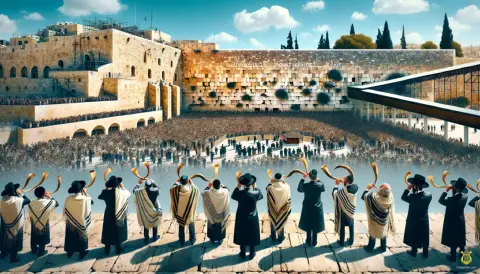
The sound of the shofar distinguishes and sets Rosh Hashanah apart from all the holidays of the Jewish calendar. The Torah calls it “the Day of Blowing the Shofar.” (Bamidbar 29:1) “G-d has ascended amid shofar blasts; the L-rd, amid the sound of the shofar,” it says about Rosh Hashanah in the book of Tehillim (47:6). Although G-d’s commandment to blow the shofar on Rosh Hashanah surpasses human understanding, it contains a hint that helps us grasp its meaning. The unique quality of the shofar’s sound has an extraordinarily powerful effect on the Jewish soul. The shofar, writes Rambam, seems to cry out: “Awake, sleepers, from your sleep! Slumberers, awaken from your drowsiness! Examine your deeds, return to teshuvah, and remember your Creator!” Who are these “sleepers” and “slumberers”? Rambam answers: “They are those who have forgotten the truth amid the vanities of their time and devoted all their years to empty and futile pursuits, from which neither help nor salvation will come.” It is precisely them whom the shofar calls: “Look into your own souls and improve your ways and deeds! Let each of you abandon his evil path and the thought that is not good!..” Why does the sound of the shofar make such a profound impression on the Jewish soul? Because it sounded at the Giving of the Torah: “And it came to pass on the third day, when morning came: There were thunder and lightning, and a heavy cloud upon the mountain, and the sound of the shofar was exceedingly loud; and all the people in the camp trembled... And the sound of the shofar grew increasingly stronger; Moses spoke, and G-d answered him with a voice.” (Shemot 19:16, 19). All the Jews were present at the Giving of the Torah without exception: those who came out of Egypt were there both in body and soul, while all the others were present in soul alone. As a rule, the shofar was made from a ram’s horn, and the fact that a “ram’s horn” and “shofar” are one and the same is clear from Joshua bin Nun’s command concerning the decisive attack on the city of Jericho (Joshua 6:5): “And it shall come to pass, when the ram’s horn is sounded, when you hear the sound of the shofar...” However, according to Halachah (Mishnah, Rosh Hashanah 3:2), the horns of various animals are suitable as a shofar for Rosh Hashanah, with the exception of a cow’s horn. The reason is that “all shofarot are called a horn and are called a shofar, except for a cow’s horn, which is called a horn but is never called a shofar.” (Jerusalem Talmud, Rosh Hashanah 3:2). In addition, the Gemara (Babylonian Talmud, Rosh Hashanah 26a, and Rashi’s commentary there) invokes the principle: “A prosecutor can never become a defender.” Since a cow is associated with the Golden Calf, blowing its horn would recall that terrible sin; it would thus become a prosecutor against Israel before the heavenly beit din. On Rosh Hashanah, however, we pray for forgiveness for our sins, and the sound of the shofar must serve as our defender. Therefore, the shofar for Rosh Hashanah is preferably made from a curved horn rather than a straight one, although a straight horn is also valid. The Babylonian Talmud cites the opinion that on Rosh Hashanah, “the more a person humbles—literally, ‘bends’—his mind, the better.” On this day, one should pray with the heart raised toward G-d, while lowering one’s head as a sign of complete submission to the Higher Will. To remind everyone of this, the shofar blown on Rosh Hashanah is curved. Yet a shofar is not made from a deer’s antler or an antelope’s horn because they are not hollow but solid, and therefore cannot be used for blowing. This is hinted at by the word “shofar,” which shares a root with the word “shefoferet” (a tube): a shofar horn must necessarily be hollow. (Babylonian Talmud, Rosh Hashanah 26a; Tosafot “Hutz Mi-keren Parah” and the commentary of the Ran) Thus, a shofar is always a horn, but not every horn can be a shofar. 60 Shofar Blasts and One-Sixtieth of Death The shofar awakens sleepers, and sleep is one-sixtieth of death. The resurrection of the dead will also take place amid the sound of the shofar. “And it shall come to pass on that day: a great shofar shall be sounded, and those lost in the land of Assyria and those cast away in the land of Egypt shall come.” (Yeshayahu 27:13) The exiles are those who are not in their proper place, who have gone beyond the bounds. One who is lost is someone who does not know where he came from. This is the power of the shofar: it awakens the deepest point of a person’s “I,” makes people wise, and returns the lost and the exiled. The shofar frightens and awakens, and awakening means casting off everything that has clung to us from the outside—all that is external. Men are required to hear at least 60 shofar blasts on Rosh Hashanah (lechat’chilah) in order to fulfill the mitzvah of hearing the shofar: 30 before the Mussaf Amidah and 30 afterward. However, the mitzvah is fulfilled post facto if one hears at least 30 blasts on each day of Rosh Hashanah. Women need hear only 30 shofar blasts on each day of Rosh Hashanah. Although 100 shofar blasts are sounded on Rosh Hashanah, hearing all 100 is an optional minhag. There is no need to hear every blast; one must hear blasts that include: 3 tashrat (tekiah-shevarim-teruah-tekiah); 3 tashat (tekiah-shevarim-tekiah); 3 tarat (tekiah-teruah-tekiah). Once the blessing over the shofar blowing on Rosh Hashanah has been recited, one may not speak or perform any action (hefsek) that would interrupt the entire process of the blessings and the series of shofar blasts. Shofar Kavanot According to the Baal Shem Tov Once, the Baal Shem Tov asked one of his senior disciples, Wolf Kitzes, to blow the shofar on Rosh Hashanah. To help him concentrate while performing this ritual, the Besht advised him to study the kabbalistic kavanot associated with the shofar. Wolf Kitzes immersed himself in his studies, making numerous notes so that he could review them just before the service and strengthen his devout intention even further. The holiday arrived, and Wolf began looking for his notes, but they had mysteriously disappeared. And that was not even the worst of it: overcome with anxiety, he forgot everything he had read. He could not recall a single kavannah. But there was nothing to be done—he stood before the congregation and began blowing the shofar with an empty mind and a broken heart. At the conclusion of the service, the Besht turned to his disciple and exclaimed: - Yashar koach! I have never before heard such inspired shofar blasts! — But, teacher, Wolf Kitzes exclaimed, — I forgot everything I had studied the day before and blew the shofar without a single kavannah in my mind. If anything, I had only the humility of a person who knows that he knows nothing! - My dear Wolf, the Besht said with a smile, — the palaces of earthly kings contain many chambers, each opened by its own key. But if a person has a simple ax, he can enter any of them. If this is so with earthly kings, then surely it is so with the King of kings. Kavanot are the keys to the chambers, but no door can withstand a person with a humble heart. What is this ax before which no lock can stand? A broken heart. When you understand that the necessary keys cannot be found, that all your spiritual efforts have merely served as an aid to a clever “I,” and therefore you cannot enter the chambers of Awakening, your heart breaks into pieces. Then all the locks crumble into dust and the doors open. (Gaon Moshe Shapiro, https://www.ou.org/holidays/rosh-hashanah/halacha-lmaaseh-on-rosh-hashana/, Rami Shapiro)
Shofar Kavanot - 60 Shofar Blasts: One-Sixtieth of Death
Was this helpful?
100% of readers found this article helpful (13 votes).
Please note: some articles on our site contain the holy Names of the Almighty. If you print these articles, they may not be thrown away or destroyed. Please handle printed copies with care and respect.
Tags: Numbers, Shofar, 60 Shofar Blasts and 1/60 of Death, Kavanot of the Shofar