The Story of a Kaddish in Pressburg
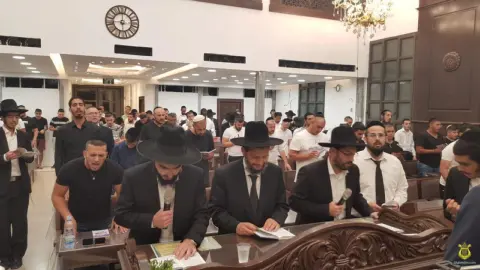
This remarkable story was told at the Hatam Sofer Memorial in Bratislava—the former Pressburg.
It concerns
Ktav Sofer (the son of the Hatam Sofer) and the grandson of
Rabbi Akiva Eiger—both of whom are buried at the site.
One hundred years ago, Pressburg (modern-day Bratislava) was one of the most important cities in Austria-Hungary, and its local yeshiva was considered the most influential in Europe.
At that time, a wealthy merchant lived in Pressburg and owned a large store in the very center of the city. He was a respected man who took an active role in the life of the Jewish community and never spared any expense when it came to charity.
He had one practice connected with charity. Every day, he calculated his earnings and set aside ten percent as maaser (tithe). He would later give this money to the yeshiva.
Suddenly, he fell ill and departed this world, ascending to the heavenly yeshiva. He left behind a widowed wife and five orphaned daughters.
His wife was a very intelligent and energetic woman who had always helped her husband in his affairs. She tried to preserve everything as it had been before her husband's passing, and each day she gave the maaser from the day's proceeds to the head of the yeshiva, the renowned Ktav Sofer.
Since they had no sons, immediately after her husband's death the woman arranged with Ktav Sofer for the yeshiva students to recite Kaddish in memory of her husband for eleven months, as well as on the anniversary of his passing. She also asked them to recite a second Kaddish for all the Jewish souls for whom Kaddish had not been recited for one reason or another.
About ten years passed in this way. Sometimes the maaser amounted to less than usual, but the woman still made sure that the yeshiva students received their share from every day's proceeds.
Then business at the store began to deteriorate. The daily income grew smaller and smaller, until losses began to mount. The wealthy man's widow continued coming to the yeshiva every day, sometimes regretfully telling Ktav Sofer that she had brought nothing with her. But she never stopped asking that the daily Kaddish continue, even when she was unable to provide the yeshiva with financial assistance, and she was always assured that she had nothing to worry about.
With each passing day, business grew worse, and soon the righteous woman was forced to sell her jewelry and other valuables to feed her daughters. No one knew how desperate the family's situation had become. Only the students and staff of the yeshiva knew that the family was on the verge of bankruptcy.
One day, a shadkhan (matchmaker) came to their home.
“Your daughters have grown up and become lovely young women,” he said. “Perhaps you have been too busy dealing with business matters to notice that the time has come to marry them off. I am sure I can suggest many candidates from among the yeshiva students, and you will have plenty to choose from. All you need to do is tell me what dowry you will provide for each girl.”
The widow decided not to reveal her true circumstances. She said that she would think it over and give him an answer after some time. As soon as the shadkhan left, the unfortunate widow burst into tears and went to the yeshiva. After speaking with Ktav Sofer, she admitted that she could not understand why all this was happening to her, why she was suddenly losing everything. Then she once again asked whether the yeshiva was continuing to recite the Kaddishim she had commissioned, and was told that nothing had changed.
She asked them to continue reciting the Kaddish, promising that as soon as her situation improved, she would resume supporting the yeshiva.
As soon as the widow left the yeshiva and stepped into the street, an unusually dignified-looking old man approached her. He greeted her and asked how she was doing. The widow immediately burst into tears and shared her situation, explaining that she had been reduced to such poverty that she could not even marry off two of her daughters. The old man seated her on a bench, took out a checkbook, and wrote her a check for a very large sum. He asked her to summon two witnesses. Still unable to believe her eyes, the widow hurried into the yeshiva and brought back two witnesses. In their presence, the old man handed her the check and then gave one of the witnesses a sample of his signature.
Early the next morning, the widow went to the bank.
She approached one of the clerks and showed him the check. The clerk looked at it and said that it was for a very large amount and that he would have to consult the bank manager.
He asked the woman to wait a moment and went to the bank's administration office, where he showed the check to the manager.
Upon seeing the check, the manager fainted. Panic broke out in the bank. Several times the manager regained consciousness, only to faint again. The police arrived, and, suspecting the widow of fraud, locked her in a separate room and began investigating this strange affair.
When doctors revived the bank manager, he asked to speak with the widow who had presented the check. Upon learning that she was locked in the security room, the manager insisted on going to her himself. He apologized to her and then invited her into his office.
Once they were alone, the manager asked her to explain how she had come to possess the check.
The woman told him her story, mentioning her late husband, the maaser they had given to the yeshiva, the Kaddishim she had commissioned for her husband and for souls for whom no one was praying, and the mysterious old man.
The manager asked whether she could identify the old man from a photograph. The woman said that she would certainly recognize him. She also mentioned the two witnesses from the yeshiva, who could identify him as well—especially since they had signed the back of the check, while the old man had also signed their notebooks. The manager was pleased to hear this. After examining the signatures, he ordered that the witnesses be brought to the bank. They turned out to be
Rabbi Yosef Chaim Sonnenfeld and
Rabbi Shimon Sofer.
The rabbis came to the bank and confirmed the widow's account. The manager said that he would personally deposit the check into the widow's account, since it had been drawn on his family's account, but his wife would also have to sign it. He asked that she be given a note requesting that she come to the bank immediately and bring all the family photographs with her.
The bank manager was Jewish, but his wife was not. When she appeared at the door of his office, he asked the widow and the rabbis to wait in another room. After they left, the manager told his wife everything and suggested that she show the widow the family photographs to see whether she recognized anyone. In response, the manager's wife declared that if everything she had just heard proved true, she would convert to Judaism and become Jewish.
The manager spread out all the photographs his wife had brought on his desk. He then invited the widow and each of the rabbis into the office separately and asked whether they recognized the mysterious stranger among the people in the photographs. The woman and both rabbis pointed to the very same person.
The manager gathered everyone in his office and told them the whole story:
- Do you know who gave her this check? It was my father. He managed this bank before me. But he died ten years ago! I must admit that I never recited Kaddish for my father. Last night he appeared to me in a dream and said that he had been saved from Gehinnom thanks to a Kaddish commissioned by a woman for souls for whom no one recites prayers. My father added that this woman had fallen into hardship and that we were obligated to help her. He would write her a check for 20,000 kronen, and if I did not honor it, my father would strangle me in my sleep. I awoke terrified. In the morning, I told my wife about the dream, and she was deeply shaken as well. When I saw this check, I fainted because I realized that my father had truly appeared to me. I will pay the 20,000 kronen my father promised. But that is not all. I will add another 20,000 from my own funds, because you fulfilled my obligation for me and saved my father's soul through those Kaddishim.
- I am sorry that I turned away from Judaism,” the manager continued, addressing his guests. “Now I see that our G-d is One, that He is the truth, and that He rewards each person according to his deeds. I have decided that from this moment on, I will observe all the commandments of the Creator set forth in the Torah. My wife is also ready to undergo conversion and live as a Jewish woman. Please help us understand what we must do and how to do it.”
The manager ordered that 40,000 kronen be given to the woman. The first thing she did upon receiving the full amount was bring one-tenth of it to the yeshiva. Soon afterward, her business recovered, and all her daughters married righteous, G-d-fearing Torah scholars.
(silatehilim.com at the “Hatam Sofer Memorial”)
Was this helpful?
100% of readers found this article helpful (24 votes).
Please note: some articles on our site contain the holy Names of the Almighty. If you print these articles, they may not be thrown away or destroyed. Please handle printed copies with care and respect.