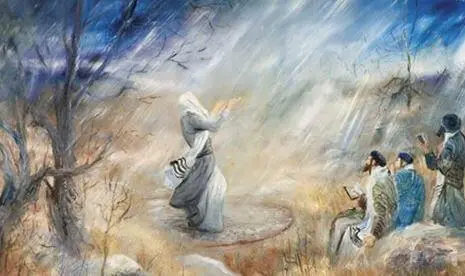
The Torah repeatedly tells us how the greatest righteous individuals would rise to pray in an unusual manner—drawing a circle around themselves.
the Arizal (may his merit protect us) teaches, based on the book “Etz HaDa’at Tov”, that Noah saved the giant Og from the waters of the Flood, fed him, and made a place for him beside the Ark. But how did Og merit being the only one saved apart from those who were in the Ark?
The Arizal explains that Og abstained from the immorality that had brought his generation to the Flood. As it were, he drew a circle around himself and stood within it, preserving his body and soul in holiness. He was therefore saved from the Flood and called Og—in Hebrew, “he drew a circle”—עג עוגה—(ag ugah).
The Torah tells us about three of the greatest tzadikim who prayed by drawing a circle around themselves.
Moses our Teacher
The Midrash “Avot de-Rabbi Natan” (chapter 9) relates that when Miriam was afflicted with leprosy, Aaron asked his brother to pray for his sister.
Moses then drew a small circle and stood in its center, pleading with G-d on her behalf: “Master of the Universe! I will not move from this place until my sister Miriam is healed.”
As the Torah states: “El na refa na lah”—(Please, G-d, please heal her). (Numbers 12:13)
The Almighty then answered Moses: “If a king became angry with her, and her father became angry with her, she would be ashamed for seven days; for Me, Who am the King of kings, she should be ashamed for fourteen days. But for your sake she is forgiven, as it is written: ‘And the L-rd said to Moses: If her father had spat in her face, would she not be ashamed for seven days? Let her be confined for seven days.’” Moses our Teacher received an immediate answer to his prayer.
The Prophet Habakkuk
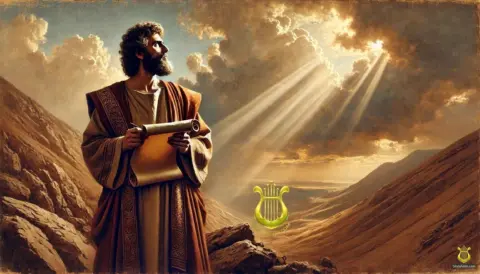
The prophet Habakkuk, for whom the Almighty performed a double miracle—birth to elderly parents and resurrection from the dead—naturally had an extraordinary bond with the Almighty.
When addressing Him with a request or prayer, Habakkuk would draw a circle around himself on the ground and not leave it, saying:
“I will stand at my watch … and wait to see what He will say to me and what He will answer.” (Habakkuk 2:1).
On one occasion he even said to the Creator: “Master of the Universe, I will not move from here until You tell me when the final exile of the Children of Israel will end.” (Ma’ari Kara, Habakkuk 2:1)
The Almighty said to him: “Since you called out to Me and did not question My deeds, I will answer you.I have already spoken of the time of the exile [in Babylonia, that it would end after seventy years], and it has ended. Therefore, do not say that the appointed time [of the final redemption] has not yet arrived; you must simply wait for it [just as the Babylonian exile ended, so the final exile will come to an end].”
Thus Habakkuk recorded this prophecy in his book:
“For the vision is yet for the appointed time [of redemption], and it speaks of the end [of days, and it will not deceive. Though it tarries [the redemption], wait for it, for it will surely come; it will not be late.” (Habakkuk 2:3)
This uncertainty compelled the prophet Habakkuk to undertake such an unusual act—drawing a circle and persistently pleading for an answer from the Almighty.
Rabbi Honi HaMe’agel
The Talmud, in tractate Ta’anit, relates the story of the great tzadik Honi HaMe’agel—“me’agel” meaning one who drew a circle.
“It happened that the month of Adar was coming to an end, but rain had still not fallen. They sent [students] to Honi HaMe’agel to pray for rain, and rain would fall. He prayed, but no rain came. [Then] he drew a circle on the ground and stood inside it.
He said: “Master of all worlds! Your children have turned to me, considering me, as it were, someone close to You. I swear by Your Great Name that I will not move from this place until You have mercy on Your children.”
A light rain began to fall.
His students said to him: “Teacher! We have seen you, and we will not die. But it seems to us that this rain is falling only to release you from your oath.”
He exclaimed: “I did not ask for this, but [I asked] for rain to [fill] the cisterns, canals, and [underground] caves.”
Then a terrible storm broke out, and such abundant rain fell that every drop filled a barrel.
His students said to him: “Teacher! We have seen you, and we will not die. But it seems to us that this rain is falling to destroy the world.”
He exclaimed again: “I did not ask for this, but I asked for rain that would be welcome, beneficial, and generous!”
The rain he had requested began to fall, (but it continued for a very long time), until the entire population ascended the Temple Mount [to take refuge] from the rain (and flooding).
They said to him: “Teacher, you prayed for rain to fall. Pray for the rain to stop.”
He said: “I was taught that one does not pray for the cessation of an abundant blessing. Therefore, bring me a bull for a thanksgiving offering.”
They brought him a bull. He placed both hands upon it and said: “Master of the Universe! Israel, Your people, whom You brought out of Egypt, can endure neither an abundance of blessing nor great misfortune. When You become angry with them, they cannot endure it; when You shower them with abundant and great goodness, they cannot endure it either. May it be Your will that the rains cease and the clouds disperse from above the world!”
At that moment, a wind began to blow, the clouds parted, and the sun shone. The people went out into the fields and gathered truffles and [other] mushrooms.
Shimon ben Shetach sent the following message to Honi:
“Were you not Honi, I would place you under a ban. But what can I do to you? You act demandingly before the Almighty, and He fulfills your wishes—like a son who makes demands of his father, and the father fulfills all his whims. Regarding you, the Torah says (Proverbs 23:25): ‘Let your father and mother rejoice, and let her who bore you exult.’” (Mishnah Ta’anit, III, 8; Babylonian Talmud, Ta’anit 23a)The Lubavitcher Rebbe asks:
“Why specifically a circle? Could he not have stood in a corner and prayed?”
And he explains: “The meaning is that a circle is a figure in which all points are equidistant from the center, and there is no distinction between those farther away and those closer. The essence of divine service is self-sacrifice, in which everyone is equal and there is no division.The meaning of ‘drawing a circle’ and thereby bringing rain is devoted service in prayer.”
The third elections showed that now, more than ever, Jews must “stand in a circle”, as our greatest tzadikim did—in the circle of Jewish life: Torah, Shabbat, Jewish books…
Within this circle, our prayers for redemption will be accepted much more quickly.
(Based on “Avot de-Rabbi Natan,” Rabbi Ovadia Yosef on “Pirkei Avot,” R. M. Abramovich)
Was this helpful?
100% of readers found this article helpful (4 votes).
Please note: some articles on our site contain the holy Names of the Almighty. If you print these articles, they may not be thrown away or destroyed. Please handle printed copies with care and respect.
Material from our site may be copied for the purpose of spreading Torah, provided a link to Silatehilim.com is included. Any use of the site's material in print publications or for commercial purposes is prohibited without the rights holder's consent.