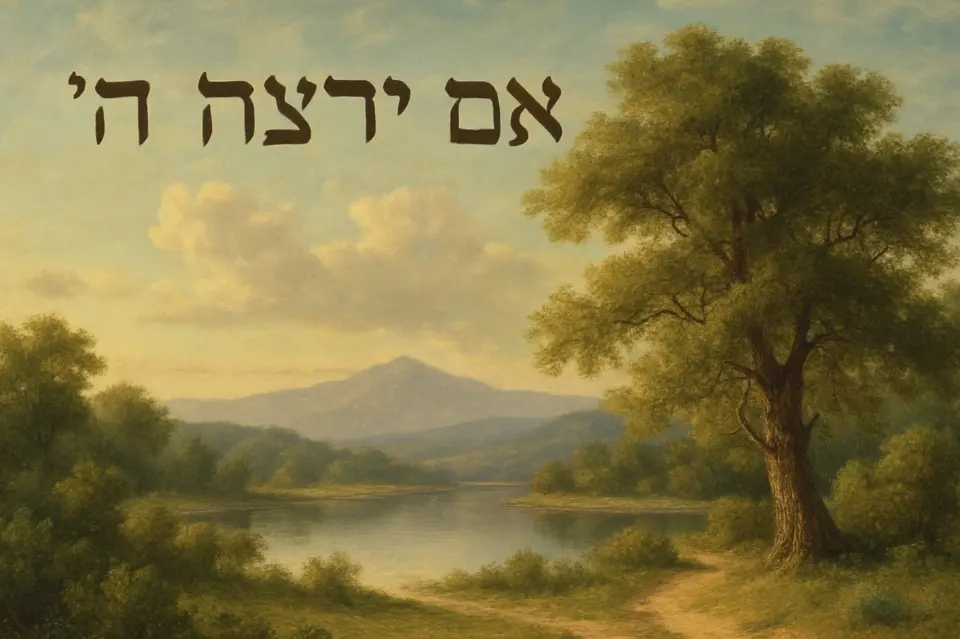
Just One Phrase: “Im Yirtze Hashem”
In the desert, the Al-mighty instructed the Jewish people, through the
“ananei haKavod” (Clouds of Glory), when to set out on their journey.
In the prayer
“The 42 Stops in the Desert” – מב מסעות, by Rabbi Shimshon of Ostropol, we find this manifestation of the Al-mighty in the phrase
“u-fakad madberana” (and the guardian commanded).
Shelah HaKadosh teaches that although today we do not have Clouds of Glory to show us where and when to travel, our movements are still in the hands of the Al-mighty. This applies to everything we do. We think that we make our own decisions, but in truth, the Al-mighty guides us.
The shidduchim we choose, the parnassah we pursue, and millions of other details—all are in the hands of the Al-mighty. Everything happens according to the Al-mighty’s will: we act in a particular way, and precisely that outcome comes about. We must remember this. We should not think that things happen by chance or solely according to our own choices.
Shelah HaKadosh (Derech Chaim, Tochochot Musar 12) writes: “This is a lesson in mussar: in everything a person does, he should say
“im yirtze Hashem” (if the Al-mighty wills), or
“be-ezrat Hashem” (with G-d’s help).
For example, when he travels, he should say: “I am traveling
“be-ezrat Hashem Yitbarach” (with G-d’s help), and I plan to stop at such-and-such a place
“im yirtze Hashem”.
When he arrives at that place, he should thank the Al-mighty and say: “With G-d’s help, I have arrived here, and I plan to continue on such-and-such a day
“be-ezrat Hashem, im yirtze Hashem”.
When a person conducts himself in this way, the Name of the Al-mighty will always be on his lips. We must train ourselves to follow this instruction of the Shelah HaKadosh. We should say these words with every action we take. The Name of the Al-mighty should always be on our lips, and the understanding that without the Al-mighty’s help we can accomplish nothing should always be in our hearts.
Stories of Tzadikim with “Im Yirtze Hashem”
In 5685 (1925), the
Chafetz Chaim announced to his community in Radin that he was planning to travel to Eretz Yisrael. It was a kind of farewell. After he finished speaking, one of those present approached him and said:
—Why didn’t the Rebbe say:
“Im yirtze Hashem”?
That Motzaei Shabbat, the Rebbetzin fell ill, and they were unable to travel.
(This story was told by Reb Yechezkel Abramsky, who heard it from Reb Isser Zalman Meltzer.)
Once, a chassid said to the
Kosov Rebbe: “I will be in Zlatopol for Shabbat.”
The Rebbe replied: “Do you really think you will make it to Zlatopol for Shabbat?”
The chassid set out, but encountered many obstacles and ultimately had to return to Kosov. He asked the Rebbe: “If the Rebbe knew that I would not reach Zlatopol, why didn’t you tell me not to go?”
The Rebbe replied: “I was not certain that you would fail to arrive. But when I heard how confidently you said that you would be there, and that you did not even say ‘im yirtze Hashem,’ I began to doubt that you would make it.”
Rabbeinu Chida relates the following story, which emphasizes the importance of always saying
“im yirtze Hashem”.
A wealthy man was generous and helped the poor, but believed that he had acquired his fortune entirely through his own efforts. One day, he set out for the market to buy oxen. Eliyahu HaNavi appeared before him in the guise of a merchant and asked: “Where are you going?” The wealthy man replied: “I am going to buy oxen.” The merchant said: “Say: I am going to buy oxen, im yirtze Hashem.”
The wealthy man dismissed him: “Why should I say that? I have money, I am going to the market, and therefore I will buy them. If I had no money, then yes, it would be worth saying. But I am wealthy and can buy anything myself.”
He continued on his way, unaware that he had dropped his wallet. Eliyahu picked it up and placed it on a rock in the forest. The wealthy man spent a long time looking for suitable oxen, but when he was ready to pay, he discovered that his wallet was gone. He returned home empty-handed.
Some time later, he took money again and set out for the market. On the way, he once more encountered Eliyahu, this time in the guise of an old man. “Where are you going?” he asked. “To buy oxen,” the wealthy man replied. The old man said: “You will not be able to buy them unless it is the will of the Al-mighty. Say ‘im yirtze Hashem.’” “I can manage without that,” the wealthy man replied. Eliyahu then caused him to fall asleep, took his wallet, and placed it next to the first one, on the same rock in the forest. When he awoke, the wealthy man realized that he had lost his money again and returned home.
At home, he reflected on what had happened and decided that from then on, he would always say “im yirtze Hashem.”
The third time, he went to the market. On the way, he met a young man who said: “If you need help bringing the oxen home, hire me.”
The wealthy man replied: “Im yirtze Hashem, if I succeed in buying them, I will hire you.”
He easily found good oxen at a good price and hired the young man to bring them to his home. On the way, the oxen suddenly ran into the forest. The wealthy man ran after them and saw that they had stopped beside the very rock where both wallets were lying. He thanked the Al-mighty. When they returned home, the young man disappeared.
The wealthy man realized that he had been Eliyahu HaNavi, and that everything that had happened to him was a manifestation of Divine Providence.
Train yourselves to have your lips constantly utter just one phrase—
“Im yirtze Hashem” (if Hashem wills).
(Based on the magazine “The Well of Torah,” on Parashat Naso, under the direction of Rabbi Elimelech Biderman)
P.S. It is remarkable that among the Mountain Jews—perhaps the only community in the entire Diaspora—expressions of this kind have been preserved in everyday use:
- “Khudore voistge” (if Hashem wills)
- “Khudo ish dge” (if Hashem permits)
Please note: some articles on our site contain the holy Names of the Almighty. If you print these articles, they may not be thrown away or destroyed. Please handle printed copies with care and respect.