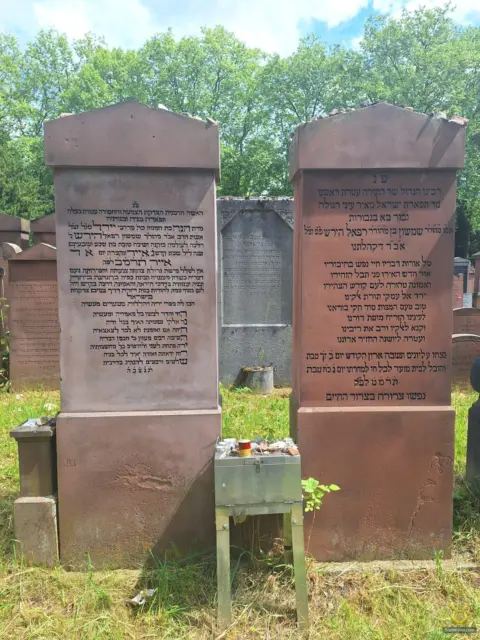
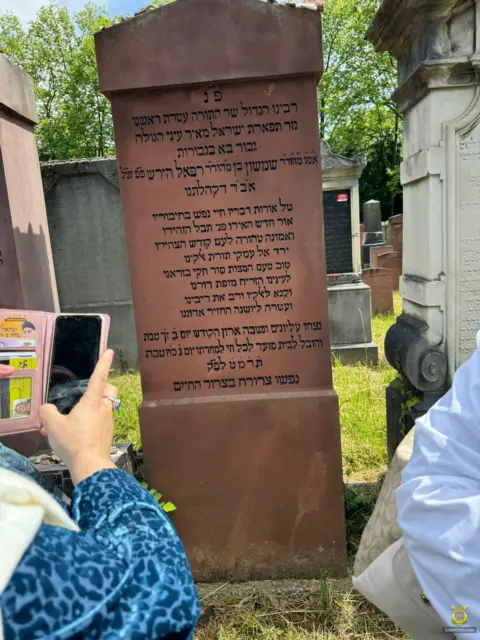
Grave
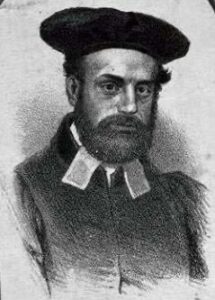
Samson Raphael Hirsch
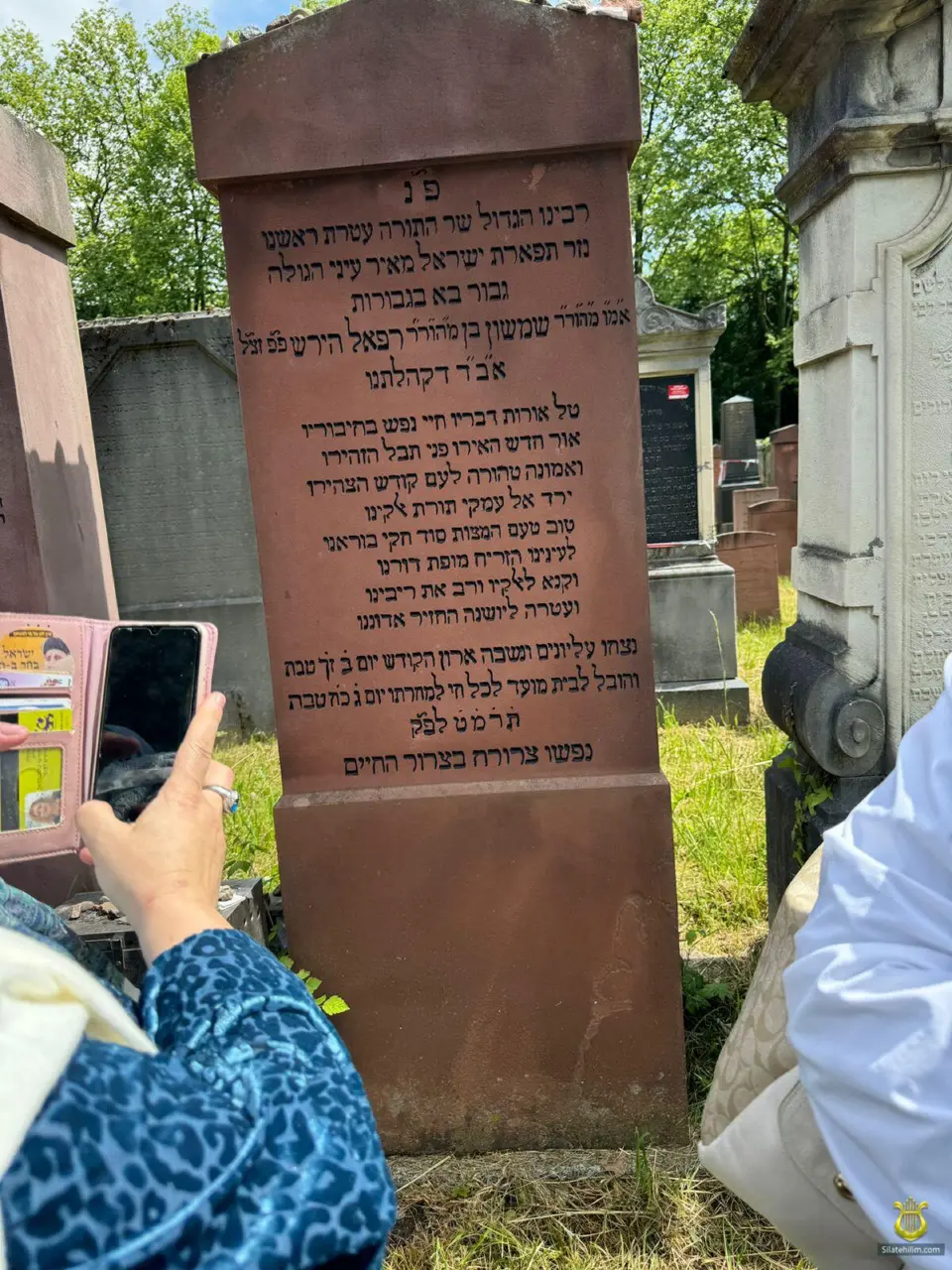
Yahrzeit (Hillula)
- 27 Tevet — Rabbi Shimshon Raphael Hirsch
Rabbi Samson Raphael Hirsch (1808–1888)
Yahrzeit – 27 Tevet
Resting place – Frankfurt am Main, Germany
Rabbi Hirsch was born in Hamburg, which at the time was part of France.
His father, although a merchant, devoted most of his time to the study of Torah, and his grandfather, Mendel Frankfurter, was the founder of the Talmud Torah in Hamburg and assistant rabbi of the neighboring community of Altona.
Rabbi Hirsch was a student of Chacham Isaac Bernays, and the education he received, combined with his teacher's influence, led him to decide not to become a merchant, as his parents had wished.
He studied Talmud from 1828 to 1829 in Mannheim under Rabbi Jacob Ettlinger. He then enrolled at the University of Bonn, where he studied alongside his future opponent Abraham Geiger.
In 1830, Rabbi Hirsch was elected chief rabbi of the principality of Oldenburg. During this period he wrote his book "The Nineteen Letters on Judaism," which was published under the pseudonym "Ben Uziel" in Altona in 1836.
This work made a profound impression in Jewish circles because it was something new — a brilliant, intellectual presentation of Orthodox Judaism in classical German, and a fearless, uncompromising defense of all its institutions and precepts.
In 1843, Rabbi Hirsch applied for the position of Chief Rabbi of the British Empire. Of 13 candidates, mostly from Germany, he made the shortlist of four: Nathan Marcus Adler, Hirsch Hirschfeld, Benjamin Hirsch Auerbach, and Rabbi Hirsch. Adler was awarded the position on December 1, 1844. Of the 135 congregations, each with one vote, Adler received 121 votes, Hirschfeld 12, and Hirsch 2.
In 1846, Hirsch was called to the rabbinate of Nikolsburg in Moravia, and in 1847 he became Chief Rabbi of Moravia and Austrian Silesia. He spent five years in Austria, reorganizing Jewish communities and teaching numerous students; he also served, in his official capacity as chief rabbi, as a member of the Moravian Landtag, where he advocated for expanding the civil rights of Jews in Moravia.
In 1851, he led an Orthodox separatist group of the Jewish community in Frankfurt am Main, at a time when the rest of the community had adopted Reform Judaism.
Rabbi Hirsch organized a Realschule and a Bürgerschule, which provided a thorough Jewish education along with those aspects of secular education deemed true according to Torah (Torah im Derech Eretz).
He also founded and edited the monthly journal "Jeschurun."
In the last years of his life, Rabbi Hirsch worked to establish the "Freie Vereinigung für die Interessen des orthodoxen Judentums," an association of independent Jewish communities. Within 30 years of his death, this organization would serve as a model for the formation of the international Orthodox movement Agudas Israel. Rabbi Hirsch had a deep love for the Land of Israel, as is evident from his writings, but he was opposed to the pro-Zionist activity of Zvi Hirsch Kalischer.
Based on accounts from members of his family, it is quite likely that Hirsch contracted malaria while in Emden, which continued to plague him with fevers for the rest of his life.
Limud
"And Shem and Japheth took a garment, and laid it upon both their shoulders, and went backward, and covered the nakedness of their father." (Genesis 9:23)
"Took — not 'they took,'" comments Rashi on this verse. That is, Shem took it, and Japheth joined him... Furthermore, in covering their father's nakedness with the garment, the sons were guided by different considerations: Shem did so to conceal the inner shame contained in his father's unseemly physical state, while Japheth was concerned with the aesthetic side of the matter: he simply thought that a drunken, naked man looked unseemly. Rabbi Samson Raphael Hirsch explains that these verses of the Torah describe the prototypes of three fundamentally different cultural approaches that we observe among nations and individuals. Shem represents spirituality. Ham represents the dominance of crude materiality. Japheth represents the union of the spiritual and the material. Rabbi Hirsch further explains that there are nations whose purpose is to conquer and destroy, to eat and drink, violence and coarseness. There are also other nations that pour their vital force and energy into creating artistic and aesthetic values. They cover crude matter with beautiful drapery and touch the spiritual through a love of poetry and music. These nations are the followers of Japheth's moral approach. However, this approach is not the highest point of spirituality. The true essence of spirituality, Rabbi Hirsch explains, is that only by recognizing truth and absolute good can a person fully realize his potential. It is this idea that underlies the culture built by the descendants of Shem."
(From a trip to the Kivrei Tzadikim in Alsace-Lorraine with Rabbanit Chava Kuperman; https://dailyzohar.com/tzadikim/610-Rabbi-Shimshon-Raphael-Hirsch)Gallery