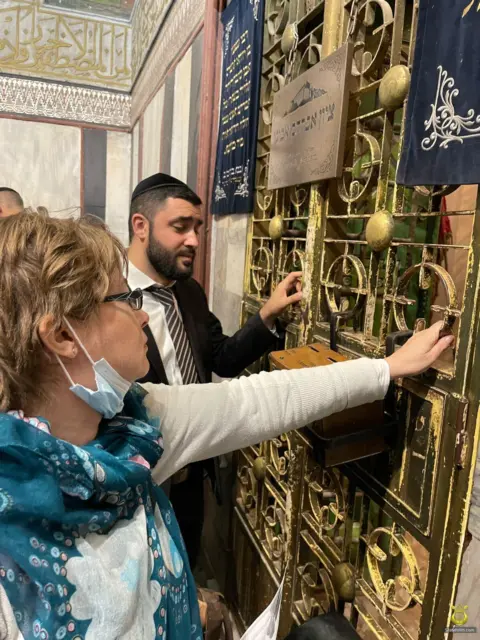
Grave
Yonatan Eybeshitz

Yahrzeit (Hillula)
- 21 Elul — Rabbi Yonatan Eybeshitz
Rabbi Yonatan bar Natan-Neta Eybeshitz (1690-1764) was a great halachic authority and kabbalist.
Yahrzeit – 21 Elul
Resting place – Altona, Germany
A direct descendant of David HaMelech. He was born near Krakow. His father, Rabbi Natan-Neta of Krakow, was the grandson of the famous kabbalist Rabbi Natan-Neta Shapiro, author of "Megaleh Amukot" (Revealer of Depths).
As a child, he was a "shovav" – mischievous.
Sipurei Tzadikim – When Adar Arrives
Once, in the month of Adar, young Yonatan learned in cheder the verse from the Mishnah: "mi-shenichnas Adar – marbin be-simcha" – (when Adar arrives, we increase our joy). He came home and started making noise, banging sticks on pots. His mother, seeing this behavior, asked him, "Son, what's going on, why are you behaving this way?" Yonatan replied, "The month of Adar has come – we must increase our joy, I'm doing what it says." And he carried on like this until his father came home, at which point he quieted down. His mother then asked him, "Why did you stop? Aren't you fulfilling what the Sages said?" The clever Yonatan answered, "Because it says: 'mi-shenichnas Av – memaatim be-simcha' – (when the month of Av arrives, we decrease our joy) – when Papa (Av) arrives (a play on words), we decrease our joy."
In his famous work "Ya'arot Devash" (Honeycombs), one can find interesting hints and segulot.
Sipurei Tzadikim – Two Stories About Roosters
1. Once a machloket (dispute) arose with the chief rabbi of Hamburg and Altona, the Chacham Tzvi. The dispute concerned the kashrut of a rooster in whose body no heart was found upon slaughter. Although according to Torah law the absence of such a vital organ renders an animal unfit for consumption (treif), the Chacham Tzvi ruled the meat of this rooster kosher. In his view, since a rooster cannot live without a heart, it must have had one, which was simply lost through careless slaughtering. However, another prominent Hamburg rabbi ruled the rooster treif, since the heart was indeed not present. The two rabbis then turned to the leading halachic authorities of Europe to settle their dispute – and it was the twenty-year-old Rabbi Yonatan Eybeshitz who responded to this call. He turned to physiologists for clarification. It turned out that cases had already been documented in which a bird was born entirely without a heart, but over the course of its life a compensatory organ developed that performed the heart's functions. Such a bird could exist, but according to halacha it is not fit for consumption – and Rabbi Eybeshitz ruled the Hamburg rooster treif. His opinion prevailed, and the Chacham Tzvi was forced to leave his community. (Perakim be-Toldot Yisrael, part 2)
2. Another story tells how Rabbi Eybeshitz was once received at the imperial court of Charles VI in Vienna. One of the courtiers asked Rabbi Eybeshitz in the presence of the emperor: "I have heard that it is written in your books that the Mashiach will appear in the guise of a poor man riding a donkey. How will this poor man manage to overcome the mighty kings who, as you claim, will ultimately submit to him?" Instead of answering, Rabbi Eybeshitz asked the king to arrange a rooster fight in one of the halls of his palace. According to the terms of the contest, each courtier was to bring his own fighting rooster to the palace – and Rabbi Eybeshitz also arrived, with a small rooster. At the king's signal, all the courtiers released their mighty roosters into the hall set aside for the fight, locked the doors, and pressed against the windows to watch the battle. As a result of the fierce struggle, one fighting rooster after another fell, and then Rabbi Eybeshitz's little rooster, which had hidden in a corner during the fight, came out to the middle of the hall and pecked one of the fallen "champions." All the onlookers laughed, and Rabbi Eybeshitz explained: "It will be exactly the same in the days of Mashiach. The mighty rulers will clash with one another and fight until they all fall from their thrones. And then our righteous Mashiach will reveal himself and subdue all the nations." (Ma'asei Avoteinu, parashat Balak)
Segulot of Rabbi Yonatan Eybeshitz
1. Shacharit
The most important thing for a Jew is prayer – and the most important prayer is the morning prayer, Shacharit. However hard it may be to get in the right frame of mind, it is important for a good day to pray in the morning. If a person cannot pray with kavana, let him at least pray that Hashem should help him attain kavana.
2. Tehillim 13 for Good Fortune
If a person needs good fortune, he should do a certain specific thing for 13 days – and the best thing is to read Tehillim 13 for 13 days, setting aside one coin each day, and lighting a candle for David HaMelech.
3. For a Shidduch – 7 Meals Before Yom Kippur
/en/7-сеудот-перед-йом-кипур-кенегед-шева-бр/
(Based on a lesson by Rav Yisrael Yakobov, "Tzadikim in Elul," from the website "Imrei Noam")
Gallery