Every woman carries a spark of Chavah’s neshamah, but only a Jewish woman has been granted the privilege of rectifying her sin through the mitzvah of hafrashat challah. (Esther Rivka Toledano)1. A segulah: sifting flour 13 times to receive forgiveness“Vehaya baacholchem milechem haaretz tarimu terumah la-Ad-nai. Reshit arisoteichem challah tarimu terumah kitrumat goren ken tarimu otah” — (When you eat the bread of the land, you shall set aside a gift for G-d. From the first portion of your dough, you shall set aside a challah offering; like the gift from the threshing floor, so shall you set it aside).
Chazal teach that through the meal offering — the minchah — the Jewish people received atonement. The minchah was included among the offerings brought for atonement. A meal offering was made from wheat or barley flour. Yet few remember that the flour was sifted 13 times. We know that 13 is a sacred number for the Jewish people: the 13 middot harachamim of the Almighty, and the gematria of the words “echad” and “ahavah”.
The Torah then tells us that one portion of the minchah was burned on the altar, while another was given to the kohanim to eat: “And the kohen shall atone for the entire community, and they shall be forgiven” — “venislach lo.” Noting that the words “lechem” (challah), “melach” (salt), denoting the ingredients we sift before kneading the dough, and the word “mechol” (forgive) consist of the same letters, we arrive at the following conclusion.
By sifting the flour for “lechem” 13 times and adding “melach” — salt — we merit, through the 13 middot of Hashem’s mercy — berachamim rabbim, vechesed, veahavah — “mechol” — forgiveness. (A “Sila Tehillim” insight based on A. Davidov’s book The Bread of Our Life)
2. A segulah: placing 12 challot on the Shabbat table in the form of the vowel sign segol
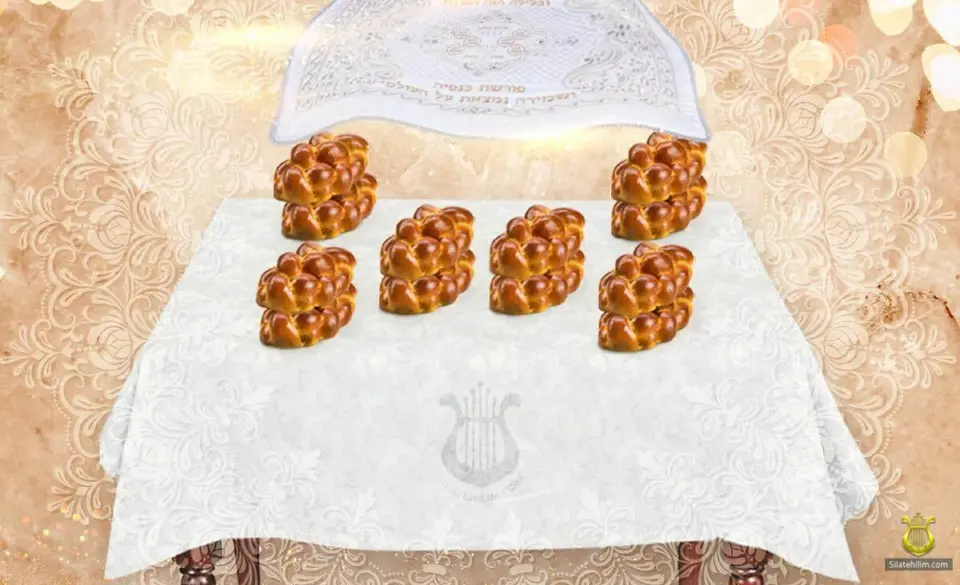
Rabbanit Leah Ben Abu (the great-granddaughter of Baba Sali) conveys a family tradition practiced according to the Ari HaKadosh: placing 12 challot on the Shabbat table, corresponding to the “lechem ha-panim,” as they were arranged in the Temple on the golden table, in the form of two segol vowel signs facing one another: “segol”.
This tradition was passed down by the family of Garmu, descendants of Kehat and Aharon and heirs of Pinchas, who served as kohanim in the Temple for many years. (Mishnah, Shekalim 5:1) They alone preserved the secret of baking and kneading the “lechem ha-panim,” as Moshe Rabbeinu had commanded them: “Take fine flour and bake twelve loaves from it... And place them in two rows, six to a row, on the pure table before the L-rd.”
Ro’eh Ne’eman said that the 12 loaves corresponded to the 12 words of Birkat Kohanim, while the Name “Yud, Kei, Vav, Kei,” recited three times between them, corresponded to the 12 letters on the golden table. (Zohar, Ekev)
When reciting the blessing over bread, the head of the household should take and lift the two upper challot placed in the center — this is a segulah that blesses the entire coming week. (See the post photo.) (Based on A. Davidov’s book The Bread of Our Life)
3. A segulah for inviting the Shechinah“Baruch Atah… ha-motzi lechem min haaretz” — in this berachah, we note that the word “ha-motzi” (Who brings forth bread from the earth) is written with the definite article. Chazal explain that when we say “ha-motzi...” in the blessing, we affirm that the process of creation continues and that we cooperate with the Creator. When we pronounce “ha,” we invite the Shechinah to accept our offering. By lifting two challot during the blessing, corresponding to the double portion of manna that fell on Shabbat, we lift one challah for le-Olam ha-zeh (for this world), and the other for le-Olam ha-ba (for the World to Come).
4. A segulah for overcoming stutteringRabbanit Kanievsky (of blessed memory) taught that during hafrashat challah, one may use a segulah that cures stuttering.
The segulah is to place the challot close together while they are baking, so that they join. After baking, lift the two challot that joined during baking above the stutterer’s head, separate them, and ask Hashem to unlock the “closing of the mouth,” pronouncing His full Name. (Based on the book Rebbetzin Kanievsky — A Legendary Mother to All)5. A segulah for cleansing the home of curses, the evil eye, and witchcraft
The separated piece of challah, wrapped in foil, is burned in a fire — preferably on a gas burner. The windows are closed so that the smell of the burning challah permeates the entire home; this is a powerful segulah for cleansing the home of every kind of negativity: harm, the evil eye, slander, curses, and witchcraft. After the challah has burned for some time, place it in two bags (Chazal teach that not even a dog should be able to eat it) and discard it. Then wash your hands thoroughly, and only afterward begin braiding the challot — it is not proper to return to the dough pieces left on the hands from the separated challah.
Rabbanit Leah Ben Abu teaches that it is not proper to burn the separated challah in the oven in which the challah will be baked; it is better to wrap it in several bags and discard it. (“Hafrashat Challah” in Meron with Baba Sali’s great-granddaughter, for “Sila Tehillim”)6. A segulah for an easy birth
It is written in the Mishnah (31b): “Because of three things a woman dies in childbirth: failure to observe the mitzvah of niddah, challah, and lighting Shabbat candles.”
It is customary to separate challah at least once during the ninth month of pregnancy.
We have found a connection between childbirth and hafrashat challah. The gematria of the word חלה “challah” is 43. Chazal advise reciting Tehillim 100 before separating challah. Psalm 100 contains exactly 43 words. This psalm is also customarily recited before childbirth. Kabbalah teaches that the kelipah that obstructs childbirth is called גם, which also has a gematria of 43. By reciting Psalm 100 and fulfilling the mitzvah of hafrashat challah, a woman removes the negative influence of this kelipah. Rabbi Chaim Palagi points out that although we know women are endangered in childbirth if they have not observed their three mitzvot, the opposite is also true: the Almighty’s mercy is many times greater than His judgment. If a woman fulfills the mitzvah of challah, she will give birth easily, smoothly, and joyfully. (Based on a lesson by Alexander Tzvi Sypkov)7. A segulah for teshuvah — bringing a loved one (son, daughter, or husband) back to Judaism or into the family
In her lesson “The Power of a Jewish Mother,” dedicated to Rachel Imeinu, Rabbanit Yamima Mizrachi revealed a beautiful segulah of the Ben Ish Chai connected with challah.
If someone’s family member (husband, son, or daughter) has strayed from faith or left or distanced themselves from the family, the following segulah is considered very effective.
To bring a man back, braid a challah from three strands, directing one’s kavanah toward each strand corresponding to Avraham, Yitzchak, and Yaakov. As you braid and shape the challah, say that the person for whom you are praying should be returned to the chain of the Patriarchs. We would add that it is good to bless this person while braiding the three strands with the same blessings with which each of the Patriarchs was blessed: “Bakol, Mikol, Kol.”
If this is happening with a woman (daughter or sister), braid a challah from four strands, corresponding to the four Matriarchs — Sarah, Rivkah, Leah, and Rachel — and pray that she be endowed with their qualities and virtues.
8. A segulah for freedom from fearRabbanit Yamima Mizrachi taught in a lesson that while kneading the dough for challah, we can rid ourselves of our fears, because challah draws “chalkhalah” (the same letters as in the word “challah”) — fears — out of us; this word is a synonym for “pachad” — fear.
9. A segulah for parnassah
The Talmud reminds us what happens when this mitzvah is not observed:
“For the sin [of neglecting the separation] of challah, blessing is withheld from what is stored, a curse is placed upon prices, and what one sows will be reaped by others.” (Shabbat 32b)
— “Blessing is withheld from what is stored” — wine, oil, and grain are generally stored for long periods. If the mitzvah of challah is not observed, stored foods will spoil.
— “A curse is placed upon prices” — when stores are depleted, prices rise.
— “What one sows will be reaped by others” — the third evil that befalls those who do not observe the mitzvah is that although they sow seeds in the hope of seeing a full harvest, others will gather the fruits of their labor and eat them.
Tosafot (on Sotah 11a) says: “midah tovah merubah” — the reward for fulfilling and observing a mitzvah is many times greater than the punishment for refraining from it.
Separating challah brings abundant material blessings to the world. If neglecting challah causes blessing to disappear, then simply lifting a small piece of dough and declaring, “Harei zo challah” — (this is challah) — can make us recipients of the gift of parnassah.
The Komarna Rebbe points out that the first letters of the words in the verse (Proverbs 30:8): “hatrifeni lechem chuki” — (feed me the bread allotted to me) — (hei, lamed, chet) spell the word “challah.”10. A segulah of hafrashat challah — surrounding oneself with angelsRabbi Aharon of Karlin and his son arrived at a small town early Friday morning. They saw smoke rising from the chimneys, evidence that the women were baking challah before Shabbat. Rabbi Aharon said: “Look at the angels rising from the chimneys! Indeed, through their efforts, the women should attain the level of Ruach HaKodesh — only anger prevents this.”
Baba Sali once related that a woman came to him for a blessing, and the tzadik saw many angels surrounding her. Baba Sali asked her: “What have you just done?” The woman replied: “I separated challah and baked for Shabbat.”(Based on a lesson by Rabbanit Leah Ben Abu)
The gematria of the word “challah” חלה is 43, while the volume of the challot in the Temple was 50 kav. Adding 43 and 50 gives 93 — the gematria of the word “shield,” מגן, which, according to the Zohar (Shelach), is an acronym for the names of the angels Michael, מיכאל, Gabriel, גבריאל, and Nuriel, נוריאל. These three angels protect a person who fulfills the mitzvah of separating challah. (Based on a lesson by Alexander Tzvi Sypkov)11. A segulah for weakening curses
The Midrash Rabbah states that the world was created for the sake of three mitzvot: separating challah, separating tithes, and separating the first fruits (bikkurim). The mitzvah of separating challah weakens the curse with which the Almighty cursed man and the earth, saying that man would eat his bread by the sweat of his brow. (Based on a lesson by Alexander Tzvi Sypkov)12. A segulah for strengthening faith
When challah is separated, the following blessing is recited: “Lehafrish challah min ha-isah” — (to separate challah from the dough).
The gematria of the word “isah” (dough) is 145. The gematria of “challah” is 43. When we remove (separate) “challah” (43) from the dough (145), 102 remains — the gematria of “emunah” (faith).
13. A segulah for blessing the home
In Temple times, when most Jews lived in the Land of Israel, challah was one of the 24 gifts given to the kohanim, providing them with sustenance and enabling them to serve in the Temple.
Although most Jews today do not live in the Land of Israel, we continue to separate challah in accordance with the enactment of the Sages.
The prophet Yechezkel says: “And you shall give the first portion of your dough to the kohen, so that blessing may rest upon your home.” (Ezekiel 44:30)
14. A segulah — tikkunThe Shelah HaKadosh (may his merit protect us) taught that when challah is separated, the bread is sanctified and “purifies the body and soul of the one who eats it”; a tikkun takes place.
The Ari HaKadosh taught: “The sweat that a person produces while preparing for Shabbat is a segulah for washing away all sins.”15. How to receive a share in the World to ComeRabbi David Lida says that “challah” is an acronym for the words “chelek le-Olam ha-Ba” — (a share in the World to Come); that is, whoever separates challah merits a place in the World to Come.
16. A segulah for bringing a korban in one’s personal TempleRabbi Shimshon Pincus teaches that women are not obligated to study Torah or perform time-bound mitzvot. However, they can bring offerings, korbanot, to Hashem in their personal Temple — within the four walls of their Jewish home. The Temple was destroyed because of our transgressions, but there is still a place where the Shechinah, the Divine Presence, rests: the Jewish home. When a woman separates and bakes challah, she connects herself with the “Lechem ha-Panim” — the bread that was baked in the Temple.
17. A segulah for bringing sustenance to the world
It is stated in PirkeiAvot (5:10): “If [everyone decides] not to separate the prescribed portion from the dough, a famine begins.”18. A segulah of an eternal sign“Know that hafrashat challah is for a woman like putting on tefillin. Tefillin are a symbol of a good Jew. What does this mean for a woman who is not obligated to wear tefillin? Shabbat itself is called a sign, an ‘eternal sign.’ And the mitzvah of hafrashat challah is like tefillin for a woman — an eternal sign of Shabbat.”(The Brisker Rebbe)19. A segulah — not to give the mitzvah of hafrashat challah to anyone elseRabbeinu Chida writes in Machazikei Berachah, in response to the Ya’avetz: “If a husband undertook to separate challah without his wife’s permission, he must compensate her with money, as is customary when one person takes a mitzvah away from another.”
This demonstrates the tremendous importance of the mitzvah of hafrashat challah.
20. A segulah — challah in place of 500 fasts
Chazal said: “Preparing food for Shabbat is equivalent to 500 Ta’anit (fasts).”21. A segulah for separating challah on Friday
The Mishnah Berurah, the Ben Ish Chai in the name of the Arizal, and other authorities among Chazal explain in detail the idea of separating challah specifically on Friday: “Adam HaRishon, created on Friday, was called the ‘challah of the world.’ Because of the sin of the Etz HaDa’at, Chavah spoiled this ‘challah dough’ on Friday. Women rectify this act through the mitzvah of hafrashat challah specifically on Friday — Erev Shabbat.”22. A segulah for separating challah — at least once a year
The Ben Ish Chai (Parashat Shemini) writes that a woman should perform hafrashat challah at least once during the year — the year should not pass without hafrashat challah — “there must be something to add to one’s merits.”23. A segulah — praying during hafrashat challah, a time of Et Ratzon
Rabbeinu Yonah writes that the moment we perform a mitzvah is an auspicious time to turn to Heaven with any request. When a woman fulfills one of her three special mitzvot, she merits special Divine mercy. These are precious moments when we can connect directly with our Creator and be heard — with no angels between us.
“Sefer Hagahot Maimoniyot” states: “When a woman fulfills one of her three mitzvot, the Almighty grants her the desire of her heart and does not restrain the movement of her lips.And therefore a woman should pray while performing the mitzvah that she be granted children who are tzadikim, pious and G-d-fearing, and who know His blessed Name.”24. A segulah for praying for Klal Yisrael
During hafrashat challah, it is a segulah to pray for Klal Yisrael, the Jewish people as a whole. “One who asks on behalf of another will be answered first.” (Bava Kamma 92a) — the Gemara tells us. Through prayers for our people, our personal requests will be answered swiftly.
25. A segulah for being filled with strengthThe Chafetz Chaim explains how the Torah’s mitzvot correspond to the 248 limbs and 365 sinews of our bodies, and what energy the organs receive from the mitzvot. The hands that knead the challah receive an extraordinary spiritual light at that time.
If the dough is kneaded with both hands, one can see how our hands receive strength: the gematria of the word “yad” (hand) is 14. Two hands together equal 14 + 14 = 28, which is the numerical value of the word “koach” (strength).
26. A segulah for being filled with joy
It is stated in Ecclesiastes (2:10): “For my heart rejoiced in all my labor.”
The Midrash explains that the labor which brings such joy and satisfaction is “hafrashat challah.” (Kohelet Rabbah 2:13) Indeed, women will attest that when we are ready to separate challah, our hearts fill with joy and satisfaction.
27. A segulah — performing netilat yadayim before hafrashat challah
Washing the hands hints at two beautiful requests that we silently direct to the Almighty during hafrashat challah. The word מים “mayim” (water) is an acronym for the words in the ninth blessing of the Amidah: ומלא ידינו מברכתיך — “umale yadeinu mibirchotecha” — (fill our hands with Your blessings); and also for the phrase: וּמֵעֹשֶׁר מַתְּנוֹת יָדֶיךָ — “umeosher matanot yadecha” — (and enrich us with the gifts of Your hand).28. A segulah for lighting candles for tzadikim before hafrashat challahShlomo HaMelech compared the soul to a light: “The candle of the L-rd is the soul of man.” (Proverbs 20:27) Rabbeinu Bachya writes that the soul derives a certain pleasure when a candle is lit for it. The soul is a spiritual entity, and light is spiritual as well.
According to “Divrei Sofrim,” when we light a candle for a tzadik, we give his soul pleasure. The tzadik then intercedes for us in Heaven.
29. A segulah for giving tzedakah before hafrashat challahRambam teaches in Hilchot Matanot Aniyim that prayers are accepted in the merit of tzedakah.
30. A segulah for performing hafrashat challah on the eve of one’s birthday
The “Nefesh David” says that it is good to separate challah on the eve of one’s birthday, so that the separation takes place the day before while the challah is baked on the birthday itself. Thus, the personal year concludes with a mitzvah — and with one of the three mitzvot especially associated with women. This is a siman tov for the entire coming year! (Based on a lesson by Alexander Tzvi Sypkov)
(Based on the books Hafrashat Challah by Esther Rivka Toledano (translation by silatehilim.com), The Bread of Our Life by Adam Davidov; and lessons on hafrashat challah with Rabbanit Leah Ben Abu, Yamima Mizrachi, and Alexander Tzvi Sypkov — copying prohibited without indicating a link to the website)
Was this helpful?
100% of readers found this article helpful (60 votes).
Please note: some articles on our site contain the holy Names of the Almighty. If you print these articles, they may not be thrown away or destroyed. Please handle printed copies with care and respect.
Material from our site may be copied for the purpose of spreading Torah, provided a link to Silatehilim.com is included. Any use of the site's material in print publications or for commercial purposes is prohibited without the rights holder's consent.