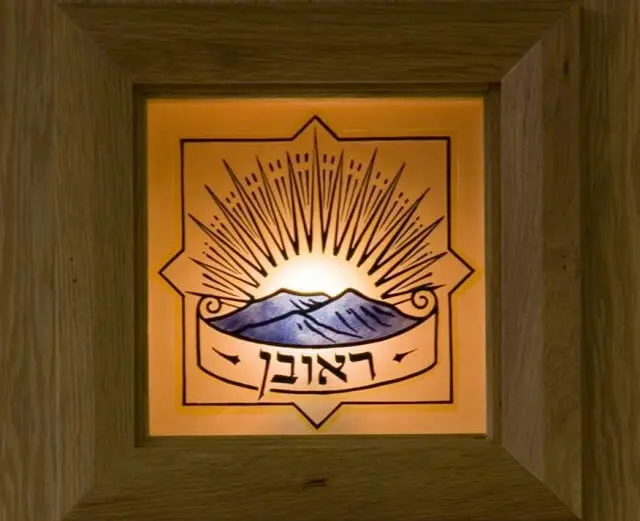
Reuven (ראובן) — the eldest son of the patriarch Yaakov and his wife Leah, and one of the progenitors of the twelve Tribes of Israel.
Reuven's years of life: 2192–2317 (1568–1443 BCE).
He was born in Haran on 14 Kislev 2192 (1568 BCE), when his father Yaakov was 84 years old (Bereishit 29:32; Yalkut Shimoni 162).
As the sages of the esoteric tradition explain, Reuven, Yaakov's firstborn, was a new incarnation (gilgul) of the soul of Cain, Adam's first son. (Seder HaDorot)
After he was born, his mother Leah declared: “G-d has seen my distress (רָאָה בְּעָנְיִי), and now my husband will love me” — and therefore the child was named Reuven (רְאוּבֵן). (Bereishit 29:32)
This name also recorded Leah's joyful exclamation: “Look — a son (רְאוּ בֵּן — reu ben)! G-d has given me a son!” (Pirkei de-Rabbi Eliezer 36).
This seemingly spontaneous exclamation of the mother contained a hidden prophecy: “Look, my son will not be like my father-in-law's son (that is, Esau), who willingly sold his birthright to Yaakov and then hated him for it! But when, in the future, Yaakov takes the birthright from my son and gives it to Yosef — the son of my sister Rachel — Reuven will not only bear Yosef no grudge, but will also try to rescue him from danger”. (Berachot 7b, Rashi)
When Reuven was 13 years old, the family returned from Haran to Yaakov's homeland, the land of Canaan. (Bereishit 31:17–18)
Soon the family reached Hebron, and there fifteen-year-old Reuven saw his righteous grandfather Yitzchak for the first time and studied Torah with him. (Shemot Rabbah 1:1)
During that same period, Reuven and his brothers often went to pasture the flocks in distant grazing grounds, including the area around Shechem, where there were expansive meadows. In 2213 (1547 BCE), during one such journey, Reuven took part in an armed clash with the armies of seven Canaanite kings who had attempted to avenge the people of Shechem on Yaakov's family; the confrontation ended with the conclusion of a peace treaty. (Yalkut Shimoni 133)
In 2214 (1546 BCE), his mother Leah died in Hebron. She was buried in the family burial cave — the Cave of Machpelah. (Seder HaDorot)
Three key events are associated with Reuven, Yaakov's firstborn son by Leah:
- He brought mandrakes to his mother;
- He moved Yaakov's bed from Bilhah's tent;
- He did not participate in the sale of Yosef, even though Yaakov favored Yosef and Yosef was a claimant to the birthright.
1) Mandrakes
Mandrakes (דודאים) — the outward appearance of this plant's root resembles a little person. Interestingly, the gematria of the word דודאים is equal to the numerical value of the expression כאדם, “ke-adam” (like a person) = 65. (Baal HaTurim, Bereishit 30:14)
The Zohar HaKadosh says: “If you say that the mandrakes opened Rachel's womb, this is not so, for it is written: ‘And G-d heard her and opened her womb,’ meaning that Hashem made her capable of giving birth. Although mandrakes can aid conception, they cannot enable a barren woman to conceive, since childbirth depends on one's mazal. Mandrakes can help women whose ability to conceive is impeded by certain causes, but who are not barren and who, according to their mazal, are destined to give birth.” (Zohar, Vayeitzei 156b–157a)
The gematria of חטא עץ הדעת טוב ורע — “chet etz ha-da'at tov ve-ra” — (the sin of the Tree of Knowledge of Good and Evil) is the same as that of וַיִּמְצָא דוּדָאִים בַּשָּׂדֶה וַיָּבֵא אֹתָם אֶללֵאָה — “va-yimtza dudaim ba-sadeh va-yavei otam el Leah” — (he found mandrakes in the field and brought them to Leah).
Leah's exchange of the mandrakes was a tikkun (rectification) for the sin of Esau, who sold his birthright.
Esau said: “I am approaching death, so why do I need the birthright?” (Bereishit 25:32)
He scorned his future spirituality for the sake of physical pleasures.
Esau asked for הָאָדֹם הָאָדֹם הַזֶּה — “ha-adom, ha-adom ha-zeh” — (this red, red stuff).
The word אָדֹם – “adom” contains all the letters of the word דוּדָאִים — “dudaim” — דוּדָאים.
The two remaining letters are יַד – “yad” — (hand), with which one can either take or give. By giving the mandrakes to Rachel so that she could fulfill a mitzvah, Leah rectified Esau's sin.
Rachel, too, was part of this rectification, giving up her own happiness for the sake of her sister.
“And Rachel said to Leah: Give me, please, some of your son's mandrakes.” But she replied: “Is it not enough that you have taken my husband?”
Rabbi Shimon bar Yochai taught: “Because she disrespected the righteous man, she was not buried together with him.”
And concerning this it is said: “Therefore he shall lie with you” — (he will not rest with me, but with you) — in the Cave of Machpelah.
Rabbi Berechya said: “Rabbi Elazar said: This one lost and that one lost; this one gained and that one gained. Leah lost the mandrakes but gained the Tribes (and the birthright); Rachel gained the mandrakes but lost the Tribes (and the birthright).Rabbi Shmuel bar Nachman said: ‘Leah lost the mandrakes but gained the Tribes and burial (beside her husband); Rachel gained the mandrakes but lost the Tribes and burial (beside her husband).’
Relying on the mandrakes as a segula for infertility, Rachel ultimately did not give birth and lost a night with Yaakov;
Leah, however, merited two sons — Yissachar and Zevulun — because she exchanged the mandrakes for a night with Yaakov.
Rabbi Levi said: “Come and see how wonderful the mediation of these mandrakes was, for through them two Tribes arose in Israel — Yissachar and Zevulun.”
It is said in Shir HaShirim (7:14): “The mandrakes give off fragrance,” and to this day the fragrance of the mandrakes symbolizes Yissachar and Zevulun, one of whom studies Torah with the support of the other.
Another secret of the mandrakes can be found in the word mandrakes itself, if it is divided into two words:
דוּדָאִים — אם דָּוִיד — “im David” — meaning “if David.”
Through the transaction involving the mandrakes, David and Mashiach were conceived.
Another way to read the same words — אם דָּוִיד — is “em David” — the mother of David. Through exchanging the mandrakes for a night with Yaakov, Rachel became the spiritual mother of David and Mashiach.
In Rachel's merit, Hashem will gather the exiles and bring redemption.
2) He lay on his father's bed in Bilhah's tent
On the way to the city of Hebron, on 11 Cheshvan 2207 (1554 BCE), Rachel, Yaakov's second wife, died in childbirth. Some time afterward, Yaakov moved his bed into the tent of Rachel's maidservant, Bilhah. Hurt by this, Reuven moved his father's bed without permission into the dwelling of his mother Leah, saying: “If my mother's sister was previously her rival, shall her sister's maidservant now become her rival?” (Bereishit 35:16–22)
From the Torah we learn that after Rachel's death, Yaakov moved his bed into Bilhah's tent because the Shechinah was there, rather than into the tent of his senior wife Leah. The Zohar notes that Reuven showed extreme disrespect toward his father and toward G-d when he demonstratively lay on Bilhah's bed, seeking to defend the family honor of his mother Leah. This is how the verse in the section of Vayishlach should be understood: “Reuven went and lay with Bilhah, his father's concubine...” (35:22) — he lay not with her, but on her bed. The Zohar suggests that Reuven lay on Bilhah's bed because he thought that Yaakov wanted more children and apparently that he and his brothers had sinned.
For this transgression, Yaakov stripped Reuven of the birthright, which passed to Yosef, Rachel's firstborn (I Divrei HaYamim 5:1; Maharsha, Bava Batra 123a).
When the family returned to Hebron, fifteen-year-old Reuven saw his righteous grandfather Yitzchak for the first time. Over the next several years, Reuven studied the foundations of Divine wisdom under the guidance of his father and grandfather. (Shemot Rabbah 1:1).
When the brothers decided to kill Yosef because of his lashon hara, Reuven was the only one to object: “Do not harm the boy! He is still too young to be subject to the death penalty! And certainly he did not desire our death, as you thought.” (Bereishit 37:21, 42:22; Sforno)
When the other brothers continued to insist on the death penalty, Reuven nevertheless tried to save Yosef, saying: “Let us not kill him! Do not spill blood! Throw him into this pit in the wilderness, but do not lay a hand on him!” (Bereishit 37:22).
The brothers understood him to mean that he, too, agreed that Yosef should be put to death, but was merely suggesting a method of execution that would leave no blood on their hands. (Pirkei de-Rabbi Eliezer 38) In truth, however, Reuven intended to wait for a suitable opportunity, take Yosef out of the pit, and return him to his father. (Bereishit 37:22; Makkot 10a)
Reuven feared that his father would blame him specifically for Yosef's death, as the eldest of the brothers who could and should have stopped the others. Moreover, his father might suspect him of taking advantage of the situation to avenge Yosef's having received the birthright from him. (Bereishit Rabbah 84:19)
The brothers decided to place him in a deep pit: if he was innocent, he would be saved, and if he was guilty, he would perish in the wilderness.
As soon as Yosef approached, they stripped off his long, striped tunic, which his father had given him, and threw him into the pit (Bereishit 37:23–24).
When the brothers sat down to eat, Reuven withdrew some distance away and waited for a suitable opportunity to free Yosef. He hoped that if he succeeded in saving Yosef, his father would also forgive him for his earlier sin. (Bereishit Rabbah 84:19).
When it grew dark, Reuven returned to the pit, but there was no one in it. He thought that Yosef had died of fright or had been bitten by a poisonous snake, and that the brothers had removed his body. In his grief, Reuven tore his clothes and returned to his brothers, saying: “The boy is not in the pit! If Yosef has perished, how will I return to my father?!” (Bereishit 37:29–30)
The brothers then told him that passing merchants had pulled Yosef out of the pit and taken him into slavery. “What have you done?! — Reuven asked bitterly. — Surely our father will descend to the grave in grief!” In response, the brothers told him that they had sworn to one another not to reveal the truth to their father about what had actually happened — and Reuven joined their oath. (Pirkei de-Rabbi Eliezer 38)
At a joint council, they decided to soak Yosef's striped tunic in the blood of a slaughtered young goat and bring it to their father, saying that they had found the tunic in the wilderness. (Bereishit 37:31–32)
By saving his brother from execution, Reuven rectified the sin of fratricide committed by Adam's first son, Cain.
Yaakov's blessing: “Reuven, my firstborn, my strength and the first fruit of my vigor, foremost in rank and foremost in power.”
May the zechut of Reuven ben Yaakov protect our people!
Was this helpful?
100% of readers found this article helpful (8 votes).
Please note: some articles on our site contain the holy Names of the Almighty. If you print these articles, they may not be thrown away or destroyed. Please handle printed copies with care and respect.
Material from our site may be copied for the purpose of spreading Torah, provided a link to Silatehilim.com is included. Any use of the site's material in print publications or for commercial purposes is prohibited without the rights holder's consent.