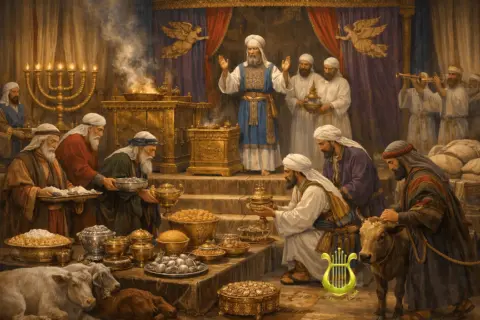
Parashat HaNesi'im (The Offering of the Tribal Leaders) is the service of the 12 Tribes. (Bamidbar 7)
Rabbi Natan Neta Shapira — the “Megaleh Amukot” — a great Kabbalist from Krakow, taught that the Hebrew word “nasi” is an acronym for the phrase “nitzotzo shel Yaakov Avinu”—the spark of our father Jacob, the father of the nation of Israel (Megaleh Amukot, section 84).
One who reads Parashat Nesi'im—the offering of one Tribe—every day (especially during the first 13 days of Nisan) receives shefa from that shevet (Tribe), from the gifts brought by the tribal leaders—the nesi'im.
The “Kaf HaChaim” writes that after reading each section about the offerings of the nesi'im, it is good to give 3 coins to tzedakah in memory of a close relative who has passed away, or in memory of all deceased Jews. These 3 coins correspond to the three levels of the soul—Nefesh, Ruach, and Neshamah. Multiplying 3 by 13 gives 39, the gematria of the word tal (dew), through which Techiyat HaMetim will take place.
Segulot
1. A Segulah for Finding a Spouse—Parashat HaNesi'im
HaGaon HaRav Yanuka (shlita) cites a special segulah for finding a spouse: reading Parashat HaNesi'im. When he was asked about the connection between Parashat HaNesi'im and marriage, Rabbeinu explained that there is a connection between offerings (korbanot) and marriage. He quoted the Gemara in Gittin (90b) and Sanhedrin (22a), which says that when a husband deeply distresses his wife, even the mizbe'ach (Altar) sheds tears. This demonstrates a clear connection between korbanot and marriage, making the reading of Parashat HaNesi'im a segulah for finding one's zivug (life partner).
2. Reading Parashat HaNesi'im during the First 13 Days of Nisan
The first 13 days of Nisan are the days on which the Mishkan was consecrated in the second year after the Exodus from Egypt. During the first 13 days of Nisan, the leader of each Tribe brought an offering in turn. Accordingly, it is customary to read Parashat “Nesi'im” (Bamidbar 7), corresponding to the service of the leaders of the 12 Tribes, and then recite the prayer “Yehi ratzon”. On the 13th day, the first four pesukim of Parashat Beha'alotcha are read, corresponding to the Tribe of Levi (but the prayer “Yehi ratzon” is not recited).
The Offerings of the Nesi'im
1. The Tribe of Judah (1 Nisan)
Prayer Before Reading the Torah
“Yehi ratzon milfanecha, Ado-nai Elo-hai ve-Elo-hei avotai, she-tehe chashuvah u-merutzah kri'ateinu ba-Torah seder korban nasi Nachshon ben Aminadav mi-shevet Yehudah—korbano, asher hikriv la-chanukat mizbechah ha-kadosh. Ve-ha'aleh aleinu ke'ilu hisagnu kol nitzotzin kedoshin ve-kol ha-orot kedoshot ha-klulot bi-kedushat zeh ha-shevet lehavin u-lehaskil be-Toratecha u-ve-yiratecha la'asot retzonecha kol yemei chayai—ani ve-zari ve-zera zari me-atah ve-ad olam. Amen, selah.”
(May it be Your will, O L-rd, my G-d and the G-d of my fathers, that our reading from the Torah of the order of the offering of the leader, Nachshon son of Aminadav, of the Tribe of Judah—the offering he brought for the dedication of the holy Altar—be precious and pleasing. May it be credited to us as though we had attained all the holy sparks and all the holy lights contained within the sanctity of this Tribe, so that we may understand and comprehend Your Torah and, in awe of You, fulfill Your will all the days of my life—I, my offspring, and my descendants, from now and forever. Amen, selah.)
“Va-yehi be-yom kalot Moshe lehaким et ha-Mishkan va-yimshach oto va-yekadesh oto ve-et kol kelav va-yimshachem va-yekadesh otam. Va-yakrivu nesi'ei Yisrael rashei beit avotam hem nesi'ei ha-matot hem ha-omdim al ha-pekudim. Ve-yavi'u et korbanam lifnei Ado-nai shesh agalot tzav u-shneim asar bakar, agalah al shnei ha-nesi'im ve-shor le-echad, va-yakrivu otam lifnei ha-Mishkan. Va-yomer Ado-nai el Moshe lemor: Kach me-itam ve-hayu la'avod et avodat Ohel Mo'ed ve-natata otam el ha-Levi'im, ish ke-fi avodato. Va-yikach Moshe et ha-agalot ve-et ha-bakar va-yiten otam el ha-Levi'im. Et shtei ha-agalot ve-et arba'at ha-bakar natan li-vnei Gershon ke-fi avodatam. Ve-et arba ha-agalot ve-et shemonat ha-bakar natan li-vnei Merari ke-fi avodatam be-yad Itamar ben Aharon ha-Kohen. Ve-li-vnei Kehat lo natan, ki avodat ha-kodesh aleihem ba-katef yisa'u. Va-yakrivu ha-nesi'im et chanukat ha-mizbe'ach be-yom himashach oto, va-yakrivu ha-nesi'im et korbanam lifnei ha-mizbe'ach. Va-yomer Ado-nai el Moshe: nasi echad la-yom, nasi echad la-yom, yakrivu et korbanam la-chanukat ha-mizbe'ach.”
11. And it came to pass when Moshe finished setting up the Mishkan and anointed it and sanctified it, together with all its vessels, and the Altar and all its utensils, and anointed and sanctified them, (2) that the leaders of Israel, the heads of their ancestral houses, who were the leaders of the Tribes and stood over those counted, approached. (3) They brought their offering before the L-rd: six covered wagons and twelve oxen—one wagon from every two leaders and one ox from each—and presented them before the Mishkan. (4) And the L-rd said to Moshe: (5) Take them from them, and they shall be used for the service of the Tent of Meeting; give them to the Levites, each according to his service. (6) Moshe took the wagons and the oxen and gave them to the Levites. (7) He gave two wagons and four oxen to the sons of Gershon, according to their service. (8) He gave four wagons and eight oxen to the sons of Merari, according to their service, under the supervision of Itamar, son of Aharon the Kohen. (9) But to the sons of Kehat he did not give any, because the holy service was upon them; they had to carry it on their shoulders. (10) The leaders brought offerings for the dedication of the Altar on the day it was anointed, and the leaders presented their offerings before the Altar. (11) And the L-rd said to Moshe: Let one leader each day bring his offering for the dedication of the Altar.
Reading of the Torah Portion
12. VA-YEHI HAMAKRIV BAYOM HARISHON ET-KORBANO NACHSHON BEN-AMINADAV LE-MATEH YEHUDAH. 13. VE-KORBANO KA'ARAT-KESEF ACHAT SHELOSHIM U-ME'AH MISHKALAH, MIZRAK ECHAD KESEF SHIV'IM SHEKEL BE-SHEKEL HAKODESH, SHNEIHEM MELE'IM SOLET BELULAH VA-SHEMEN LE-MINCHAH. 14. KAF ACHAT ASARAH ZAHAV MELE'AH KETORET. 15. PAR ECHAD BEN-BAKAR, AYIL ECHAD, KEVES ECHAD BEN-SHENATO LE-OLAH. 16. SE'IR IZIM ECHAD LE-CHATAT. 17. U-LEZEVACH HASHELAMIM BAKAR SHENAYIM, EILIM CHAMISHAH, ATUDIM CHAMISHAH, KEVASIM BENEI SHANAH CHAMISHAH. ZEH KORB AN NACHSHON BEN-AMINADAV.
— “And on the first day, Nachshon son of Aminadav, of the Tribe of Judah, brought his offering. His offering was: one silver bowl weighing one hundred and thirty (shekels), one silver basin weighing seventy shekels according to the sacred shekel; both filled with fine flour mixed with oil for a meal offering; one gold spoon weighing ten (shekels), filled with incense; one young bull, one ram, and one yearling lamb as a burnt offering; one goat as a sin offering; and as a peace offering: two cattle, five rams, five goats, and five yearling lambs. This was the offering of Nachshon son of Aminadav.”
Prayer After Reading the Torah
“Yehi ratzon milfanecha, Ado-nai Elo-heinu ve-Elo-hei avoteinu, she-im ani—avdecha—mi-shevet Yehudah ha-chatum be-Malchut she-karati be-Toratecha parashat ha-nasi Nachshon ben Aminadav nasi Yehudah korbano, asher hikriv la-chanukat mizbechah ha-kadosh, she-yihyeh olah lefanecha kri'at ve-limud seder korbano ke'ilu hisagnu kol ha-sodot ve-kol ha-Shemot ha-Kedoshim ha-yotze'im mi-rashei tevot ve-sofei tevot Mikra Kodesh, ela ve-nishalma parim sefateinu. Ve-ya'iru na aleinu ve-al kol beit Yisrael acheinu kol nitzotzot ha-kedushah ve-kol ha-orot kedoshot ha-klulot bi-kedushat zeh ha-shevet lehavin u-lehaskil be-Toratecha u-ve-yiratecha yirat ha-romemut la'asot retzonecha ke-retzoneinu kol yemei chayeinu—anachnu ve-zar'einu ve-zera zar'einu.
Ve-kesham she-be-chodesh ha-zeh padita et amcha, shivtei nachalatecha mi-kur ha-barzel mi-Mitzrayim, u-zacharta be-ahavah le-tehillah le-shem u-le-tiferet le-shemot matot avotam al ha-nisim, al ha-purkan, al ha-gevurot ve-al ha-teshu'ot she-asita imah em. Ken, Ado-nai Elo-heinu ve-Elo-hei avoteinu, tzonecha be-rachamim tifkod u-zchor lanu ahavat ha-kadmonim shivtei Kah be-galut ha-chayil ha-zeh, shevet Yehudah be-dochak u-ve-tza'ar. U-kesham she-hodu la-Ado-nai chasdo be-yetzi'at Mitzrayim bi-zchut Yehudah, ken nodeh Lecha, Ado-nai Elo-heinu ve-Elo-hei avoteinu, al ge'ulateinu ve-al pedut nafsheinu bi-zchut Yehudah—melech be-achav, ve-lo yasur shevet mi-Yehudah u-mechokek mi-bein raglav. Zaro le-olam yihyeh ve-khiso ke-shemesh negdecha, melech be-yofyo techezena eineinu ve-yismach levaveinu.
Ve-timloch Atah—Hu Ado-nai, Elo-heinu—meherah al kol ma'asecha, be-har Tzion—Mishkan Kevodecha—u-ve-Yerushalayim—ir Mikdashecha—as written in Your holy words: “The L-rd shall reign forever, your G-d, O Zion, from generation to generation, Hallelujah.” And it is said: “For the kingdom is the L-rd's, and He rules over the nations. And saviors shall ascend Mount Zion to judge the mountain of Esau, and the kingdom shall be the L-rd's. And the L-rd shall be King over the entire earth; on that day the L-rd shall be One and His Name One.” May the words of my mouth and the meditation of my heart be acceptable before You, Ado-nai, my Rock and Redeemer. Accept our prayer and hear our cry, Knower of all hidden things.”
(May it be Your will, O L-rd, our G-d and the G-d of our fathers, that if I—Your servant—belong to the Tribe of Judah, sealed in the attribute of Malchut, then my reading in Your Torah of the section of the leaders—Nachshon son of Aminadav, the leader of Judah, his offering, which he brought for the dedication of the holy Altar—be credited to me by You as though I had attained all the secrets and all the Holy Names emerging from the first and last letters of these holy Scriptures, and instead of bulls our lips should offer words. Please enlighten us and all the house of Israel, our brothers, with all the holy sparks and holy lights contained in the sanctity of this Tribe. May we be clothed in the sanctity of this Tribe, so that we may understand and comprehend Your Torah and, in awe and reverence of You, fulfill Your will as our own all the days of our lives—we, our offspring, and our descendants.)
And just as at that time, in this month, You redeemed Your people—the Tribes of Your inheritance—from the iron furnace of Egypt, and remembered with love, for glory and splendor, the names of the Tribes of their fathers through the miracles, trials, strict judgments, and salvations that You performed for them, so too remember and visit us, O L-rd our G-d and the G-d of our fathers, Your flock, with mercy, and remember with love the ancient Tribes of G-d in this exile: the Tribe of Judah, in distress and sorrow. And just as then they praised the kindness of the L-rd at the Exodus from Egypt in the merit of Judah, so may we praise You, O L-rd our G-d and the G-d of our fathers, for our redemption and for the deliverance of our souls in the merit of Judah, a king among his brothers. May the scepter not depart from Judah, nor the lawgiver from among his descendants; may his seed endure forever and his throne be like the sun before You. May our eyes behold the King in His beauty, and may our hearts rejoice.
May You reign, O L-rd our G-d, speedily over all Your works, on Mount Zion, the dwelling place of Your Glory, and in Jerusalem, Your holy city, as it is written in Your sacred words: “The L-rd shall reign forever, your G-d, O Zion, from generation to generation, Hallelujah.” And it is said: “For the kingdom is the L-rd's, and He rules over the nations. And saviors shall ascend Mount Zion to judge the mountain of Esau, and the kingdom shall be the L-rd's. And the L-rd shall be King over the entire earth; on that day the L-rd shall be One and His Name One.” May the words of my mouth and the meditation of my heart be acceptable before You, O L-rd, my Rock and Redeemer. Accept our prayer and hear our cry, Knower of all hidden things.)
2. The Tribe of Issachar (2 Nisan)
Prayer Before Reading the Torah
“Yehi ratzon milfanecha, Ad-nai Elo-hai ve-Elo-hei avotai, she-tehe chashuvah u-merutzah kri'ateinu ba-Torah seder korban nasi Netanel ben Tzuar mi-shevet Yissachar—korbano, asher hikriv la-chanukat mizbechah ha-kadosh. Ve-ha'aleh aleinu ke'ilu hisagnu kol nitzotzin kedoshin ve-kol ha-orot kedoshot ha-klulot bi-kedushat zeh ha-shevet lehavin u-lehaskil be-Toratecha u-ve-yiratecha la'asot retzonecha kol yemei chayai—ani ve-zari ve-zera zari me-atah ve-ad olam. Amen, selah.”
(May it be Your will, O L-rd, my G-d and the G-d of my fathers, that our reading from the Torah of the order of the offering of the leader, Netanel son of Tzuar, of the Tribe of Issachar—the offering he brought for the dedication of the holy Altar—be precious and pleasing. May it be credited to us as though we had attained all the holy sparks and all the holy lights contained within the sanctity of this Tribe, so that we may understand and comprehend Your Torah and, in awe of You, fulfill Your will all the days of my life—I, my offspring, and my descendants, from now and forever. Amen, selah.)
Reading of the Torah Portion
18. BA-YOM HA-SHENI HIKRIV NETANEL BEN-TZUAR NESI YISSACHAR. 19. HIKRIV ET-KORBANO KA'ARAT-KESEF ACHAT SHELOSHIM U-ME'AH MISHKALAH, MIZRAK ECHAD KESEF SHIV'IM SHEKEL BE-SHEKEL HAKODESH, SHNEIHEM MELE'IM SOLET BELULAH VA-SHEMEN LE-MINCHAH. 20. KAF ACHAT ASARAH ZAHAV MELE'AH KETORET. 21. PAR ECHAD BEN-BAKAR, AYIL ECHAD, KEVES ECHAD BEN-SHENATO LE-OLAH. 22. SE'IR IZIM ECHAD LE-CHATAT. 23. U-LEZEVACH HASHELAMIM BAKAR SHENAYIM, EILIM CHAMISHAH, ATUDIM CHAMISHAH, KEVASIM BENEI SHANAH CHAMISHAH. ZEH KORBAN NETANEL BEN TZUAR.
— On the second day, Netanel son of Tzuar, leader of the Tribe of Issachar, brought his offering.
He brought his offering: one silver bowl weighing one hundred and thirty (shekels), one silver basin weighing seventy shekels according to the sacred shekel; both filled with fine flour mixed with oil for a meal offering; one gold spoon weighing ten (shekels), filled with incense; one young bull, one ram, and one yearling lamb as a burnt offering; one goat as a sin offering; and as a peace offering: two cattle, five rams, five goats, and five yearling lambs. This was the offering of Netanel son of Tzuar.
Prayer After Reading the Torah
“Yehi ratzon milfanecha, Ado-nai Elo-heinu ve-Elo-hei avoteinu, she-im ani—avdecha—mi-shevet Yissachar ha-chatum be-middat Netzach de-Malchut she-karati be-Toratecha parashat ha-nasi Netanel ben Tzuar nasi Yissachar korbano, asher hikriv la-chanukat mizbechah ha-kadosh, she-yihyeh olah lefanecha kri'at ve-limud seder korbano ke'ilu hisagnu kol ha-sodot ve-kol ha-Shemot ha-Kedoshim ha-yotze'im mi-rashei tevot ve-sofei tevot Mikra Kodesh, ela ve-nishalma parim sefateinu. Ve-ya'iru na aleinu ve-al kol beit Yisrael acheinu kol nitzotzot ha-kedushah ve-kol ha-orot kedoshot ha-klulot bi-kedushat zeh ha-shevet lehavin u-lehaskil be-Toratecha u-ve-yiratecha yirat ha-romemut la'asot retzonecha ke-retzoneinu kol yemei chayeinu—anachnu ve-zar'einu ve-zera zar'einu.
Ve-kesham she-be-chodesh zeh padita et amcha, Yisrael, mi-kur ha-barzel mi-Mitzrayim, ve-hirbita secharam shel avoteinu be-Mitzrayim ba-yamim ha-eleh u-vi-zman ha-zeh bi-zchut Yissachar, ve-achar kach yatzu bi-rechush gadol. Ken, Ado-nai Elo-heinu ve-Elo-hei avoteinu, nakavah secharcha le-amcha ha-dvuyim ve-sachufim ba-galut ha-chayil ha-zeh, ve-ten sechar tov le-khol ha-botchim be-Shimcha be-emet u-le-olam lo nevosh ki Vechah batachnu u-le-shu'atecha kivinu kol ha-yom bi-zchut Yissachar u-virchato: “Va-yar menuchah ki tov ve-et ha-aretz ki na'emah.” Chazeh Tzion kiryat Moadeinu, eineinu tirenah Yerushalayim naveh sha'anan, ohel bal yitzan, yeseidotav la-netzach ve-khol chavaleha bal yinateku. Ado-nai Elo-him Tzeva'ot, hashiveinu, ha'er panecha ve-nivashe'ah. Barchenu, taharenu, rachamei tzidkatecha tamid gomleinu.”
(May it be Your will, O L-rd, our G-d and the G-d of our fathers, that if I—Your servant—belong to the Tribe of Issachar, sealed in the attribute of Netzach de-Malchut, then my reading in Your Torah of the section of the leaders—Netanel son of Tzuar, the leader of Issachar, his offering, which he brought for the dedication of the holy Altar—be credited to me by You as though I had attained all the secrets and all the Holy Names emerging from the first and last letters of these holy Scriptures, and instead of bulls our lips should offer words. Please enlighten us and all the house of Israel, our brothers, with all the holy sparks and holy lights contained in the sanctity of this Tribe. May we be clothed in the sanctity of this Tribe, so that we may understand and comprehend Your Torah and, in awe and reverence of You, fulfill Your will as our own all the days of our lives—we, our offspring, and our descendants.)
And just as at that time, in this month, You redeemed Your people, Israel, from the iron furnace of Egypt, and increased the reward of our fathers in Egypt during those days and at that time, in the merit of Issachar, and afterward they left with great wealth, so too establish for us, O L-rd our G-d and the G-d of our fathers, Your reward for Your people, suffering and carried away in this exile. Grant a good reward to all who trust in Your Name in truth; may we never be put to shame, for we trust in You and hope for Your salvation all day, in the merit of Issachar and his blessing: “He saw that rest was good and that the land was pleasant.” Look upon Zion, the city of our gatherings! May our eyes behold Jerusalem, a tranquil dwelling, an unshaken tent; its stakes shall never move, and none of its cords shall be severed. O L-rd, G-d of Hosts, restore us; shine Your countenance upon us, and we shall be saved.)
3. The Tribe of Zebulun (3 Nisan)
Prayer Before Reading the Torah
“Yehi ratzon milfanecha, Ado-nai Elo-hai ve-Elo-hei avotai, she-tehe chashuvah u-merutzah kri'ateinu ba-Torah seder korban nasi Eliav ben Chelon mi-shevet Zevulun—korbano, asher hikriv la-chanukat mizbechah ha-kadosh. Ve-ha'aleh aleinu ke'ilu hisagnu kol nitzotzin kedoshin ve-kol ha-orot kedoshot ha-klulot bi-kedushat zeh ha-shevet lehavin u-lehaskil be-Toratecha u-ve-yiratecha la'asot retzonecha kol yemei chayai—ani ve-zari ve-zera zari me-atah ve-ad olam. Amen, selah.”
(May it be Your will, O L-rd, my G-d and the G-d of my fathers, that our reading from the Torah of the order of the offering of the leader, Eliav son of Chelon, of the Tribe of Zebulun—the offering he brought for the dedication of the holy Altar—be precious and pleasing. May it be credited to us as though we had attained all the holy sparks and all the holy lights contained within the sanctity of this Tribe, so that we may understand and comprehend Your Torah and, in awe of You, fulfill Your will all the days of my life—I, my offspring, and my descendants, from now and forever. Amen, selah.)
Reading of the Torah Portion
24. BA-YOM HA-SHELISHI NASI LIVNEI ZEVULUN ELIAV BEN-CHELON. 25. KORBANO KA'ARAT-KESEF ACHAT SHELOSHIM U-ME'AH MISHKALAH, MIZRAK ECHAD KESEF SHIV'IM SHEKEL BE-SHEKEL HAKODESH, SHNEIHEM MELE'IM SOLET BELULAH VA-SHEMEN LE-MINCHAH. 26. KAF ACHAT ASARAH ZAHAV MELE'AH KETORET. 27. PAR ECHAD BEN-BAKAR, AYIL ECHAD, KEVES ECHAD BEN-SHENATO LE-OLAH. 28. SE'IR IZIM ECHAD LE-CHATAT. 29. U-LEZEVACH HASHELAMIM BAKAR SHENAYIM, EILIM CHAMISHAH, ATUDIM CHAMISHAH, KEVASIM BENEI SHANAH CHAMISHAH. ZEH KORBAN ELIAV BEN-CHELON.
— On the third day, the leader of the sons of Zebulun, Eliav son of Chelon, brought his offering.
His offering was one silver bowl weighing one hundred and thirty (shekels), one silver basin weighing seventy shekels according to the sacred shekel; both filled with fine flour mixed with oil for a meal offering; one gold spoon weighing ten (shekels), filled with incense; one young bull, one ram, and one yearling lamb as a burnt offering; one goat as a sin offering; and as a peace offering: two cattle, five rams, five goats, and five yearling lambs. This was the offering of Eliav son of Chelon.
Prayer After Reading the Torah
“Yehi ratzon milfanecha, Ado-nai Elo-heinu ve-Elo-hei avoteinu, she-im ani—avdecha—mi-shevet Zevulun ha-chatum be-middat Hod Malchut she-karati be-Toratecha parashat ha-nasi Eliav ben Chelon nasi Zevulun korbano, asher hikriv la-chanukat mizbechah ha-kadosh, she-yihyeh olah lefanecha kri'at ve-limud seder korbano ke'ilu hisagnu kol ha-sodot ve-kol ha-Shemot ha-Kadosh ha-yotze'im mi-rashei tevot ve-sofei tevot Mikra Kodesh, ela ve-nishalma parim sefateinu. Ve-ya'iru na aleinu ve-al kol beit Yisrael acheinu kol nitzotzot ha-kedushah ve-kol ha-orot kedoshot ha-klulot bi-kedushat zeh ha-shevet lehavin u-lehaskil be-Toratecha u-ve-yiratecha yirat ha-romemut la'asot retzonecha ke-retzoneinu kol yemei chayeinu—anachnu ve-zar'einu ve-zera zar'einu.”
And just as You redeemed our forefathers from Egypt and established Your Shechinah among them, in Your dwelling place, in the merit of Zevulun, so, Adonai our G-d and G-d of our forefathers, remember Your congregation, which You acquired of old, in this bitter and swiftly approaching exile. In the merit of Zevulun, restore Your Shechinah to Your glorious House of Residence. Dwell in Jerusalem, Your city, as You have said, and soon establish David's throne within it. Remember this vine, which is connected to the Holy Name Vav-Heh, all day long, and show us Your Hod for good. Save us, Adonai our G-d, and gather us from among the nations, that we may give thanks to Your holy Name and glory in Your praise. Fulfill for Your servants the blessing of Zevulun: “They will summon peoples to the mountain; there they will offer sacrifices of righteousness, for they will be nourished by the abundance of the seas and by treasures hidden in the sand.” Adonai Tzevaot is with us; the G-d of Jacob is our stronghold forever. O steadfast and holy One, in Your abundant goodness, lead Your congregation. May the words of my mouth and the meditation of my heart find favor before You, Adonai, my Rock and my Redeemer.”
(May it be Your will, Adonai, my G-d and the G-d of my forefathers, that if I—Your servant—belong to the tribe of Zevulun, sealed in Hod of Malchut, then my reading in Your Torah of the section concerning the princes—Eliav ben Chelon, prince of Zevulun, and his offering, which he brought for the dedication of the holy altar—be credited to me by You as though we had attained all the mysteries and all the Holy Names emerging from the first and final letters of these Holy Scriptures, and as though, instead of bulls, we had offered the words of our lips. Please illuminate us and the entire House of Israel—our brethren—with all the holy sparks and all the holy lights included in the sanctity of this tribe. May we be clothed in the sanctity of this tribe, so that we may understand and comprehend Your Torah and, with fear and awe of You, fulfill Your will as our own all the days of our lives—we, our children, and our children's children.)
4. The Tribe of Reuben (4 Nisan)
Prayer Before Reading the Torah
“Yehi ratzon milfanecha, Adonai Elohai ve-Elohei avotai, she-tehi chashuvah u-merutzah kriatenu ba-Torah seder korban nasi Elitzur ben Shedeur mi-shevet Reuven—korbano, asher hikriv la-chanukat mizbechaha ha-kadosh. Ve-ha'aleh aleinu ke'ilu hisagnu kol nitzotzin kedoshim ve-kol ha-orot kedoshot ha-klulot bi-kedushat zeh ha-shevet, lehavin u-lehaskil be-Toratecha u-ve-yiratecha la'asot retzonecha kol yemei chayai—ani ve-zari ve-zera zari me-atah ve-ad olam. Amen, sela.”
(May it be Your will, Adonai, my G-d and the G-d of my forefathers, that our reading from the Torah of the order of the offering of the prince Elitzur ben Shedeur of the tribe of Reuben—his offering, which he brought for the dedication of the holy altar—be precious and pleasing, and be credited to us as though we had attained all the holy sparks and all the holy lights included in the sanctity of this tribe, so that we may understand and comprehend Your Torah and fulfill Your will with fear of You all the days of my life—I, my children, and my children's children—from now and forever. Amen, sela.)
Reading the Torah Passage
30. On the fourth day, the prince of the descendants of Reuben, Elitzur ben-Shedeur. 31. His offering: one silver bowl weighing one hundred and thirty (shekels), one silver basin weighing seventy shekels, by the sacred shekel; both filled with fine flour mixed with oil for a meal offering. 32. One gold ladle weighing ten (shekels), filled with incense. 33. One young bull, one ram, and one yearling lamb for an olah. 34. One male goat for a chatat. 35. And for the sacrifice of peace offerings: two cattle, five rams, five goats, and five yearling lambs. This was the offering of Elitzur ben-Shedeur.
Prayer After Reading the Torah
“Yehi ratzon milfanecha, Adonai Eloheinu ve-Elohei avoteinu, she-im ani—avdecha—mi-shevet Reuven ha-chatum be-Chesed de-Malchut, she-karati be-Toratecha parashat ha-nasi Elitzur ben Shedeur nasi Reuven—korbano, asher hikriv la-chanukat mizbechaha ha-kadosh, she-yihyeh olah lefanecha kriat ve-limud seder korbano ke'ilu hisagnu kol ha-sodot ve-kol ha-Shemot ha-Kedoshim ha-yotze'im mi-rashei tevot ve-sofei tevot Mikra kodesh, ela ve-nishalma parim sefateinu. Ve-ya'iru na aleinu ve-al kol Beit Yisrael achenu kol nitzotzot ha-kedushah ve-kol ha-orot kedoshot ha-klulot bi-kedushat zeh ha-shevet, lehavin u-lehaskil be-Toratecha u-ve-yiratecha yirat ha-romemut, la'asot retzonecha kirtzoneinu kol yemei chayeinu—anachnu ve-zarenu ve-zera zarenu.
Ve-ke-sham she-ra'ita oni amcha—tzone mar'itecha—Yisrael be-Mitzrayim ba-yamim ha-eleh u-vi-zman ha-zeh bi-zchut Reuven. Ken, Adonai Eloheinu ve-Elohei avoteinu, be-galut ha-zeh habita u-re'eh et cherpatenu, u-vi-zchut Reuven re'eh na be-oniyeinu u-maher le-ga'alenu ge'ulah shleimah. Ana be-koach gedulat yeminecha tatir tzerurah. Kumah ezratah lanu u-fadenu le-ma'an chasadecha. Hafleh chasadecha, moshi'a chosim mi-mitkomemim bi-minecha. Yihyu le-ratzon imrei fi ve-hegyon libi lefanecha, Adonai—tzuri ve-go'ali.”
(May it be Your will, Adonai our G-d and G-d of our forefathers, that if I—Your servant—belong to the tribe of Reuben, sealed in Chesed of Malchut, then my reading in Your Torah of the section concerning the princes—Elitzur ben Shedeur, prince of Reuben, and his offering, which he brought for the dedication of the holy altar—be credited to me by You as though we had attained all the mysteries and all the Holy Names emerging from the first and final letters of these Holy Scriptures, and as though, instead of bulls, we had offered the words of our lips. Please illuminate us and the entire House of Israel—our brethren—with all the holy sparks and all the holy lights included in the sanctity of this tribe. May we be clothed in the sanctity of this tribe, so that we may understand and comprehend Your Torah and, with fear and awe of You, fulfill Your will as our own all the days of our lives—we, our children, and our children's children.)
And just as there You saw the poverty of Your people—the flock of Your pasture, Israel—in Egypt in those days and at that time, in the merit of Reuben, so, Adonai our G-d and G-d of our forefathers, look upon and see our disgrace in this exile, and in the merit of Reuben, please see our poverty and hasten to redeem us with a complete redemption. Please, by the power of Your mighty right hand, release the bonds. Rise to our aid and redeem us for the sake of Your kindness. Display Your wondrous kindness, O Savior of those who trust in You, from those who rise up against Your right hand. May the words of my mouth and the meditation of my heart find favor before You, Adonai, my Rock and my Redeemer.
5. The Tribe of Simeon (5 Nisan)
Prayer Before Reading the Torah
“Yehi ratzon milfanecha, Adonai Elohai ve-Elohei avotai, she-tehi chashuvah u-merutzah kriatenu ba-Torah seder korban nasi Shlumi'el ben Tzurishaddai mi-shevet Shimon—korbano, asher hikriv la-chanukat mizbechaha ha-kadosh. Ve-ha'aleh aleinu ke'ilu hisagnu kol nitzotzin kedoshim ve-kol ha-orot kedoshot ha-klulot bi-kedushat zeh ha-shevet, lehavin u-lehaskil be-Toratecha u-ve-yiratecha la'asot retzonecha kol yemei chayai—ani ve-zari ve-zera zari me-atah ve-ad olam. Amen, sela.”
(May it be Your will, Adonai, my G-d and the G-d of my forefathers, that our reading from the Torah of the order of the offering of the prince Shlumi'el ben Tzurishaddai of the tribe of Simeon—his offering, which he brought for the dedication of the holy altar—be precious and pleasing, and be credited to us as though we had attained all the holy sparks and all the holy lights included in the sanctity of this tribe, so that we may understand and comprehend Your Torah and fulfill Your will with fear of You all the days of my life—I, my children, and my children's children—from now and forever. Amen, sela.)
Reading the Torah Passage
36. On the fifth day, the prince of the descendants of Simeon, Shlumi'el ben-Tzurishaddai. 37. His offering: one silver bowl weighing one hundred and thirty (shekels), one silver basin weighing seventy shekels, by the sacred shekel; both filled with fine flour mixed with oil for a meal offering. 38. One gold ladle weighing ten (shekels), filled with incense. 39. One young bull, one ram, and one yearling lamb for an olah. 40. One male goat for a chatat. 41. And for the sacrifice of peace offerings: two cattle, five rams, five goats, and five yearling lambs. This was the offering of Shlumi'el ben-Tzurishaddai.
Prayer After Reading the Torah
“Yehi ratzon milfanecha, Adonai Eloheinu ve-Elohei avoteinu, she-im ani—avdecha—mi-shevet Shimon ha-chatum be-Gevurah de-Malchut, she-karati be-Toratecha parashat ha-nasi Shlumi'el ben Tzurishaddai nasi Shimon—korbano, asher hikriv la-chanukat mizbechaha ha-kadosh, she-yihyeh olah lefanecha kriat ve-limud seder korbano ke'ilu hisagnu kol ha-sodot ve-kol ha-Shemot ha-Kedoshim ha-yotze'im mi-rashei tevot ve-sofei tevot Mikra kodesh, ela ve-nishalma parim sefateinu. Ve-ya'iru na aleinu ve-al kol Beit Yisrael achenu kol nitzotzot ha-kedushah ve-kol ha-orot kedoshot ha-klulot bi-kedushat zeh ha-shevet, lehavin u-lehaskil be-Toratecha u-ve-yiratecha yirat ha-romemut, la'asot retzonecha kirtzoneinu kol yemei chayeinu—anachnu ve-zarenu ve-zera zarenu.
Ve-ke-sham she-shamata ne'akat bnei Yisrael—amcha—be-Mitzrayim ba-yamim ha-eleh u-vi-zman ha-zeh bi-zchut Shimon. Ken, Adonai Eloheinu ve-Elohei avoteinu, pakdenu bi-fkudat yeshu'ah ve-rachamim be-galut ha-mar ve-ha-nimhar ha-zeh u-vi-zchut Shimon, kabel rinat amcha, sagvenu, taharenu, Nora. Shema koleinu u-kabel be-rachamim u-ve-ratzon et tefilateinu ha-no'akim me-bor galut u-me-eretz shivyah. El, habita dal kevodeinu ve-shikutzenu ke-tumat nidah. Ad matai uzcha be-shivui ve-tifartecha be-yad tzar. Hemah yir'u ve-yavoshu ve-yechatu mi-gevurotam. Urerah gevurotecha ve-hoshi'enu lema'an Shemecha. Adonai ke-gibor yetzei, ke-ish milchamah ya'ir kinah, yari'a af yatzriach al oyevav yitgabar.”
(May it be Your will, Adonai our G-d and G-d of our forefathers, that if I—Your servant—belong to the tribe of Simeon, sealed in Gevurah of Malchut, then my reading in Your Torah of the section concerning the princes—Shlumi'el ben Tzurishaddai, prince of Simeon, and his offering, which he brought for the dedication of the holy altar—be credited to me by You as though we had attained all the mysteries and all the Holy Names emerging from the first and final letters of these Holy Scriptures, and as though, instead of bulls, we had offered the words of our lips. Please illuminate us and the entire House of Israel—our brethren—with all the holy sparks and all the holy lights included in the sanctity of this tribe. May we be clothed in the sanctity of this tribe, so that we may understand and comprehend Your Torah and, with fear and awe of You, fulfill Your will as our own all the days of our lives—we, our children, and our children's children.)
And just as there You heard the groaning of the children of Israel—Your people—in Egypt in those days and at that time, in the merit of Simeon, so, Adonai our G-d and G-d of our forefathers, visit us with salvation and mercy in this bitter and swiftly approaching exile. In the merit of Simeon, accept the prayer of Your people; strengthen and purify us, O Awesome One. Hear our voice and graciously and willingly accept our prayer, as we groan from the pit of exile and the land of captivity. G-d, behold how our glory has been brought low and how our impurity has become like a source of defilement to us. How long will Your strength remain in captivity and Your splendor in the hands of the oppressor? They will see, be ashamed, and be confounded by their might. Awaken Your strength and save us for the sake of Your Name. Adonai will go forth like a mighty man; like a warrior He will arouse His zeal, cry out, raise the battle shout, and prevail over His enemies.
6. The Tribe of Gad (6 Nisan)
Prayer Before Reading the Torah
“Yehi ratzon milfanecha, Adonai Elohai ve-Elohei avotai, she-tehi chashuvah u-merutzah kriatenu ba-Torah seder korban nasi El'yasaf ben Deu'el mi-shevet Gad—korbano, asher hikriv la-chanukat mizbechaha ha-kadosh. Ve-ha'aleh aleinu ke'ilu hisagnu kol nitzotzin kedoshim ve-kol ha-orot kedoshot ha-klulot bi-kedushat zeh ha-shevet, lehavin u-lehaskil be-Toratecha u-ve-yiratecha la'asot retzonecha kol yemei chayai—ani ve-zari ve-zera zari me-atah ve-ad olam. Amen, sela.”
(May it be Your will, Adonai, my G-d and the G-d of my forefathers, that our reading from the Torah of the order of the offering of the prince El'yasaf ben Deu'el of the tribe of Gad—his offering, which he brought for the dedication of the holy altar—be precious and pleasing, and be credited to us as though we had attained all the holy sparks and all the holy lights included in the sanctity of this tribe, so that we may understand and comprehend Your Torah and fulfill Your will with fear of You all the days of my life—I, my children, and my children's children—from now and forever. Amen, sela.)
Reading the Torah Passage
42. On the sixth day, the prince of the descendants of Gad, El'yasaf ben-Deu'el. 43. His offering: one silver bowl weighing one hundred and thirty (shekels), one silver basin weighing seventy shekels, by the sacred shekel; both filled with fine flour mixed with oil for a meal offering. 44. One gold ladle weighing ten (shekels), filled with incense. 45. One young bull, one ram, and one yearling lamb for an olah. 46. One male goat for a chatat. 47. And for the sacrifice of peace offerings: two cattle, five rams, five goats, and five yearling lambs. This was the offering of El'yasaf ben-Deu'el.
Prayer After Reading the Torah
“Yehi ratzon milfanecha, Adonai Eloheinu ve-Elohei avoteinu, she-im ani—avdecha—mi-shevet Gad ha-chatum be-akevot Hod de-Malchut, she-karati be-Toratecha parashat ha-nasi El'yasaf ben Deu'el nasi Gad—korbano, asher hikriv la-chanukat mizbechaha ha-kadosh, she-yihyeh olah lefanecha kriat ve-limud seder korbano ke'ilu hisagnu kol ha-sodot ve-kol ha-Shemot ha-Kedoshim ha-yotze'im mi-rashei tevot ve-sofei tevot Mikra kodesh, ela ve-nishalma parim sefateinu. Ve-ya'iru na aleinu ve-al kol Beit Yisrael achenu kol nitzotzot ha-kedushah ve-kol ha-orot kedoshot ha-klulot bi-kedushat zeh ha-shevet, lehavin u-lehaskil be-Toratecha u-ve-yiratecha yirat ha-romemut, la'asot retzonecha kirtzoneinu kol yemei chayeinu—anachnu ve-zarenu ve-zera zarenu.
Ve-ke-sham she-be-tzeit Yisrael mi-Mitzrayim הורדת lahem ha-man mi-Shmei meromecha, ve-hu ke-zera gad bi-zchut Gad, ken, Adonai Eloheinu ve-Elohei avoteinu, Chasin Kadosh, be-rov tuvcha naheil adatך ba-galutenu zeh, u-fetach lanu otzrot talah ila'ah chivrah mi-trei mazalei Notzer ve-Nakeh, derech Chayecha, ve-garon le-Aba ve-Ima, u-min Aba ve-Ima le-Zeir Anpin, u-mi-Zeir Anpin le-heikal tapuchin kadishin de-mitman atihyav mezona ila'ah merachya de-tachnin taman mana le-tzadikaya, ve-sava et ha-olam kulo mi-tuvcha, ve-ten tal u-matar li-vrachah al kol penei ha-adamah, mi-meged Shamayim, mi-tal u-me-tehom rovzet tachat.
U-vi-zchut Gad ha-chatum be-akevot Hod de-Malchutecha hayah ke-tal le-Yisrael, yifrach ke-shoshana va-yach shorashav ka-Levanon. Yalchu yonekotav, vihi ka-zayit hodo, ve-re'ach lo ka-Levanon. U-vi-shu'atecha tashuv Malkeinu ve-tagbi'a keren Mashiach ben David—avdecha. Ve-natata me-hodecha alav, gadol kevodo bi-shu'atecha. Hod ve-hadar teshaveh alav.”
(May it be Your will, Adonai our G-d and G-d of our forefathers, that if I—Your servant—belong to the tribe of Gad, sealed in the heel of Hod of Malchut, then my reading in Your Torah of the section concerning the princes—El'yasaf ben Deu'el, prince of Gad, and his offering, which he brought for the dedication of the holy altar—be credited to me by You as though we had attained all the mysteries and all the Holy Names emerging from the first and final letters of these Holy Scriptures, and as though, instead of bulls, we had offered the words of our lips. Please illuminate us and the entire House of Israel—our brethren—with all the holy sparks and all the holy lights included in the sanctity of this tribe. May we be clothed in the sanctity of this tribe, so that we may understand and comprehend Your Torah and, with fear and awe of You, fulfill Your will as our own all the days of our lives—we, our children, and our children's children.)
And just as there, when Israel went out of Egypt, You brought down manna from the highest heavens for them, and it was like coriander seed, in the merit of Gad, so, Adonai our G-d and G-d of our forefathers, O steadfast and holy One, in Your abundant goodness, lead Your people in this exile of ours. Open for us the treasuries of the supernal white dew flowing from the aspects of Notzer and Nakeh, from Abba and Imma; from Abba and Imma to Zeir Anpin; and from Zeir Anpin to the cultivation of the holy apple orchard, and from there for the sustenance of the righteous and the satisfaction of the entire world from Your goodness. Grant dew and rain for blessing upon the whole face of the earth, from the goodness of the heavens, from dew, and from the deep that lies beneath.
And in the merit of Gad, sealed in the heel of Hod of Your Malchut, may he be like dew to Israel, blossoming like a lily and putting down roots like Lebanon. Its branches will spread, its beauty will be like that of an olive tree, and its fragrance like Lebanon. In Your salvation, bring us back from captivity, our King, and raise up the horn of Mashiach ben David, Your servant. You have bestowed upon him of Your glory; great is his honor through Your salvation. You have placed splendor and majesty upon him.
7. The Tribe of Ephraim (7 Nisan)
Prayer Before Reading the Torah
“Yehi ratzon milfanecha, Adonai Elohai ve-Elohei avotai, she-tehi chashuvah u-merutzah kriatenu ba-Torah seder korban nasi Elishama ben Amihud mi-shevet Ephraim—korbano, asher hikriv la-chanukat mizbechaha ha-kadosh. Ve-ha'aleh aleinu ke'ilu hisagnu kol nitzotzin kedoshim ve-kol ha-orot kedoshot ha-klulot bi-kedushat zeh ha-shevet, lehavin u-lehaskil be-Toratecha u-ve-yiratecha la'asot retzonecha kol yemei chayai—ani ve-zari ve-zera zari me-atah ve-ad olam. Amen, sela.”
(May it be Your will, L-rd, my G-d and G-d of my fathers, that our reading from the Torah of the section concerning the offering of the prince Elishama ben Ammihud of the tribe of Ephraim—his offering, which he brought for the dedication of the holy Altar—be precious and acceptable. May it be reckoned for us as though we had attained all the holy sparks and all the holy lights contained in the sanctity of this tribe, so that we may understand and comprehend Your Torah and fulfill Your will in awe of You all the days of my life—I, my offspring, and my offspring’s offspring—from now and forever. Amen, Selah.)
Reading of the Torah Passage
48. On the seventh day: the prince of the children of Ephraim, Elishama son of Ammihud. 49. His offering: one silver bowl weighing one hundred and thirty (shekels), one silver basin weighing seventy shekels, by the shekel of the Sanctuary; both filled with fine flour mixed with oil for a meal offering. 50. One gold ladle weighing ten (shekels), filled with incense. 51. One young bull, one ram, and one yearling lamb for a burnt offering. 52. One male goat for a sin offering. 53. And for a peace offering: two cattle, five rams, five he-goats, and five yearling lambs. This was the offering of Elishama son of Ammihud.
—On the seventh day: the prince of the children of Ephraim, Elishama son of Ammihud.
His offering: one silver bowl weighing one hundred and thirty (shekels), one silver basin weighing seventy shekels, by the shekel of the Sanctuary; both vessels filled with fine flour mixed with oil for a meal offering. One gold ladle weighing ten (shekels), filled with incense. One young bull, one ram, and one yearling lamb for a burnt offering. One male goat for a sin offering. And for a peace offering: two cattle, five rams, five he-goats, and five yearling lambs. This was the offering of Elishama son of Ammihud.
Prayer After Reading the Torah
“May it be Your will, Ado-nai our G-d and G-d of our fathers, that if I, Your servant, am of the tribe of Ephraim, sealed within the crown of Yesod of Zeir Anpin, then my reading in Your Torah of the section of the prince, Elishama son of Ammihud, prince of Ephraim, and his offering, which he brought for the dedication of Your holy Altar, may the reading and study of the order of his offering be considered before You as though we had attained all the mysteries and all the Holy Names emerging from the first and last letters of these sacred verses, and instead of bulls may our lips fulfill the offering. May all the holy sparks and holy lights contained in the sanctity of this tribe shine upon us and upon all the house of Israel, our brethren, so that we may understand and comprehend Your Torah, and fulfill Your will in reverence and awe of You, as our own will, all the days of our lives—we, our offspring, and our offspring’s offspring.
Unique and exalted One, turn to Your people, to those who remember Your holiness, the children of Ephraim, Benjamin, and Manasseh. Awaken Your might and come to our salvation. Soon establish the throne of the kingdom of Mashiach ben Ephraim in Jerusalem. Let there be no distress or sorrow in our redemption, so that Mashiach ben Ephraim, who will begin to comfort us, will not be killed, and we may raise our banners over the nations and over the wicked Armilus. He asked life of You; You granted him length of days forever, as Moses, the man of G-d, blessed him: “His majesty is like that of his firstborn bull, and his horns are the horns of a wild ox; with them he shall gore nations together, to the ends of the earth. Such are the myriads of Ephraim, and such are the thousands of Manasseh.”
And in the merit of Ephraim, sealed within the crown of Yesod of Zeir Anpin, remember, Ado-nai, the children of Edom who say: “Lay it bare, lay it bare, down to its foundation.” “I shall cut down all the horns of the wicked; the horns of the righteous shall be raised.” For You bless the righteous, Ado-nai; You surround him with favor as with a shield. You will arise and have mercy on Zion, for it is time to favor her, for the appointed time has come for Israel to leave Egypt. He who redeemed the fathers will redeem the children a second time. Israel will rejoice in its Maker; the children of Zion will exult in their King. The jealousy of Ephraim will disappear, and those who oppose Judah will be destroyed. May the words of my mouth and the meditation of my heart be acceptable before You, Ado-nai, my Rock and my Redeemer.”
(May it be Your will, L-rd, my G-d and G-d of my fathers, that if I, Your servant, am of the tribe of Ephraim, sealed within the crown of Yesod of Zeir Anpin, then what I have read in Your Torah—the section of the princes: Elishama son of Ammihud, prince of Ephraim, and his offering, which he brought for the dedication of the holy Altar—may You reckon my reading and study of the order of his offering as though we had attained all the mysteries and all the Holy Names emerging from the first and last letters of these sacred verses, and instead of bulls may our lips bring an offering. May all the holy sparks and all the holy lights contained in the sanctity of this tribe shine upon us and upon all the house of Israel, our brethren, and may we be clothed in the holiness of this tribe, so that we may understand and comprehend Your Torah and fulfill Your will in fear and awe of You, as our own, all the days of our lives—we, our offspring, and our offspring’s offspring.
Unique and exalted One, turn to Your people, to those who remember Your holiness, the children of Ephraim, Benjamin, and Manasseh. Awaken Your might and come to our salvation. Soon prepare the throne of the kingdom of Mashiach ben Ephraim in Jerusalem. Let there be no calamity or sorrow in our redemption, so that Mashiach ben Ephraim, who will begin to comfort us, will not be killed, and we may raise our banners over the nations and over the wicked Armilus. He asked life of Him; He granted him length of days forever, as Moses, the man of G-d, blessed him: “His majesty is like that of his firstborn bull, and his horns are the horns of a wild ox; with them he shall gore nations together, to the ends of the earth. Such are the myriads of Ephraim, and such are the thousands of Manasseh.”
And in the merit of Ephraim, sealed within the crown of Yesod of Zeir Anpin, remember, Ado-nai, the children of Edom who say: “Lay it bare, lay it bare, down to its foundation.” Cut down all the horns of the wicked; raise the horns of the righteous. For You bless the righteous, Ado-nai; You surround him with favor as with a shield. You will arise and have mercy on Zion, for it is time to favor her, for the appointed time has come for Israel to leave Egypt. He who redeemed the fathers will redeem the children a second time. Israel will rejoice in its Maker; the children of Zion will exult in their King. The jealousy of Ephraim will disappear, and those who oppose Judah will be destroyed. May the words of my mouth and the meditation of my heart be acceptable before You, Ado-nai, my Rock and my Redeemer.
8. The Tribe of Manasseh (8 Nissan)
Prayer Before Reading the Torah
“May it be Your will, Ado-nai, my G-d and G-d of my fathers, that our reading in the Torah of the section concerning the offering of the prince, Gamliel son of Pedahtzur of the tribe of Manasseh—his offering, which he brought for the dedication of the holy Altar—be precious and acceptable. May it elevate us as though we had attained all the holy sparks and all the holy lights contained in the sanctity of this tribe, so that we may understand and comprehend Your Torah and fulfill Your will in awe of You all the days of my life—I, my offspring, and my offspring’s offspring—from now and forever. Amen, Selah.”
(May it be Your will, L-rd, my G-d and G-d of my fathers, that our reading in the Torah of the section concerning the offering of the prince, Gamliel son of Pedahtzur of the tribe of Manasseh—his offering, which he brought for the dedication of the holy Altar—be precious and acceptable. May it be reckoned for us as though we had attained all the holy sparks and all the holy lights contained in the sanctity of this tribe, so that we may understand and comprehend Your Torah and fulfill Your will in awe of You all the days of my life—I, my offspring, and my offspring’s offspring—from now and forever. Amen, Selah.)
Reading of the Torah Passage
54. On the eighth day: the prince of the children of Manasseh, Gamliel son of Pedahtzur. 53. His offering: one silver bowl weighing one hundred and thirty (shekels), one silver basin weighing seventy shekels, by the shekel of the Sanctuary; both filled with fine flour mixed with oil for a meal offering. 54. One gold ladle weighing ten (shekels), filled with incense. 55. One young bull, one ram, and one yearling lamb for a burnt offering. 56. One male goat for a sin offering. 57. And for a peace offering: two cattle, five rams, five he-goats, and five yearling lambs. This was the offering of Gamliel son of Pedahtzur.
—On the eighth day: the prince of the children of Manasseh, Gamliel son of Pedahtzur.
His offering: one silver bowl weighing one hundred and thirty (shekels), one silver basin weighing seventy shekels, by the shekel of the Sanctuary; both vessels filled with fine flour mixed with oil for a meal offering. One gold ladle weighing ten (shekels), filled with incense. One young bull, one ram, and one yearling lamb for a burnt offering. One male goat for a sin offering. And for a peace offering: two cattle, five rams, five he-goats, and five yearling lambs. This was the offering of Gamliel son of Pedahtzur.
Prayer After Reading the Torah
“May it be Your will, Ado-nai our G-d and G-d of our fathers, that if I, Your servant, am of the tribe of Manasseh, sealed in the aspect of Yesod, then my reading in Your Torah of the section of the prince, Gamliel son of Pedahtzur, prince of Manasseh, and his offering, which he brought for the dedication of the holy Altar, may the reading and study of the order of his offering be considered before You as though we had attained all the mysteries and all the Holy Names emerging from the first and last letters of these sacred verses, and instead of bulls may our lips fulfill the offering. May all the holy sparks and holy lights contained in the sanctity of this tribe shine upon us and upon all the house of Israel, our brethren, so that we may understand and comprehend Your Torah and fulfill Your will in reverence and awe of You, as our own will, all the days of our lives—we, our offspring, and our offspring’s offspring.
For the children of Ephraim, Benjamin, and Manasseh, awaken Your might and come to our salvation. Just as You bore Israel’s burdens and removed the suffering that oppressed us in Egypt in those days and at that time, so now, Ado-nai our G-d and G-d of our fathers, in the merit of Manasseh, You, G-d, will not destroy us in this exile. Behold, Your people are this great nation; do not leave it confined in a land of oblivion. Bring my soul out of confinement so that I may praise Your Name. Therefore we hope in You, Ado-nai our G-d, to soon see the glory of Your power, so that idols may disappear from the earth and graven images be destroyed, and the world be repaired under the sovereignty of the Almighty. Rejoice, Zion; let the daughters of Judah exult because of Your judgments, Ado-nai. Concerning Zion it shall be said: “Each person was born in it,” and He, the Most High, will establish it. Amen, Selah. May the words of my mouth and the meditation of my heart be acceptable before You, Ado-nai, my Rock and my Redeemer.”
(May it be Your will, L-rd, my G-d and G-d of my fathers, that if I, Your servant, am of the tribe of Manasseh, sealed in the aspect of Yesod, then what I have read in Your Torah—the section of the princes: Gamliel son of Pedahtzur, prince of Manasseh, and his offering, which he brought for the dedication of the holy Altar—may You reckon my reading and study of the order of his offering as though we had attained all the mysteries and all the Holy Names emerging from the first and last letters of these sacred verses, and instead of bulls may our lips bring an offering. May all the holy sparks and all the holy lights contained in the sanctity of this tribe shine upon us and upon all the house of Israel, our brethren, and may we be clothed in the holiness of this tribe, so that we may understand and comprehend Your Torah and fulfill Your will in fear and awe of You, as our own, all the days of our lives—we, our offspring, and our offspring’s offspring.
For the children of Ephraim, Benjamin, and Manasseh, awaken Your might and come to our salvation. Just as You bore Israel’s burdens and removed the suffering that oppressed us in Egypt in those days and at that time, so now, Ado-nai our G-d and G-d of our fathers, in the merit of Manasseh, You, G-d, will not abandon us in this exile. See that Your people, this great nation, should not remain imprisoned in a land of oblivion. Bring my soul out of confinement so that I may praise Your Name. Therefore we hope in You, Ado-nai our G-d, to soon see the glory of Your power, to remove idols from the earth and destroy graven images, and to perfect the world under the reign of Shaddai. Zion shall rejoice, and the daughters of Judah shall exult because of Your judgments, Ado-nai. Concerning Zion it shall be said: “Each person was born in it,” and He, the Most High, will establish it. May the words of my mouth and the meditation of my heart be acceptable before You, Ado-nai, my Rock and my Redeemer.
9. The Tribe of Benjamin (9 Nissan)
Prayer Before Reading the Torah
“May it be Your will, Ado-nai, my G-d and G-d of my fathers, that our reading in the Torah of the section concerning the offering of the prince, Avidan son of Gidoni of the tribe of Benjamin—his offering, which he brought for the dedication of the holy Altar—be precious and acceptable. May it elevate us as though we had attained all the holy sparks and all the holy lights contained in the sanctity of this tribe, so that we may understand and comprehend Your Torah and fulfill Your will in awe of You all the days of my life—I, my offspring, and my offspring’s offspring—from now and forever. Amen, Selah.”
(May it be Your will, L-rd, my G-d and G-d of my fathers, that our reading in the Torah of the section concerning the offering of the prince, Avidan son of Gidoni of the tribe of Benjamin—his offering, which he brought for the dedication of the holy Altar—be precious and acceptable. May it be reckoned for us as though we had attained all the holy sparks and all the holy lights contained in the sanctity of this tribe, so that we may understand and comprehend Your Torah and fulfill Your will in awe of You all the days of my life—I, my offspring, and my offspring’s offspring—from now and forever. Amen, Selah.)
Reading of the Torah Passage
60. On the ninth day: the prince of the children of Benjamin, Avidan son of Gidoni. 61. His offering: one silver bowl weighing one hundred and thirty (shekels), one silver basin weighing seventy shekels, by the shekel of the Sanctuary; both filled with fine flour mixed with oil for a meal offering. 62. One gold ladle weighing ten (shekels), filled with incense. 63. One young bull, one ram, and one yearling lamb for a burnt offering. 64. One male goat for a sin offering. 65. And for a peace offering: two cattle, five rams, five he-goats, and five yearling lambs. This was the offering of Avidan son of Gidoni.
—On the ninth day: the prince of the children of Benjamin, Avidan son of Gidoni.
His offering: one silver bowl weighing one hundred and thirty (shekels), one silver basin weighing seventy shekels, by the shekel of the Sanctuary; both vessels filled with fine flour mixed with oil for a meal offering. One gold ladle weighing ten (shekels), filled with incense. One young bull, one ram, and one yearling lamb for a burnt offering. One male goat for a sin offering. And for a peace offering: two cattle, five rams, five he-goats, and five yearling lambs. This was the offering of Avidan son of Gidoni.
Prayer After Reading the Torah
“May it be Your will, Ado-nai our G-d and G-d of our fathers, that if I, Your servant, am of the tribe of Benjamin, sealed in the point of Zion, then my reading in Your Torah of the section of the prince, Avidan son of Gidoni, prince of Benjamin, and his offering, which he brought for the dedication of the holy Altar, may the reading and study of the order of his offering be considered before You as though we had attained all the mysteries and all the Holy Names emerging from the first and last letters of these sacred verses, and instead of bulls may our lips fulfill the offering. May all the holy sparks and holy lights contained in the sanctity of this tribe shine upon us and upon all the house of Israel, our brethren, so that we may understand and comprehend Your Torah and fulfill Your will in reverence and awe of You, as our own will, all the days of our lives—we, our offspring, and our offspring’s offspring.
Just as You took vengeance for the children of Israel against Egypt and brought Your people forth to salvation with Your great strength—“Your right hand, Ado-nai, glorious in power; Your right hand, Ado-nai, shatters the enemy. You stretched out Your right hand; the earth swallowed them up”—in the merit of Benjamin the righteous, so too, Ado-nai our G-d and G-d of our fathers, in this bitter and hastily arrived exile, let Your hand reach all Your enemies; let Your right hand reach all those who hate You. The right hand of Ado-nai is exalted; the right hand of Ado-nai performs mighty deeds. Look down from heaven and see, and remember this vine, and the branch that Your right hand planted, and the stock that You strengthened. You will bring them and plant them on the mountain of Your inheritance, the place You made for Your dwelling, Ado-nai, the Sanctuary, O L-rd, which Your hands established. Concerning the portion of Benjamin, Your beloved, it is said: “Of Benjamin he said: The beloved of Ado-nai shall dwell securely beside Him; He shelters him all day, and He rests between his shoulders.” Rebuild the foundations of Zion, which You destroyed in Your anger, from which fire emerged and consumed its foundations. Go forth to save Your people, to save Your anointed one; crush the head of the house of the wicked, laying it bare from its foundation to its neck. Selah! Concerning Zion it shall be said: “Each person was born in it,” and He, the Most High, will establish it. Unique and exalted One, turn to Your people, to those who remember Your holiness. May the words of my mouth and the meditation of my heart be acceptable before You, Ado-nai, my Rock and my Redeemer.”
(May it be Your will, L-rd, my G-d and G-d of my fathers, that if I, Your servant, am of the tribe of Benjamin, sealed in the point of Zion, then what I have read in Your Torah—the section of the princes: Avidan son of Gidoni, prince of Benjamin, and his offering, which he brought for the dedication of the holy Altar—may You reckon my reading and study of the order of his offering as though we had attained all the mysteries and all the Holy Names emerging from the first and last letters of these sacred verses, and instead of bulls may our lips bring an offering. May all the holy sparks and all the holy lights contained in the sanctity of this tribe shine upon us and upon all the house of Israel, our brethren, and may we be clothed in the holiness of this tribe, so that we may understand and comprehend Your Torah and fulfill Your will in fear and awe of You, as our own, all the days of our lives—we, our offspring, and our offspring’s offspring.
Just as You avenged the children of Israel against the Egyptians and brought Your people forth to salvation through Your great power—“Your right hand, Ado-nai, glorious in power; Your right hand, Ado-nai, shatters the enemy. You stretched out Your right hand; the earth swallowed them up”—in the merit of Benjamin the righteous, so too, Ado-nai our G-d and G-d of our fathers, in this bitter exile that came upon us so swiftly, let Your hand overtake all Your enemies; let Your right hand overtake all those who hate You. The right hand of Ado-nai is exalted; the right hand of Ado-nai performs mighty deeds. Look down and remember this vine, and its branch, which Your right hand planted, and the shoot that You strengthened. Bring them and plant them on the mountain of Your inheritance, the place You made for Your dwelling, Ado-nai, the Sanctuary, O L-rd, which Your hands established. Concerning the portion of Benjamin, Your beloved, it is said: “Of Benjamin he said: The beloved of Ado-nai shall dwell securely beside Him; He shelters him all day, and He rests between his shoulders.” Restore the foundations of Zion, which You destroyed in Your anger, from which fire emerged and consumed its foundations. Go forth to save Your people, to save Your anointed one; crush the head of the house of the wicked, laying it bare from its foundation to its neck. Selah! Concerning Zion it shall be said: “Each person was born in it,” and He, the Most High, will establish it. Unique and exalted One, turn to Your people, to those who remember Your holiness. May the words of my mouth and the meditation of my heart be acceptable before You, Ado-nai, my Rock and my Redeemer.
10. The Tribe of Dan (10 Nissan)
Prayer Before Reading the Torah
“May it be Your will, Ado-nai, my G-d and G-d of my fathers, that our reading in the Torah of the section concerning the offering of the prince, Ahiezer son of Ammishaddai of the tribe of Dan—his offering, which he brought for the dedication of the holy Altar—be precious and acceptable. May it elevate us as though we had attained all the holy sparks and all the holy lights contained in the sanctity of this tribe, so that we may understand and comprehend Your Torah and fulfill Your will in awe of You all the days of my life—I, my offspring, and my offspring’s offspring—from now and forever. Amen, Selah.”
(May it be Your will, L-rd, my G-d and G-d of my fathers, that our reading in the Torah of the section concerning the offering of the prince, Ahiezer son of Ammishaddai of the tribe of Dan—his offering, which he brought for the dedication of the holy Altar—be precious and acceptable. May it be reckoned for us as though we had attained all the holy sparks and all the holy lights contained in the sanctity of this tribe, so that we may understand and comprehend Your Torah and fulfill Your will in awe of You all the days of my life—I, my offspring, and my offspring’s offspring—from now and forever. Amen, Selah.)
Reading of the Torah Passage
66. On the tenth day: the prince of the children of Dan, Ahiezer son of Ammishaddai. 67. His offering: one silver bowl weighing one hundred and thirty (shekels), one silver basin weighing seventy shekels, by the shekel of the Sanctuary; both filled with fine flour mixed with oil for a meal offering. 68. One gold ladle weighing ten (shekels), filled with incense. 69. One young bull, one ram, and one yearling lamb for a burnt offering. 70. One male goat for a sin offering. 71. And for a peace offering: two cattle, five rams, five he-goats, and five yearling lambs. This was the offering of Ahiezer son of Ammishaddai.
—On the tenth day: the prince of the children of Dan, Ahiezer son of Ammishaddai.
His offering: one silver bowl weighing one hundred and thirty (shekels), one silver basin weighing seventy shekels according to the sacred shekel; both vessels filled with fine flour mixed with oil for a meal offering; 68. One golden ladle weighing ten (shekels), filled with incense; one young bull, one ram, one yearling lamb as a burnt offering; one goat as a sin offering; and as a peace offering: two bulls, five rams, five goats, and five yearling lambs. This was the offering of Ahiezer son of Ammishaddai.
Prayer after Reading the Torah
“Yehi ratzon milfanecha, Adonai Eloheinu ve-Elohei avoteinu, she-im ani—avdecha—mi-shevet Dan ha-chatum be-perek ha-tachton de-Hod de-Malchut, she-karati be-Toratecha parashat ha-nasi Ahiezer ben Ammishaddai nasi Dan korbano, asher hikriv la-chanukat mizbechacha ha-kadosh, she-yihyeh olah lefanecha kriyat ve-limud seder korbano ke-ilu hisaggnu kol ha-sodot ve-kol ha-Shemot ha-Kedoshim ha-yotze'im mi-rashei teivot ve-sofei teivot Mikra Kodesh ela ve-nishalma parim sefateinu. Ve-ya'iru na aleinu ve-al kol Beit Yisrael acheinu kol nitzotzot ha-kedushah ve-kol ha-orot ha-kedoshot ha-kelulot bi-kedushat zeh ha-shevet lehavin u-lehaskil be-Toratecha u-ve-yiratecha yirat ha-romemut la'asot retzonecha kirtzoneinu kol yemei chayeinu—anachnu ve-zar'einu ve-zera zar'einu.
U-che-shem she-amadta lahem—le-amcha Yisrael—ba'et tzaratam be-Eretz Mitzrayim ve-ravta et rivam ve-danta et dinam bi-zechut Dan, ken, Adonai Eloheinu ve-Elohei avoteinu, harem keren Mashiach ben David—avdecha—asher lakachta mi-zaro shel David, yadin ba-goyim male geviyot machatz rosh al eretz rabbah. Ve-shafat be-tzedek dalim ve-hochiach be-mishor le-anvei aretz ve-hikah eretz be-shevet piv u-ve-ruach sefatav yamit rasha. Ve-hinosei shofet ha-aretz hashev gemul al ge'im. Le-esor malcheihem be-zikim ve-nechbedeihem be-chavlei varzel la'asot bahem mishpat katuv. Ve-alu moshi'im be-har Tziyon lishpot et har Esav ve-haytah la-Adonai ha-meluchah. Ki shamah yashvu kisot le-mishpat, kisot le-beit David. Ve-hishmia Adonai et hod kolo ve-nachat zero'o yareh. Elohim Tzevaot hashiveinu ve-ha'er panecha ve-nivash'eah. Yihyu le-ratzon imrei fi ve-hegyon libi lefanecha, Adonai—Tzuri ve-Go'ali.”
(May it be Your will, O L-rd our G-d and G-d of our fathers, that if I—Your servant—am from the tribe of Dan, sealed in the lower section of Hod de-Malchut, then what I have read in Your Torah, the section concerning the princes: Ahiezer ben Ammishaddai, prince of Dan—his offering, which he brought for the dedication of Your holy altar—may You regard my reading and study of the order of his offering as though we had attained all the secrets and all the Holy Names emerging from the first and last letters of these Holy Scriptures, and instead of bulls, may the words of our lips be accepted. Please illuminate us and all the House of Israel, our brethren, with all the holy sparks and all the holy lights contained in the sanctity of this tribe, and may we be clothed in the holiness of this tribe, to understand and comprehend Your Torah, and in awe and reverence of You, the awe of exaltation, to fulfill Your will as our own, all the days of our lives—we, our offspring, and the offspring of our offspring.
And just as You arose there to champion the cause of Your people Israel in their time of distress in the land of Egypt, and You championed their cause and judged their case in the merit of Dan, so too, O L-rd our G-d and G-d of our fathers, raise up the horn of Mashiach ben David, Your servant, whom You took from the seed of David. He shall judge among the nations; the earth shall be filled with corpses, and he shall strike the head of the vast land. He shall judge the poor with righteousness and decide fairly for the meek of the land; he shall strike the land with the rod of his mouth, and with the breath of his lips he shall put the wicked to death. Arise, Judge of the earth, repay the arrogant according to their deeds, to bind their kings with chains and their nobles with iron fetters, to carry out upon them the written judgment. Saviors shall ascend Mount Zion to judge the mountain of Esau, and the kingdom shall be the L-rd’s. For there the thrones of judgment stood, the thrones of the House of David. The L-rd shall make the glory of His voice heard and shall reveal the strength of His arm. Restore us and shine Your countenance upon us, and we shall be saved! May the words of my mouth and the meditation of my heart be acceptable before You, O L-rd, my Rock and my Redeemer.)
11. The Tribe of Asher (11th of Nisan)
Prayer before Reading the Torah
“Yehi ratzon milfanecha, Adonai Elohai ve-Elohei avotai, she-tehe chashuvah u-merutzah kriyateinu ba-Torah seder korban nasi Pagiel ben Ochran mi-shevet Asher—korbano, asher hikriv la-chanukat mizbechacha ha-kadosh. Ve-ha'aleh aleinu ke-ilu hisaggnu kol nitzotzin kedoshim ve-kol ha-orot ha-kedoshot ha-kelulot bi-kedushat zeh ha-shevet lehavin u-lehaskil be-Toratecha u-ve-yiratecha la'asot retzonecha kol yemei chayai—ani ve-zari ve-zera zari me-atah ve-ad olam. Amen, sela.”
(May it be Your will, O L-rd my G-d and G-d of my fathers, that our reading in the Torah of the order of the offering of the prince Pagiel ben Ochran of the tribe of Asher—his offering, which he brought for the dedication of the holy altar—be precious and acceptable. May this be credited to us as though we had attained all the holy sparks and all the holy lights contained in the sanctity of this tribe, so that we may understand and comprehend Your Torah and fulfill Your will in awe of You all the days of my life—I, my offspring, and the offspring of my offspring—from now and forever. Amen, sela.)
Reading the Torah Portion
72. Bayom ashtei asar yom nasi livnei Asher Pagiel ben-Ochran. 73. Korbano ka'arat-kesef achat sheloshim u-me'ah mishkalah, mizrak echad kesef shiv'im shekel be-shekel ha-kodesh, sheneihem mele'im solet belulah va-shemen le-minchah. 74. Kaf achat asarah zahav mele'ah ketoret. 75. Par echad ben-bakar, ayil echad, keves echad ben-shenato le-olah. 76. Se'ir-izim echad le-chatat. 77. U-le-zevach ha-shelamim bakar shenayim, elim chamishah, atudim chamishah, kevasim benei-shanah chamishah. Zeh korban Pagiel ben-Ochran.
—On the eleventh day, the leader of the children of Asher, Pagiel son of Ochran. His offering: one silver bowl weighing one hundred and thirty (shekels), one silver basin weighing seventy shekels according to the sacred shekel; both vessels filled with fine flour mixed with oil for a meal offering; one golden ladle weighing ten (shekels), filled with incense; one young bull, one ram, one yearling lamb as a burnt offering; one goat as a sin offering; and as a peace offering: two bulls, five rams, five goats, and five yearling lambs. This was the offering of Pagiel son of Ochran.
Prayer after Reading the Torah
“Yehi ratzon milfanecha, Adonai Eloheinu ve-Elohei avoteinu, she-im ani—avdecha—mi-shevet Asher ha-chatum be-akev Netzach de-Malchut, she-karati be-Toratecha parashat ha-nasi Pagiel ben Ochran nasi Asher korbano, asher hikriv la-chanukat mizbechacha ha-kadosh, she-yihyeh olah lefanecha kriyat ve-limud seder korbano ke-ilu hisaggnu kol ha-sodot ve-kol ha-Shemot ha-Kedoshim ha-yotze'im mi-rashei teivot ve-sofei teivot Mikra Kodesh ela ve-nishalma parim sefateinu. Ve-ya'iru na aleinu ve-al kol Beit Yisrael acheinu kol nitzotzot ha-kedushah ve-kol ha-orot ha-kedoshot ha-kelulot bi-kedushat zeh ha-shevet lehavin u-lehaskil be-Toratecha u-ve-yiratecha yirat ha-romemut la'asot retzonecha kirtzoneinu kol yemei chayeinu—anachnu ve-zar'einu ve-zera zar'einu.
U-che-shem she-ga'alta amcha Beit Yisrael mi-kur barzel mi-Mitzrayim ba-yamim ha-eleh u-vi-zman ha-zeh ve-ta'aseh Lecha Shem ke-ha-yom ha-zeh ve-ozen shomaat ve-te'asreinu lemor: ashrei ha-am she-kachah lo bi-zechut Asher, ken, Adonai Eloheinu ve-Elohei avoteinu, karev lanu ketz ha-geulah ve-aseh imanu ot le-tovah, ve-ot li-yeshuah, ve-ot le-rachamim. Yir'u soneinu va-yeivoshu, yechezu oyveinu va-yachlimo, ki Atah—Adonai—ezrateinu ve-nechamateinu, az yomru va-goyim: higdil Adonai la'asot im eleh, ashrecha Yisrael, mi chamocha am nosha ba-Adonai, ashrei ha-goy asher Adonai Elohav, ha-am bachar le-nachalah Lo.
Yitzmach keren le-David ve-arichat ner le-ven Yishai meshichecha bi-meherah be-yameinu ve-osher ba-aretz ve-yered mayim ad yam u-mi-nahar ad afsei aretz. Lefanav yichre'u tzi'im ve-oyevav afar yelachechu, malchei Tarshish ve-i'im minchah yashivu, malchei Sheva u-Seva eshkar yakrivu. Ve-yishtachavu lo kol melachim, kol goyim ya'avduhu. Yehi shemo le-olam lifnei shemesh Yinon shemo ve-yitbarechu vo kol goyim yeashruhu. Elohim Tzevaot hashiveinu ve-ha'er panecha ve-nivash'eah. Yihyu le-ratzon imrei fi ve-hegyon libi lefanecha, Adonai—Tzuri ve-Go'ali.”
(May it be Your will, O L-rd our G-d and G-d of our fathers, that if I—Your servant—am from the tribe of Asher, sealed in the heel of Netzach de-Malchut, then what I have read in Your Torah, the section concerning the princes: Pagiel ben Ochran, prince of Asher—his offering, which he brought for the dedication of the holy altar—may You regard my reading and study of the order of his offering as though we had attained all the secrets and all the Holy Names emerging from the first and last letters of these Holy Scriptures, and instead of bulls, may the words of our lips be accepted. Please illuminate us and all the House of Israel, our brethren, with all the holy sparks and all the holy lights contained in the sanctity of this tribe, and may we be clothed in the holiness of this tribe, to understand and comprehend Your Torah, and in awe and reverence of You, the awe of exaltation, to fulfill Your will as our own, all the days of our lives—we, our offspring, and the offspring of our offspring.
And just as You redeemed Your people, the House of Israel, from the iron furnace of Egypt in those days, at this time, and made a Name for Yourself as on that day, and granted us a listening ear and brought us happiness, saying: “Fortunate is the people whose portion is such,” in the merit of Asher, so too, O L-rd our G-d and G-d of our fathers, bring near to us the end of the Redemption and grant us a good sign, a sign of salvation, and a sign of mercy. May our haters see and be ashamed; may our enemies see and be humiliated, for You, O L-rd, are our help and our consolation. Then the nations will say: “The L-rd has done great things for them.” Fortunate are you, Israel! Who is like you among the nations, a people saved by the L-rd? Fortunate is the nation whose G-d is the L-rd, the people He chose as His inheritance.
May the horn of David flourish, and may the lamp of the son of Yishai, Your anointed one, shine soon, in our days. May there be abundance in the land, and may water flow down to the sea and from the river to the ends of the earth. Before him the desert dwellers will kneel, and his enemies will lick the dust. The kings of Tarshish and the islands will bring tribute; the kings of Sheba and Seba will offer gifts. All kings will bow down to him; all nations will serve him. May his name endure forever; may his name be as long-lasting as the sun, and may all nations bless themselves by him and call him fortunate. G-d of Hosts! Restore us and shine Your countenance upon us, and we shall be saved! May the words of my mouth and the meditation of my heart be acceptable before You, O L-rd, my Rock and my Redeemer.)
12. The Tribe of Naphtali (12th of Nisan)
Prayer before Reading the Torah
“Yehi ratzon milfanecha, Adonai Elohai ve-Elohei avotai, she-tehe chashuvah u-merutzah kriyateinu ba-Torah seder korban nasi Ahira ben Einan mi-shevet Naphtali—korbano, asher hikriv la-chanukat mizbechacha ha-kadosh. Ve-ha'aleh aleinu ke-ilu hisaggnu kol nitzotzin kedoshim ve-kol ha-orot ha-kedoshot ha-kelulot bi-kedushat zeh ha-shevet lehavin u-lehaskil be-Toratecha u-ve-yiratecha la'asot retzonecha kol yemei chayai—ani ve-zari ve-zera zari me-atah ve-ad olam. Amen, sela.”
(May it be Your will, O L-rd my G-d and G-d of my fathers, that our reading in the Torah of the order of the offering of the prince Ahira ben Einan of the tribe of Naphtali—his offering, which he brought for the dedication of the holy altar—be precious and acceptable. May this be credited to us as though we had attained all the holy sparks and all the holy lights contained in the sanctity of this tribe, so that we may understand and comprehend Your Torah and fulfill Your will in awe of You all the days of my life—I, my offspring, and the offspring of my offspring—from now and forever. Amen, sela.)
Reading the Torah Portion
78. Bayom shenem asar yom nasi livnei Naphtali Ahira ben-Einan. 79. Korbano ka'arat-kesef achat sheloshim u-me'ah mishkalah, mizrak echad kesef shiv'im shekel be-shekel ha-kodesh, sheneihem mele'im solet belulah va-shemen le-minchah. 80. Kaf achat asarah zahav mele'ah ketoret. 81. Par echad ben-bakar, ayil echad, keves echad ben-shenato le-olah. 82. Se'ir-izim echad le-chatat. 83. U-le-zevach ha-shelamim bakar shenayim, elim chamishah, atudim chamishah, kevasim benei-shanah chamishah. Zeh korban Ahira ben-Einan.
—On the twelfth day, the leader of the children of Naphtali, Ahira son of Einan.
His offering: one silver bowl weighing one hundred and thirty (shekels), one silver basin weighing seventy shekels according to the sacred shekel; both vessels filled with fine flour mixed with oil for a meal offering; one golden ladle weighing ten (shekels), filled with incense; one young bull, one ram, one yearling lamb as a burnt offering; one goat as a sin offering; and as a peace offering: two bulls, five rams, five goats, and five yearling lambs. This was the offering of Ahira son of Einan.
Prayer after Reading the Torah
“Yehi ratzon milfanecha, Adonai Eloheinu ve-Elohei avoteinu, she-im ani—avdecha—mi-shevet Naphtali ha-chatum be-perek ha-tachton de-Netzach de-Malchut, she-karati be-Toratecha parashat ha-nasi Ahira ben Einan nasi Naphtali korbano, asher hikriv la-chanukat mizbechacha ha-kadosh, she-yihyeh olah lefanecha kriyat ve-limud seder korbano ke-ilu hisaggnu kol ha-sodot ve-kol ha-Shemot ha-Kedoshim ha-yotze'im mi-rashei teivot ve-sofei teivot Mikra Kodesh ela ve-nishalma parim sefateinu. Ve-ya'iru na aleinu ve-al kol Beit Yisrael acheinu kol nitzotzot ha-kedushah ve-kol ha-orot ha-kedoshot ha-kelulot bi-kedushat zeh ha-shevet lehavin u-lehaskil be-Toratecha u-ve-yiratecha yirat ha-romemut la'asot retzonecha kirtzoneinu kol yemei chayeinu—anachnu ve-zar'einu ve-zera zar'einu.
U-che-shem she-be-tzet Yisrael ba-yamim ha-eleh u-vi-zman ha-zeh banah bacharta mi-kol ha-amim ve-telamdeinu Torah u-mitzvot metukim mi-devash ve-nofet tzufim bi-zechut Naphtali, ken, Adonai Eloheinu ve-Elohei avoteinu, kad sheinu be-mitzvotecha, sim chelkeinu be-Toratecha ba-galut ha-chayil ha-zeh, ki lo tishkach mi-pi zar'einu. Ha'arev na, Adonai Eloheinu ve-Elohei avoteinu, et divrei Toratecha be-finu u-ve-fifiyot amcha Beit Yisrael, ve-ten be-libbeinu binah lehavin u-lehaskil, lishmoa, lilmod ve-lelamed, lishmor ve-la'asot u-lekayem et kol divrei Talmud Toratecha be-ahavah. Ve-ha'er eineinu be-Toratecha, u-fetach libbeinu lidrosh ve-latur be-chochmah, chosen yeshuot, chochmah va-da'at, liheyot be-finu ke-devash le-matok nefesh u-marpe la-atzam. Ve-chamol al amcha ve-rachem al nachalatecha, ve-yatza choter mi-geza Yishai ve-netzer mi-shorashav yifreh. Ve-nachah alav ruach Adonai, ruach chochmah u-vinah, ruach da'at ve-yirat Adonai. Ki mi-Tziyon tetze Torah u-devar Adonai mi-Yerushalayim. Elohim Tzevaot, shuv na, habeit mi-shamayim u-re'eh u-fkod gefen zot.”
(May it be Your will, O L-rd our G-d and G-d of our fathers, that if I—Your servant—am from the tribe of Naphtali, sealed in the lower section of Netzach de-Malchut, then what I have read in Your Torah, the section concerning the princes: Ahira ben Einan, prince of Naphtali—his offering, which he brought for the dedication of the holy altar—may You regard my reading and study of the order of his offering as though we had attained all the secrets and all the Holy Names emerging from the first and last letters of these Holy Scriptures, and instead of bulls, may the words of our lips be accepted. Please illuminate us and all the House of Israel, our brethren, with all the holy sparks and all the holy lights contained in the sanctity of this tribe, and may we be clothed in the holiness of this tribe, to understand and comprehend Your Torah, and in awe and reverence of You, the awe of exaltation, to fulfill Your will as our own, all the days of our lives—we, our offspring, and the offspring of our offspring.
And just as at the Exodus of Israel from Egypt in those days, at this time, You chose us from among all the nations and taught us Torah and mitzvot, sweeter than honey and the drippings of the honeycomb, in the merit of Naphtali, so too, O L-rd our G-d and G-d of our fathers, sanctify us with Your mitzvot, grant us our portion in Your Torah in this exile, for it will not be forgotten from the mouths of our descendants. May the words of Your Torah, O L-rd our G-d and G-d of our fathers, be pleasant in our mouths and in the mouths of Your people, the House of Israel. Grant understanding to our hearts, to comprehend and discern, to hear, learn and teach, guard, perform and fulfill all the words of the teaching of Your Torah with love. Illuminate our eyes with Your Torah and open our hearts to seek and explore wisdom, the storehouse of salvation, wisdom and knowledge, so that it may be in our mouths like honey, sweetening the soul and healing the bones. Have compassion on Your people and have mercy on Your inheritance. May a shoot emerge from the stem of Yishai, and a branch grow from his roots. The spirit of the L-rd shall rest upon him—the spirit of wisdom and understanding, the spirit of knowledge and fear of the L-rd. For Torah shall go forth from Zion and the word of the L-rd from Jerusalem. G-d of Hosts, please return; look down from heaven, behold, and remember this vine.
13th of Nisan
Prayer before Reading the Torah
“Yehi ratzon milfanecha, Adonai Elohai ve-Elohei avotai, she-tehe chashuvah u-merutzah kriyateinu ba-Torah parashat ha-menorah. Ve-ha'aleh aleinu ke-ilu hisaggnu kol nitzotzin kedoshim ve-kol ha-orot ha-kedoshot ha-kelulot bi-kedushat ha-menorah ha-zot lehavin u-lehaskil be-Toratecha u-ve-yiratecha la'asot retzonecha kol yemei chayai—ani ve-zari ve-zera zari me-atah ve-ad olam. Amen, sela.”
(May it be Your will, O L-rd my G-d and G-d of my fathers, that our reading in the Torah of the passage concerning the Menorah be precious and acceptable. May this be credited to us as though we had attained all the holy sparks and all the holy lights contained in the sanctity of this Menorah, so that we may understand and comprehend Your Torah and fulfill Your will in awe of You all the days of my life—I, my offspring, and the offspring of my offspring—from now and forever. Amen, sela.)
Reading the Torah Portion
1. Vaydaber Adonai el-Moshe lemor. 2. Daber el-Aharon ve-amarta elav: Beha'alotecha et-ha-nerot el-mul penei ha-menorah ya'iru shiv'at ha-nerot. 3. Vaya'as ken Aharon el-mul penei ha-menorah he'elah neroteha ka'asher tzivah Adonai et-Moshe. 4. Ve-zeh ma'aseh ha-menorah mikshah zahav ad yerechah ad pirchah mikshah hi ka-mar'eh asher her'ah Adonai et-Moshe ken asah et-ha-menorah.
1. The L-rd spoke to Moses, saying: 2. Speak to Aaron and say to him: When you raise up the lamps, let the seven lamps give light toward the face of the Menorah. 3. Aaron did so: toward the face of the Menorah he raised its lamps, as the L-rd had commanded Moses. 4. This was the workmanship of the Menorah: hammered gold, from its base to its flower, it was hammered work. According to the pattern that the L-rd had shown Moses, so did he make the Menorah.
Prayer after Reading the Torah
“Yehi ratzon milfanecha, Adonai Eloheinu ve-Elohei avoteinu, she-im ani—avdecha—mi-shevet Levi ha-chatum be-Tiferet Malchut, she-karati be-Toratecha parashat ha-nerot she-natata be-ahavah le-Aharon kadoshecha—nasi shevet ha-Levi'im, she-yihyeh olah kriyat parashat ha-nerot ke-ilu hisaggnu kol sodotecha.
U-che-shem she-ra'ita et oni amcha ve-tzon mar'itecha be-kur ha-barzel be-Mitzrayim ve-nitchabarta ve-nitlaveita imahem be-kol tzarotam be-sinah bi-zechut Levi, ken, Adonai Eloheinu ve-Elohei avoteinu, Ehyeh Asher Ehyeh na gibor dorshei yichudecha kaveh shomrem ba-galut ha-chayil ha-zeh u-ve-tuvecha ha-gadol yashuv charon apecha me-amcha u-me-irecha u-me-nachalatecha ve-kayem lanu et ha-davar she-hivtachtanu al yedei Moshe avdecha. Ehyeh Asher Ehyeh ezrah be-tzarot ve-ne'emar: ve-af gam zot bihyotam be-eretz oyeveihem lo me'astim ve-lo ge'altim le-kalotam lehafeir briti itam ki Ani Adonai Eloheihem. Ve-ne'emar: be-kol tzarotam lo tzar u-mal'ach panav hoshi'am be-ahavato u-ve-chemlato Hu ge'alam va-yenatlem va-yenassem kol yemei olam. Ve-hishav kohanim la-avodatam u-Levi'im be-duchanam ve-Yisrael be-ma'amadam ve-yilvu elecha vi-sharetucha.
Ve-al ken nekaveh Lecha Adonai Eloheinu lirot meherah be-Tiferet uzzecha. Titen le-roshecha livyat chen, atarah tif'eret timagenecha. Uri, livshi bigdei tifartecha, Yerushalayim ir ha-kodesh, ve-haytah ateret tif'eret be-yad Adonai ve-tzנif meluchah be-kaf Elohecha, u-le-amcha Yisrael hekam et devarecha lemor: u-letitcha Elyon al kol ha-goyim asher asah le-tehilah u-le-Shem u-le-tif'eret. Ki tif'eret uzamo Atah u-vi-retzonecha tarum karneinu. Yihyu le-ratzon imrei fi ve-hegyon libi lefanecha, Adonai—Tzuri ve-Go'ali.”
(May it be Your will, the L-rd, our G-d and the G-d of our fathers, that if I—the servant of G-d—am of the tribe of Levi, sealed in Tiferet Malkhut, then may my reading in Your Torah of the passage concerning the lamps that You lovingly gave to Aaron, Your holy one, the prince of the tribe of Levi, be reckoned by You as though we had grasped all their mysteries.
And just as there You saw the poverty of Your people and the sheep of Your flock in the iron furnace of Egypt, and chose them and clung to them in all their afflictions, appearing in the thornbush in the merit of Levi, so too, the L-rd, our G-d and the G-d of our fathers, the One Who is and will be, we pray: Almighty One! Guard those who proclaim Your unity like the apple of Your eye in this exile, and in Your great goodness, calm the anger of Your wrath against Your people, Your flock, and Your inheritance. Fulfill for us the word that You promised us through Moshe, Your servant: “The One Who is and will be helps in times of trouble.” And it is said: “Yet even despite all this, when they will be in the land of their enemies, I will not despise them or reject them to the point of destroying them and breaking My covenant with them, for I am the L-rd their G-d.” And it is said: “In all their affliction He was afflicted, and the angel of His Presence saved them; in His love and compassion He redeemed them, carried them, and lifted them up throughout all the days of old.” And restore the kohanim to their service, the Levites to their platform, and the Jews to their standing place; may they be with You and serve You.
Therefore, we place our hope in You, the L-rd our G-d, that we may soon behold the splendor of Your might. Place upon Your head a crown of glory, a crown of splendor. Awaken, awaken, clothe yourself in your strength, Zion! Clothe yourself in your garments of majesty, Jerusalem, the holy city. And may the crown of glory be in the hand of the L-rd, and the royal diadem in the hand of your G-d. Fulfill for Your people Israel Your words: “And to set you above all the nations that He has made, for praise, renown, and splendor.” For You are the glory of their strength; through Your favor our horn is exalted. May the words of my mouth and the meditation of my heart be acceptable before You, O L-rd, my Rock and my Redeemer.)
After this, Chapter 4 of the Book of the Prophet Zechariah is read:
(1) Then the angel who spoke with me returned and awakened me as a man who is awakened from his sleep. (2) And he said to me: What do you see? And I said: I see—and behold, a menorah entirely of gold, with a bowl atop it, and seven lamps upon it, and seven tubes for each of the lamps atop it. (3) And two olive trees were above it, one on the right of the bowl and the other on its left. (4) And I answered and said to the angel who spoke with me: What are these, my lord? (5) And the angel who spoke with me answered and said to me: Do you not know what these are? And I said: No, my lord. (6) And he answered and said to me: This is the word of the L-rd to Zerubbabel: Not by might and not by power, but by My spirit, said the L-rd of Hosts. (7) Who are you, great mountain before Zerubbabel? You shall become a plain, and he shall bring forth the chief stone amid cries of: “Grace, grace to it!” (8) And the word of the L-rd came to me, saying: (9) The hands of Zerubbabel have founded this House, and his hands shall complete it; and you shall know that the L-rd of Hosts has sent me to you. (10) For who has despised the day of small things? They shall rejoice and see the plumb line in the hand of Zerubbabel. These seven are the eyes of the L-rd, ranging throughout all the earth. (11) And I answered and said to him: What are these two olive trees on the right and on the left of the menorah? (12) And I answered a second time and said to him: What are these two olive branches that pour out gold through the two golden openings? (13) And he said to me: Do you not know what these are? And I said: No, my lord. (14) And he said: These are the two anointed ones who stand beside the Lord of all the earth.
(Dailyhalacha, http://www.yeshshem.com/kabbalah-blog-nissan, translation and transliteration by Alexander Tzvi Sypkov)