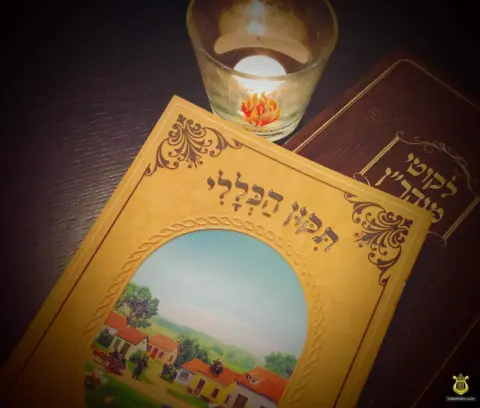
Tikkun HaKlali - the Fundamental Rectification of Pgam HaBrit
Tikkun HaKlali is the fundamental rectification of Pgam HaBrit (the damage caused to one's covenant with the Almighty).
Pgam HaBrit refers to all types of transgressions of the Torah laws governing a person's behavior in matters of intimacy (adultery, marital infidelity, wasteful emission of seed, violation of the laws of family purity).
The Zohar HaKadosh states that it is precisely in this area that a person's main test in this world lies.
And if a woman violates the laws of nidda, the child born from that union is also drawn into the sin of Pgam HaBrit. That is why Rabbi Nachman insists that Tikkun HaKlali also helps women and children, and advises that they read it as well.
Great is the reward of one who reads it with focused intention, but even simple reading brings benefit. It is important to read it in order and without interruption. It is preferable to read it during the day, but it may also be read at night.
"Know and believe that anyone can be pulled out of the mud, even if he has buried himself in it - we will pull him out".
"Through the rectification of this sin, the righteous Mashiach will come and gather our scattered ones".
"It is difficult for a person to rectify each specific sin with all its numerous circumstances, and it is impossible to fully rectify it, since every sin contains an immeasurable multitude of details requiring rectification ... because there are places so narrow and subtle that no rectification (tikkun) can penetrate them except for the Tikkun HaKlali". (Rabbi Nachman of Breslov)
Interestingly, the gematria of the word Tehillim = 485 - תהלים 400+5+30+10+40
The gematria of the name Lilit לילית together with the five letters of her name is also: 30+10+30+10+400+5 = 485.
The correspondence between these gematrias indicates that there is a power in the recitation of Tehillim that releases drops of seed captured by the forces of impurity as a result of "keri" from their grasp. The rectification for a person who has experienced "keri" (emission of seed) during sleep, G-d forbid, is to recite, on that very day it happened, 10 psalms from the Book of Tehillim, since there is a power in reciting Tehillim to release a drop of seed from under the dominion of the impure shell that has seized it. For the word Tehillim has the very same gematria as Lilit (together with the 5 letters of her name).
And therefore one should recite 10 psalms corresponding to 10 words: Bracha, Ashrei, Maskil, Shir, Nitzuach, Nigun, Tefila, Hodu, Mizmor, Halleluyah. (Rashi on Pesachim) Since there are 10 types of melodies, which correspond to 10 types of song mentioned in the Book of Tehillim, 10 types of pulse, 10 musical notes, and so on - as brought in the Zohar HaKadosh (6).And there is a power within each of these 10 songs to nullify the power of impurity.
For the word Ashrei, for example, means sight and gazing, which is the opposite of the aforementioned impure shell, which primarily draws its power from the corruption of the power of sight, as it is said: "And his eyes grew dim...", which alludes to the curse identified with Lilit, as our sages of blessed memory explain. (Tikkunei Zohar, Tikkun 44, page 79b)
It turns out that she draws her power primarily from the corruption of the power of sight. And the song Ashrei, which points to sight, is the opposite of this impure shell.
Likewise, the word Maskil (one of the 10 mentioned above) represents the power of intellect (sechel). And this power is capable of breaking and subduing the power of impurity that opposes it and seeks to bring a person to the loss of his mind. Therefore its name is Koach HaMeshakel, sharing the same root as the word Sechel, but opposite to it in meaning: "the power of destruction", as brought elsewhere.
The word Halleluyah represents the power of holiness, meant for praise and admiration. Through this power, a person praises the Almighty and marvels at His greatness and His deeds, which leads to a state of endless joy. This power is capable of breaking and subduing the opposing power of impurity Yalala, (the melody of grief and the sense of emptiness). Its name sounds similar to the word "halleluyah", but is opposite to it in meaning.
And know that the 10 types of song mentioned there, which oppose the damage mentioned there, are indicated by the following verses:
- Bracha (blessing): "I will bless the L-rd who has guided me, also my conscience admonished me in the nights". (Psalm 16:7)
- Ashrei (happy is): "Happy is he whose transgression is forgiven, whose sin is pardoned". (Psalm 32:1)
- Maskil (understanding, instruction): "A prudent wife is from the L-rd". (Mishlei-Proverbs 19:14)
- Shir (song): "And in the night His song is with me". (Psalm 42:9)
- Nitzuach (leading, conducting): "For the Leader. Destroy not…". (Psalm 59:1)
- Nigun (melody): "I remember my melody in the night". (Psalm 77:7)
- Tefila (prayer, unsalted): "Can that which is unsavory be eaten without salt?" (Job 6:6)
- Hodu (give thanks, hod - splendor): "Lest you give your splendor to others". (Mishlei-Proverbs 5:9)
- Mizmor (psalm, zmirot - songs): "Who gives songs in the night". (Job 35:10)
- Halleluyah (praise the L-rd): "A G-d-fearing woman - she shall be praised". (Mishlei-Proverbs 31:30)
"When my days come to an end and I depart from this world, I will intercede for anyone who comes to my resting place, reads these ten psalms, and gives charity. However heavy his transgressions may be, I will do everything to save and cleanse him... I am certain of everything I say. But most of all, I am certain that these psalms help with a special power. Here are their numbers: 16, 32, 41, 42, 59, 77, 90, 105, 137, 150... This is the Tikkun HaKlali - the general rectification. Every sin has its own rectification. But this is the general rectification." (Rabbi Nachman of Breslov)
(From the collection "Tikkun HaKlali" of Rabbi Nachman of Breslov)