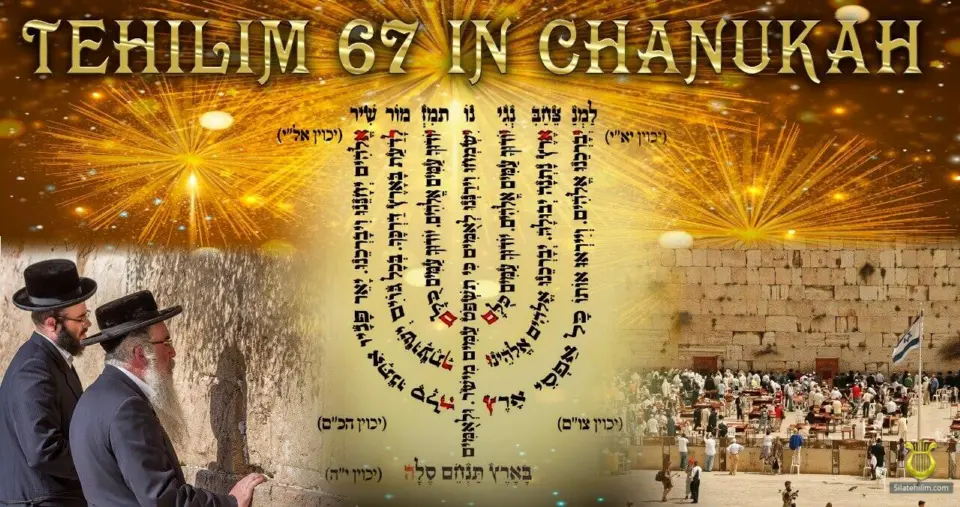
Tehillim 67 in the Form of a Menorah – Segulot of the Kabbalists
Rabbi Eliezer of Worms asserts that
“David HaMelech composed this psalm through Ruach HaKodesh, and it contains great and wondrous secrets and allusions. It is written in the form of a Menorah: three verses on the right, a long verse in the middle, and three verses on the left.”
He also mentions the importance of having Tehillim 67 written in the form of a seven-branched Menorah, like the one that stood in the Temple.
The Kabbalists teach that the Holy One, blessed be He, showed this psalm to David through Ruach HaKodesh, written in a special way in the form of a Menorah. He also showed it to Moses during the vision of how the Menorah was to be made.
Rabbi David Abudraham likewise points out that this psalm became known as the
“Psalm of the Menorah”, since it contains seven verses corresponding to the seven branches of the Menorah.
Tehillim 69 also contains 49 letters, corresponding to the knobs, cups, and flowers on the seven branches of the Menorah, which together number 49. In addition, the first verse contains four words, corresponding to its tongs and trays, of which there were two pairs.
The book
“Menorat Zahav Tahor” by Rabbi Chaim Bechner cites numerous segulot associated with reciting this psalm in the form of a Menorah:
1. “The Sages promise that no evil decree will befall those who recite this psalm in the form of a Menorah every day at dawn. This will be as precious to the Creator as if they had lit a lamp in the Temple, and they will be promised the World to Come.”
2. In his works,
Rabbeinu Chida describes numerous segulot associated with reciting the
“Psalm of the Menorah”, whose reward is great. If one recites it in the form of a Menorah written on parchment (klaf) before finishing the Amidah, it is a segula for protection during travel. He also states that King David, when setting out to war, would concentrate on the secret of the Menorah. Thus, he overcame his enemies, who literally fell before him, as described here:
Tehillim 67 – The Secret of King David’s Shield
3.
Ben Ish Chai (Parashat Vayigash) teaches that the 67th psalm in the form of a Menorah should be before the reader's eyes in the same orientation in which it stood in the Temple—not horizontally (for example, by tilting the book). If there is no image of the psalm in the form of a Menorah, it is sufficient to envision it before oneself.
4.
The Book of HaRokeach states that it is a great segula to write Psalm 67 in the form of a Menorah on the Aron Kodesh of a synagogue, since it protects the community from evil decrees.
5. Furthermore,
the Zohar HaKadosh states that Psalm 67, written in the form of a Menorah on the Aron Kodesh and recited by members of the community whenever the Torah is taken out, is a segula for protecting the city.
6. One who recites Psalm 67 from Rosh Chodesh Kislev opens his mazal during this month.
(“Sila Tehillim” translation from the “Hevrat Pinto” website, based on Rabbi David Hanania Pinto Shlita – copying is prohibited without citing a link to the website)
Was this helpful?
99% of readers found this article helpful (72 votes).
Please note: some articles on our site contain the holy Names of the Almighty. If you print these articles, they may not be thrown away or destroyed. Please handle printed copies with care and respect.