The Secret of “Shema Yisrael” in Parashat Vayigash
The Secret of “Shema Yisrael” in Parashat Vayigash
- “And He said: I am G-d, the G-d of your father; do not be afraid to go down to Egypt, for I will make you there into a great nation. I will go down with you to Egypt, and I will also surely bring you back; and Yosef shall place his hand on your eyes.”(Vayigash 46:3–4)
The holy Zohar says that this pasuk contains the secret of the prayer “Shema Yisrael”—the “sod of Shema Yisrael.”
When Yaakov fell asleep on his way to Egypt, Hashem showed him the entire picture of the exile that awaited his descendants.
Yaakov was horrified by what lay ahead for his children.
Seeing Yaakov’s fear, Hashem said to him: “Do not be afraid… I will go down with you…”The Admor of Tsanz/Klausenburg, Rabbi Yehuda Yekutiel Halberstam and Rabbi Meir Simcha of Dvinsk, in Meshech Chochmah, offer a stunning commentary on this pasuk. They explain that every day we recite: “Shema Yisrael, Hashem Elokeinu, Hashem Echad.”
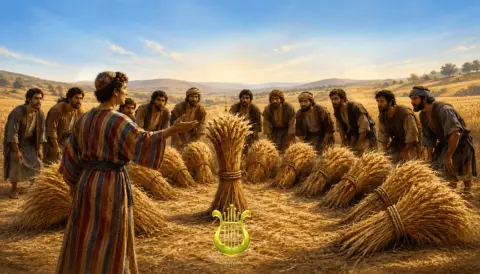
The Midrash relates that when Yaakov sensed that death was approaching, he called his twelve sons to him. When he realized that he had lost his prophetic gift and could no longer tell them what awaited them, he became frightened: were all twelve sons prepared to follow the path of serving the One G-d? After all, Avraham had an unworthy son, Yishmael, and Yitzchak, Yaakov’s father, had Esav. Yaakov’s sons understood what was troubling their father, and in order to dispel his doubts, they cried out in unison: “Shema Yisrael, Hashem Elokeinu, Hashem Echad”. In other words, not one of them would stray from the path of faith in the One G-d.
When Yaakov heard these words, he joyfully exclaimed: “Baruch Shem Kevod Malchuto LeOlam Vaed!”—as an expression of gratitude to the Almighty that none of his sons had proved unworthy.
- “Shema, Yisrael”(listen, Israel)—they said, addressing their father, Yisrael.
- “Hashem Elokeinu”—Hashem (merciful), Elokeinu (the Judge)—that is, “Listen, Israel: the merciful G-d is the Judge.”
The two Sages ask: where did “Elokeinu” disappear to in the second part: “Hashem Echad” (G-d is One)?
If the two components of the prayer “Shema” represent two attributes of Hashem—Merciful and Judge—why is the second attribute absent from the second part?
The essential meaning of “Shema Yisrael”, the Sages explain, is that the Creator is—now—both merciful and the Judge. Merciful—He loves and cares for us; Judge—He judges and repays each person according to his deeds.
In “Shema Yisrael”, we proclaim that the Hashem who is present now, together with Elokeinu(the strict Judge, who punishes and repays according to one’s deeds), will in the end be only Hashem(the One who does good).
When we are in pain, it may seem that there is only judgment—that there is only Elokim. But this pain is not pain for its own sake; it is pain for the sake of goodness. In the end, there will be only goodness—only Hashem.
This is the essence of “Shema”—it is a declaration of faith: in the end, we will see that the One who is now both Hashem(goodness) and Elokeinu(judgment) will, in the end, be only Hashem(goodness).
But not everyone merits seeing this during his lifetime.
For 22 years, Yaakov could find no consolation, because there is no comfort for one who mourns someone who is alive.
And so Hashem promised him, for all the suffering Yaakov had endured because of Yosef, that he would find repose through Yosef—and that Yosef himself would close his eyes. In other words, during his lifetime he would see goodness in the end.
(Rav Benzion Melamed, based on a lesson on “Tomer Devorah”)
Was this helpful?
100% of readers found this article helpful (32 votes).
Please note: some articles on our site contain the holy Names of the Almighty. If you print these articles, they may not be thrown away or destroyed. Please handle printed copies with care and respect.
Material from our site may be copied for the purpose of spreading Torah, provided a link to Silatehilim.com is included. Any use of the site's material in print publications or for commercial purposes is prohibited without the rights holder's consent.