Pitum HaKetoret – Segulot
As stated in the holy book, the Zohar HaKadosh, only the Ketoret (Incense) shatters impurity, and nothing brings such joy to G-d as the Incense. It also nullifies witchcraft and evil forces in the home. Even fragrances and smoke of incense prepared by people can nullify witchcraft—how much more so the Ketoret. (Zohar, Vayikra 11a)
The Ketoret was burned in the Temple courtyard on a small golden altar. (Zohar, Vayakhel)
G-d established the following law: anyone who looks at the text and reads the passage about the Incense every day will be saved from harmful things and witchcraft in the world. He will be saved from all misfortunes, evil thoughts, harsh judgments, and death. No harm will befall him that day, because the impure force cannot rule over him. However, one must have the appropriate kavanot when reading this passage. Reading the text describing the preparation of the Ketoret correctly, precisely, and with kavanah is considered equivalent to performing the mitzvah in the Temple. (Zohar, Vayakhel 218b)
Rabbi Shimon said: “If people knew how highly the act of burning the Incense is valued by Hashem, they would take every word of this passage and set it as a crown upon their heads, like a golden diadem. And if a person has the appropriate kavanot every day while reading this prayer, he has a share in this world and the World to Come. Death will be removed from him, and he will be saved from all judgments of this world, from evil forces, and from the judgment of Gehinom.”
When the smoke of the Incense rose in a column, the Kohen Gadol saw within it the letters of the secret of the Holy Name; he saw them fluttering in the air and rising upward like a pillar. Then many holy chariots surrounded the Incense on every side as it ascended in Light and Joy, bringing delight to the One who takes pleasure in it. The Ketoret binds the knots—that is, it unites everything above and below. It has already been established that this purifies a person from the yetzer hara (the impure force).
The Ketoret means
“a knot” in Aramaic. Aaron was distinguished by his special concern for shalom among the Jewish people—he reconciled them and bound them together. Therefore, measure for measure, he and his descendants were granted the privilege of binding the Jewish people to G-d forever.
Rabbi Abba said: “The Incense is the loftiest offering, through whose power the higher and lower worlds are blessed.” (Zohar on Vayakhel, Sulam, Tzvi Nisan-zon)
Malach HaMavet (the Angel of Death) loses his power over one who studies the order of the preparation of the Ketoret every day.
Aaron used the Ketoret to stop the further spread of the epidemic. (Bamidbar 17:12–13)
Reading the Ketoret provides protection from illness and accidents.
Even those who are childless may merit a child if they read the entire text of Pitum HaKetoret three times a day. (Ramban, Bamidbar 3:39)
The word “Ketoret” is an acronym for the words Kedushah (holiness), Taharah (purity), Rachamim (mercy), and Tikvah (hope). Thus, the Ketoret gave the soul holiness, purity, mercy, and hope—all that sustained the Jewish people. (Tanchuma, Tetzaveh 14)
One who recites the entire text of the mitzvah of the Ketoret during the morning prayer, Shacharit, keeps death away from his home. (Zohar on Pinchas)
Magical forces are activated for one who knowingly recites the text describing the preparation of the Ketoret, with understanding and without mistakes.
“Both men and women are obligated to study the entire order of the Ketoret, and to read and recite it with complete understanding, in order to merit the wondrous gifts and healing powers embedded in the text.”
Segulot of Pitum HaKetoret
- Nullifies epidemics and various illnesses—as Aaron used the Incense to stop the further spread of the epidemic. (Bamidbar 17:6–15)
- Saves one from subjugation by other kingdoms.
- Blessing rests in the hands of the one who reads Pitum HaKetoret.
- One will be saved from the judgment of Gehinom.
- Drives away klipot (husks/shells), chitzonim (foreign, harmful forces), and the sitra achra (the other side—the impure force).
- Nullifies witchcraft.
- Drives away evil thoughts.
- One who reads Pitum HaKetoret merits both worlds: this world and the World to Come.
- Drives dinim (judgments) away from oneself.
- One will be pleasant and favorably received by everyone around him.
- A segula for wealth.
- The Ketoret “gladdens the heart of the Holy One, blessed be He, and frees the world from His anger and punishment.” (Zohar, “Vayikra”)
- The Ketoret nullifies the death sentence of the “Heavenly Court,” together with the korbanot, the offerings in the Temple, which were purchased with the machatzit ha-shekel—the half-shekel that every Jew contributed to the treasury of the community of Israel once a year. (Zohar Chadash, “Ki Tisa”)
- Malach HaMavet, the Angel of Death, loses his power over one who studies the order of the preparation of the Ketoret every day. (“Mi-Za'av Umi-Paz”)
- Ten Jews (a minyan) who study Pitum HaKetoret at the bedside of a sick person help him overcome illness quickly, and even overcome death. (Ma'avar Yabok 4:5)
- Those who are childless may merit a child if they read the entire text of Pitum HaKetoret three times a day. (Ramban, Bamidbar 3:39)
- The text of Pitum HaKetoret is not recited at night, before dawn.
- Reciting this text daily helps a person gain respect in the eyes of others while also freeing him from oppression by those in power and by non-Jews. (Sefer Segulot Yisrael, “Kuf”)
- One who is concerned for his well-being should fulfill this mitzvah three times a day. (Sha'ar HaKavanot)
- It is good to give tzedakah each time before reading the Ketoret.
- In difficult situations, read Pitum HaKetoret three times in each of the four corners of the room in which you are praying.
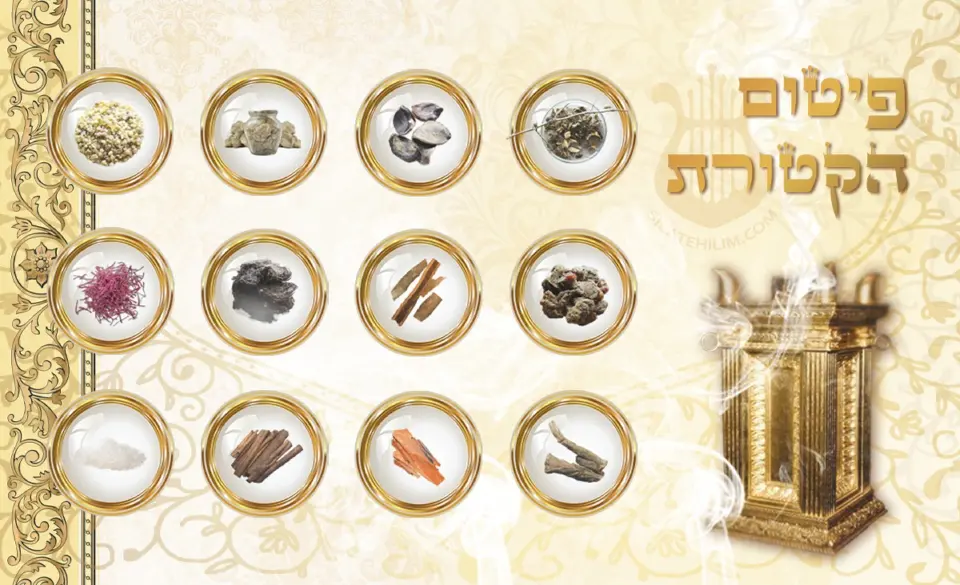
- On Ta'anit Esther, read Pitum HaKetoret, setting aside a prutah with each mention of one of the eleven ingredients of the Ketoret. (Rabbi Yeshayahu Pinto)
- Read it during epidemics, because it was through this very prayer that Aaron HaKohen stopped the plague. (Bamidbar 17:6–15)
Fortunate is the one who aligns his intentions, thoughts, and actions with the word of the Creator: “And he shall be like a tree planted beside streams of water, which yields its fruit in due season, and whose leaf never withers; and in all that he does, he shall prosper.” (Tehillim 1:3)
“Pitum HaKetoret” from the sefer “Mi-Za'av Umi-Paz” by Rabbi Pinchas Zabihi
“Pitum HaKetoret” According to the Sefer “Mi-Zahav Umi-Paz” by Rabbi Pinchas Zabihi
The order of “Pitum HaKetoret” according to the Arizal—the prayer text with transliteration
The Order of "Pitum HaKetoret" According to the Arizal - Prayer Text with Transliteration
(Yeshiva “Kise Rahamim” for “Sila Tehilim,” Rabbi A. Davidov, “The Letters of Our Life”)
Was this helpful?
100% of readers found this article helpful (83 votes).
Please note: some articles on our site contain the holy Names of the Almighty. If you print these articles, they may not be thrown away or destroyed. Please handle printed copies with care and respect.