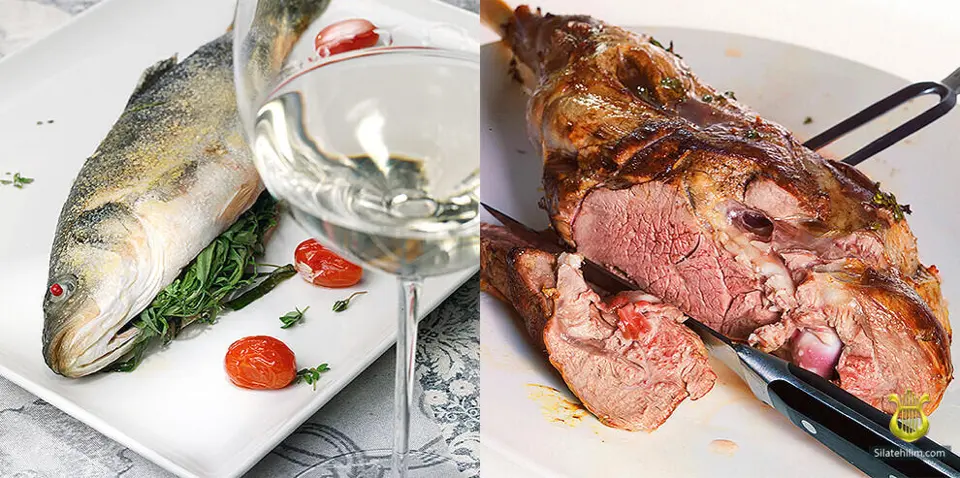
The Prohibition Against Eating Fish and Meat Together — Jewish Prohibitions of Our Grandmothers
One detail stands out clearly from childhood memories: every meal always began with appetizers and fish; then the plates were cleared and replaced, and meat dishes were served.
As it turns out, this tradition has a basis: Judaism prohibits mixing certain types of food.
One such prohibition is the prohibition against eating fish with meat together. They may not be eaten at the same time, but it is permitted to eat one after the other; fish may be eaten before meat, as is customary.
The commentators explain that meat and fish differ in their basic properties: fish cools the body (it contains iodine, which dissolves fats), while meat is rich in fats and warms the body; this combination is dangerous, primarily in the areas involved in chewing and swallowing food.
Between eating fish and meat, one must eat and drink something or rinse one's mouth; the plates and utensils must also be changed.
Sephardic Jews are especially careful to perform mayim emtsa'im—[intermediate] handwashing before beginning to eat meat.
Shulchan Aruch also speaks of the prohibition against eating fish and meat together.
Kosher animals have two aspects: a neutral one (their meat was used as an offering in the Temple) and a base one (blood, whose “biological” composition reflects the animal's “beastly” nature; for this reason, it was removed from the meat before the offering was brought in the Temple).
Fish in our diet strengthens our animal nature, but on a different basis than meat. Preparing fish for consumption does not require shechitah (a special method of slaughter) or the removal of blood.
Fish live in a special environment—they swim in the sea and other bodies of water. According to Jewish tradition, water symbolizes the Torah, or Chesed (pure kindness). There are no evil inclinations in an aquatic environment. The fish we eat spiritually elevates our physical desires, and they are accepted by the Almighty. That is why fish is customarily served during Shabbat meals.
Chazal teach that those who eat meat and fish simultaneously may develop the illness tzara'at, which helps explain the nature of this prohibition.
Other Jewish sources explain that tzara'at arises from spiritual causes. Among them are slander and gossip... The Talmud lists seven causes that can lead to the appearance of tzara'at (Tractate Arakhin, folio 16). All of them are connected with violations of commandments governing relationships between people (theft, arrogance) or those that restrict a person's conduct in serving the Almighty (blasphemy, and false oaths invoking His name). But food and violations of the laws of kashrut are not mentioned here at all.
According to the Torah, anyone showing signs of tzara'at must be isolated and, until fully healed, is required to live outside the Jewish camp (Vayikra, ch. 13, v. 46). Maharal, in his book Chiddushei Aggadot, explains that a person afflicted with this illness is guilty of disrupting the harmony of relationships between people and therefore should not live among them.
Food greatly influences a person's spiritual state: it becomes life energy and shapes a person's spiritual character. That is why it is so important to observe this prohibition.
(Compiled by the site's editorial staff based on articles by Rav Yitzchak Yaakov Fuchs and Rav Eliyahu Essas, evrey.com)