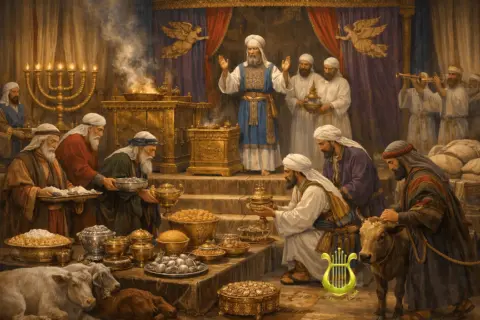
- “Veyekar pidyon nafsham” — (and precious is the redemption of their souls).
“Pidyon Nefesh” literally means the redemption of the soul. What does this mean? The Talmud contains the concept of “tinok shenishbah” — (a child taken captive). Consider a real-life situation: enemies capture a Jewish child and raise him as a non-Jew. When he returns to his people many years later, many Jewish values will be foreign to him. In our generation, the overwhelming majority of our long-suffering people have found themselves in the role of that captive child. Millions of Jews throughout the world have been cut off from their roots. If we look realistically and soberly at the situation, almost our entire people today has found itself in the role of the captive child. The body has been given freedom, while the soul is held captive. It has been severed from its source. The connection with the Creator has been disrupted. The soul suffers, weeps, and cries out. But as a rule, we do not hear it, being preoccupied with the constant pursuit of this world's illusory pleasures. The soul tries to cry out to us, but we brush it aside. Sometimes the Creator takes pity on a person and sends signals that cannot be ignored. But in most cases, the ominous signals that G-d sends a person may be perceived as misfortunes or failures: illness, unemployment, family conflicts, debt, legal proceedings, problems with children, and so forth. At first, we try to deal with the difficult situation ourselves; often, a person is forced to admit that he cannot cope with it by his own efforts. We need help from Above. How can we receive it? The most important and effective means is heartfelt prayer. Sometimes our prayers are answered immediately, out of compassion. Often, we are required to show patience and persistence. And gratitude. And the ability to recognize the small miracles that G-d constantly sends us — even when we are in distress. But there are situations in which we are forced to admit that our own merits are insufficient for us to merit salvation. The help of a tzadik is needed — an intermediary who will lift our prayer to the Creator. The Shulchan Aruch states that when, G-d forbid, one of a person's relatives falls ill, one should turn to a Torah scholar so that he will pray for the sick person. However, sometimes the tzadik sees that his prayer alone is not enough. The person on whose behalf he is praying must also take part. It is known that a person's life force is connected with blood. In Hebrew, as in the Holy Language of the Torah, “blood” is “dam,” while the plural is “damim.” The same word in Aramaic, the language in which the Talmud is written, is “damim” and means “money.” The Sages saw the following connection: When a person gives a substantial sum of money to charity — an amount that is difficult for him to part with — it is as though he is giving his blood, with which his soul is connected. Thus, charity has the power to redeem the soul — to save it from misfortune. Needless to say, much depends on the tzadik to whom the money is given. It is known that Rabbi Chaim of Tzanz (who himself lived in great poverty and did not take a single penny for himself from the donations given to him) often insisted that the donations be substantial. When one of the Chassidim asked him, “Rebbe, why do you want me to donate such a large sum? You know how much I love money!” the tzadik replied, “No, I am the one who loves money, because I know how it must be spent!” In his talks (Sichot HaRan, 175), Rabbi Nachman of Breslov teaches: “there are 24 Heavenly Courts, and only a great tzadik knows how to effect a soul's redemption in each of them. Rabbi Nachman transmitted this power to effect “Pidyon Nefesh” — the redemption of the soul — to his closest disciples. Rabbi Yitzchak Ginsburgh teaches that when one wishes to ask something of the Rebbe as a tzadik, one writes a note known among Chabad Chassidim as a PaN. PaN is an abbreviation of two Hebrew words: “Pidyon Nefesh”, literally meaning “redemption of the soul,” when a Chassid asks the Rebbe, or a tzadik, to pray on his behalf. However, the same letters begin the words “Pirsumei Nisa” (“publicizing the miracle”). Therefore, when a person tells others about miracles, it is akin to writing a PaN to the Rebbe. When a PaN is written, in the merit of the PaN the tzadik arouses G-d's great compassion, and G-d performs a miracle. Then everyone has an obligation to tell about the miracles G-d performs. There are two PaN's — “panim” — one has “life in the light of the King's countenance” (“pan” (פן) — plural “panim” (פנים), meaning “face”). It seems that “Pirsumei Nisa” is the right pan, while “Pidyon Nefesh” is the left pan — let the discerning understand. Thus, there is panim — two panim — and since the gematria of the word “pan” equals the gematria of the word “ayin” — (eye) — there are also two eyes. As we see, among Breslov Chassidim this is a prayer, while in Chabad it is a note to the Rebbe. In any case, it is a request to our tzadikim to intercede for us before the Creator, so that He will show compassion to the petitioner and his family.
Tehillim 49 — “Pidyon Nefesh” and the 24 Heavenly Courts
Tehillim 49 — “Pidyon Nefesh” and the 24 Heavenly Courts
Tehillim 49:9
Was this helpful?
100% of readers found this article helpful (85 votes).
Please note: some articles on our site contain the holy Names of the Almighty. If you print these articles, they may not be thrown away or destroyed. Please handle printed copies with care and respect.
Tags: Segulot, The Hidden Meaning of Tehillim, Tehillim 49, Tehillim for Pidyon Nefesh, Pidyon Nefesh by Rabbi Nachman of Breslov, 24 Heavenly Courts