Nails—Our Grandmothers’ Jewish Prohibitions
When we were children, our grandmothers forbade us to cut our nails at night and on certain days. They also would not let us scatter the nail clippings. It is interesting to see what our Jewish sources say about this.The Ben Ish Chai writes that nails symbolize growth and reproduction (since they continue to grow even in extreme old age). Therefore, it is customary to look at them by the light of the Havdalah candle (the ceremony separating the holy from the weekday, performed at the conclusion of Shabbat and festivals)—this is a good sign.
On the other hand, nails that extend beyond the flesh are a source of life energy and strength for the forces of impurity. Therefore, they should always be cut before Shabbat (the Ninth of Av).
Cutting nails symbolizes interrupting growth, reproduction, and “fruitfulness.” Therefore, spiritual forces “attach themselves” to nail clippings, causing a woman who steps on them to suffer a miscarriage. The holy Zohar states that 125 types of impurity, bound to the level of the mighty Serpent, descend into the world. Twenty-seven of the foremost among them settle in women and cleave to them. Woe to anyone who approaches her during her time of impurity (niddah). For one who approaches her gives form to the blemish Above. Because of this sin, the mighty Serpent is aroused Above and casts impurity into a place where it is not needed. It joins with the Female and causes its hair to multiply in the Male, while the Female becomes defiled, her hair grows, and her nails increase. Then judgments begin to awaken throughout the universe, and everything becomes defiled. Regarding this it is written: “For he has defiled the Sanctuary of the L-rd.” (Numbers 19:20) The Sanctuary of the L-rd has been defiled by the sins of mankind. It is explained: What is the meaning of the verse, “And I will place enmity between you and the woman”? (Genesis 3:15) The Serpent introduced 24 types of impurity into the Female when it joined with her, corresponding to the gematria of the word “enmity” = 24. Twenty-four types were awakened Above and 24 below. The hair grew, the nails increased, and then judgments were awakened throughout everything. When a woman wishes to purify herself before the mikveh, she must cut the hair that grew during the days of her impurity and trim her nails, together with all the dirt beneath them. For this has been taught among the Mysteries of Impurity: the impurity in the nails awakens another impurity. They should therefore be carefully concealed. One who destroys them is, as it were, awakening Mercy in the universe, and it has been taught that a person should not leave behind a reminder of the instruments of evil. For we have learned that 1,405 types of evil cling to the impurity introduced by the mighty Serpent, and all of them cling to the impurity of the nails. Let him therefore destroy this impurity and the nails upon which it has left its imprint. One who steps on them with bare feet or while wearing shoes may harm himself. Rabbi Shimon bar Yochai said: “There are five things through which a person brings about his own death: Eating peeled garlic; eating a peeled onion; eating a peeled egg; drinking from a vessel that remained uncovered throughout the night; Spending the night in a cemetery; cutting one’s nails and scattering them (because of the danger that a pregnant woman may step on them and miscarry).” (Babylonian Talmud, Niddah 17a)The Talmud states: "A chasid burns his nail clippings, a tzadik buries them, and a rasha (sinner) scatters them".
The Talmud explains that the need to burn or bury nail clippings is due to the danger posed by scattered nails: if a pregnant woman steps on them, she may miscarry.
Rashi writes that it is preferable to burn the nails rather than bury them, since buried nails may accidentally be dug up and scattered. Rashi explains that for this reason, one who burns them is called a chasid (a higher degree of piety), while one who buries them is called a tzadik.
However, it is important to know that there is no need specifically to bury nail clippings. They may also be gathered into a bag and thrown into a garbage bin. Better still, they can be thrown into a toilet and flushed away (since in this case there is no concern that they will later be scattered, making this method somewhat similar to burning).
As for hair, there is no prohibition against scattering it, so there is no need to burn or bury it. Nevertheless, it is preferable to flush it down the toilet.
Why Should a Pregnant Woman Be Wary of Nail Clippings?
The Talmud (in Tractate Niddah 17a and Tractate Moed Katan 18a) says that one should be careful not to scatter nail clippings in places where women frequently go. (Where women generally do not go—for example, in a beit midrash, a men’s bathhouse, and the like—there is no need for such caution.) A pregnant woman may unknowingly step on them and miscarry. The Talmud further states that if the nails are moved from the place where they originally fell, they no longer cause harm. Therefore, the Perishah writes that if nail clippings are scattered where women frequently go, they should at least be moved from that spot (with a broom or the like). However, if they are moved to another place in the same room, they remain dangerous.
May a Jew Cut His Fingernails and Toenails on the Same Day?
Rabbi Yosef Karo writes in Magid Meisharim (Proverbs 23:6) that an angel (a maggid—as is known, Rabbi Yosef Karo had an angel who would periodically appear to him, guide him, and teach him Torah) told him that one should not cut one’s fingernails and toenails on the same day. He also added that toenails should be cut on Thursday and fingernails on Friday. This ruling is cited by the Magen Avraham (introduction to siman 260) and, following him, by the Mishnah Berurah (260:6).
However, Rabbeinu Chida (Rabbi Chaim Yosef Azulai, 1724–1806) writes in Machazik Berachah (paragraph 4): “From what is stated in the book Shaar HaKavanot, it is evident that the Arizal was not concerned about cutting fingernails and toenails on the same day.” Therefore, according to the Chida, this is permitted.
Since the Mishnah Berurah cites only the words of the author of the Magen Avraham, it is clear that one should try not to cut fingernails and toenails on the same day. However, if this is very difficult, one may presumably rely on the Chida’s opinion. I heard that Rav Elyashiv permitted a woman who found it difficult to cut her fingernails and toenails on different days to cut them on the same day.
(Rabbi Reuven Kuklin)
Why Is It Important to Cut One’s Nails Before Shabbat?
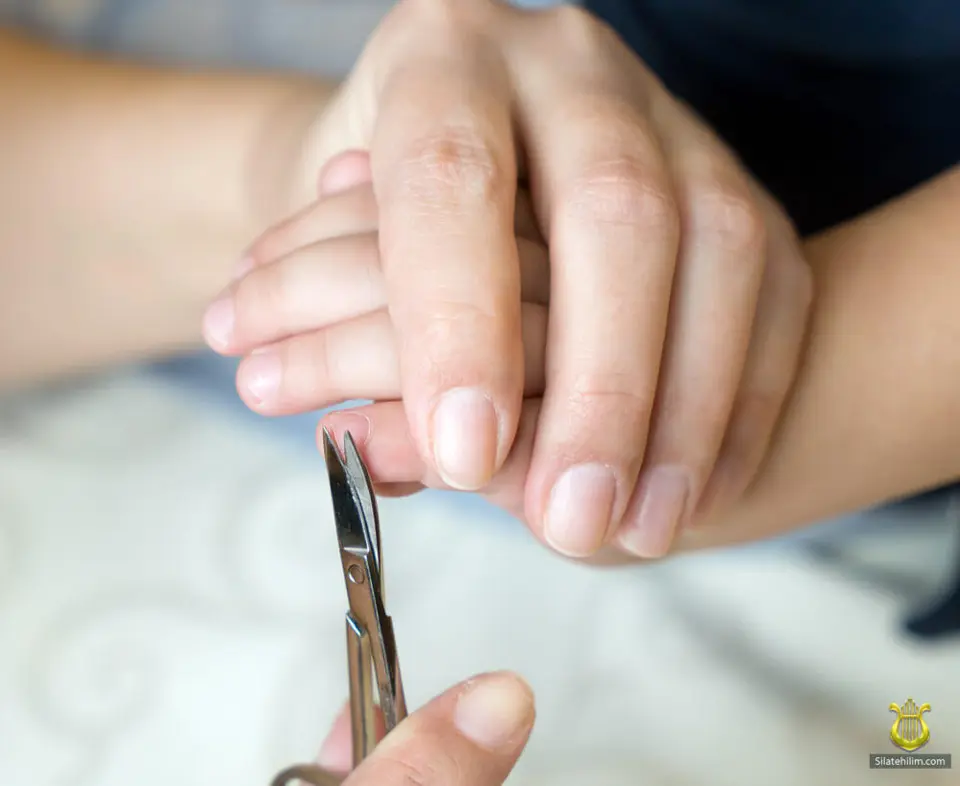
It is a person’s obligation to cut his nails on the eve of every Shabbat, and this should be done in honor of Shabbat. Rema wrote that nails should not be cut in their natural order, from one finger to the next. Rather, begin with the left hand: start with the fourth finger (the ring finger), proceed to the index finger, and so on. The overall order is 4-2-5-3-1 (where 1 is the thumb, 2 the index finger, and so forth).
Then, on the right hand, begin with the index finger, proceed to the ring finger, and so on. The overall order is 2-4-1-3-5. Some authorities do not require strict adherence to this rule. The Mishnah Berurah notes that one should nevertheless try to follow it:
on the left hand: 4-2-5-3-1 (where 1 is the thumb, 2 the index finger, and so forth) on the right hand: 2-4-1-3-5One should try not to cut one’s nails on the fifth day of the week (Thursday), because cut nails begin to grow back on the third day when counting from the day they were cut. If they are cut on the fifth day of the week, they begin growing again on Shabbat, and therefore such nail-cutting is not considered to have been done in honor of Shabbat. Some authorities say that fingernails and toenails should not be cut on the same day, but that toenails should preferably be cut on the fifth day of the week (Thursday), and fingernails on the sixth day (Friday). Others, however, do not insist on this. In some communities, it is not customary to cut hair or nails on Rosh Chodesh, even when it coincides with the eve of Shabbat, because Rabbi Yehudah HaChasid instructed that this be avoided. Thursday is the first day from the time of cutting, Friday is the second day, and Shabbat is the third day. In such a case, one should have one’s hair cut on the fifth day of the week. Others say that if Rosh Chodesh falls on the eve of Shabbat, and one did not manage to cut one’s nails on the fifth day, one may nevertheless do so on the eve of Shabbat. For the prohibition against having long nails on Shabbat takes precedence over the usual custom of not cutting them on Rosh Chodesh.
(From the book “The Light of Shabbat”)
Why Is It Customary to Look at One’s Nails During Havdalah? The book Kaf HaChaim states that it is customary to look at the nails rather than at other parts of the body. One reason, according to the Arizal, is that the sign of blessing is imprinted on the hands. Nails grow quickly, and this is a sign of blessing (Rabbeinu Yonah). A hint of this custom is found in the Tikkunei Zohar, which says that Adam, the first man, was entirely covered with nail-like substance. The Holy Zohar on Nails: “Her nails, which allude to human sins, write, recording their sins with the intransigence of strict judgment. Regarding this it is said: ‘The sin of Judah is marked with an iron stylus, with a diamond point.’ (Jeremiah 17:1). A diamond writes and carves into stone, and hews it on every side. And the statement, ‘Her nails, which allude to human sins, writing and recording their sins with the intransigence of strict judgment,’ means that if one is not found worthy, the power of the attribute of judgment concealed in the nails is revealed. Since this attribute of judgment is revealed, they become hard. Regarding this it is said: ‘The sin of Judah is marked with an iron stylus, with a diamond point (literally: nail).’ For the point of ‘manula,’ contained and concealed in the nail, is called ‘the iron stylus.’ The point of ‘miftecha,’ revealed in the nail and ruling when Israel are worthy, is called ‘the diamond point (nail).’ And ‘the sin of Judah’ means that when they sin, these two points are revealed over them, and their sins are then marked both with ‘the iron stylus’ and with ‘the diamond point (nail).’ Since the point of manula is also revealed over them, they are immediately punished. However, concerning those who fulfill His will, it is said: ‘No tool of iron was heard in the Temple while it was being built.’ For the diamond cut everything, while the ‘tool of iron’—the manula—‘was not heard,’ because it was concealed. And it is said: ‘The diamond writes and carves (in stone)’—the emergence of katnut from the levels called stones—‘and hews it on every side’—giving it its form on every side during the gadlut of these levels.” The impurity of these nails signifies that all those who are not cleaved to the King’s body (guf), the middle line, but are cleaved to the left line and draw nourishment from the side of impurity when the Moon is in its diminution—the fullness they draw from the side of the nails (tzipornaim) passes to the side of this impurity, known as the impurity of the nails. (Zohar, Vayechi 287–288)