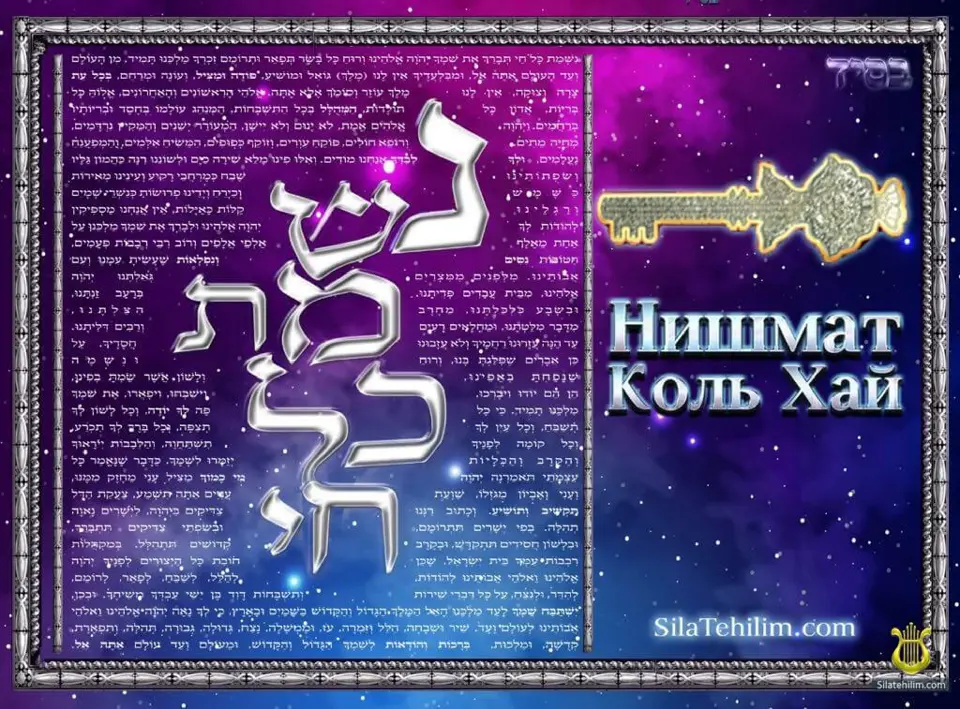
Nishmat Kol Chai after Shabbat Mincha – a segula for Parnassah
There is a segula to recite “Nishmat Kol Chai” after the Shabbat Mincha prayer (especially on holidays), as a special expression of gratitude to G-d for all the goodness He created on Shabbat, and also as a means of securing salvation in the future.
This is part of an ancient custom, which many people vowed to observe after being saved from danger, or as a prayer for salvation, as described in such books as Ben Ish Chai and Chemdat Yamim.
Shabbat Mincha
Reciting this prayer during Shabbat Mincha (and sometimes on holidays as well) is part of the tradition of giving thanks for the Shabbat that has passed.
Since the most pleasing and precious thing to Hashem is a prayer of thanksgiving, and “Nishmat” is one of His most beloved prayers of thanksgiving,
it should be recited at this special time—immediately after the prayer, when the prayer of Eliyahu HaNavi is accepted, at the time when the holy Shabbat and all its blessings are preparing to flow into the weekdays. In order to help preserve and receive all this, a gratitude-filled prayer that will find favor with Hashem is needed, on the level of “Nishmat Kol Chai.”
In other words, Mincha is the final and most powerful prayer of Shabbat. All the blessings of this holy day have been gathered, and we long to carry them over into the weekdays—but how?
Through expressing gratitude in advance—“Nishmat Kol Chai.”
The prayer “Nishmat” is a profound Kabbalistic prayer, acknowledging that all creations must thank their Creator.
Yishtabach
The Sages call even the blessing of “Yishtabach” exceedingly powerful and awe-inspiring. It contains 13 praises, corresponding to the 13 Attributes of Mercy, and they should be recited unhurriedly and melodiously, as praise of the King. (Rabbeinu Chida, in the name of the Ya'avetz, 18)
Rabbi Akiva Ber, in his siddur Avodat Bore Olam, calls “Nishmat Kol Chai” an awe-inspiring and great praise of G-d, comparable to the Song of Songs.
The gematria of “Nishmat Kol Chai” is 858, which is also the gematria of the expression “Kodesh Kodashim,” hinting at a connection with the holiness of Shir HaShirim.
Numbers
The prayer “Nishmat Kol Chai,” from the first word through and including “anachnu modim,” consists of 45 words.
These words carry the kavanah of the holy Name “Ma,” whose gematria is also 45.
From the words “Ve'ilu pinu” through “ve'im avoteinu”—a total of
50 words—this corresponds to the Shechinah, called by the Name “Mi,” in the aspect of Binah.
From the words “Milefan im miMitzrayim” through “takshiv vetoshia”—100 words. This corresponds to the wholeness of the entire Malchut of the Shechinah, which includes the ten sefirot, each of which is included within the ten—making 100 in all.
50 words correspond to the 50 Gates of Binah.
The 100 words (tevot) represent the completion and fullness of all ten sefirot (Chochmah, Binah, Malchut, Hod, and so on). They contain the various forces (kochot) and forms of light (orot) of all the sefirot.
“Each sefirah includes 10, and each of those ten contains another 10.
Therefore, for example, within the sefirah of Chochmah there are 100 forces, lights, and streams of abundance (shefa).
When a person studies or contemplates this with the proper intention (kavanah), he is blessed on all these levels of light, abundance, and blessing of that particular aspect (middah).
Thus there are ten qualities (middot) included within the ten sefirot.
And the Holy Shechinah is found in the world of Atzilut, in the sefirah of Malchut, and resides upon the Chariot (Merkavah).”
“Argaman”—4 AngelsThe Shechinah resides upon the Chariot—the Merkavah of “Argaman,” an acronym formed from the names of the angels:
Uriel, Raphael, Gabriel, Michael, Nuriel.
Michael corresponds to Chesed, Gabriel to Gevurah, Raphael to Malchut, and Uriel and Nuriel to Tiferet (half Chesed and half Din).
The Merkavah of “Argaman” is the Chariot of the Shechinah.
Incidentally, we encounter this word twice in Shir HaShirim (it is important to have kavanah for the names of the angels when reading it).
After the words and numerical levels 45 (Ma), 50 (Nun), and 100 (Kuf) are recited and directed with kavanah, the Holy Shechinah descends and takes its seat upon the four holy Chayot of the Chariot.
A hint to the four angels is contained in the expression:
“Befi—Yesharim… Tzadikim… Chassidim… Kedoshim,” where Yitzchak and Rivka are spiritually present—the angels dwell there.
Segula for Soldiers from Rabbi Eshel
When leaving home for military service, or before traveling to another country, place your hand on the mezuzah and say that when you return home safely, alive and well, bli neder, you will recite “Nishmat Kol Chai.”
(Based on a lesson by the student of “Matok MiDevash,” Rabbi Yitzchak Cohen)