Hannah’s Prayer – How to Reach the Heavens
Hannah was one of the seven women prophets mentioned in the Tanakh. She was the wife of Elkanah and the mother of the prophet Samuel. The name Hannah derives from the word
“chen”—grace. Hannah’s prayer contains
113 words—exactly the number of times the word
“lev” (
heart) appears in the Torah.
Drunk?
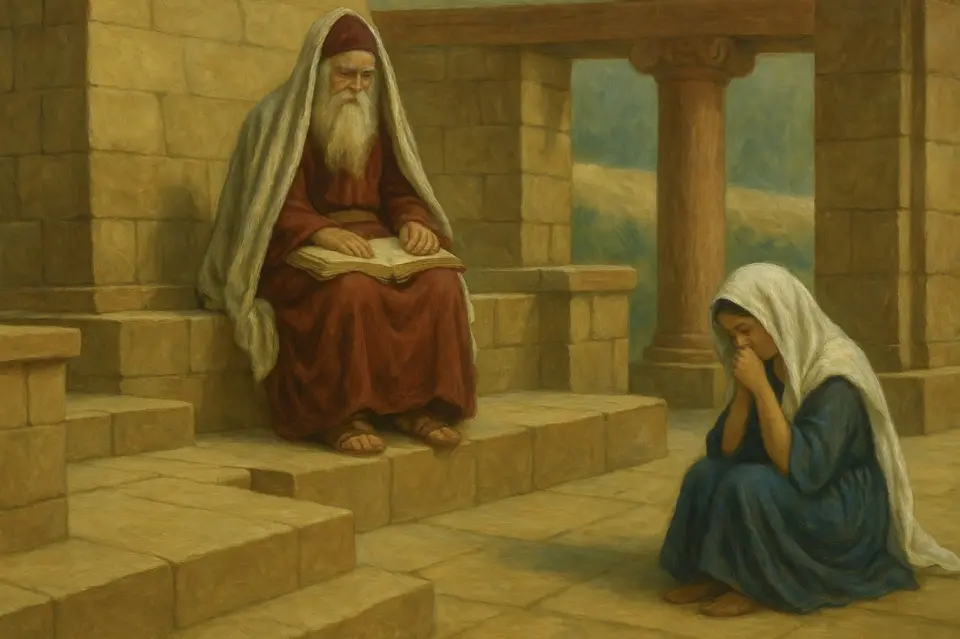
When Eli the High Priest saw Hannah praying, he decided that she was drunk (she was praying with trembling). Therefore, he consulted the Urim and Thummim, where the letters appeared:
Shin, Kaf, Resh, Hei—and by combining them, Eli the High Priest formed the word “
shikora”
(drunk)
And he asked Hannah:
-
“Are you drunk?”—to which Hannah replied:
-
“You have not read it correctly; you are mistaken. I am not drunk— not “shikora,” but “kesara” (the same letters)—like Sarah (childless). I have come to weep out my childlessness.”
A Woman’s Prayer
The Sages said that all the laws of prayer can be learned from the sincere prayer of one woman—Hannah, the mother of the prophet Samuel. The Talmudic tractate Berakhot devotes an entire page to the laws and moral principles derived from this prayer. May this serve as encouragement to us: one of the women of our nation was able to teach the entire people of Israel the laws of prayer, what arguments to present before the Almighty so that He will hear our prayers, and how to persevere without giving up. For Hannah, who was childless, was able to conceive through her prayer at the age of 130. Through her wisdom, she understood how one must pray to the Almighty: in a whisper, standing, and keeping four cubits away from those sitting nearby, among other things. With her feminine wisdom, Hannah understood how to appease the Creator and what arguments to use to plead with Him to send her a son. She said:
“Master of the Universe! Everything You created in a woman was created for a purpose: eyes are needed for seeing, ears for hearing, a nose for smelling, a mouth for speaking, hands for performing work, feet for walking, breasts for nursing... And these breasts that You placed opposite my heart—what are they for? Are they not for nursing? Then give me a son, and I will nurse him.”
How to Persuade the Almighty
What Hannah did is called
“victory over the Almighty.” Rabbi Nachman of Breslov teaches:
“For the conductor (la-menatzeach). A song. A psalm.” (Tehillim 66:1)
This means:
“Sing to the One whom they defeat (menatzchin), and He rejoices.”
“When a person speaks before the Holy One, blessed be He, presenting his arguments and requests, it is as though he wishes to defeat the Holy One, while the L-rd, blessed be He, derives pleasure from this. In order to receive this pleasure, He sends such words that make it possible, as it were, to defeat Him, for otherwise it would be impossible for a human being of flesh and blood to defeat the Holy One, blessed be He. Rather, the L-rd Himself sends the arguments with which He can be defeated.” (Likutei Moharan I, 119)
Rabbi Nachman teaches from this prayer: “When you need something, and the only way to obtain it is to speak with the Almighty, but you do not know what to say to Him—simply begin speaking with Him, and the Almighty Himself will send you the words you need. This is advice for anyone who does not know what to say to G-d. The Creator Himself will place persuasive words in your mouth—words you never expected from yourself. Then you will merit defeating the Almighty and receiving from Him the help you so greatly need.”
Sotah
Rabbi Yosef Dov Soloveitchik of Brisk (“Beit Ha-Levi”) explains that, in seeking to achieve her goal, Hannah resorted to an extreme measure: she threatened G-d that if He refused her—if He did not give her a child—she would seclude herself with another man in order to undergo the
“sotah” ordeal. In ancient times, this test was intended for women suspected of infidelity to their husbands; during it, G-d’s Name was erased from a parchment and dissolved in water. When the suspected woman—the
“sotah”—drank this water, the outcome depended on how she had actually behaved: if she was guilty of adultery, she faced a painful death; but if she was innocent, then, as compensation for the humiliation and fear she had endured, she was rewarded with pregnancy and gave birth to a son—this is the Torah’s promise. Hannah decided to invoke this promise. She said:
“L-rd, I am firmly resolved to do this. Since I will be innocent, You will have to give me a child, for You promised this in Your Torah, and You will never violate what is written in it.” The desperate prayer of a woman who dared to take a risk.
Hannah’s Arguments
And she said:
“L-rd of Hosts” (I Samuel 1:11)
- “Master of the Universe! Of all the hosts that You created in Your world, is it difficult for You to give me one son?”
- “And do not forget Your maidservant” (I Samuel 1:11)
- “Master of the Universe! Do not forget me.”
She also said:
“You created three causes of a woman’s death: neglecting the laws of niddah, challah, and kindling the Shabbat candles. Have I transgressed even one of them?” When Samuel grew a little older and made a mistake punishable by death, Hannah came and wept before Eli the High Priest:
“I am that woman who stood here beside you to pray to the L-rd. I stood with you and prayed so much that I received this son—do not punish him.”
Eli answered her:
“Allow me to punish him, and I will give you another, even greater son.”
Hannah said to him:
“I prayed for this child, and the L-rd fulfilled my request—the very thing I asked of Him.” In other words, she wanted the very son for whom she had prayed and strengthened herself in prayer.
The Four Foundations of Hannah’s Prayer
Malbim notes that four things helped Hannah in her relationship with G-d:
First, she was
“bitter of soul,” and G-d always hears the prayer of a person with a broken heart.
Second, she
“prayed to the L-rd,” meaning that she turned to Him with all her heart.
Third, she wept during her prayer, for
“the gates of tears are never closed.”
Fourth, she made a
vow, which is also very helpful when a person asks G-d for assistance.
Hannah’s Gilgul
“Now he had two wives: the name of one was Hannah, and the name of the other was Peninnah. Peninnah had children, but Hannah had no children.” (I Samuel 1:2)
The name
Hannah (חנה) is an acronym for three mitzvot incumbent especially upon women:
The letter
ח (chet) signifies
“challah,” the mitzvah of separating challah from a specified amount of dough;
The letter
נ (nun) signifies
“niddah,” the laws associated with family purity;
The letter
ה (hei) begins the mitzvah of lighting
“hadlakat nerot,” the Shabbat candles.
These three mitzvot, in which women have a special obligation, are contained in Hannah’s name and hint at the meticulous care with which she observed them. The tractate Berakhot (31b) states that Hannah appealed to the Almighty: “Have I violated even one of these precepts in any way? Why, then, do You not give me children?” Yet the verse says that the Almighty closed her womb, doing so in order to inspire her to pray more intensely and merit bringing into the world such a great son as the prophet Samuel.
In the book
“Gilgulei Neshamot,” Rama mi-Fano (Rabbi Menachem Azariah of Fano) writes that Elkanah, Hannah’s husband, was the gilgul of Lamech, while Hannah was the gilgul of Zillah. Their destinies were also similar. Of Lamech’s two wives, Adah was “for children,” while Zillah was “for her husband.” She drank a potion that rendered a woman childless so that she would not lose her attractiveness. Her name hints at this: Zillah means one who is in the shadow (
“tsel” in Hebrew) of her husband. Perhaps this is why the text does not say that Elkanah took two wives, but simply says that he had two wives—as though they had already been his wives at some point, in a previous incarnation. The writings of the Arizal reveal an even deeper connection.
Sarah, Hannah, the Shunamite woman, and the woman from the city of Zarephath—all were gilgulim of one soul.
Sarah’s household was blessed threefold in connection with the three mitzvot: separating challah, lighting candles, and observing the laws of niddah. But the Sages add that Sarah did not fully rectify all three mitzvot, and therefore three other righteous women came and completed what Sarah had begun. Hannah rectified niddah, the Shunamite woman rectified candle-lighting, and the woman of Zarephath rectified challah. As another parallel among these women, the commentators note that all of them experienced miracles and difficulties in having children. Sarah gave birth at the age of 90, Hannah was childless for nineteen years, and the women of Shunem and Zarephath experienced miracles involving the resurrection of their sons.
Samuel Lived for 52 Years
It is interesting that when the young Samuel sinned before both his father and his teacher and was liable to punishment, Hannah pleaded for him: “I prayed for this
son.”
The Passover Haggadah contains the words:
“Rabbi Elazar ben Azariah said: ‘Although I appear to be seventy years old...’”
At that time, Rabbi Elazar was only 18 years old. How could he say this about himself?
Chazal explain that Rabbi Elazar was a gilgul of the soul of Samuel the Prophet, who lived for 52 years. If we add his 18 years to 52, we arrive at 70.
Hannah prayed for a son—“ben”—whose gematria is 52.
Hannah’s Vow
“If You will indeed look upon the suffering of Your maidservant ... and give Your maidservant a male child, I will dedicate him to the L-rd for all the days of his life, and no razor shall touch his head,” Hannah prayed. (I Samuel 1:11)
Rashi points out that this refers not merely to being granted a child, but to a tzadik—a righteous person marked by exceptional purity of thought. Hannah makes a vow, saying:
“I will dedicate him to the L-rd for all the days of his life”—that is, his entire life will be devoted to G-d. Yet all this is contrary to the order established by G-d. The angels through whom a person’s qualities are assigned before birth announce whether the person will be “strong or weak, rich or poor, beautiful or unattractive. But the angels do not say whether the one who will be born will be a tzadik (righteous person) or a rasha (wicked person).” (Niddah 16b) This is because
“everything is in the hands of Heaven except the fear of Heaven.” (Niddah 16b)
A Prayer from the Heart
“And she, bitter of soul, prayed to the L-rd and wept greatly.” (I Samuel 1:10) When a person withdraws from personal desires and all thoughts of self, humbling himself like a servant before his Master, this inevitably elicits a response from G-d,
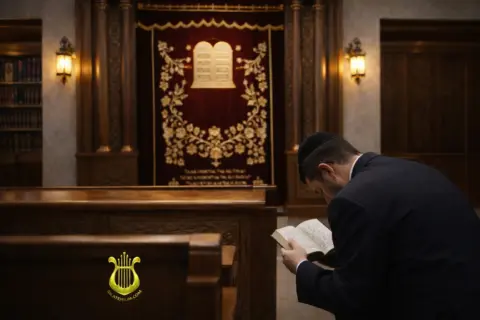
“as water reflects a face to a face.” (Proverbs 27:19) Turning one’s heart toward prayer—kavanah—is the central lesson we learn from Hannah’s prayer.
Rosh Hashanah and Hannah’s Prayer
The Haftarah read on the first day of Rosh Hashanah tells of Hannah—for it was on this very day that Hannah conceived. But there is another connection between this reading and the holiday. Jews traditionally do not pray on Rosh Hashanah for the fulfillment of their material and personal needs.
When Eli the High Priest asked her,
“How long will you remain drunk?”—meaning that when we crown G-d as King, it is not appropriate to think about earthly and personal matters—Hannah replied:
“I am pouring out my soul before the L-rd” (I Samuel 1:15). And because this desire arose from the very essence of our soul, which is bound and united with the Creator, the High Priest blessed Hannah:
“Go in peace, and may the G-d of Israel grant your request—the very thing you asked of Him.” (I Samuel 1:17)
Hannah’s Prayer (Transliteration)
Prayer of Hannah (Transliterated)
Hannah’s Prayer—a Special Segula for the Month of Kislev
Hannah's Prayer – A Special Segula in the Month of Kislev
Hannah’s Prayer and the Amidah
Hannah’s Prayer and the Amidah
Hannah and Peninnah—the Reward for Tzarot
Hannah and Peninnah — a Reward for Tzarot, or: Do Not Oppress
Please note: some articles on our site contain the holy Names of the Almighty. If you print these articles, they may not be thrown away or destroyed. Please handle printed copies with care and respect.