The Life Line — “Kav Melave” and Connection with Tzadikim
The Secret of Connecting with a Tzadik at His Kever
Gaon and Nazir Ha-Rav Yehuda Ohad Turjeman—a direct descendant of a Moroccan Mekubal—teaches that when you connect with a tzadik, you connect with his mazal. Even non-Jews come to a tzadik because they feel this connection with the tzadikim.
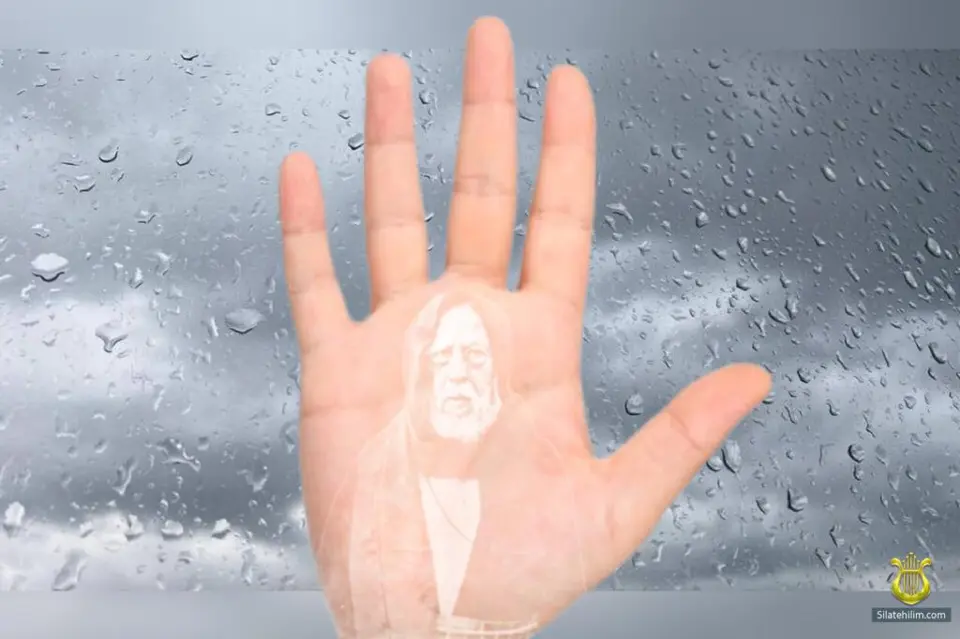
The Kabbalists teach that the middle line on the hand is the line of the neshamah—the line of mazal. It begins at the base of the palm (the root) and, crossing all the other lines, rises toward the base of the fingers. It corresponds to a person's mind, fortune, and soul.
For women, the life line is visible on the left hand; for men, on the right.
Sometimes, among children of righteous ancestors or wealthy people, this line begins at the edge of the palm, slightly to the side. Those who have such a line should know that they received all their good fortune through their father or some grandfather—in the merit of their ancestors.
Sometimes the life line ends and then continues.
The Mekubalim teach that there is a concept called “Kav Melave”—a line of accompaniment. This is a thread that follows you, connects you with a tzadik, and protects your mazal.
It can be seen on the hand: first comes the neshamah line; then it stops, and, slightly displaced, another line begins. This is the “Kav Melave”—the thread of accompaniment. It is the secret of the connection either with a tzadik or with a powerful righteous ancestor who accompanies you. This is precisely why people are given the names of tzadikim: the tzadik then connects with the person and protects him or her.
But there are other lines as well—right at the base of the fingers. Above the solid line, one can see small vertical or lateral markings. These are attached lines—the lines of tzadikim who watch over and protect you.
These are the lines of tzadikim with whom you have connected during visits to Kivrei Tzadikim, at their Hillulot/Yahrzeit observances (if you light candles for them, set aside tzedakah in their honor, read their prayers or study teachings from their Torah, and recount stories of tzadikim). This is a unique opportunity to connect with tzadikim and be under their protection.
A True Story of a Connection with the Mekubal Rabbi Raphael Encaoua
Once, a woman with a serious problem came to Rav Turjeman for help, and he asked her to show him her left hand. Seeing a portrait of the Mekubal Rabbi Raphael Encaoua on her hand, Rav Turjeman asked her, “Are you connected with Rabbi Raphael Encaoua?”
She said, “No, I don't know who that is.”
—“He was a great Moroccan rabbi,” Rav Turjeman replied.
—“I am from Bnei Brak—I follow the Chafetz Chaim, and my husband is Ashkenazi,” the woman said.
—“But I see that you have a very strong connection with this tzadik. You are not telling me something. I will not be able to help you this way.”
She then said that her father was Moroccan and perhaps he could explain something. The Rav asked for her father's telephone number and called him immediately.
When Rav Turjeman asked the same question over the phone about a connection with the tzadik Rabbi Raphael Encaoua, there was first a pause. After a moment of confusion, the woman's astonished father answered the question with a question of his own: “How do you know about my connection with this tzadik?” They arranged to meet.
When Rav Turjeman told him at their meeting that he had seen a portrait of the tzadik on his daughter's hand, the man was stunned. For some time he could not speak, but then he gathered his strength and told the following story.
He admitted that he had a very strong connection with Rabbi Raphael Encaoua. He was born in Morocco, but before his birth, whenever his mother became pregnant with another child, she would suffer a miscarriage.
Among Moroccan Jews, there was a tradition—a segula: if a woman was prone to miscarriages, she would go to the “Chevra Kadisha”—the burial society—and enter into an agreement. A transaction called “machluf” was performed, whereby the child passed into the ownership of the “Chevra Kadisha” and no longer belonged to its mother, thereby changing its mazal. The “Chevra Kadisha” would usually give such a child the name of a great tzadik, whose zekhut would preserve and protect the fetus so that the child would be born safely.
His mother did exactly this, and the Chevra Kadisha drew up a bill of sale with her and named the child Raphael Encaoua. In fact, the child was born and survived. That child was the woman's father.
When he was a teenager, the family moved to Israel, and the boy knew nothing about the circumstances of his birth.
When the time came for him to be drafted, he joined the army. During a leave, one of his army friends invited him to go out and have fun on Shabbat. He tried to refuse, saying that his family observed Shabbat and he could not go, but his friend pressured him—as often happens—and the young man gave in. On Friday night, after everyone had gone to sleep, he escaped through the window to a party.
When the young man returned home in the early morning, he saw his mother sitting on a chair right by the door, waiting for him. When he asked why she was sitting there and not sleeping, his mother replied sharply: “I know everything. You violated Shabbat tonight. Tzadik Raphael Encaoua came to me in a dream and strangled me. He said: ‘Your son, who was named after me and possesses my mazal, is violating Shabbat??? This is an aveirah gedolah—a grave sin. I will not allow it.’”
His mother had to tell her son everything. After this incident, the young man did complete teshuvah, to such an extent that his “Kav Melave” was passed on to his daughter as well.
Rav Yehuda Ohad Turjeman explained to the man that all his mazal in life came through the zekhut of Rav Raphael Encaoua, and that he should regard such a gift in life with profound awe and gratitude.
(Based on a trip to Kivrei Tzadikim in Morocco with the “Sila Tehillim” group and a video lesson by Gaon and Nazir Ha-Rav Yehuda Ohad Turjeman)
Was this helpful?
100% of readers found this article helpful (99 votes).
Please note: some articles on our site contain the holy Names of the Almighty. If you print these articles, they may not be thrown away or destroyed. Please handle printed copies with care and respect.
Material from our site may be copied for the purpose of spreading Torah, provided a link to Silatehilim.com is included. Any use of the site's material in print publications or for commercial purposes is prohibited without the rights holder's consent.