How G-d Separated Challah, or the Spiritual Alchemy of Hafrashat Challah
How G-d Separated Challah, or the Spiritual Alchemy of Hafrashat Challah
It is written in Bereishit Rabbah: “Why was the mitzvah of challah given to her—the woman?”
He (Rabbi Yehoshua) said to them: “Because she corrupted Adam, the first man—the challah of the world.”
How do we know that Adam was challah?
Rabbi Yose ben Katzarta said:
“Just as a woman kneads flour with water and then separates challah, so first ‘a mist rose from the earth,’ and afterward ‘G-d formed man from the dust of the earth.’ (Bereishit 2:6)
Mitzvah or Privilege
Every woman possesses a spark of Chavah’s neshamah, but only a Jewish woman has been given the privilege of rectifying her sin.
How G-d Separated Challah
“Dust of the earth mixed with water”—this is how G-d created the first man.
The Midrash “Yalkut Me’am Lo’ez” (Bereishit 2:7) describes in detail how Hashem created man—in analogy to challah.
Earth:
“From red earth, G-d created blood;
from green earth, G-d created the internal organs;
from yellow earth, G-d created human skin;
from white earth, He made the bones and sinews.
The earth that would become Adam’s body was taken from throughout the world: his torso from Babylonia, and his arms and legs from the rest of the world.
For his head, G-d took earth from the holiest place in the world—the Temple Mount, where the Shechinah, the Divine Presence, always dwells.”
The Midrash explains that this was done so that wherever a person dies and is buried, he will be received back into the earth.
Water
G-d gathered water from throughout the planet and created man from this water. Water was poured into the earth, kneaded, and shaped—the process of making challah can be compared to the way G-d created Adam HaRishon.
By making challah, we can rectify the destruction that occurred in the world as a result of Chavah’s sin.
By fulfilling the mitzvah of challah, a woman in her own kitchen can bring about a Tikkun, a spiritual rectification of an event that took place during the six days of Creation!
How Was This Transmitted to the Jewish Woman?
There is a well-known statement about the miraculous blessings bestowed upon our matriarch Sarah, the wife of Avraham Avinu: “As long as Sarah was alive, a candle burned in her tent from Shabbat to Shabbat, the dough was blessed, and a cloud of the Shechinah rested over her tent. After Sarah’s death, all three blessings disappeared; but when Rivkah arrived, they all returned.” (Bereishit Rabbah 60:16)
All three signs correspond to the three uniquely Jewish mitzvot of women—the blessing over the dough is hafrashat challah.
Tosafot (on Sotah 11a) says: “Midah tovah merubah”—the reward for fulfilling and observing a mitzvah is many times greater than the punishment for refraining from it.
Separating challah brings abundant material blessings to the world. If neglecting challah causes blessing to disappear, then simply lifting a small piece of dough and declaring, “Harei zo challah”—this is challah—we can become recipients of the gift of parnassah.
The Admor of Komarna points out that the first letters of the words in the verse (Mishlei 30:8), “Hatrifeini lechem huki”—feed me my daily bread—(hei, lamed, chet) form the word “challah.”A Mitzvah of the Land of Israel“Speak to the children of Israel and say to them: When you come to the Land to which I am bringing you, then, when you eat of the bread of the Land, you shall set aside a gift for the L-rd. From the first portion of your dough, you shall give a cake as a gift; like the gift from the threshing floor, so shall you give it. From the first portion of your dough, give the L-rd a gift throughout your generations.” (Bamidbar 15:18–22)
“Sefer HaChinuch” explains that the challah that was separated was originally intended for the Kohanim who served in the Holy Temple. Challah was one of the 24 gifts to the Kohanim. These gifts enabled them to devote themselves to serving in the Beit HaMikdash and studying Torah without worrying about earning a livelihood.
Today, we are all in a state of ritual impurity, and therefore the separated challah may not be eaten. Nevertheless, the Sages required us to preserve this mitzvah. Although most Jews today do not live in the Land of Israel, by rabbinic decree we continue to separate challah.
The Prophet Yechezkel says: “You shall give the first portion of your dough to the Kohen, so that blessing may rest upon your home.” (Yechezkel 44:30)
The “Hagahot Maimoniyot” states that the Jewish people were granted the privilege of entering Eretz Yisrael and settling the Land precisely so that they could fulfill the mitzvah of hafrashat challah:
“Because of this [mitzvah of separating challah], the Jewish people were found worthy of entering Eretz Yisrael.As it is said: ‘When you enter the Land of Israel.’”Spiritual Alchemy
When we separate challah, we elevate physical dough and transform it into a spiritual entity.
Flour symbolizes materialism, while the task of the Jewish people in this world is to imbue the physical world with spirituality. Everything that G-d created in His world is intended for us to use in His service. Until an object is used for a spiritual purpose, it remains limited and physical. Flour remains flour. Water remains water. But use them for a mitzvah, and they become spiritual entities. When we separate challah, it is not only the separated portion that is sanctified, but the entire dough.
Rabbi Moshe Chaim Luzzatto (Ramchal) writes in “Pitchei Chochmah VeDa’at”: “A separate portion of dough is taken, and the entire dough becomes sanctified... and this has a measure: ‘One portion of dough given to G-d sanctifies the remainder.’TikkunimThe Shlah HaKadosh said that when challah is separated, the bread is sanctified and “purifies the body and soul of the one who eats it.”The Bread of Faith
The blessing for separating challah according to the Ashkenazi nusach is: “Lehafrish challah min ha’isah”—to separate challah from the dough.
The gematria of the word “isah” (dough) is 145. The gematria of the word “challah” is 43. When we remove (separate) “challah” (43) from the dough (145), 102 remains, the gematria of the word “emunah” (faith).
Against Idolatry
It is written: “Whoever fulfills the mitzvah of hafrashat challah nullifies idolatry.” (Midrash Rabbah, Tazria 15). By separating challah and demonstrating that G-d is the Source of every blessing, we strengthen our faith and oppose idolatry.
Nourishment for the SoulSefer HaChinuch (mitzvah 385) writes: “A person’s life depends on his nourishment, and most of the world lives primarily by eating bread. Therefore, G-d wished to give us a constant mitzvah concerning bread. And since bread sustains our bodies, the holiness it carries after being used for a mitzvah will nourish our souls.”Punishment for Neglecting Hafrashat ChallahPirkei Avot 5:10 says: “If [everyone decides] not to separate the required portion from the dough, a famine begins.”
How to Gain a Share in the World to ComeRabbi David Lida says that “challah” is an acronym for “chelek Olam HaBa”—a portion in the World to Come. In other words, one who separates challah has prepared a place for himself in the World to Come.
A Korban in One’s Personal TempleRabbi Shimshon Pincus teaches that women are not obligated to study Torah or perform time-bound mitzvot. But they can bring offerings, korbanot, to Hashem in their own personal Temple—the four walls of their Jewish home. The Temple was destroyed because of our transgressions, but there is still a place where the Shechinah, the Divine Presence, rests: the Jewish home. When a woman separates and bakes challah, she connects with “Lechem HaPanim”—the bread that was baked in the Temple.
Hafrashat Challah Corresponding to Tefillin
The Levi family was proud to live in the same building as Rabbi Yitzchak Zev Soloveitchik, the Brisker Rav.
This took place in the years when many Jewish housewives brought already braided challahs to a communal bakery to be baked before Shabbat—not everyone had an oven. Each week they braided their challahs and carefully carried their trays to the local bakery to bake them. Every week, two girls from the Levi family carried the challahs to the bakery, passing the windows of the Brisker Rebbe’s study on their way.
One week, after Friday evening prayers, the Brisker Rav approached Mr. Levi. “Is your wife well?” he asked. Surprised, Mr. Levi replied: “Actually, she became ill this week and is now in bed.” Seeing his surprise, the Brisker Rav explained: “Every Friday morning, your daughters pass my window with their challahs. This morning I did not see them, and I realized that something had happened—surely the woman of the house was ill.” The Brisker Rebbe warmly blessed Levi’s wife with good health, adding that he hoped she would be baking challahs again the following week. Then he added: “Know that hafrashat challah is like putting on tefillin for a woman. Tefillin are a symbol of a good Jew. What does this mean for a woman who is not obligated to wear tefillin? Shabbat itself is called a sign, an ‘eternal sign.’ And the mitzvah of hafrashat challah is like a woman’s tefillin—an eternal sign of Shabbat.”The Prophet Amos spoke of the time before the coming of Mashiach: “Behold, days are coming—declares the L-rd G-d—when I will send a famine upon the land: not a famine for bread or a thirst for water, but for hearing the words of the L-rd.” (Amos 8:11)
Today, bakeries are filled with every kind of bread: rye and gluten-free, sourdough and whole-grain. But which of these breads brings warmth? Homemade challah is the secret spiritual ingredient that brings shalom to our homes.
Do Not Give the Mitzvah of Hafrashat Challah to Anyone ElseRabbeinu Chida writes in “Machazikei Berachah”, in response to the Ya'avetz: “If a husband undertook to separate challah without his wife’s permission, he must compensate her financially, as is customary when someone takes a mitzvah away from another.”
This demonstrates the tremendous importance of the mitzvah of hafrashat challah.
Five Hundred Fast Days
Chazal said: “Preparing food for Shabbat is equivalent to 500 ta’anit fasts.”Angels Created by Hafrashat ChallahRabbi Aharon of Karlin and his son arrived in a small town early on Friday morning. They saw smoke rising from the chimneys, evidence that the women were baking challah for Shabbat.
Rabbi Aharon said: “Look at the angels rising from the chimneys!”“In truth, through their efforts the women should have attained the level of Ruach HaKodesh—but anger prevents this.”
Through her work preparing for Shabbat, a Jewish woman merits Divine protection and creates angels! The Midrash “Yalkut Shimoni, Iyov” says: Rabbi Meir stated: “If a person performs many mitzvot, he creates many angels, as it is said: ‘For He commands His angels concerning you, to guard you in all your ways.’” (Tehillim 91:11)
Even if 999 accuse a person and one speaks in his defense, the person is saved.
The Time for Separating Challah
It is a segula to separate challah on Friday.
Mishnah Berurah and Ben Ish Chai, citing the Arizal, explain this idea in detail: “Adam HaRishon, who was created on Friday, was called ‘the challah of the world.’ Because of her sin involving the Etz HaDa’at, Chavah corrupted this ‘challah dough.’ Women rectify this act through the mitzvah of hafrashat challah specifically on Friday—Erev Shabbat.
A Year Without ChallahBen Ish Chai (Parashat Shemini) writes that a woman should perform hafrashat challah at least once during the year—it is not appropriate for a year to pass without hafrashat challah, “so that she will have something to add to her merits.”Et RatzonRabbeinu Yonah writes that when we perform a mitzvah, it is an auspicious time to turn to Heaven with any request. When a woman fulfills one of her three special mitzvot, she merits special Divine favor. These are precious moments when we can connect directly with our Creator and be heard—with no angels between us.
Sifting the Flour
Sifting is a time for reflection: what are the impurities that must be discarded, and what is beneficial for our service of G-d and our relationships with others?
Interestingly, the Mishnah and Gemara use the word “merakeh” for sifting, which is a synonym for “rikud” (dancing).
When we sift flour, we try to restore it to its original state, when it was freshly ground.
Each of us has a pure neshamah, a holy soul. Mistakes and failures clog it with impurities, but if we sift them out, we can return to our original state.
For the Temple, flour was sifted 13 times. We know that 13 is a sacred number for the Jewish people: the 13 “middot of rachamim” of G-d, and the gematria of the words “echad” and “ahavah.”
The Garmu family, from the family of Kehat and Aharon, descendants of Pinchas, who served as Kohanim in the Temple for many years and preserved the secrets of baking challah and the recipe for “Lechem HaPanim,” sifted the flour 11 times.
Kneading the DoughChofetz Chaim explains how the mitzvot of the Torah correspond to the 248 limbs and 365 sinews of our bodies, and what energy the organs receive from the mitzvot.
The hands that knead challah receive an extraordinary spiritual light at that time.
The Arizal (may his merit protect us) also said:
“The sweat that a person produces while preparing for Shabbat is a segula for washing away one’s sins.”
If we knead the dough with both hands, we can see how our hands receive strength: the gematria of the word “yad” (hand) is 14. Two hands together equal 14 + 14 = 28, which is the numerical value of the word “koach” (strength).
Challah Made with Olive Oil
Challah should be kneaded only with olive oil. There were no other kinds of oil in the Temple. And if we separate challah in accordance with the mitzvah as it was performed in the Temple, we should fulfill it literally, as the Torah says:
Bamidbar 15:4
“...then the one who presents his offering to the L-rd shall bring a meal offering: a tenth of an ephah of choice flour mixed with a quarter of a hin of oil.”
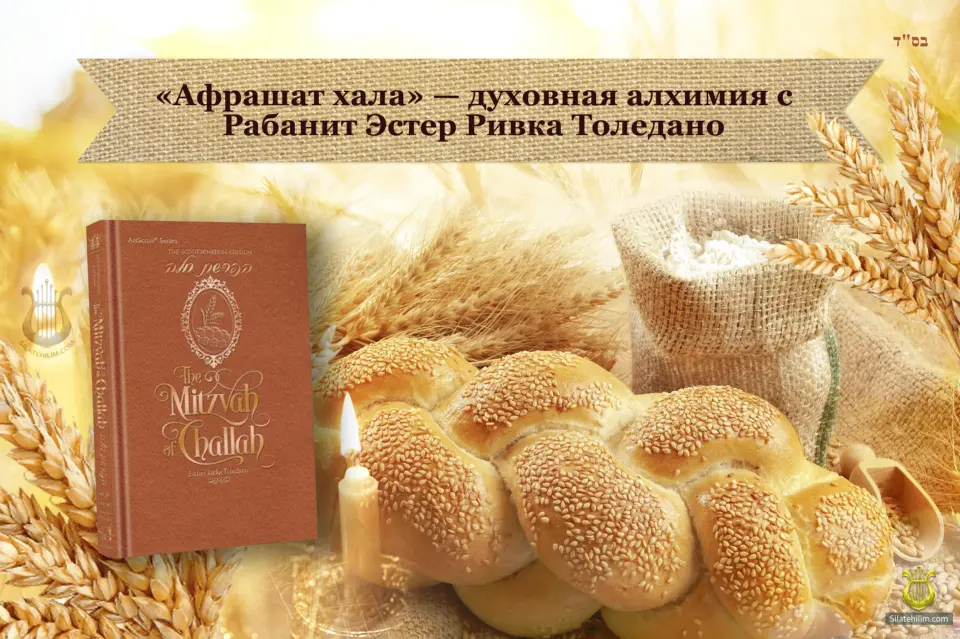
(Translated by silatehilim from the book “Hafrashat Challah” by Rabbanit Esther Rivka Toledano)
Was this helpful?
100% of readers found this article helpful (55 votes).
Please note: some articles on our site contain the holy Names of the Almighty. If you print these articles, they may not be thrown away or destroyed. Please handle printed copies with care and respect.
Material from our site may be copied for the purpose of spreading Torah, provided a link to Silatehilim.com is included. Any use of the site's material in print publications or for commercial purposes is prohibited without the rights holder's consent.