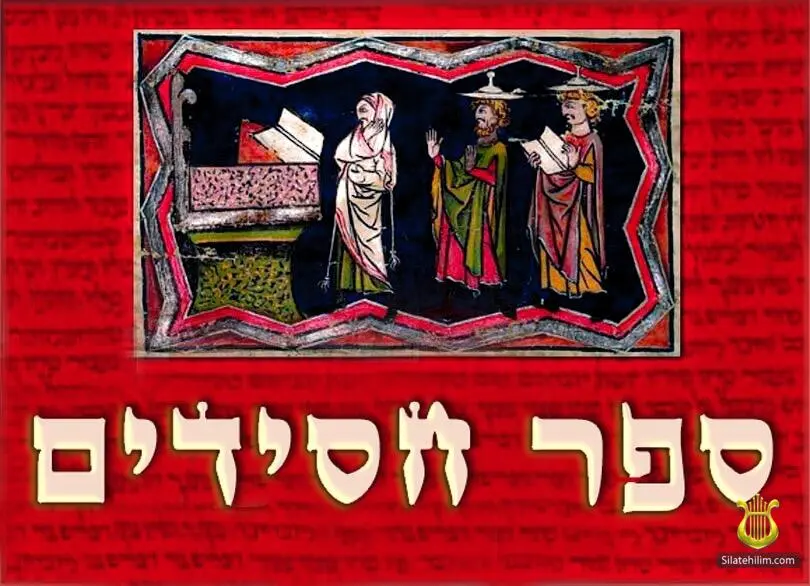
The Testament of Rabbi Yehuda HaChasid from Sefer Chasidim
(with additional warnings)
A special appendix to Sefer Chasidim (The Book of the Pious) is the “Testament of Rabbi Yehuda HaChasid,” which contains 70 points concerning family matters, childbirth, choosing names for children, death, private property, and other aspects of life.
For centuries, this testament continued to astonish scholars, since the rabbi’s warnings not only did not derive from primary sources such as the Talmud or the mystical teachings, but at times even contradicted them. Some of his instructions applied only to specific cities in Germany or only to his descendants.
Because of the special respect accorded to Rabbi Yehuda HaChasid, it became customary among the scholars of Europe in every subsequent generation to study the testament of Rabbi Yehuda HaChasid carefully and regard its instructions as practical Halachah.
In any event, the words of the great Rabbi should be treated with attention. Great scholars said that whoever followed the Testament of Rabbi Yehuda HaChasid would prosper (that is, would act correctly).
[The first 15 points concern the laws of mourning]
16. One should not build a stone house oneself, but should purchase one. A person who built a stone house should not live in it, since he or one of his children may die. It is preferable to sell the house. There are doubts regarding a wooden house.
17. One should not build a house where no houses previously stood. If one does build there, other people should live in it during the first year.
18. One should not install a bathhouse in a home, as this may cause the house to collapse. However, a bathhouse intended for public use is permissible.
19. One should not build a house taller than a synagogue.
20. One should not completely seal up a window or doorway, so that a person will not be harmed by demons that pass through them. A small opening should be left.
21. One should not build a house or convert a Beit Midrash into a residence, since it is holy to G-d.
22. One should not marry his niece.
23. A man should not marry a woman who has the same name as his mother, or a woman whose father has the same name as he does. If he has already married her, the name should be changed, and this may help.
24. People with the same name should not marry their children to each other’s children.
25. Two brothers should not marry two sisters.
26. One should not marry his deceased wife’s sister.
27. Two brothers should not marry a mother and daughter, nor should two sisters marry a father and son.
28. One should not marry his children twice to the children of the same person.
29. One should not marry a stepsister and stepbrother to each other.
30. One should not marry both of his children on the same day. Otherwise, they will not have good fortune.
31. If two grooms are married in the same synagogue on Shabbat, one of them will become poor, be forced to leave, or die.
32. One should not hunt a deer for a wedding, since a deer brought for a wedding brings misfortune.
33. Married brothers should not live in the same city. This is alluded to in the verse: “When brothers dwell together.” (Devarim 25:5)—this refers to levirate marriage, since it applies when the brothers lived in the same city.
34. Three or more heads of households (families) should not live in the same house. Otherwise, one of them will become poor or die.
35. The same person should not serve as sandak at the circumcisions of two sons, except when the first son has already died.
36. One should not refrain from intimacy with his wife on the night she immersed in the mikveh.
37. A person who jokingly or hyperbolically says that he will do something must fulfill his word for as long as he lives.
38. If a person leaves home to set out on a journey, he should not return to retrieve something he forgot. He should approach the house and ask that the item he needs be brought out to him.
39. One should not polish one’s shoes on the same day that one plans to set out on a journey.
40. One should not sit in a carriage or on a horse that is aboard a ship. Some maintain that one should likewise not sit on a plank protruding from the ship.
41. One should not slaughter ducks in Shevat. Some do not slaughter them in Tevet either, but the main prohibition is not to slaughter them in Shevat.
42. If a duck, rooster, or other animal overturns a bowl or other vessel, it should be slaughtered immediately.
43. A cow that gives birth to two calves at once, a hen that lays two eggs at once, and other animals that experience something contrary to nature should be slaughtered immediately.
44. A tree that bears fruit twice a year should be cut down immediately, roots and all.
45. One should not cut down a fruit-bearing tree.
46. One should not hide away a grain harvest in storage in order to wait until prices rise. Whoever does so will suffer a loss.
47. One should not write “this is my property” in a book. It is sufficient to write one’s name.
48. On the first day of the new month, one should not cut one’s hair, shave, or cut one’s nails.
49. One should not demolish an oven or stove used for cooking in order to make use of the space where it stood. Anyone who does so places himself in danger.
50. A hen that crows like a rooster should be slaughtered immediately. Everything that contradicts the laws of nature should be removed from the home.
51. The descendants of Rabbi Yehuda should not name a son Yehuda or Shmuel. A rabbi should not live in the city of Edelburg, as he will die there at a relatively young age. A kohen or a person named Elazar should not live in Regensburg. One should not live in Augsburg, Austria, unless one leaves there for a month every year. When a woman among his descendants gives birth, she should not eat chicken first. 52. A person should not raise calves born to his own animals.
52. One should not set a hen to hatch eggs so that chicks will grow. Nor should one allow a hen to sit on eggs by itself.
53. A man should not grow a sidelock.
54. Breastfeeding an infant should begin with the left breast.
55. A person who lives in Swabia will not raise sons who merit studying in a yeshivah.
ADDITIONAL WARNINGS TO THE TESTAMENT
- A man whose wife has died should not marry a second time a woman with the same name. A woman should not marry a man with the same name as her deceased husband. Nothing good will come of this, or one of them will die.
- His descendants should not name children in the family after deceased children. One should not name three sons Avraham, Yitzchak, and Yaakov (or Moshe), or one of them will die, fall ill, become mute, go insane, or suffer some similar calamity.
- If someone is taking a long time to die and is a wicked person, nothing should be said to him. If he is a righteous person and his death will cause others grief, he should be permitted to die, and one should say: “May you be permitted to die by me and by the entire world.”
- A man drank water in a house next door to the home of a deceased person. A sage rebuked him for this, and the man died soon afterward. The sage was asked to explain what had happened. He said: “I saw the Angel of Death washing his knife in that water after the first man’s death.”
- If a person lives in a city with a cemetery, then when he comes to another city that also has cemeteries, he should not go there to pray, lest he arouse the anger of the dead from his own city, who may harm him.
- One must not use a knife or sword with which a Jew was killed. A person and his entire family will face great danger if he derives benefit from such an object. The knife or sword should be buried together with the victim.
- When moving to another home, one should not remove the mezuzah from the old apartment. This is dangerous. 8. One should not raise pigeons in the home, since in a house where they are raised, either the children will die or there will be no children at all.
- One who has moved to another home should not return to live in the old home until seven full years have passed since the move.
- One should not part from a person in tears.
- One should not undergo bloodletting during the months of Tammuz, Elul, and Shevat. This can be remembered as a Hebrew acronym from the first letters (TAASH) or from the last letters (ZALAT).
- A person who recites hatavat chalom (the prayer for turning a dream to good) to rectify a bad dream should not be answered at the end with the verse: “Go, eat your bread with joy,” since the first letters of the words of this verse form the word “avel”—“mourner.”
- The inhabitants of a city whose market day is Tuesday are poor, whereas if the market day is Saturday, they are wealthy (this refers to a non-Jewish market).
- The author’s descendants should not purchase grain in order to profit from it, as this will lead to losses.
- These are auspicious dates in the Hebrew month for traveling or moving to another home: 2, 4, 9, 11, 15, 16, 19, 21, 27, and 29. It is preferable to avoid doing so on the 1st, 3rd, and 25th.
(Compiled from Sefer Chasidim by Rabbi Yehuda HaChasid, edited by Yaakov Ratner)
Was this helpful?
100% of readers found this article helpful (24 votes).
Please note: some articles on our site contain the holy Names of the Almighty. If you print these articles, they may not be thrown away or destroyed. Please handle printed copies with care and respect.