
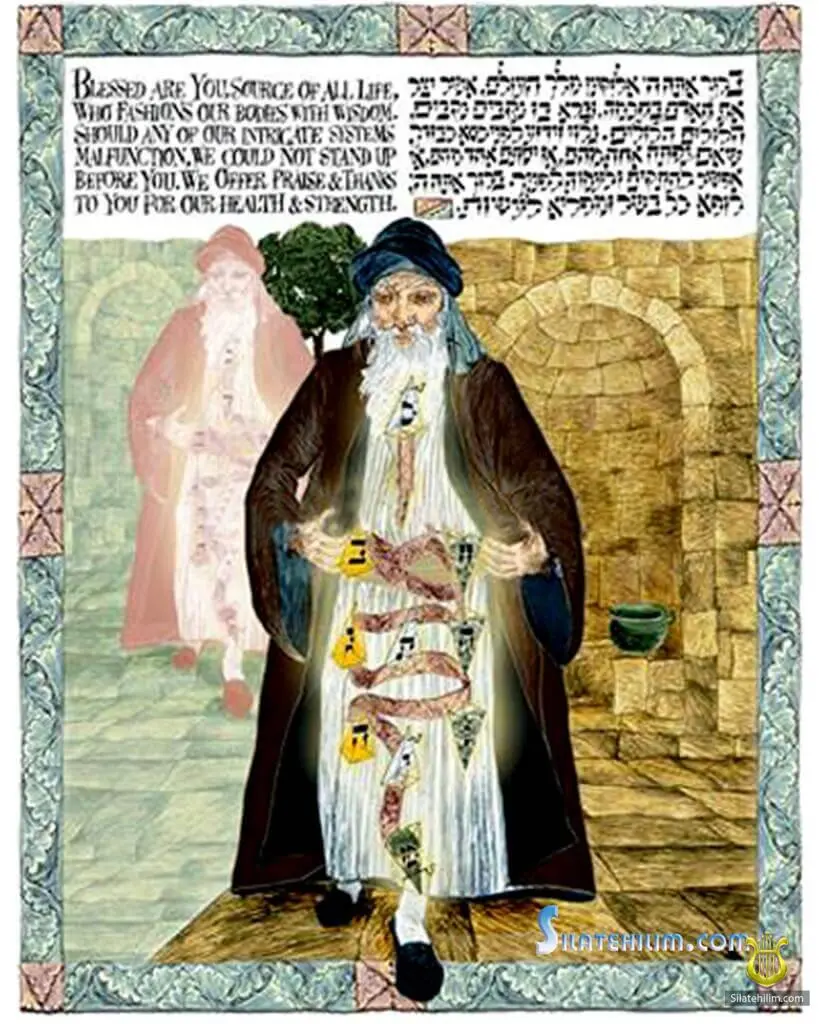
It is widely known that the blessing of “Asher Yatzar” is a segula for healing. However, for this segula to be effective, the proper kavanot are essential.
“Shoshan Ha-Sodot” reveals that this blessing contains 72 bridges of mercy (Chesed) and 42 burning coals of judgment (Gevurah).
The 42 burning coals of judgment allude to the 42-letter Name encoded in the prayer composed by Rabbi Nechunya ben HaKanah, the author of “Ana BeKoach.” It appears in every siddur, contains 42 words, and is conventionally divided into seven lines of six words each. The Name itself is formed from the initial letters of the prayer’s words and is, in turn, divided into 14 three-letter Names. This 42-letter Name corresponds to the sefirah of Gevurah, hence the comparison to burning coals.
In the blessing of “Asher Yatzar,” special emphasis is placed on the words “chalulim” (cavities) and “nekavim” (openings) by repeating them. The cavities are associated with Chesed and the 72 bridges of mercy. The openings, on the other hand, are precisely the 42 burning coals of the fire of Gevurah.
The gematria of the word “nekavim” (openings) is 202, while its repetition twice equals 404.
The Torah contains 365 negative commandments, which are associated with Gevurah. The number 39 is also connected with prohibitions and punishments: it is the number of prohibited labors on Shabbat and the number of lashes administered as punishment for violating certain prohibitions. The number 404 is the sum of 365 + 39.
The gematria of the word “chalulim” (cavities) is 124; multiplied by 2 because of its repetition, this equals 248—the number of limbs in the human body.
The blessing of “Asher Yatzar” contains 45 words, equal to the gematria of the word “adam” (man), and 171 letters, equal to three times the gematria of the words associated with human nourishment: אוכל—“ochel” (food) = 57, and זן - “zan” (sustenance) = 57.
We will now explain the connection between the 42-letter Name and human physical health.
The very concept of Gevurah is associated with strength; in relation to the body, this means the vital forces that enable a person to act actively in this world. Rabbi Yisrael Sarug explains the difference between the 72-letter Name and the 42-letter Name: the former is responsible for the flow of light from above downward, while the latter governs its flow from below upward. In terms of the symbolism proposed by “Shoshan Ha-Sodot,” the 72 bridges of mercy are associated with water, which naturally flows from above downward, while the 42 burning coals of the fire of judgment, like any fire in its natural state, direct their flames upward. According to Rabbi Sarug, ideally a person should function according to this pattern: all the blessings he receives from Above should be transformed into inner strength and returned upward in the form of mitzvot and good deeds. To “return upward” means to give an accounting before the Almighty, demonstrating that everything He sent a person was not wasted.
Therefore, when we mention openings (nekavim nekavim) in the blessing, we should have in mind all our physical strength, which must be directed toward the mitzvot.
The Arizal highlights four kavanot in the blessing of “Asher Yatzar”:
1. “ASHER YATZAR ET HA-ADAM BE-CHOCHMAH...”—that the Almighty created this world through 32 paths of wisdom: the 10 sefirot (numbers) and 22 letters;
2. “UVARA VO...”—He created it with wisdom;
3. “NEKAVIM NEKAVIM...”—365 negative commandments associated with Gevurah and the 39 prohibitions of Shabbat;
4. “CHALULIM CHALULIM...”—248 positive commandments, corresponding to the number of human limbs and associated with Chesed.
A Dispute Among the Sages
Regarding the blessing of “Asher Yatzar,” there is a machloket (dispute) between Rashi and Tosafot.
Rashi (of blessed memory) explains the phrase: “Asher yatzar et ha-adam be-chochmah” —(Who created man with wisdom)—as referring to the wisdom inherent in the fact that the human body is like a balloon capable of holding air. At the same time, our bodies have many openings—and this is an obvious paradox, since a balloon with even a single opening cannot hold air inside. Yet the human body, despite having many openings—the eyes, ears, nose, and intestines—still retains air within it.
This is the wisdom expressed by “bo nekavim, nekavim”: the Almighty created us with many openings, and nevertheless the air remains inside the body.
Tosafot, however, explain the phrase “et be-adam be-chochmah” as meaning that G-d created man after creating all the other creatures (animals and vegetation)—everything was created before Adam (Adam was created only on the sixth day). The Midrash says that when Adam HaRishon entered Shabbat, his Shabbat meal had already been prepared and set before him.
This is the meaning of “Asher yatzar et ha-adam be-chochmah”—for had Adam been created earlier, before the sixth day, he would not have had food. The wisdom lay in creating all of man’s needs first and then creating man himself, so that he could eat and make use of everything.
Maharsha (Rabbi Shmuel Eliezer Edels) offers a third explanation, according to which “be-chochmah” literally means that man was created with intelligence—that which distinguishes us from animals—and with the potential to understand the essence of things.
—“Uvara vo nekavim nekavim, chalulim chalulim”— (fashioning within him the necessary openings and internal cavities)—the difference between “nekavim” and “chalulim” is that “nekavim” refers to external openings: the mouth, nose, intestines, and ears. “Chalulim”, on the other hand, refers to internal organs such as the heart, stomach, kidneys, and so on.
The blessing then clearly states that if one of the openings or one of the cavities were to become open, a person would not survive even for an hour.
Maran gives the example of a child: while a child is in its mother’s womb, its mouth is tightly closed (it neither swallows nor suffocates), but as soon as it emerges into the world, its mouth opens and it is able to breathe.
The intestines provide another example: if an opening in the body did not open at the proper time, this could lead to serious health problems, as toxins and waste products would remain in the body. Moreover, after the openings release the body’s waste, they must close again; otherwise, this too would be dangerous for a person.
—“Umafli laasot”—(G-d created a great wonder).
The Rema explains that Hashem joined two entirely opposite substances—the soul and the body—in a single human being. Mishnah Berurah, in the section on kavanot, explains that food serves as the link between body and soul, because food has physical properties as well as spiritual properties. The body receives its physical properties, while the neshamah sustains itself through the spiritual properties of food.
Another wonder of the human body is that it knows precisely what to retain and what to eliminate. It knows exactly what the body needs and what constitutes waste.
One who regularly recites the blessing of “Asher Yatzar” with kavanah after using the restroom protects himself from many illnesses and ailments and, in particular, avoids problems with the stomach and intestines.
(Based on a lecture by Rabbi Daniel Cohen, “Shaar Ha-Emet,” and a lecture by Alexander Zvi Sypkov, “Kavanot of the Arizal”)