Grave
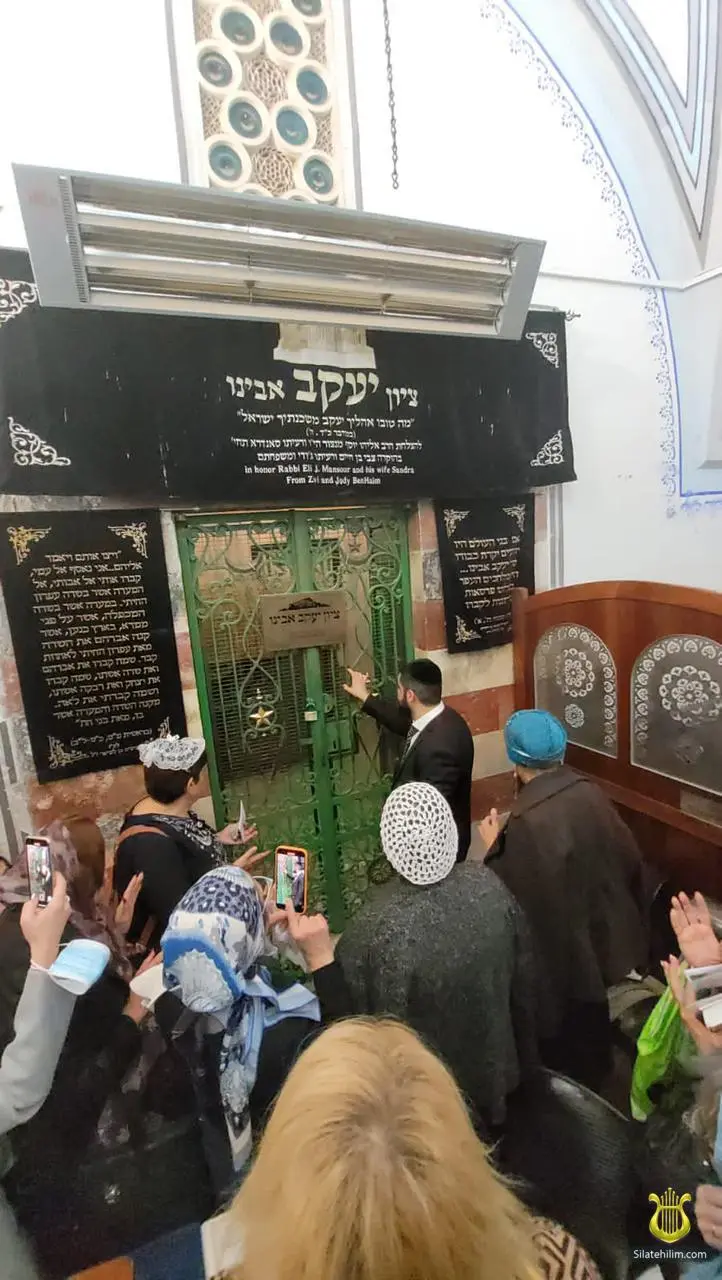
Yaakov Avinu
Yahrzeit (Hillula)
- 20 Shevat — Asher ben Yaakov Avinu - 12 Tribes
- 5 Tishrei — Naftali ben Yaakov Avinu - 12 Tribes
- 7 Tishrei — Zevulun ben Yaakov Avinu - 12 Tribes
- 15 Tishrei — Yahrzeit/Hilula of Yaakov Avinu - Hevron
- 10 Cheshvan — Gad ben Yaakov Avinu - the 12 Tribes
- 14 Kislev — Reuven ben Yaakov Avinu - 12 Tribes
- 16 Nisan — Levi ben Yaakov Avinu (12 Tribes)
- 10 Av — Issachar ben Yaakov Avinu - 12 Tribes
Yaakov Avinu – Hebron
Yahrzeit - 15 Tishrei
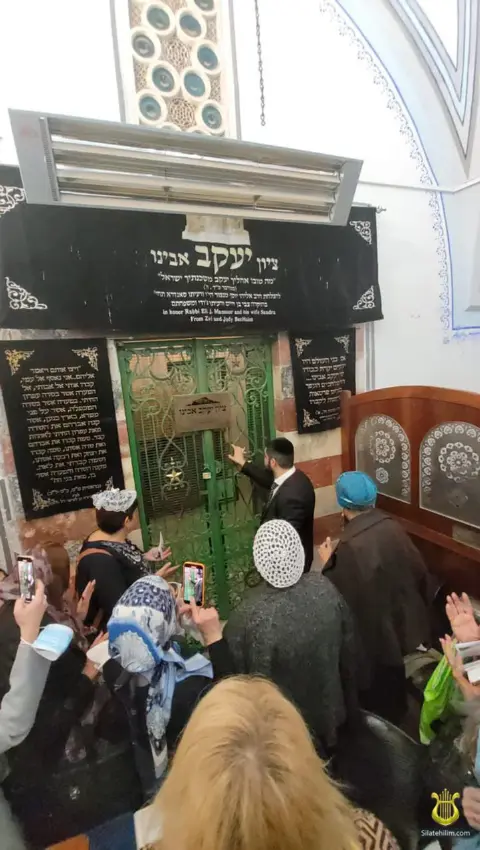
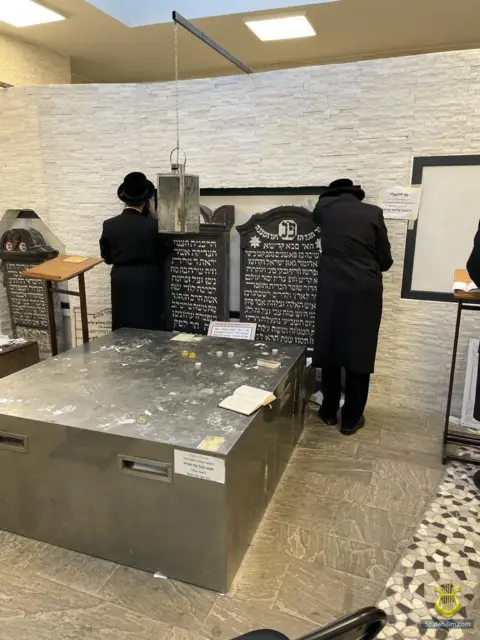
Resting place - Hebron, Me'arat HaMachpela
Yaakov ben Yitzchak (יעקב אבינו; 2108—2255 / 1652—1505 BCE) — the greatest tzadik and prophet. The third of the forefathers of the people of Israel — son of Yitzchak Avinu and grandson of Avraham Avinu.
The Torah tells us that his mother Rivka was barren for twenty years of marriage. And when she finally conceived, the pregnancy proved extremely difficult: she felt she was carrying twins, and it seemed to her that "the sons struggled within her womb," as if each were trying to overpower the other. Her sons behaved especially strangely whenever she passed by the tents where Avraham and Yitzchak studied Divine wisdom, and also whenever she passed by pagan shrines. Near the tents of the sages, one son would go still while the other seemed to strain to break free, and near the shrines it was the opposite one who strained to get out. With a mother's heart, Rivka sensed that each son was drawn to what was inherently close to him (Bereishit 25:21—22; Bereishit Rabbah 63:6; Zohar 1, 137b).
Rivka turned for advice to her husband's teachers — the prophets Shem and Ever, and it was revealed to her that in her womb were the forefathers of two nations, who would struggle with each other for dominion over the world, but that in the end "the elder shall serve the younger" (Bereishit 25:23; Bereishit Rabbah 63:6—7).
And so, in the year 2108 /1652 BCE/, two twins were born: the first was named Esav, and the second, who at birth was holding onto the heel of his elder brother, was named Yaakov (from the word eikev — heel) (Bereishit 25:24—26; Seder HaDorot). Yaakov was born already "circumcised" — without a foreskin (Avot DeRabbi Natan 2:5; Shocher Tov 9:7).
In appearance he resembled his grandfather, the forefather Avraham (Lekach Tov, Bereishit 47:18). As the sages of the hidden wisdom explain, within him dwelled the "spark of the soul" of the angel Uriel, which had previously resided in the prophet Chanoch, a disciple of the first man, Adam. And since Chanoch resembled Adam, Yaakov, too, largely inherited the spiritual likeness of the first man (Bava Metzia 84a; Zohar 2, 111a; Seder HaDorot).
1. IN THE TENTS OF THE SAGES
From childhood, Yaakov showed a special yearning for Divine wisdom: until the age of thirteen he studied the ways of serving the Creator under the guidance of his grandfather Avraham (Bereishit 25:27; Seder Olam Rabbah 1; Sefer HaYashar). He also studied with his father Yitzchak, who was especially strict and demanding with him, preferring his elder son Esav (Bereishit 25:27—28; Shemot Rabbah 1:1).
In the year 2121 /1639 BCE/, at the age of thirteen, Yaakov went to the yeshiva of Shem and Ever, where his grandfather and father had once studied (Bereishit Rabbah 63:10). There he became part of a direct tradition reaching back to the first man, created by the hands of G-d — for Shem, son of Noach (see), was the closest disciple of his great-grandfather Metushelach (see), and Metushelach was a disciple of Adam (Bava Batra 121b).
On the day in the year 2123 /1637 BCE/ when the forefather Avraham completed his earthly journey, Yaakov bought from his elder brother Esav the right of the firstborn, which entailed special obligations in serving the Creator (Bereishit 25:7—8, 30-33; Bava Batra 16b; Bamidbar Rabbah 4:8; Seder HaDorot). At the same time, Yaakov acquired from Esav his share as firstborn in the family burial site — the Cave of Machpela, where Avraham and Sarah were already buried. Yaakov drew up a bill of sale, which Esav and witnesses signed (Sefer HaYashar, Toldot). In essence, the brothers divided all of Creation between them: Esav chose this world, in which people eat, drink, conduct business, marry, and have children, while Yaakov chose the World to Come (Eliyahu Zuta 19).
That same year, 2123, a severe famine began in the land of Canaan, and Yitzchak's family moved to Gerar, the capital of the Philistines, where there was bread. After the period of famine ended, they returned to Be'er Sheva (Bereishit 26:6, 23).
In the year 2126 /1634 BCE/, Yaakov continued his studies at the yeshiva of Shem and Ever, remaining there for thirty-two years. In the year 2158 /1602 BCE/, after Shem's passing, he returned to his father, who by that time had settled in Hebron (Seder Olam Rabbah 1; Sefer HaYashar, Toldot; Seder HaDorot). There Yaakov studied continuously in his tent, mastering the kabbalistic books of Adam and Chanoch, as well as studying the Book of Creation (Sefer Yetzirah), composed by his grandfather Avraham (Zohar Chadash, Yitro 37).
Yaakov's chief qualities were love of truth and the pursuit of truth (emet), as it is written: "You shall give truth to Yaakov" (Michah 7:20). And therefore his entire life was devoted to attaining the highest wisdom and fulfilling the laws of G-d (Bereishit Rabbah 95:3; Yalkut Shimoni, Toldot 110).
2. THE FATHER'S BLESSING
-
On 14 Nisan of the year 2171 /1589 BCE/, Yaakov learned from his mother that on that very day Yitzchak intended to give Esav his primary blessing, granting the right to the land of Canaan and a special closeness to G-d. His mother persuaded Yaakov to take advantage of his father's near-blindness and pass himself off as Esav in order to receive the blessing instead of him. And although Yaakov feared that, upon discovering the deception, his father would give him "a curse instead of a blessing," he obeyed his mother — for she confided to him that it had been revealed to her in prophetic vision that this blessing was intended for him, not for Esav (Bereishit 27:6—14; Targum Yonatan, Bereishit 27:1; Targum Onkelos, Bereishit 27:13; Seder Olam Rabbah 2; Shemot Rabbah 15:11; Seder HaDorot).
Yaakov came before his father "against his will, bent over and in tears" — but he could not transgress the will of G-d (Bereishit Rabbah 65:15, Rashi; Or HaChaim, Bereishit 27:8). And when, suspecting a substitution, his father asked, "Who are you, my son?" Yaakov answered, "I am your firstborn, Esav" (Bereishit 27:18—19). The midrash explains that in truth, in answering his father, he meant the following: "(It is) I, (but) your firstborn is Esav." The word "I" also hinted that in the future it would be Yaakov's descendants, not Esav's, who would receive the Ten Commandments, which begin with the words "I am G-d." And although Yitzchak understood his answer literally, on Yaakov's part this was not a lie (Bereishit Rabbah 65:18, Etz Yosef).
And even when his father felt Yaakov's hands, he could not detect the deception, for Rivka had wisely wrapped her son's hands in the skins of young goats — so that his hands felt as hairy as Esav's. And once more his father asked, "Are you indeed my son Esav?!" And when Yaakov again answered, "I am," Yitzchak pronounced his blessing: "…Let peoples serve you, and nations bow down to you. You shall be lord over your brother. …Cursed be those who curse you, and blessed be those who bless you" (Bereishit 27:21—29). Having received his father's blessing, Yaakov immediately felt the radiance of spiritual light and an extraordinary surge of physical strength (Pirkei DeRabbi Eliezer 32).
It was hidden from Yitzchak who stood before him, so that he would bless Yaakov unknowingly — as it were, not of his own will but from G-d. And since the father wished to give Esav what Heaven had intended for Yaakov, the Creator arranged events so that Yaakov would receive his portion (Zohar 1, 139a, 143b).
As soon as Yaakov left his father's tent, Esav entered. Discovering the deception, Yitzchak "trembled in great terror," but at that very moment he perceived in prophetic insight that this blessing could pass to no one but Yaakov and his descendants, and he confirmed: "Let him (i.e., Yaakov) indeed be blessed!" (Bereishit 27:33, Ramban). The father said to Esav: "Your brother came with cunning and took your blessing" (Bereishit 27:35). And it became clear that it was not Yaakov but Esav who would be punished for the "deception" — Esav, who for many years had misled his father, concealing his true nature from him. Yaakov merely helped to correct the consequences of Esav's years of pretense and to restore the true state of affairs (Yalkut Shimoni, Toldot 115; Michtav MeEliyahu 1, pp. 94—95).
And since Yaakov's chief qualities were love of truth and the pursuit of truth, all his trials consisted of having to act, in fulfilling the Creator's will, on the very edge of falsehood and deception — just as the forefather Avraham, whose chief quality was kindness (chesed), had to perform, in his ten trials, deeds that appeared to be acts of cruelty. And like the forefather Avraham, Yaakov had to perform deeds foreign to his nature solely for the sake of Heaven, without mixing in the slightest personal motive (Michtav MeEliyahu vol. 3, p. 155, vol. 4, pp. 19—20, vol. 5, pp. 113—114).
3. FLIGHT FROM ESAV
On that same day, 14 Nisan of the year 2171, Yaakov fled from Hebron — from the wrath of his brother Esav, who had received from their father the fearsome blessing: "By your sword shall you live" (Bereishit 27:40). For fourteen years Yaakov hid in the house of his teacher Ever. And throughout all those years he studied Divine wisdom with such devotion and self-sacrifice that he never once lay down in a bed; if sleep overcame him, he would doze briefly, leaning on the table with his books (Seder Olam Rabbah 2; Megillah 17a; Sefer HaYashar, Toldot; Bereishit Rabbah 68:11, Etz Yosef).
In the year 2185 /1575 BCE/, Yaakov returned to Hebron to visit his parents (Sefer HaYashar, Toldot). His arrival reawakened the old hatred in Esav's heart, and Esav plotted to kill his brother. Then Rivka arranged for Yitzchak to urgently send Yaakov to her homeland, Charan, so that he might take one of the daughters of her brother Lavan as a wife (Bereishit 27:41—28:5).
And so Yaakov, who by that time was 77 years old, had to leave the Holy Land for the first time. At the very start of his journey he visited Be'er Sheva, where for many long years there had stood the hospitable tent of his grandfather Avraham, and then that of his father Yitzchak — for it was near Be'er Sheva that G-d had first appeared to Yitzchak, forbidding him to leave the land that in the future would be given as an inheritance to his descendants. But this prohibition did not apply to Yaakov (Bereishit 28:10; Bereishit Rabbah 68:5; Sefer HaYashar, Toldot).
Two days' journey from Be'er Sheva, he spent the night on Mount Moriah, not far from the place where his father Yitzchak had been bound upon the altar (Bereishit 28:11, Rashi; Pirkei DeRabbi Eliezer 35; Seder HaDorot). In a prophetic dream Yaakov saw a ladder set upon the earth, its top reaching to the heavens (Bereishit 28:12). The ladder rested on the ground near Be'er Sheva, its middle hovered over Mount Moriah, and its top extended into the sky far to the north (Rashi, Bereishit 28:17). Angels ascended and descended the ladder, and these were the sarim (supreme angels) of all seventy nations (Bereishit 28:12; Zohar 1, 149b).
In this prophetic vision he was also shown the four kingdoms that would rule over his descendants, the people of Israel, throughout history — their rise to the height of power and their fall. First he saw the sar of Babylon climb seventy rungs of the ladder, then fall — representing the seventy years of Babylonian dominion over Israel. Then the sar of Media and Persia climbed fifty-two rungs — and was cast down. After him the sar of Greece rose a hundred eighty rungs — and was thrown down. Finally, the sar of the kingdom of Edom, founded by the descendants of Yaakov's brother Esav, began his ascent. He climbed higher and higher, proclaiming: "I will ascend to the heights of the clouds, I will be like G-d" (Pirkei DeRabbi Eliezer 35; Vayikra Rabbah 29:2).
Seeing the dizzying height to which Esav's angel had risen, Yaakov cried out to the Almighty: "Master of the Universe! Do not let the wicked Esav fulfill the desire of his heart! Do not let his criminal design be realized!" The Talmud explains that Yaakov was pleading for protection for his descendants from "Germania of Edom — for if they succeed in carrying out their designs, they will destroy the entire world" (Megillah 6ab, Hagahot Yaavetz; Bereishit Rabbah 75:9; Michtav MeEliyahu 3, p. 203).
When it began to seem that Esav's rise would have no limit — that his dominion over the Jewish people would have no end — Yaakov became afraid: "Will this one never fall?!" The Almighty answered him: "Fear not, My servant Yaakov! Even if he climbs this ladder all the way to Heaven, I Myself will cast him down when the time comes!" And indeed, Esav's angel came crashing down, having reached almost the very top of the ladder. Then the Almighty said to Yaakov: "Now you, too, climb up!" At that moment, the midrash continues, our forefather Yaakov grew afraid and said, "What if, G-d forbid, I too should fall, as these have fallen!" The Almighty reassured him: "Fear not! If you climb, you will never fall!" But, as the midrash concludes, "Yaakov did not believe and did not climb" (that is, he did not believe in himself — that he could remain at such a height without ever sinning). G-d said to him: "Had you believed and climbed, you would never have come down again. But now, since you did not believe and did not climb, in the future your sons will be enslaved by these four kingdoms" (Vayikra Rabbah 29:2, Etz Yosef). And another midrash likewise states: "Had Yaakov climbed, there would not be the servitude and dependence on the nations in which we now find ourselves" (Shocher Tov 78:6).
(based on materials from Toldot.ru)
Gallery