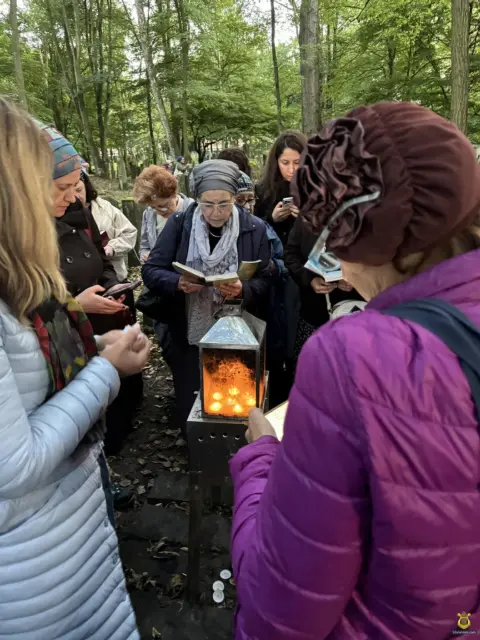
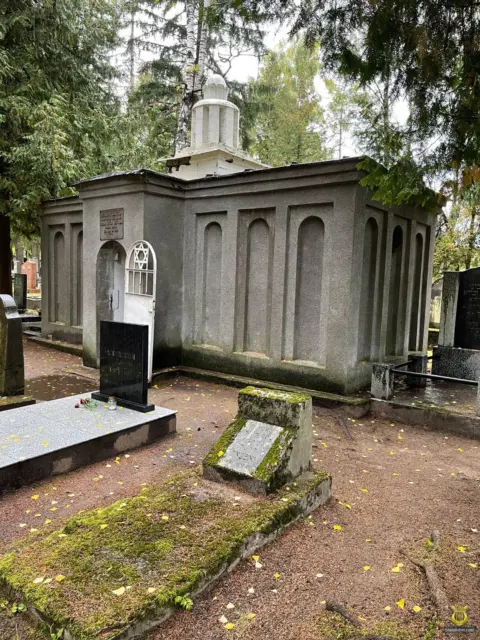
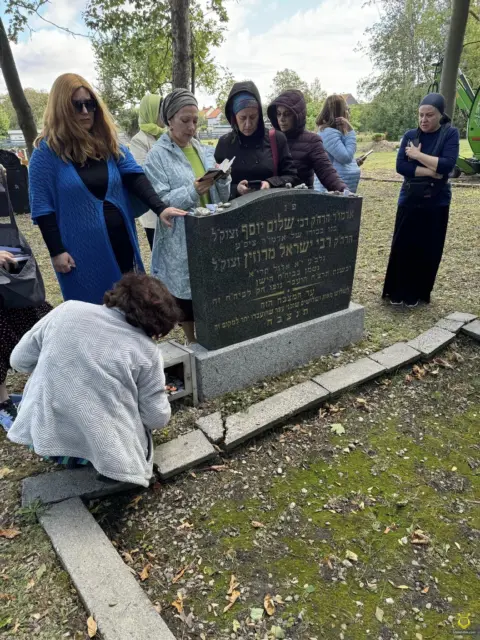
Grave
Yaavetz
Rabbi Yaakov Emden
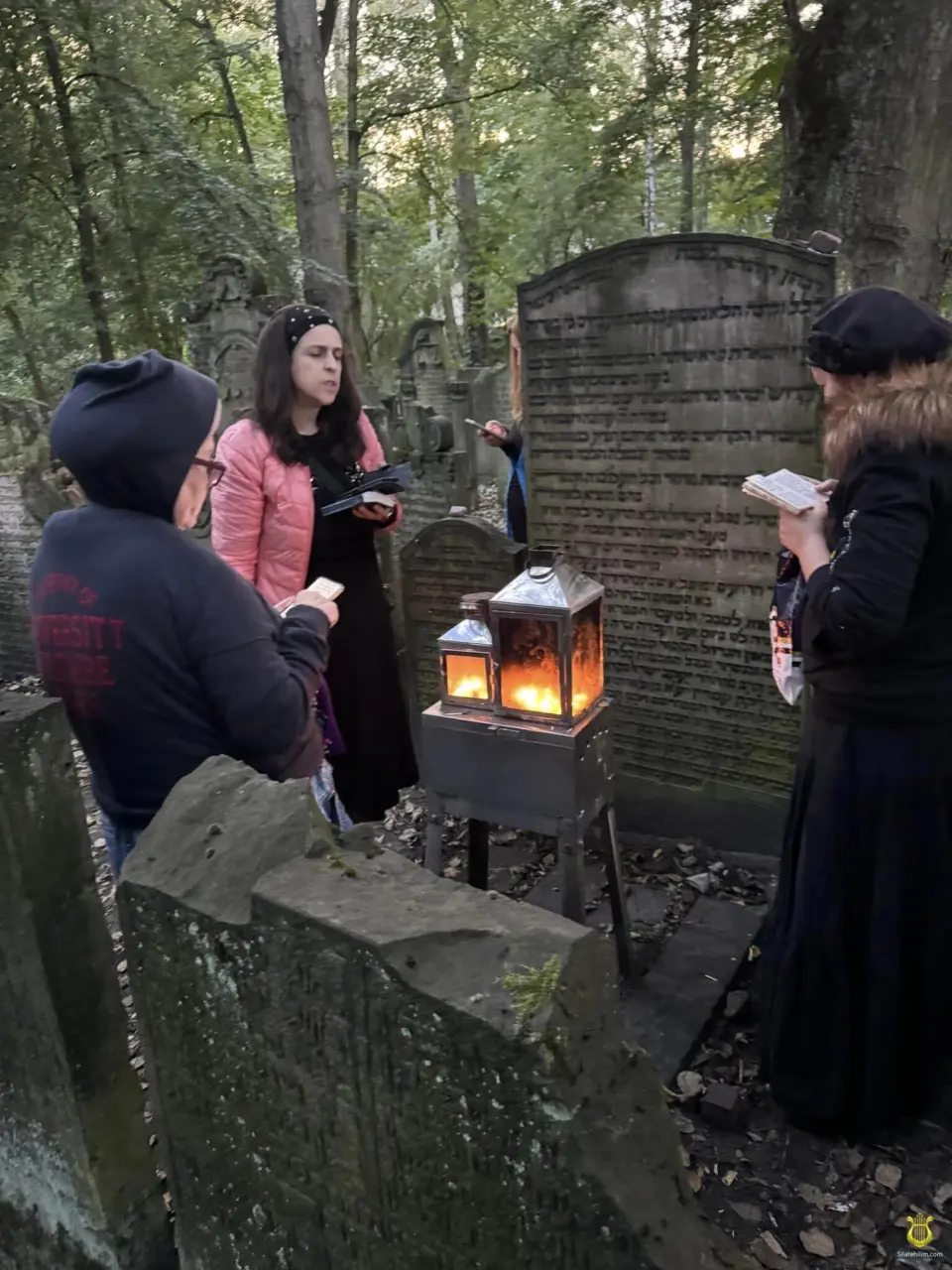
Yahrzeit (Hillula)
- 8 Adar — Rabbi Yosef Yaavetz
- 30 Nisan — Rabbi Yaakov Emden - the Yavetz
Rabbi Yaakov ben Tzvi Hirsch Emden – Yaavetz (son of Chacham Tzvi) (June 4, 1697 — April 19, 1776), was a leading German rabbi and Talmudist who defended Orthodox Judaism against the growing influence of the Sabbatean movement.
Yahrzeit – 30 Nissan
Burial place – Altona, Germany
Although Yaavetz did not approve of the Chassidic movement that arose during his lifetime, his books are highly regarded among Chassidim. 31 of his works were published during his lifetime, 10 posthumously, and the rest remain in manuscript.
Yaavetz was the son of Chacham Tzvi and a descendant of Elijah Baal Shem of Chelm. He spent most of his life in Altona (now part of Hamburg, Germany), where he did not hold an official rabbinic post and earned his living by printing books.
His son was Meshullam Solomon, rabbi of the Hambro Synagogue in London, who claimed the position of head of the Rabbis of the United Kingdom from 1765 to 1780.
Until the age of 17, Yaavetz studied Talmud under his father, Tzvi Ashkenazi, an outstanding rabbinic authority, first in Altona and then in Amsterdam (1710–1714).
Yaavetz
"When I was still a small boy, I asked my father, the Gaon, the pious Rabbi Tzvi, the glory of Israel, why he signed his name simply as 'Tzvi,' without mentioning his father. He answered me: 'These are the initials of "Tzvi ben Yaakov." When you, my son, become a man of Torah and write books and words of wisdom, sign your name as "Yaavetz," which stands for the initials Yaakov ben Tzvi.'"
In 1715, Emden married Rachel, daughter of Mordechai ben Naftali Cohen, rabbi of Ungarisch-Brod, Moravia, and continued his studies at his father-in-law's yeshiva. Emden was well versed in all areas of Talmudic literature; later he studied philosophy, Kabbalah, and grammar, and also attempted to master Latin and Dutch, though he was seriously hindered in this by his conviction that a Jew should engage in secular studies only at times when Torah study was not possible. He was an opponent of philosophy and claimed that the views contained in the "Guide for the Perplexed" could not have belonged to Maimonides, but rather to an unknown heretic. Emden spent three years in Ungarisch-Brod, where he held the position of private lecturer on Talmud. Later he began trading in jewelry and other goods, an occupation that required him to travel.
He usually refused to accept a rabbinical position, although in 1728 he was persuaded to accept the rabbinate of Emden, from which he took his name. However, since he was by nature a man of truth and wished to be independent of anyone's advice, after a few years he resigned and recited the blessing: "Blessed are You, Who has not made me [Av Beit Din]" – a play on words of the morning blessing: "Blessed are You, Who has not made me [a slave]."
In 1733, Emden returned to Altona, where he received permission from the Jewish community to own a private synagogue. At first Emden was on friendly terms with Rabbi Moshe Hagiz, head of the Portuguese-Jewish community in Altona, who later turned against Emden because of slander.
His relations with Yechezkel Katzenellenbogen, the chief rabbi of the German community, were at first positive but quickly deteriorated. A few years later, Emden received a privilege from the King of Denmark to establish a printing house in Altona. He was soon attacked for publishing the siddur (prayer book) "Amudei Shamayim" because of his sharp criticism of influential local moneychangers. His opponents did not stop condemning him even after he obtained approval for his work from the chief rabbi of the German communities. According to Jacob Katz, "Rabbi Jacob Emden: Life and Major Works" (Jacob J. Schacter, unpublished doctoral dissertation, Harvard University, 1988) "superseded" Mortimer J. Cohen's 1937 book "Jacob Emden: A Man of Controversy" as the most authoritative source on Emden.
Most of the community, including R. Aryeh Leib HaLevi Epstein of Königsberg, supported Rabbi Yonatan Eybeschutz; thus the council condemned Emden as a slanderer. People were ordered, under threat of excommunication, not to attend Emden's synagogue, and he himself was forbidden to publish anything from his press. Since Emden continued to defend his position against Rabbi Yonatan Eybeschutz, the council of the three communities ordered him to leave Altona. He refused to do so, relying on the power of the royal charter, and, as he claimed, was subjected to relentless persecution. His life seemed to be in real danger, and in May 1751 he left the city and took refuge in Amsterdam, where he had many friends and where he joined the household of his son-in-law Aryeh Leib ben Saul, an Ashkenazic rabbi. A letter from Jacob Emden to the King of Denmark dated August 20, 1743. In 1756, members of the Council of Four Lands turned to Emden for help in suppressing the Sabbatean movement. Since the Sabbateans relied heavily on the Zohar, Emden considered it prudent to study the book, and after careful study concluded that a large part of the Zohar was the work of an impostor. Emden's works show that he possessed critical abilities rarely found among his contemporaries. He was strictly Orthodox, never deviating in the slightest from tradition, even when differences in time and circumstance might have called for a departure from custom. Emden's opinions were often regarded as extremely unconventional from the standpoint of strictly traditional mainstream Judaism, although not as unusual in the more free-thinking circles of the Enlightenment.
Emden had friendly relations with Moses Mendelssohn, the founder of the Haskalah movement, and with a number of Christian scholars. In 1772, when the Duke of Mecklenburg-Schwerin issued a decree prohibiting burial on the day of death, the Jews in his territories turned to Emden with a request to prove from the Talmud that a longer exposure of the body was contrary to Jewish law. Emden referred them to Mendelssohn, who had great influence with Christian authorities and wrote beautifully in German. Mendelssohn wrote a letter to the duke, but privately complained to Emden that, based on the Talmud, the duke was right. Emden wrote to him in sharp terms, declaring that it was absurd to claim that the custom of the entire Jewish people was clearly wrong, and told Mendelssohn that such statements would only reinforce the rumors of irreligiosity that he (Mendelssohn) had brought upon himself through his associations. On the spread of monotheism, Yaavetz wrote: "We must regard Christians and Muslims as instruments for the fulfillment of the prophecy that knowledge of G-d will one day spread throughout the earth. While the nations before them worshipped idols, denied the existence of G-d, and thus did not recognize G-d's power or retribution, the rise of Christianity and Islam served to spread among the nations, to the farthest ends of the earth, the knowledge that there is One G-d – who rules the world, who rewards and punishes, and who reveals Himself to man."
Sipurei Tzadikim
Once, on a particularly harsh winter day, it was so cold that his students did not make it to the Beit Midrash early in the morning to hear his lecture. They arrived in the afternoon and found their Rav sitting wrapped in a Tallit and tefillin, studying a book. He paused his study and asked them: "Why didn't you come to the Gemara lesson this morning?" "Teacher," they answered, "it was terribly cold and hard to go outside. We were afraid of catching cold." Rabbi Yaakov wanted to raise his head, but realized he could not, because his beard had frozen to the table. He sighed and said, "It seems it is very cold," and then added: "It is written: 'Guard your feet when you go to the House of G-d' [Kohelet 4:17]." And the commentators point out that the letter 'yud' in the word 'raglecha' [your foot] is extra. This 'yud' reminds us of the 10 laws [10 being the gematria of 'yud'] concerning the feet that a Jew must observe. They are:
(1) Do not set out on a journey without praying beforehand; (2) Do not visit anyone early in the morning without having prayed; (3) Do not pray before making sure your body is clean; (4) Running to the synagogue or Beit Midrash is a mitzvah; (5) While in the synagogue, take a step forward before prayer; (6) Do not walk barefoot in the synagogue; (7) One must walk up to four kilometers to find water to wash one's hands before prayer; (8) It is forbidden to walk behind the synagogue while the congregation is praying; (9) One may not stand on a raised platform for prayer; (10) During prayer, the feet must be directed straight ahead. With a smile, Rabbi Yaakov concluded as follows: "So here are the 10 things we are warned about in the verse: 'Guard your feet when you go to the House of G-d,' yet we were not warned that our feet should not go to the synagogue because we might catch cold. However, this is what my father taught me: the verse says, 'be-veit Elokim nehalech be-ragesh' – (we walked to the house of G-d in company) [Tehillim 55:15]. The word 'beragesh' [in company] is formed from the initial letters of 'barad' (hail), 'geshem' (rain), and 'shelег' (snow), for even on such days we must reach the synagogue."
Rabbi Yaakov Emden deeply studied all areas of Torah and wisdom and wrote more than 60 books in his lifetime. He wanted to live in peace, but was constantly besieged by conflict, sorrow, and pain. The wife of his youth died while he was still young, and his beloved son Tzvi was taken from him in the prime of his life. Rabbi Yaakov died at the age of 80, having endured his share of suffering. He was survived by three sons: Rabbi Meshulam Zalman (Rav of the Hamburg Synagogue in London), Rabbi Meir (Rav of Constantinople), and Rabbi Aryeh Yehuda.
May the merit of the Tzadik protect Am Yisrael!
(https://dailyzohar.com/tzadikim/821-Rabbi-Jacob-Emden, https://hevratpinto.org/tzadikim_eng/095_rabbi_yaacov_emden_the_yavetz.html)
Gallery