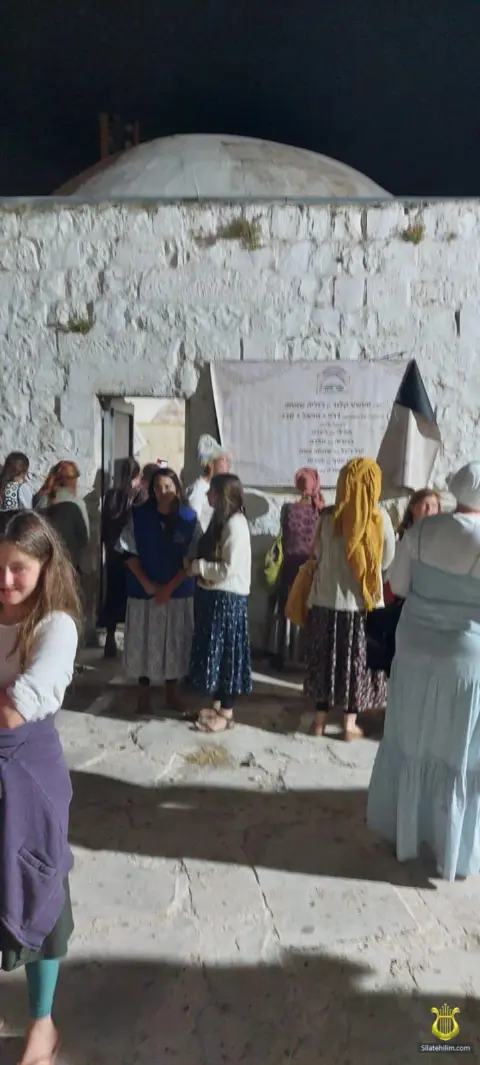
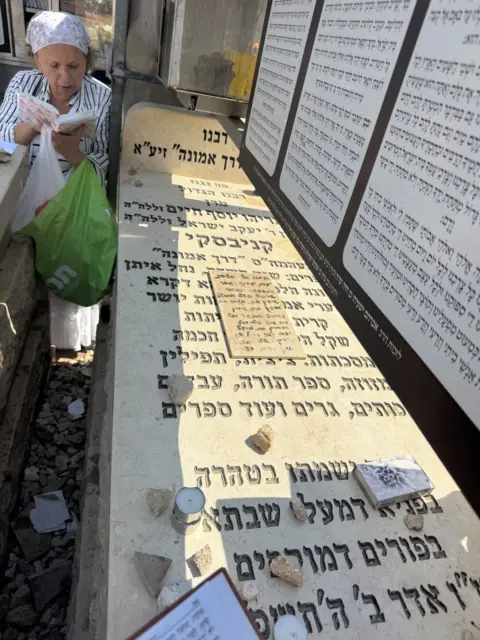
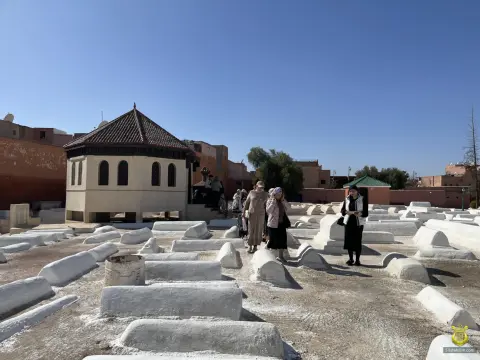
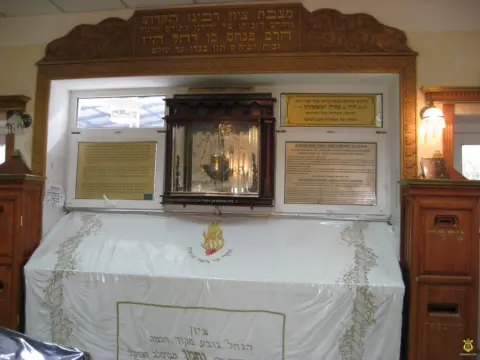
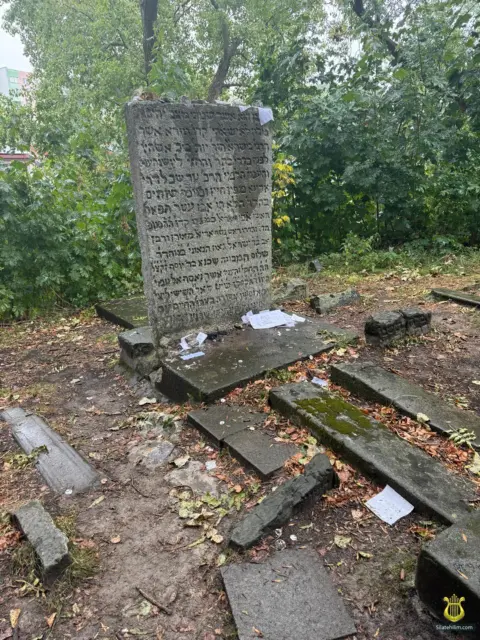
Grave
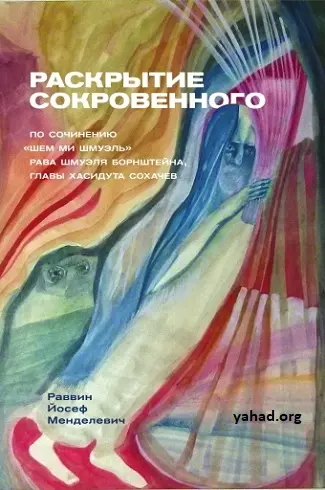
Shmuel Bornstein — "Shem MiShmuel"
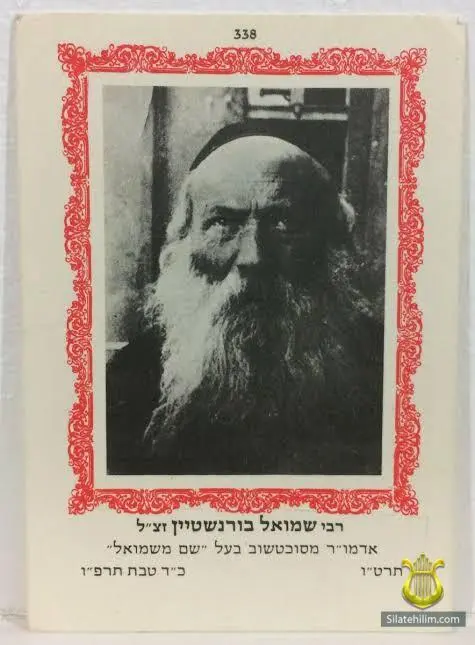
Yahrzeit (Hillula)
- 24 Tevet — Rabbi Shmuel of Sochaczew - the "Shem MiShmuel"
Rabbi Shmuel ben Avraham Bornstein - the Rebbe of Sochaczew - "Shem MiShmuel"
Yahrzeit - 24 Tevet Burial place - Sochaczew, Poland He was born in Kotzk on 2 Marcheshvan to Rav Avraham Bornstein, author of the "Avnei Nezer," and Sarah Tzina, daughter of Rabbi Menachem Mendel of Kotzk. His grandfather passed away when he was about four years old. Despite his young age, thanks to his remarkable memory, he was able to describe his grandfather and the surroundings of Kotzk in detail. At the age of eight he moved with his father to Parczew, where he received his Torah education from his father. In 1873 he married the daughter of Rabbi Lipman Litmanovich, son-in-law of Rabbi Shlomo of Radomsk. In his second marriage, he became the son-in-law of Rabbi Moshe Natan MakShonts. He continued living with his father, who had by then moved to Kruszniewice. Rabbi Avraham held his son in very high regard and often praised him. Rabbi Shmuel edited and proofread some of his father's letters, adding corrections to them. Rabbi Shmuel was unanimously chosen to succeed his father. Like his father, Rabbi Shmuel was a passionate advocate of aliyah to Eretz Yisrael. During World War I he was in Germany and it was only with great effort that he managed to reach Poland and settle in Lodz, and afterward in Zdunska Wola. After Pesach of 1855 he fell ill and passed away on 24 Tevet, 1855. His funeral took place in Sochaczew, where his father buried him. Torah on StonesFrom the moment of crossing the Jordan River and entering the Land of Israel, the entire text of the Torah was required to be inscribed on stones. The Shem MiShmuel asks: "Whenever we speak of the writing of a Torah scroll, the material on which the text is written is specially, carefully prepared parchment - so why, upon entering the Land of Israel, does the material change so drastically, from soft, tanned parchment to stone, upon which the words must be engraved?"
Until the moment the Jewish people entered the Land of Israel, the Torah was not written on parchment, but existed to a much greater degree on a theoretical level. When we speak of the Torah written on parchment, we are speaking of the Torah "written on the tablet of the heart" (Mishlei 3:3). This is contact with the Torah on the level of abstract ideas and inner feelings.When the Jewish people entered the Land of Israel, the situation became fundamentally different: the command to engrave the words of the Torah in stone means that Israel now bore direct responsibility for what happens in the physical world. It was this responsibility that frightened the spies, and as a result, the entire generation was unable to enter the Land of Israel and remained in the desert. This is the very level of fulfillment of the Torah that Moshe Rabbeinu prayed for in the weekly portion of Va'etchanan, yet never merited to attain.
The engraving of the Torah's text in stone after crossing the Jordan River represents a level that had never before been achieved. "Torah in stone" is the penetration of the spiritual into the physical, where even stones (the lowest level of creation) become fully transparent and are illuminated by the light of the Torah.
Segula The Shem MiShmuel says that hyssop (eizov) is a segula against impure spirits, and that in Tractates Sukkah and Parah, the conditions are described as to how many stalks a bundle of hyssop must contain for the mitzvah of the parah adumah. May the merit of the Tzadik protect Am Yisrael!Gallery