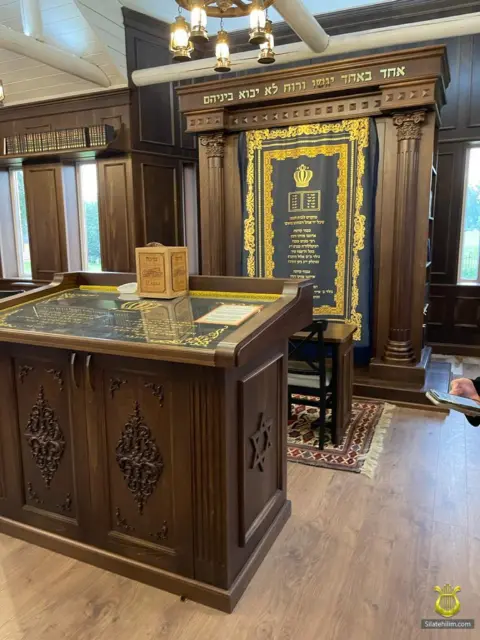
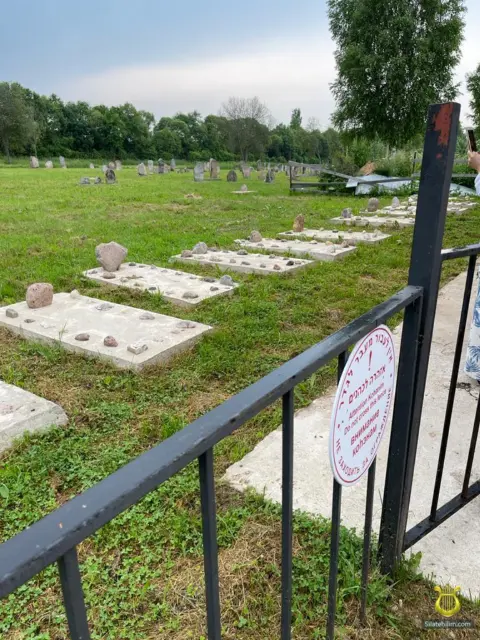
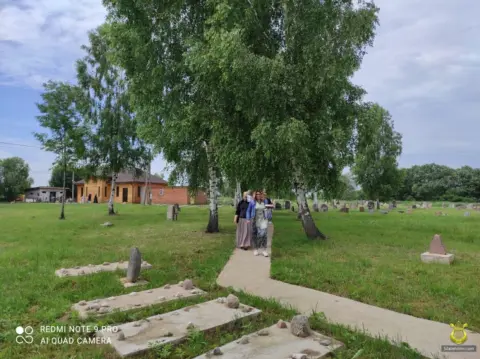
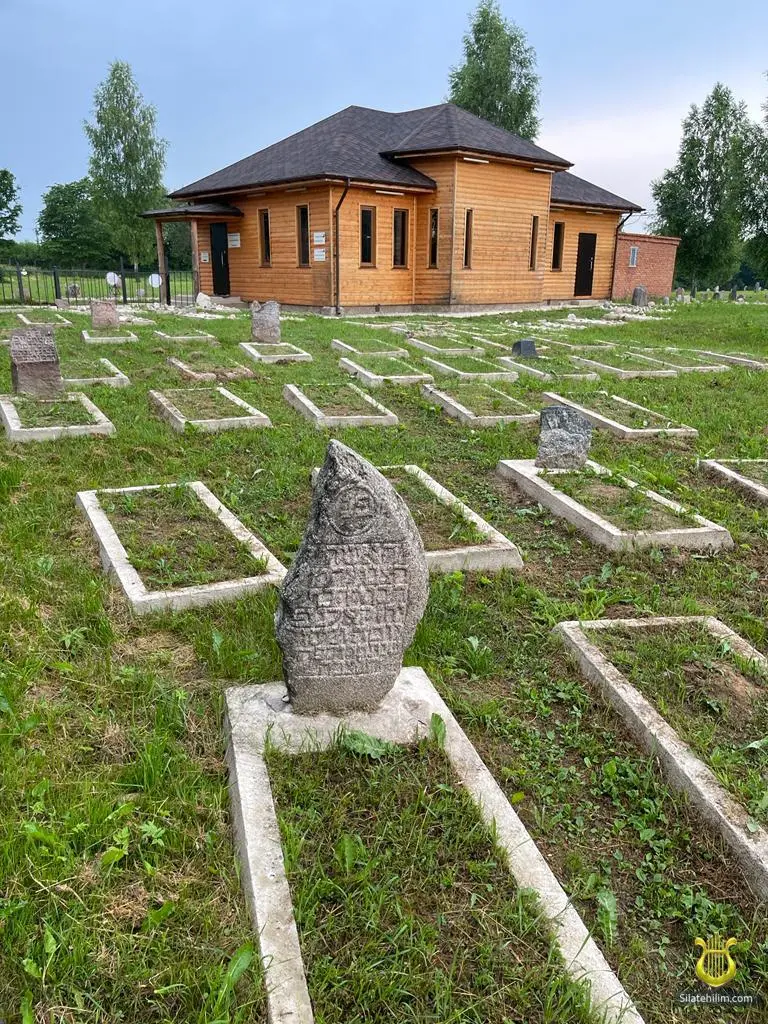
Grave
Tzemach Tzedek
3rd Lubavitcher Rebbe
Yahrzeit (Hillula)
- 13 Nisan — Rabbi Menachem Mendel - the Tzemach Tzedek
Rabbi Menachem Mendel bar Sholom Shachna of Lubavitch
Yahrzeit - 13 Nissan
Resting place - Lubavitch, Smolensk Region
The Rebbe's mother, who was born on the eve of Rosh Hashanah 5549 (1789), was Devorah Leah, daughter of the founder of Chabad Chassidism, Rabbi Schneur Zalman of Liadi (1745-1812). Rebbetzin Devorah Leah passed away three days after Menachem Mendel's third birthday, after which the orphaned child was raised by his illustrious grandfather.
The boy displayed astonishing abilities from a very early age. By the age of twelve he had already authored numerous scholarly works on questions of Halacha and was recording the Talmudic and Chassidic teachings of his grandfather, supplementing them with his own commentaries and explanations. Long before he turned twenty, Rabbi Schneur Zalman invited him to take part in conducting the necessary research and writing responsa to the numerous halachic inquiries pouring in from various Talmudic scholars across Russia and Europe.
When Rabbi Menachem Mendel was only eighteen, his grandfather discovered the manuscript of his famous discourse "The Roots of the Commandment of Prayer" ("Shoresh Mitzvat HaTefillah"), which the young man had been trying to keep hidden from everyone. Rabbi Schneur Zalman was so pleased with his find that he subsequently devoted far more time to studying together with his grandson. And when Rabbi Menachem Mendel was just twenty years old, he was appointed to oversee all of Rabbi Schneur Zalman's communal affairs.
After the passing of Rabbi Schneur Zalman (1813), he was succeeded by his son, Rabbi Dovber (uncle and father-in-law of Rabbi Menachem Mendel). It was then that Rabbi Menachem Mendel began a fourteen-year period of seclusion, which lasted fourteen years. These years of solitude were devoted to study and prayer. In 1826, when Rabbi Dovber was accused of "subversive" activity, Rabbi Menachem Mendel began to take part in public affairs, and his first undertaking was organizing a committee to defend Rabbi Dovber. When Rabbi Dovber passed away in 1827, the Chassidim turned to Rabbi Menachem Mendel and asked him to lead the Chabad-Lubavitch movement. It took him many months to decide to take on the enormous responsibility that came with this position, but in the end he accepted the offer.
Rabbi Menachem Mendel was a very prolific writer. His works represent a unique synthesis of the "esoteric" and "exoteric" aspects of Torah — reflections on the Talmud, Midrash, Kabbalah, and Chassidism coexist harmoniously and naturally, complementing one another. He would, of course, have preferred to write and edit the works of his grandfather and father-in-law rather than lead the tens of thousands who had joined the ranks of the Lubavitch movement. But the era brought new challenges. Jews in Russia were barred from many professions, including certain kinds of business activity, and poverty was spreading. Rabbi Menachem Mendel was deeply concerned with strengthening the economic position of the empire's Jewish population, and accordingly advised the Chassidim to take up farming wherever possible, even providing financial assistance to those who followed his advice.
Settling in villages was not easy for Jews in those days, so the Rebbe purchased a large plot of land near Minsk and settled a large group of Jewish families there. In 1844 he acquired from Prince Shchedrinov another plot of land with forests in Minsk province. Thus the settlement of Shchedrin was founded, and the Rebbe established a council to administer it.
The founding of Shchedrin made a profound impression on both Jews and non-Jews. A report written by an official of Minsk province to the Minister of Internal Affairs speaks of Rabbi Schneerson of Lubavitch with respect and reverence. The document notes that by founding the settlement on the acquired land, the Rebbe improved the living conditions and economic situation of the Jews, and it also mentions the Lubavitcher Rabbi's powerful influence over all the Jews of the "Jewish Pale of Settlement of the Russian Empire" and his efforts to improve their material conditions.
In 1827 Nicholas I issued a decree on "cantonists," under which children from the age of twelve began to be conscripted into the army. Under a set quota, Jewish communities were required to supply ten recruits per thousand people (the quota for non-Jews was lower, and it was easier for them to exempt their children from conscription). The conscripted children were assigned by government officials — either placed in peasant homes or sent to special schools, where they remained until the age of eighteen, after which they were transferred to barracks, where they were required to serve for the next twenty-five years. This meant that children were torn away from home and cheder for a very long time, deliberately alienated from their people.
No parent would willingly subject their child to such a cruel ordeal, but the community was obligated to fulfill the quota. This gave rise to the despicable trade of the "khapers" (catchers), whose job was to seize or kidnap children and hand them over to government officials. Heartbreaking scenes in which children were literally torn from their mothers' arms became commonplace. It was especially hard on the poorer segments of the Jewish population, who had no means to buy their children's freedom from the "khapers."
Rabbi Menachem Mendel took up this problem with great energy, disregarding the possible threats and danger of the situation. It was necessary to save as many already-conscripted children as possible. To this end, the Rebbe formed a special council whose tasks were:
1. To examine the situation of each Jewish community in order to help reduce the number of children it was required to send into military service.
2. To take part in freeing children who had already been seized. This task was carried out by a secret society known as "Tachiyat HaMeitim" ("Reviving the Dead"). The main method of securing release was paying ransom to the officials involved in the matter. The latter would return the children while reporting to the authorities that they had died en route, and would also inform the relevant community of the boy's "death." These "death certificates" brought parents indescribable joy. The "deceased," of course, had to be hidden for a long time (hence the society's name), after which they were sent off to Talmud Torahs far from their home towns.
3. To send trustworthy people to the places where the cantonist children were stationed, whose task was to offer them moral support and encourage them to remain faithful to their religion and their people.
This activity involved not only enormous expense but also great danger, since it was tantamount to treason against the state. Nevertheless, this underground program was carried out successfully, and not a single case of betrayal was ever recorded.
At the same time, Rabbi Menachem Mendel focused his efforts on supporting agricultural centers in the Vitebsk and Minsk areas. He sent one of the leading figures of the Chassidic movement, Rabbi Hillel of Paritch, on a tour of the settlements in the Kherson region. Spending most of his summers there for several years, he not only taught the local Jews Torah and the fear of Heaven in the spirit of true Chassidism, but also instilled in them a striving for brotherly love, mutual assistance, and the cultivation of the foundations of high moral character.
He devoted twelve years of his communal work to providing material support to Jews, protecting children from the "khaper" kidnappers, and looking after the subsequent safety and spiritual support of the cantonists.
Rabbi Menachem Mendel paid special attention to the conditions under which Jewish recruits served in the Tsarist army. He obtained permission for special representatives to be present wherever Jewish units were stationed, to sustain the Jewish soldiers' morale and help them avoid the traps set by cunning Christian missionaries. The Rebbe also gave every possible support to needy students studying Torah in yeshivot and institutions of higher learning.
For many years he continued his work without encountering the slightest opposition from opponents of Chassidism — whether from the religious group known as the Misnagdim or from representatives of the so-called "Enlightenment" (Maskilim). Those were times of peaceful coexistence between Chassidim and Misnagdim. The latter always regarded Rabbi Menachem Mendel's frequent visits to Minsk and Vilna with deep respect and never failed to attend his Chassidic and Talmudic lectures.
The St. Petersburg Conference
In 1843 the Tsarist government decided to organize a conference to address important religious matters, which, at the instigation of the Maskilim, it intended to use to introduce innovations into the school system that contradicted the traditional system of Jewish education. In order to devise an effective plan to counter the threat posed by this conference, a Rabbinical Commission made up of representatives of the Chassidim and Misnagdim was convened, and Rebbe Menachem Mendel was included in it.
The first meeting between Rabbi Menachem Mendel and the Misnagdim leader Rabbi Yitzchak of Volozhin made a favorable impression on both participants. According to eyewitness accounts, the conversation convinced the Misnagdim that the Chassidim were true followers of the Torah, and reassured the Chassidim of the piety and righteousness of the Misnagdim. This renewal of friendly relations and cooperation had, on the whole, a salutary effect on the relationship between Chassidim and Misnagdim. The former rivals reconciled and began working together for the good of traditional Judaism.
At the first session of the conference convened by the government in 1843, Rabbi Menachem Mendel expressed his view that the only legitimate purpose of such a forum could be to raise the level of religious observance and righteousness among Jews; he reiterated that Jewish customs could not be changed, since they "are considered part of the Torah." Although over the four months of this "conference of conferences" the Rebbe received threats from its chairman, a seat occupied by one of the ministers, and was placed under house arrest more than once, his resolve to resist any changes to Jewish customs remained unshakable. "We have not gathered here to legislate," he said. "We have gathered to shed more light and to clarify for ourselves the principles established long before us and set down in the laws of the faith of Moses. And to clarify for ourselves the customs of Israel and to prevent the distortion of G-d's commandments and Jewish traditions."
In the end, not a single one of the changes proposed by the Maskilim was adopted. Rabbi Mendel's resolve and self-sacrifice impressed every one of the participants without exception and further enhanced his already impeccable reputation in the eyes of the public. In 1844, in recognition of his invaluable work at the St. Petersburg conference, Nicholas I granted Rabbi Menachem Mendel the title of "honorary citizen." Such a high honor made a deep impression on the Jewish population of the Russian Empire, and whenever any problem arose concerning the Jewish community of Belarus, people would immediately turn to the Rebbe for help, who could, if necessary, negotiate with the government.
In summarizing the results of the Rabbinical conference, the Rebbe presented the Minister of Internal Affairs with a report on the economic condition of the Jews living within the "Pale of Settlement" and submitted a petition to the government to expand this territory. The minister's response was favorable, and, on the suggestion of one of his advisors, he invited Rabbi Menachem Mendel and two interpreters (Feitelson and Khaikin) to visit him in the capital to work out the proposal in detail. The minister received the Rebbe warmly and assured him that his proposal would be submitted to the cabinet at its next meeting; however, a few days later it became known that the matter concerning the economic condition of the Jews of Vitebsk, Mogilev, and Minsk provinces had not been fully adopted. A decree was issued forbidding the expulsion of Jews from villages and estates if they had already been living on that land. In this way, the position of Jews living in rural areas was secured by law, which in effect expanded the Pale of Settlement.
News of the new decree, secured thanks to Rabbi Menachem Mendel, spread rapidly among the Jews, and hundreds of Jewish families lost no time in taking advantage of the new opportunities. Eager to gain access to the new territory, they backdated their moves so as to fall under the new decree. Over the summer of 1844, several hundred families settled in rural areas, gaining the ability to earn a livelihood. Moreover, as a result of the mass migration of Jews from the cities to the countryside, the problems of overcrowding and competition were eased.
Rabbi Menachem Mendel's personal charisma attracted tens of thousands of Chassidim from every corner of Europe and Russia, and the 38 years during which he led the movement were a time of true flourishing for Chabad. And, like his predecessors before him, he was able to inspire his successors by his own example.
(https://jewish.ru/ru/people/society/9570/)
https://silatehilim.com/%d1%81%d0%b8%d0%bb%d0%b0-%d1%82%d0%b5%d0%b8%d0%bb%d0%b8%d0%bc-%d1%80%d0%b5%d0%b1%d0%b5-%d1%86%d0%b5%d0%bc%d0%b0%d1%85-%d1%86%d0%b5%d0%b4%d0%b5%d0%ba/
https://silatehilim.com/%d0%ba%d0%bd%d0%b8%d0%b3%d0%b0-%d1%82%d0%b5%d0%b8%d0%bb%d0%b8%d0%bc-%d0%be-%d0%b2%d0%b0%d0%b6%d0%bd%d0%be%d1%81%d1%82%d0%b8-%d1%87%d1%82%d0%b5%d0%bd%d0%b8%d1%8f-%d0%b4%d0%b0%d0%b6%d0%b5-%d1%81/
https://silatehilim.com/%d0%ba%d0%b0%d0%ba-%d1%80%d0%b0%d0%b7%d0%bd%d0%b8%d1%86%d0%b0-%d0%bc%d0%b5%d0%b6%d0%b4%d1%83-%d1%81%d0%b5%d1%84%d0%b0%d1%80%d0%b4%d1%81%d0%ba%d0%be%d0%b9-%d0%b8-%d0%b0%d1%88%d0%ba%d0%b5%d0%bd%d0%b0/
Gallery