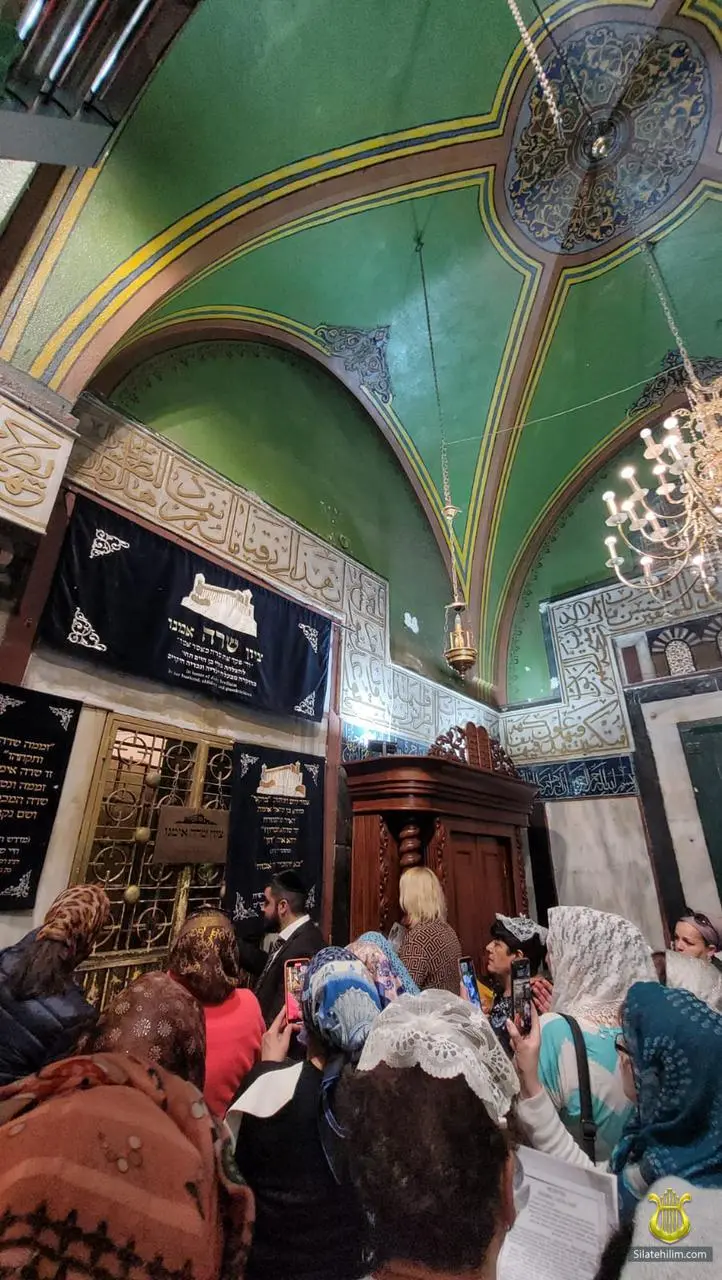
Sarah Imeinu
Only 4 women are called Matriarchs: Sarah, Rivka, Rachel and Leah. (Berachot 16b)
At first Sarah was a princess to her own people, and later she became a princess to the entire world. (Berachot 13a)
Abraham and Sarah were converts (gerim). (Bamidbar Rabbah 8:9). All converts and G-d-fearing people in the world descend from those who drank the milk of Sarah Imeinu. (Pesikta Rabbati 42:23)
The letter "yud," which Ha-Shem commanded to be removed from the name Sarai, stood and wept for many years, until Yehoshua bin Nun came and G-d added it to his name. (Sanhedrin 107a)
The letter "Yud," whose numerical value is 10, was split in half – one half was given to Sarah, and the other half was given to Avram so that he would be called Abraham. (Yerushalmi, Sanhedrin 2:6)
All the years of Sarah's life passed in joy and gladness. (Lekach Tov, Bereishit 23:1).
The 37 years from the birth of Yitzchak until he was bound upon the altar were "the years of Sarah's life." (Bereishit 23:1, Zohar 1:123a)
Avimelech cursed Sarah, and the curse was fulfilled in her descendants, as it is written: "Behold, it is for you a covering of the eyes." (Genesis 20:16)
He said to her: "Since you concealed that Abraham is your husband and caused me so much grief, may you have sons whose eyes will be closed," and this indeed happened to her son, as it is written: "Yitzchak grew old and his eyesight dimmed." (Bava Kamma 93a)
Avimelech gave her royal garments and made her a noblewoman, so that no man would approach her. All heard that she was a Queen and feared her. (Tanchuma, Vayera 27)
Abraham said: "Behold now, I know that you are a woman beautiful to behold." (Bereishit 12:11) From this we learn that until then he had not noticed his wife's beauty, which is normal for other husbands. (Etz Yosef, Tanchuma Lech Lecha 5)
There are 7 known prophetesses in the Torah: Sarah, Miriam, Devorah, Chana, Avigail, Chuldah and Esther. (Megillah 14a)
Sarah's second name was Yiskah. Why was she called Yiskah? From the word meaning "to gaze" – she was able to see things through Ruach HaKodesh. (Megillah 14a)
With no woman in the Torah, except Sarah, did the Almighty speak directly. (Yerushalmi, Sotah 7:1)
The Almighty spoke to all the righteous women through an angel, but to Sarah He spoke directly. (Lekach Tov, Bereishit 23:1)
At the age of 100 she was like a twenty-year-old, meaning without sins deserving heavenly punishment, because from the age of 20 a person becomes liable to heavenly punishment. (Bereishit Rabbah 58:1)
The hymn "Eshet Chayil" was said by King Solomon about Sarah Imeinu, from "aleph" to "tav." (Shochar Tov 112:1)
The Matriarch Sarah was extremely modest. (Bava Metzia 87a)
The Patriarch Abraham brought people under the wings of the Divine Presence, converting them to the belief in the One G-d.
Sarah did the same. He converted the men, she converted the women. (Avot D'Rabbi Natan 12:8)
He – the men, she – the women. (Zohar 1:102b)
(Tzadikim.com)
Chayei Sarah
"And the life of Sarah was a hundred and twenty-seven years; these were the years of the life of Sarah." (Chayei Sarah)
Rabbeinu Moshe Alshich, one of the leading Mekubalim of Tzfat, asks why the length of Sarah Imeinu's life is mentioned twice.
The Gemara says that Abraham Avinu married Sarah Imeinu when she was very young. When she gave birth to Yitzchak Avinu, she was 90, and Abraham Avinu was 100. He was 10 years older than her. When they both fully recognized the Creator, Abraham Avinu was 48 years old and Sarah Imeinu was 38.
In Heaven, only the righteous years of a person's life are called "alive." The years that a person lived without Torah are called in Shamayim "not alive."
Example: a person does Teshuvah at the age of 52 and passes away at 66. In Shamayim, his years amount to 14 "living" years. Based on the Teshuvah, he is judged for 52 "non-living" years.
"And the life of Sarah was" ויהיו – has a gematria of
37.
127 years of Sarah Imeinu's life were counted in Shamayim as a full 127 "living" years. The 37 "non-living" years before she did Teshuvah were joined together with the 90 "living" years.
The reason the length of Sarah Imeinu's life is mentioned twice is that there are two kinds of "living." The first "living" is quantity, and the second is quality. As it is said: "כי בי ירבו ימיך For through Me your days will be multiplied" – this is quality, and "ויוסיפו לך שנות חיים and the years of your life will be lengthened" – this is quantity.
This is why the age of Sarah Imeinu is mentioned twice, saying שני, חיי שרה (secondly, the length of Sarah's life). Her Teshuvah was complete, and therefore she merited having both kinds of "living" – quantity and quality. And through Teshuvah she perfected her "living" years and merited that her 37 "non-living" years be counted as "living."
(Sefer "Derushim on the Torah," Bereishit, Ben Ish Chai)
Gilgulim
The Arizal (may his merit protect us) reveals the gilgul of Sarah Imeinu.
Sarah, Chana, the Shunamite woman, and the woman of Tzarfat – all of them were the gilgul of a single soul.
In Sarah's household there was a threefold blessing connected to three mitzvot: separating challah, lighting candles, and observing the laws of niddah. But the Sages add that Sarah did not fully complete all of these mitzvot, so three other righteous women came afterward and finished what Sarah had begun.
Chana perfected niddah,
The Shunamite woman – candle lighting,
The woman of Tzarfat – challah.
And as another parallel between these women, the commentators point out that all of them experienced miracles and difficulties in having children.
Sarah gave birth at the age of ninety, Chana was childless for nineteen years, and the women of Shunem and Tzarfat experienced miracles of their sons being resurrected from the dead.
https://silatehilim.com/%d0%b3%d0%b8%d0%bb%d1%8c%d0%b3%d1%83%d0%bb%d0%b5%d0%b9-%d0%bd%d0%b5%d1%88%d0%b0%d0%bc%d0%be%d1%82-%d1%86%d0%b0%d0%b4%d0%b8%d0%ba%d0%b8%d0%bc/