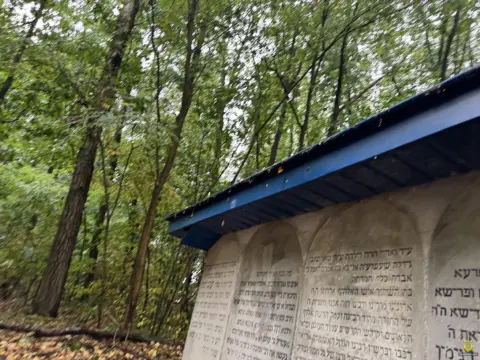
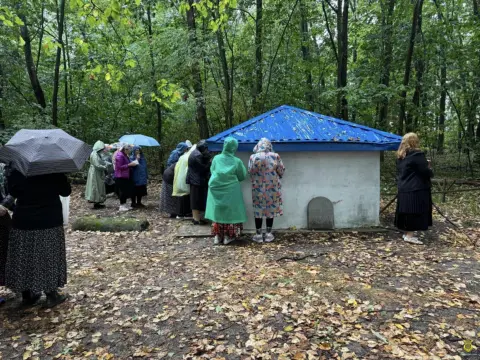
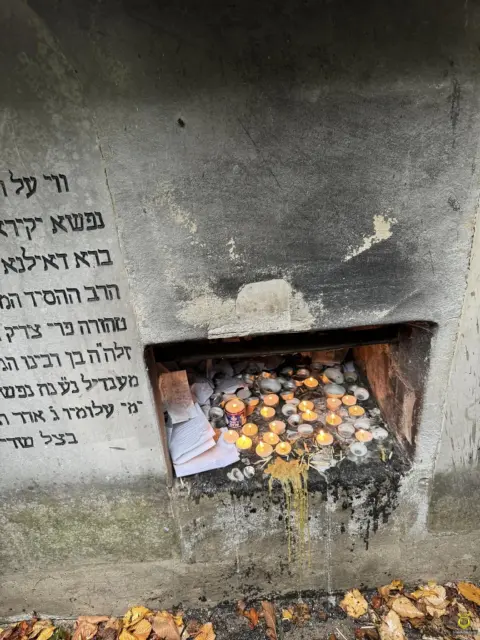
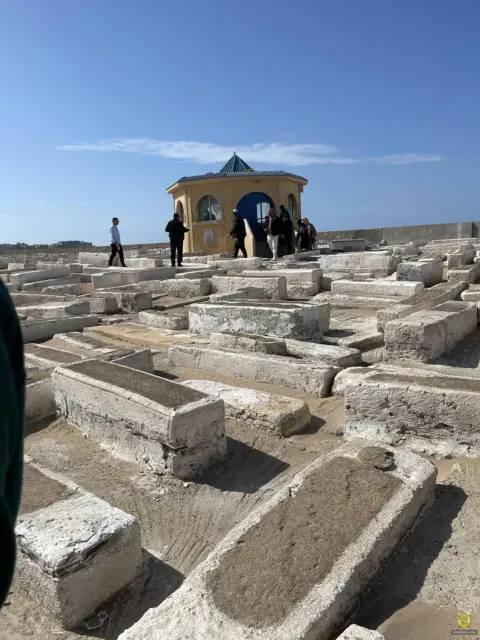
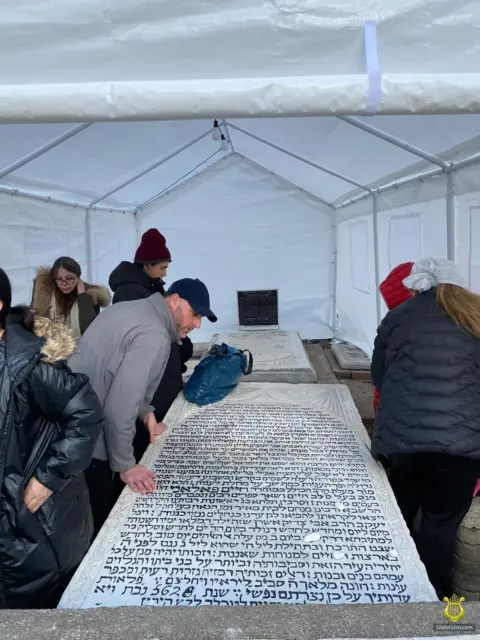
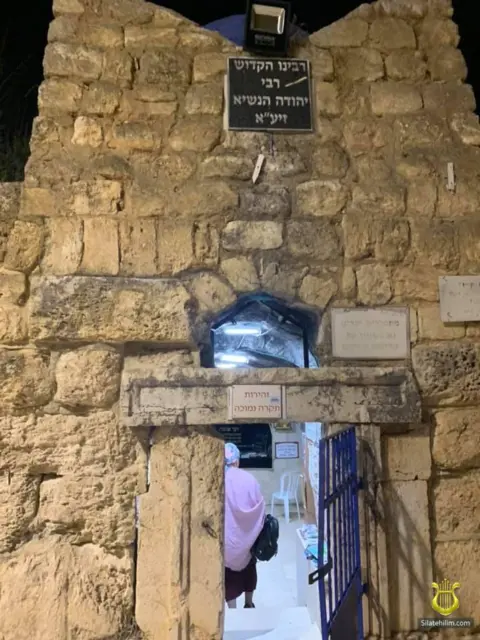
Grave
Menachem Mendel of Kotzk
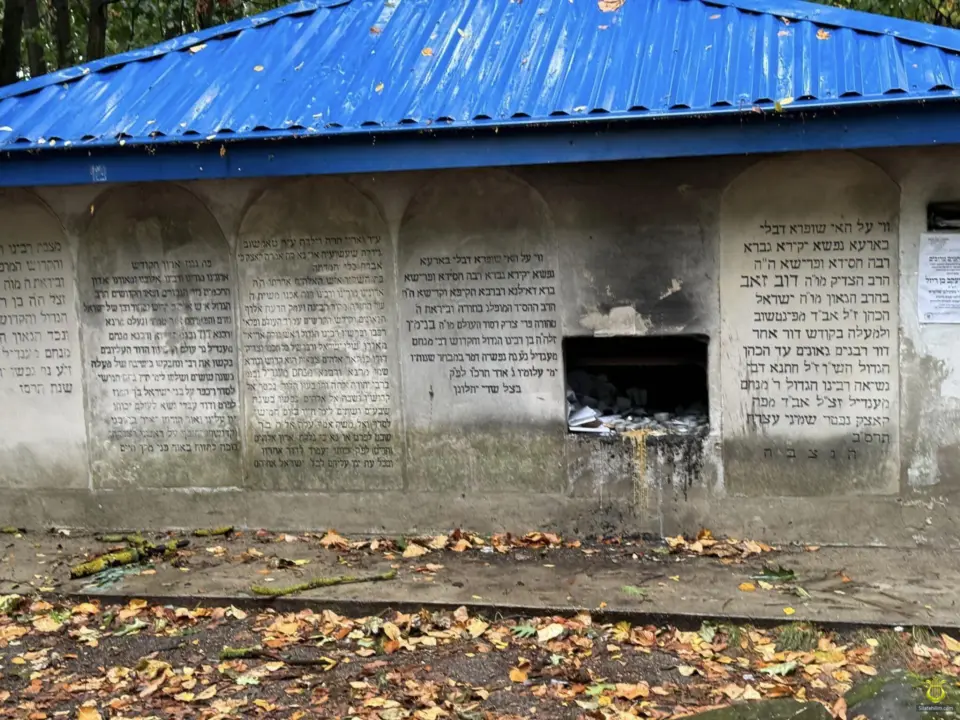
Yahrzeit (Hillula)
- 22 Shevat — Rabbi Menachem Mendel of Kotzk – the Kotzker Rebbe
Rabbi Menachem Mendel Morgenstern of Kotzk – the Kotzker Rebbe (1787-1859)
Yahrzeit – 22 Shevat
Resting place – Kotzk, Poland
Once, after reading Elie Wiesel's book "Souls on Fire," which describes the Chassidic Rebbes in an unusual way, I discovered for myself the greatness of the Kotzker Rebbe's personality, who differed from all others in his incredible concern for the Jewish people and his bright, pointed sayings.
Menachem Mendel received his Torah education from his father, Leibush Morgenstern, a fierce opponent of Chassidism. By the age of 13, he had mastered the entire Talmud. After his marriage at age 14, his father introduced him to the world of Chassidism, and he soon became a devoted follower of the Chozeh of Lublin and Rabbi Simcha Bunim of Peshischa, whom he eventually succeeded.
When he became the Rebbe of Kotzk, thousands of Chassidim flocked to the town, and many outstanding young Torah scholars were drawn to his holy personality and vast Torah knowledge. Among his most outstanding disciples were the Chidushei HaRim of Ger and Rabbi Chanoch of Alexander.
Rabbi Menachem Mendel opened up a new kind of Chassidus. If the Baal Shem Tov embodied "chesed" (kindness), Reb Mendel represented "din" (judgment/strictness). While the Baal Shem Tov sought to embrace all people, Reb Mendel knew that what he sought could only be attained by an elite few. The Baal Shem uplifted people; Reb Mendel rebuked them for their shortcomings and always demanded more. Reb Mendel attracted young, brilliant, driven youth. He demanded scorching self-examination and scorned mitzvot performed with any trace of self-interest. He recognized the centrality of the ego but refused to accept it. An uncompromising champion of truth, he condemned falsehood and hypocrisy.
Through piercing aphorisms that became classics, he compels a Jew to face the truth, strip away all pretense and self-deception, and thereby draw closer to G-d.
He once exclaimed: "Give me ten Chassidim who will follow me into the wilderness, eat manna, and abandon this decadent world." Continuing on the path of Rav Simcha Bunim, he sought to breathe new spiritual power into the movement, making Kotzk a stronghold of Chassidism whose influence is felt to this very day.
A man of deep mystery, the Kotzker Rebbe secluded himself for 20 years, refusing all contact with others. His thoughts and comments were collected and published in "Ohel Torah" and "Emet ve-Emuna."
He was an awe-inspiring figure who left an indelible mark on Chassidic thought. The wisdom of the Kotzker Rebbe was also recorded in the book "Amud HaEmet." Instructive stories from the life of the Kotzker Rebbe are also related by Martin Buber in his "Tales of the Chassidim," which reveal the full wisdom, depth, and individuality of the Kotzker Rebbe. Here are some of them.
I Am Shabbat
Rabbi Mendel of Kotzk once said to one of his Chassidim: "Do you know who I am? There was Rabbi Ber, and there was Rabbi Shmelke, and there was Rabbi Elimelech, and there was the Rabbi of Lublin, and there was the holy Yehudi, and there was Rabbi Bunim. I am the seventh. I am the quintessence of them all. I am Shabbat."
The Soul
Regarding his soul, Rabbi Mendel of Kotzk once said to his son-in-law: "My soul is from the times before the destruction of the Temple. I am no equal to the little people of today. And I came into this world to draw a distinction between the holy and the profane."
The Heavens
A tzadik who opposed the Rabbi of Kotzk sent him a message: "I am so great that I have reached the seventh heaven." To which the Rabbi of Kotzk replied: "And I am so small that all seven heavens rest upon me."
The Fur Coat
The Rabbi of Kotzk once said of a certain well-known rabbi: "This is a tzadik in a fur coat." His students asked the Rabbi to explain what he meant. "In winter," the Rabbi explained, "one man buys a fur coat, and another buys firewood. What is the difference between them? The first wants to warm only himself, while the second wants to warm others as well."
Where G-d Dwells
"Where does G-d dwell?" Rabbi Mendel loved to surprise learned visitors who came to see him with this question. They would begin to laugh: "What kind of question is that! Is not the whole world filled with His glory?" And then Rabbi Mendel would give his own answer: "G-d dwells wherever man lets Him in."
The Setting
Rabbi Mendel used to say: "The larger and more beautiful the gem, the larger its setting. The greater and more magnificent the soul, the greater its 'shell.'"
A False World
Rabbi Mendel of Kotzk and Rabbi Yitzchak of Vorki had studied together under the wise Rabbi Bunim, and were friends whose brotherly relationship was never disturbed. However, their Chassidim held differing views on the teachings and did not always agree. One day the two tzadikim happened to be in the same town. After exchanging greetings, Rabbi Yitzchak said: "I have good news. Our students have finally made peace with one another." But this angered Rabbi Mendel, who exclaimed, his eyes flashing: "Then the forces of deception are gaining the upper hand, and Satan will soon banish truth from this world!" "What are you saying?" Rabbi Yitzchak asked in bewilderment. Rabbi Mendel continued: "Do you remember what the Midrash says about how G-d was preparing to create man, and how the angels were divided in their opinions? Love said: 'Let him be created, for he will be created for love.' Truth said: 'Let him not be created, for he will become a source of deception.' Justice said: 'Let him be created, for that will be just.' Peace said: 'Let him not be created, for he will become a source of disputes and quarrels.' What did G-d do? He seized Truth and cast it down to the earth. Have you ever pondered this story? It sounds rather strange, doesn't it? Truth is cast down and no longer stands in the way of man's creation. But what did G-d do about Peace — what answer did He give to Peace?" The Rabbi of Vorki was silent. "Well, judge for yourself," said Rabbi Mendel. "Our sages teach us that disputes and quarrels for the sake of Heaven are, from the outset, bound up with Truth. After Truth was cast down, Peace realized that peace without truth is a false peace." What cannot be counterfeited? The Rabbi of Kotzk said: "Everything in the world can be counterfeited — except truth. Because a counterfeit truth ceases to be truth."
High Prices
Once, when prices in Kotzk and the surrounding area rose sharply, the Chassidim who had come to the Rabbi for Shabbat wanted to head home the very next day, but the Rabbi kept delaying their departure. His wife was busy at the stove when he came into the kitchen, smoking his pipe. "Mendel," she said, "why are you keeping the Chassidim here? Prices at the inn are so high, and they have to pay so much for food!" "Why has food become so expensive?" said Mendel. "Because people are constantly eating. If they were constantly studying instead, then study would become expensive, and food would be cheap."
Miracles
Rabbi Mendel of Kotzk was told about a man who possessed the wondrous secret of how to create a golem. "That is not much," the Rabbi replied. "But does he know the secret art of creating Chassidim?"
Like a Cooper
One day, Rabbi Mendel of Vorki, son of Rabbi Yitzchak of Vorki, emerged from Rabbi Mendel of Kotzk's room drenched in sweat. He sat down on the bench by the entrance to catch his breath, and said to the Chassidim gathered around him: "Well, let me tell you, our holy Rabbi took me apart piece by piece — he tested me the way a cooper tests a barrel."
How Things Are Done
A Chassid of the Rabbi of Kotzk and a Chassid of the Rabbi of Chernobyl were discussing how things were done in their respective communities. The disciple of the Rabbi of Chernobyl said: "We stay awake all night from Thursday to Friday; on Friday we give charity according to our means; and on Shabbat we read the entire Book of Psalms." "And we," said the Chassid from Kotzk, "stay awake every night for as long as we have strength, we give charity whenever we encounter someone in need — provided we have the money at that moment — and we read whichever Psalms are fitting for the occasion, rather than all of them at once — for it took David seventy years of hard labor to compose the entire Book of Psalms."
Do Not Steal
Rabbi Yechiel Meir of Gostynin spent Shavuot as a guest of his teacher in Kotzk. When he returned home, his father-in-law asked him: "Well, do the people there understand Torah differently than elsewhere?" "Of course," his son-in-law replied. "How so, exactly?" the father-in-law asked. "Well, take this example," said Rabbi Yechiel. "How is the commandment 'Do not steal' understood there?" "It means one should not steal from one's fellow," replied his father-in-law. "To my mind, that's quite clear." "Then there would be no need to even mention it. But in Kotzk this commandment is understood as: do not steal from yourself!"
The Difference
When the dispute between the Chassidim of Kotzk and the Chassidim of Radoshitz was at its height, Rabbi Yissachar Ber of Radoshitz said to a Chassid of Kotzk: "Your teacher believes that if a man cannot climb over an obstacle, he should crawl beneath it. But I believe that even if he cannot climb over the obstacle, he must keep trying anyway." Rabbi Yitzchak Meir of Ger, a disciple and friend of the Rabbi of Kotzk, described this difference in another way (when a Chassid of the Rabbi of Radoshitz visited him after his teacher's death): "The whole world believes that there is a rift bordering on hatred between Kotzk and Radoshitz. But this is not so at all. In truth, we differ on only one point: in Kotzk they strive to bring Jewish hearts closer to their Father in Heaven, while in Radoshitz they strive to bring the Father in Heaven closer to Jewish hearts."
Between Kotzk and Izbica
Some time after Rabbi Mordechai Yosef of Izbica finally broke off relations with Kotzk and founded his own community, a certain Chassid who had followed him to Izbica passed through Kotzk and went to visit the Rebbe. Rabbi Mendel looked at him closely and asked, "Who is this?" — as though he were seeing this Chassid for the very first time in his life. And when the Chassid, with great anguish of soul, asked, "Does the Rabbi not recognize me?" the Rabbi replied: "It cannot be that this is you! For our sages say: 'Let the fear of your teacher be like the fear of Heaven.' And can there be two heavens?" Tell the children of Israel: "When a disciple of the Rabbi of Leshno came to see the Rabbi of Kotzk, the latter said to him: 'Give my regards to your teacher. I love him very much. But why does he cry out to G-d to send the Mashiach? Why doesn't he instead call upon the children of Israel to turn their hearts to G-d? For it is written: "Why do you cry out to Me? Speak to the children of Israel."'"
Three Pillars
Rabbi Mendel used to say: "This world stands on three pillars: Torah, service of G-d, and good deeds; and as the world moves toward its end, the first two pillars will crack, and only good deeds will remain unshaken. And then it will be fulfilled as it is written: 'Zion shall be redeemed through justice.'"
The Cherished Moment
The Rabbi of Kotzk said: "Generation after generation has made efforts to hasten the coming of the Mashiach; each generation did everything within its power, yet without success. It turned out that no one has the power to hasten the coming of the Mashiach. But the day will come when all Jews will be laboring to earn their daily bread, and their souls will be filled with confusion — and then he will come."
Those Who Cannot Pray
On the eve of Yom Kippur, Rabbi Mendel said to one of his Chassidim: "Hersh, you will pray for those Jews who cannot pray for themselves — for those who are out in the fields and in the forests, for those who are here and those who are not, and not only for the living but for the dead as well. For believe me, our house of prayer is filled with souls!" A Shelter of Love Rabbi Mendel was once asked: "In earlier times all the Chassidim loved one another. Why is it different now?" He answered: "In Heaven there is a shelter of love. It was founded by the Rabbi of Berditchev for all of humankind, and that is why the Chassidim were filled with love for one another. But the wicked also found their way there, seizing our love for their own mundane loves. And so the tzadik was forced to close that shelter."
A Corner
It is written: "He sets a boundary for darkness." Whenever he read these words, Rabbi Mendel would say: "Just one small corner — G-d left one small corner in the darkness, so that man would have a place to hide."
Why Should I Write a Book?
Rabbi Mendel's Chassidim asked him why he never wrote a book. Finally he gave them this answer: "Suppose I wrote such a book. Who would buy it? Our Chassidim. But when would they read it, if all week long they are busy earning their living? Suppose they could read it on Shabbat. But when would they find the time on Shabbat? First they go to the mikveh, then they must study and pray, and then comes the time for the Shabbat meal. But finally the meal is over, and one could sit down to read. So, one of the men who bought the book lies down on the couch and opens it. But after a hearty meal, he is overcome with drowsiness. His eyes close, and the book slips from his hands onto the floor. So tell me, why should I write this book?"
How to Remove a Severe Illness Through Selichot
https://silatehilim.com/как-через-слихот-убрать-злую-болезнь/
May the merit of the Tzadik protect Am Yisrael!
(https://dailyzohar.com/tzadikim/165-Rabbi-Menachem-Mendel-of-Kotzk)
Gallery