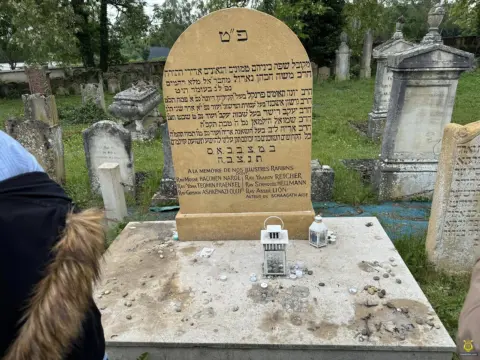
Grave
The Maharal of Prague
Yahrzeit (Hillula)
- 18 Elul — Rabbi Yehuda Loew – the Maharal of Prague
Rabbi Yehuda Leib Loew ben Betzalel – the Maharal of Prague (Morenu Ha-Rav Rabbi Loew) – (our teacher Rabbi Loew).
Yahrzeit - 18 Elul;
Resting place - Prague, the Old Jewish Cemetery;
The Maharal descended from the line of King David and was his direct descendant in the 95th generation on his father's side. Rabbi Loew's ancestors were well-known rabbis who had lived, beginning in the 12th century, in Alsace and the Rhineland. He was the youngest of four brothers. He married late, at age 32, to Perl, and was the father of six daughters and one son, named Maharal Betzalel. The Maharal was born in the Polish city of Poznań, on the night of the Passover Seder in the year 1525.
Born During a Blood Libel
The priest stared intently out the window at the gate. It was clear he was impatiently waiting for someone. He paced the room like a madman and finally exclaimed angrily: "Curse that vile drunkard!"
Suddenly the gate opened and a muscular peasant with disheveled hair entered the yard.
– Oh, Peter, – the priest exclaimed, brightening. – Welcome!
The priest offered him a glass of wine, and Peter drank it down in one gulp.
– Well, did you like the wine? – asked the priest.
– Yes, Father, – Peter said, licking his lips and eyeing the jug.
– My son! – the priest raised his voice, – I have a task for you, for which you will receive two barrels of such wine, and a great deal of money.
Almost in a whisper, the priest began to lay out his plan. Peter was to catch a Christian boy, kill him, and, under cover of night, plant the body in the house of a respected Jew. Such a devoted act would make it possible to slander the Jews with the traditional blood libel and incite a pogrom. If Peter had any doubts about the righteousness of this plan, they dissolved instantly at the sight of the pouch of money the priest handed him.
– This is a down payment, – the priest promised, – you'll get the rest after the job is done.
The Jews were preparing for the festival of Pesach. A festive atmosphere reigned in the home of Rabbi Betzalel of Worms as well. The rabbi, his sons, and several guests had returned from the synagogue. Everyone sat down around the table; the rabbi read the Passover Haggadah, and all the others recited it with him.
Suddenly the rebbetzin felt the onset of labor. She did everything she could not to disturb the festive ritual, but she could not hold back, and a deep groan escaped her. Those present rushed to fetch a midwife.
At that very same moment, Peter, the priest's messenger, was making his way to plant the sack with the body in the yard of the universally respected Rabbi Betzalel. Peter could not understand how these Jews had found out what he intended to do and had set off in pursuit of him. He turned and fled in a panic. His running with the sack bouncing on his back drew attention, and soon people were chasing him and surrounding him. The crime was exposed. And in Rabbi Betzalel's house there was double joy: the rebbetzin had given birth to a boy, Yehuda Loew, who would later become famous under the name Maharal.
The newborn's father said: "This is our comforter! For his very arrival into the world thwarted a blood libel, and it plainly hinted at his role in the world: to save his fellow Jews from their wicked enemies."
And so it was, in time to come. He became renowned not only for his great scholarship, but also for his deep concern for his people.
At the age of 28 he was chosen as rabbi of the city of Nikolsburg and Chief Rabbi of all Moravia. He held this position for 20 years. In 1573 the Rabbi moved to Prague – a city which had by then become the capital of the Habsburg Empire. And although the Maharal returned to Poznań several more times, where he first served as rabbi of the city and then as Chief Rabbi of all Poland, it was Prague that became the city where his yeshiva operated and where all his major books came to light.
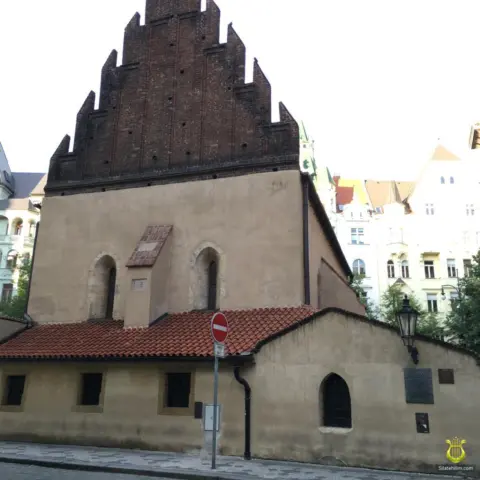
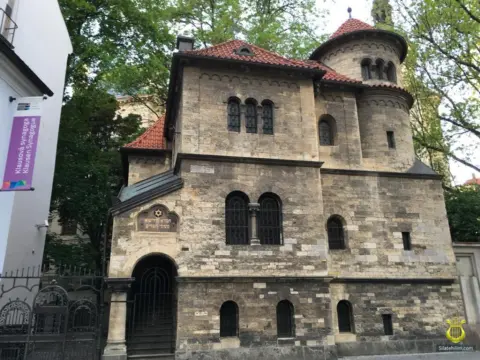
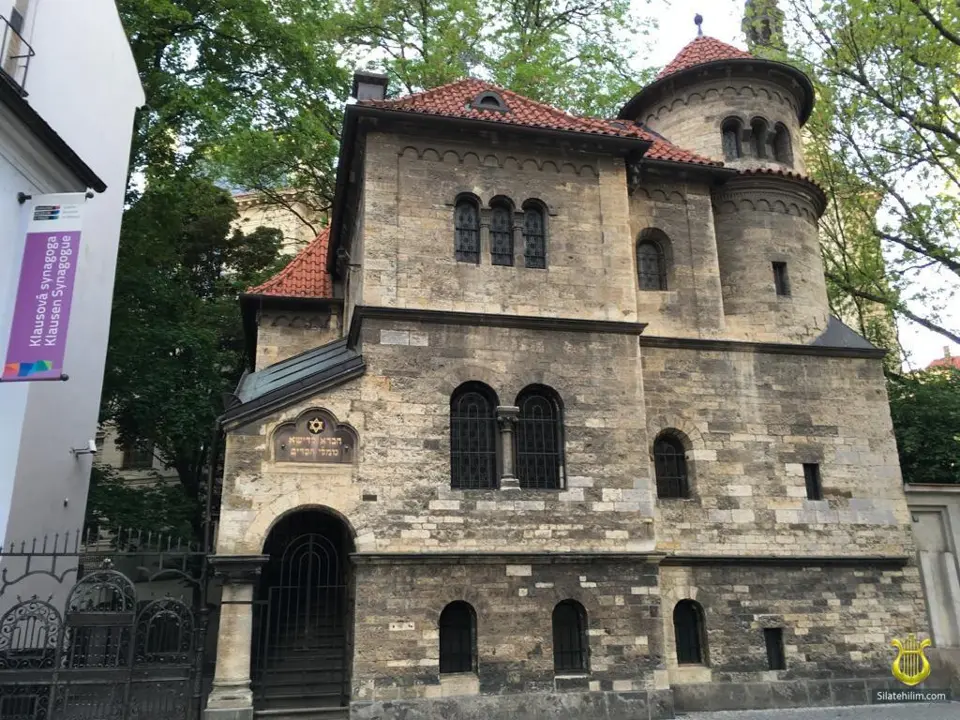
To this day, in Josefov – the Jewish quarter of Prague – the ancient "Old-New Synagogue" still stands, where the Maharal prayed, and not far from it stands the building of the yeshiva he founded in 1573, known as the "Klausen Synagogue." The yeshiva was built with funds from the banker and philanthropist Mordechai Maisel. The Maharal remained the unbroken head of the yeshiva for 36 years and raised dozens of outstanding students. One of them – Rabbi Yom-Tov Lipmann Heller, author of the famous commentary on the Mishnah.
The Maharal's teachings became a classic of Judaism: many "universally accepted" ideas and commentaries used everywhere without attribution actually belong to him.
For example, the Maharal was the first to write that the human body reflects the universe. Each of the 613 principal organs of the human body corresponds to some part of creation and to a particular mitzvah of the Torah – for the Torah, as is known from the Midrash, served the Creator as the blueprint for creating the world.
Among the works left behind by the Maharal are: "Tiferet Yisrael" – on the greatness of the Torah and the mitzvot, "Netivot Olam" – mussar, "Be'er HaGolah," "Netzach Yisrael" – on exile and redemption, "Or Chadash" on the Book of Esther, "Ner Mitzvah" – on Chanukah, "Gevurot Hashem" – on the Exodus, and others.
The Golem
The artificial man made of clay was created by the Maharal to protect the residents of the ghetto from enemies and their blood libels. On the Golem's forehead the Rabbi wrote one of the secret names of G-d – and the clay man came to life. He carried out various tasks and struck terror into the enemies of the Jews of Prague. When the blood libels ceased, the Maharal told his son-in-law, Rabbi Yitzchok Cohen, and his student Rabbi Yaakov Levit, that the Golem's services were no longer needed. A question arose: does the Golem, after his "death," render one ritually impure like all people, or not? The Maharal explained that even if flesh and bones remain after the Golem's death, as with all people, he does not render impurity, because he was not born but created. Moreover, the Golem would turn back into a lump of clay and earth, as he had been before.
Therefore the Maharal took his son-in-law with him up to the attic to destroy the Golem, even though he was a Kohen. At midnight on Lag BaOmer, 18 Iyar 1590, the Maharal ordered the Golem to carry his bed with its bedding up to the attic of the great synagogue and to sleep there. The three of them went up to the attic. The Maharal also allowed the old shamash, Rabbi Avraham-Chaim, to come with them. He told him to hold two burning candles while standing at a distance.
The Golem slept. Following the Maharal's instructions, they performed everything in reverse order from what they had done at his creation. At his creation they had stood by his feet – now they stood at his head. Then they had circled him seven times from right to left; now, seven times from left to right. Now, too, they recited the same verses, but in reverse order. (G-d-fearing Jews who know the "Sefer Yetzirah" (the Book of Creation) perfectly understand the secret of creation and also know the secret of undoing a creation.)
After this rite, the Golem turned into a hardened lump of earth in the shape of a man. The Maharal called the old shamash over and took the candles from him. They undressed the Golem, leaving only an undershirt on him, wrapped his body in old tallitot, tied them, and laid him beneath a pile of worn-out tallitot, books, and other sacred items so that no one would notice that someone lay resting there. The Maharal ordered the old shamash to burn the Golem's bedding and clothing.
In the morning a rumor spread through the city that the Golem had taken offense and run off somewhere in the night. A week later the Maharal had everyone notified that he strictly forbade anyone to enter the attic, lest a fire break out if someone carelessly lit a candle. The Maharal said that the Golem's spirit would be resurrected at the time of the revival of the dead, but not in his first body, that of Joseph, an impure spirit, and not in his second body, Yosele the Golem, but in a third body. He would not be created as before – he would be born to a great tzadik shortly before the coming of Mashiach, in order to accomplish a great and important task. However, it might also happen that he would be given the opportunity to revive his two previous bodies.
The Bayonet
Rabbi Chaim, the shamash of the Prague "Altneuschul", synagogue, had a custom of going up to the attic of the ancient synagogue about twice a year with a full basket of worn-out prayer books, tattered tallitot, tefillin straps, and other sacred items. He would open the side door in the corridor, climb the ancient steps, and reverently unlock the metal doors with a large iron key. Step by step, trembling with fear, he would enter the dimly-lit attic, illuminated by two small windows set just beneath the roof.
With slow steps he made his way to the spot where the Golem's remains lay at rest: a pile of clay beneath a heap of worn-out sacred items. A metal chain stretched around this heap gave the "grave" the appearance of a headstone. Rabbi Chaim would empty out the basket and leave.
This custom was established by the famous Maharal more than four hundred years ago. Over the years, an enormous number of baskets had been emptied there, but – remarkably! – the size of the heap never changed.
In 1939, just before the Nazis occupied Czechoslovakia, Rabbi Chaim carried up his last full basket. Throughout the nightmare of the Second World War he was shuttled from one concentration camp to another, and he remained – among the very few fortunate ones – alive after the Holocaust.
As soon as the forces of the United Nations liberated him, he hurried to Prague, to the old city, to the "Altneuschul," to the place that had once been the Jewish ghetto, where this synagogue had been built back in the thirteenth century.
He stopped by the synagogue and gazed at it for a long time. Outwardly it had scarcely changed. Thank G-d – the Nazis had not dared lay their hands on the oldest synagogue in Europe. He prayed silently and hoped that these beasts had not changed it inside either. He knocked on the door of the old Czech caretaker.
The old Czech had faithfully carried out his duties. He barely recognized Rabbi Chaim, who had aged beyond recognition, but his height left no room for doubt. Rabbi Chaim had once been the tallest man in the synagogue, and now his stooped figure and bent shoulders were but a shadow of that. The old caretaker rejoiced that the Rabbi had returned to the world of the living. He opened the doors. Rabbi Chaim entered the synagogue that was once so familiar to him, looked around, and his eyes filled with tears so that he could see nothing. His lips whispered a prayer. He thanked G-d for keeping him alive and for granting him the chance to see this holy place once more.
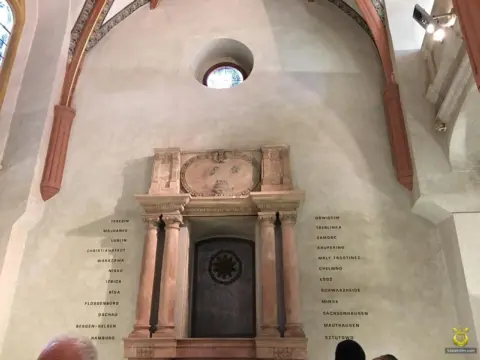
Coming to himself, he noticed a few changes. Instead of candles, electric lightbulbs now illuminated the synagogue, and the floor had been covered in concrete. Everything else remained as it had been. The old Czech explained that this had been a Nazi propaganda operation, undertaken in the first days of the occupation to prove that they were not the barbarians everyone thought them to be. They had made improvements to the synagogue, filled it with Jews brought from the concentration camps, ordered them to put on tallitot and pray. They photographed the scene to show what a cultured people they were, protecting ancient synagogues and granting Jews complete freedom to observe their religion.
Rabbi Chaim was glad the Nazis had made no further "improvements."
– And what's up there? – he asked. – Come, I'll show you, – answered the caretaker. He opened the door, and they climbed the steps. The caretaker opened the heavy iron door. Rabbi Chaim stopped, looked around anxiously, stepped forward, and… froze.
He stared, stunned, at something strange protruding from the pile of sacred items covering the Golem. It was the handle of a bayonet, driven into the heap.
– What is that? – burst from his lips,
– Oh, that's quite a story! – the Czech replied, not the least bit embarrassed.
– Listen. The day after the occupation of Prague, two German generals appeared, accompanied by a group of armed soldiers. One of them, the older one, turned to me:
– We've heard the legend of the Golem. Is it true that he's buried in the synagogue attic?
I answered that the story of the Golem is not a legend, but the truth.
– Then take us up to the attic! – the general ordered. I tried to stop them, so that they would not commit their malicious act, but the general impatiently cut me off. I had no choice, and I led them up to the attic.
– Where is he? – asked the general.
I pointed to the pile of sacred items. The generals approached, looked, and one of them exclaimed in disappointment:
– This is just a heap of rubbish and nothing more!
– G-d forbid, – I retorted, – this is not rubbish, these are worn-out religious articles, and beneath them lie the remains of the Golem.
– Clear away the junk, – the general ordered in a threatening voice. I begged them:
– My lords, my benefactors, it is strictly forbidden to touch this. So ordered the holy rabbi who created the Golem, and who afterward laid him here to rest forever. Allow me to observe, with all due respect, that desecrating this holy place is dangerous and brings great misfortune.
– Nonsense! – growled the young general, – clear away the junk right now, or…
He drew his revolver, aimed it at me, and repeated the order.
– I cannot, – it is forbidden, – I begged and pleaded for mercy, but I did not move from my spot, despite the loaded revolver aimed at me.
– Leave him be, – said the old general to his younger colleague. He called one of the soldiers over and ordered him to clear the heap. The soldier approached and thrust his bayonet into the pile of sacred items. But a moment later a loud scream filled the room. The soldier fell onto his back, his whole body convulsing. And there he remained, lifeless. Both generals were shaken. They quickly left the attic. Two soldiers hurriedly carried away the body.
– After that incident, the Germans never dared visit the synagogue attic again, – the old Czech finished his remarkable story.
Rabbi Chaim did not stay in Prague. There was nothing left for him to do there. The Jewish world that had been so dear to him had vanished. He made his way to America, alone, sorrowful, accompanied by many memories. The most striking memory he carried within him was the bayonet, symbol of the murderous Nazi power, driven into the pile of sacred items on the Golem's grave, in the attic of the Altneuschul synagogue in Prague.
The Emperor's Dream
In 1592, Emperor Rudolf II, who had a passion for alchemy and Kabbalah, invited the Maharal to his palace for an audience. The sage's personality made a tremendous impression on Rudolf. It is perhaps thanks to this that the Jews of Prague managed to avoid being expelled from the city, an expulsion that the local nobility and the Catholic Church had persistently sought.
Many wondrous stories are told about the great gaon and kabbalist, Rav Yehuda Loew, Chief Rabbi of the renowned community of Prague. Here is one of these wondrous stories.
On a fine winter's day in the year 5352 (1592), a royal messenger arrived early in the morning at the Maharal's house and invited him to come at once to Emperor Rudolf II at the royal palace. After the rabbi arrived at the palace, the emperor closeted himself with him for a long while, and no one but the two of them was present in the royal chamber. No one knew why the Maharal had been summoned by the emperor, or what subject they had discussed at such length. Yet several years later, the following story was told in Prague.
Not all the ministers of the royal court were friendly toward the Jews. Some of them could not bear to see the great respect that the residents of Prague, Jews and non-Jews alike, showed toward the Chief Rabbi of Prague, the Maharal. They were also greatly irritated by the prosperity and growth of the Jewish community under the Maharal's wise leadership, for he was considered a holy man. In short, they wished to expel the Jews together with their revered rabbi.
However, knowing that the emperor would not agree to such cruelty without good cause, the ministers turned to the empress to influence Rudolf. In the evening the empress came to Rudolf and handed him a sheet of paper – a decree of expulsion of the Jews. Everything was ready except for the emperor's signature. The empress tried to persuade him, but the emperor categorically refused to sign the decree. After much pleading, Rudolf took the paper, saying he would think it over and sign the document in the morning.
That night the emperor fell into a deep, sound sleep, and in his dream he waged war against a neighboring state. But, to his misfortune, he suffered defeat and was taken captive. He was thrown into prison, where he was to spend the rest of his life. Only death could free him from his confinement. And so Emperor Rudolf sat, year after year, in captivity, fed meager prison food, and gazed longingly through the bars at freedom. One day a charming elderly Jew happened to pass by. He paused, and rested a long gaze on the captive emperor. The emperor was overjoyed at such a rare visitor and called him closer to the bars.
– I am Rudolf, Emperor of Bohemia, – he called out to the old man. – Do you not recognize your emperor?
– The emperor has changed a great deal, – the old man answered sadly.
But the emperor swore that he was one and the same, and begged the old man to free him from his confinement. The old man struck the prison wall several times with his staff, and – behold, a wonder! – the wall split open, and the emperor stepped out.
– Come, Your Majesty, to my house, – said the old man to the emperor. – It would not be fitting for the ruler of Bohemia to appear at the palace in such a state. I will send for a barber at once to trim Your Majesty's hair, and for a tailor to sew suitable royal garments, and meanwhile let the emperor wash and rest a while in a comfortable bed.
Emperor Rudolf did not need to be asked twice. He went into the old man's house, washed, and lay down on the bed. The old man told his servant to bring two silver trays and place them beside the bed.
– And what are the two trays for? – asked Rudolf, stretching his aching bones on the comfortable bed.
– One tray is for Your Majesty's hair, and the other for your nail clippings, – answered the old man. – No one has the right to see the emperor in such a state.
– I will be forever grateful to you, – said Rudolf, and burst into tears.
When the emperor awoke from his nightmarish dream, his eyes were red from weeping. He sat up in bed and, to his great astonishment, saw on the nightstand two silver trays!
"Only that holy man, the Chief Rabbi of the Prague community, can decipher my dream," thought the emperor. At that moment there came a knock at the door; a servant entered and reported that the royal barber had arrived, and the court tailor was there as well.
– Let them wait, – Rudolf ordered, – and you, send at once for the Chief Rabbi; let them ask him to come to me without delay. I must see him this very moment.
As soon as the Maharal arrived, the emperor said mockingly:
– How did it happen that the Chief Rabbi failed to recognize his emperor last night?
– Yes, but the emperor had changed a great deal, – came the Maharal's meaningful reply.
– I want to hear more, – said the emperor, and the rabbi continued: – The emperor went to sleep last night with evil thoughts. And what did the emperor place under his pillow before he slept?
Now the emperor remembered the paper the empress had slipped to him before he went to sleep. He took the decree of expulsion of the Jews out from under his pillow and tore it up.
– I swear that I will never issue decrees against the Jews, – the emperor solemnly promised. – The Most High will reward Your Majesty for your treatment of the Jews, – the Maharal said to the emperor, – for the Creator, blessed be He, repays according to one's deeds. By saving my brethren from great danger, the emperor also saved himself from danger, as was revealed to him in his dream.
From that time on, Emperor Rudolf grew even friendlier toward the Jews than before. He became a personal friend of the Maharal, who stood watch over the interests of the Jews of Prague. The emperor never forgot his nightmarish dream and always helped the Maharal foil the schemes of the enemies of the Jews.
Yosele the Golem
– Let them in, – King Rudolf II nodded to his chamberlain. The red curtain, embroidered with an intricate pattern, was drawn aside. Four men entered, bowing low, bowing repeatedly to the king.
– Welcome, – the king responded, – Father Petros, Count Bartimiluus, the noble scholar of the house of Garbuza, and Cardinal Lotegrus! You may speak.
Count Bartimilius stepped forward, bowed once more, and said:
– Your Highness, after a public dispute with the Prague rabbi, we became convinced that he is an extraordinary man. He is learned in every field: mathematics, natural science, geography, astronomy, philosophy, history, and theology. He knows many languages, and even the knowledge of the human soul's makeup is within his grasp. There was not a single subject in which he failed to shine, not to mention his erudition in the Jewish Talmud and in the secret teachings of that ancient people. He alone stood against three hundred great scholars and defeated them. He surely possesses hidden powers as well. And so we have decided to bring to Your Majesty's attention that the Prague rabbi is capable of revealing to our emperor how to turn base metal into gold and enrich the royal treasury with untold riches.
Then the esteemed guests, bowing obsequiously, withdrew from the king's chambers.
Rabbi David Gans, the Maharal's student, writes in his work "Tzemach David":
"King Rudolf invited the gaon Maharal to his palace. Two ministers delivered this invitation, and the Maharal traveled to the palace in a royal carriage sent by the king. Rudolf received the Maharal with great honor." And here is what we read in the notes of the Maharal's son-in-law, Rabbi Yitzchak Katz, who accompanied his father-in-law in his affairs:
"The Maharal returned home cheerful and joyful and said to us: – I have managed to prevent the disaster of the blood libels more than halfway. I hope that, with G-d's help, I will manage to nullify it completely."
Ten days later a supreme decree was sent out to all the courts of the land:
1. In every case of blood libel, the king permits only the person proven to be the actual murderer to be prosecuted.
2. In every case of blood libel, the rabbi of that city, or another Jew recommended by the leadership of the Jewish community, must be present.
3. The court's ruling on a blood libel case must be submitted to the king for confirmation.
"From that time on, – writes the Maharal's son-in-law, – the situation of the Jews improved considerably, for the Maharal's dread fell upon their enemies. But the blood libels did not disappear entirely."
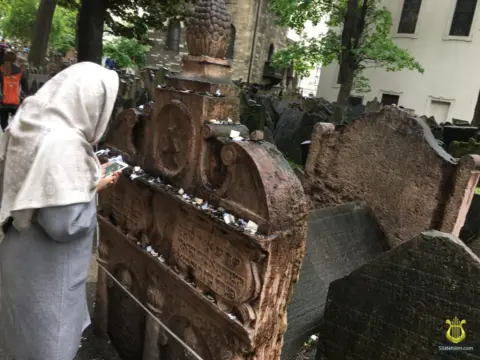
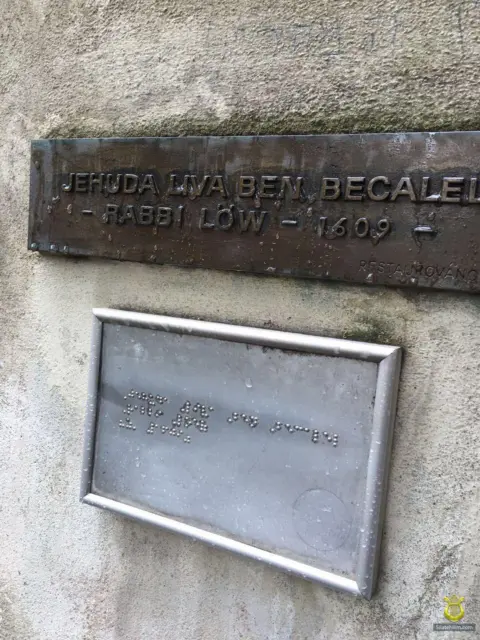
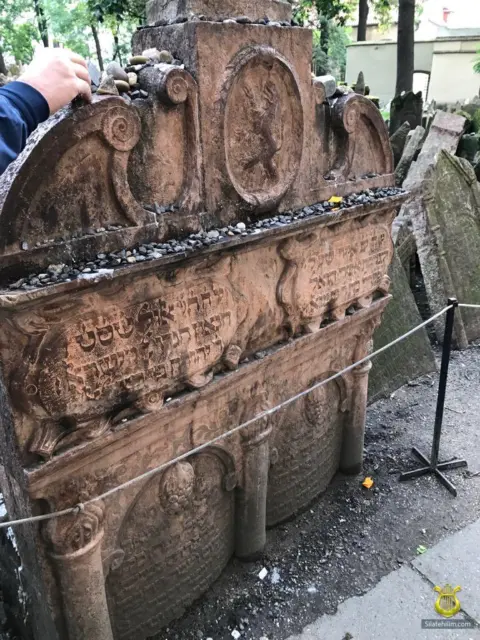
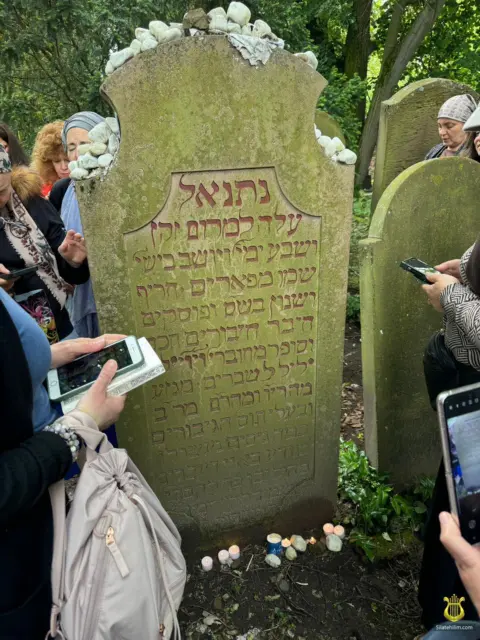
The Maharal departed for the World to Come in 1609, at the age of 84, and was buried in the Old Jewish Cemetery of Prague. His headstone still stands today among 12,000 ancient headstones crowded onto a small plot of land in the heart of the Jewish quarter. According to tradition, the Maharal's soul contained within it the wisdom of all 600,000 Jewish souls that stood at the foot of Mount Sinai.
(Tzadikim.com, Reb Zalman Leib Abelsky, "The Maharal of Prague," "The Prague Golem: Legends of the Jewish Ghetto" by Harald Salfellner)
Location
Old Jewish Cemetery, Široká, Старе-Место, Czechia
Gallery