
Grave
Moshe David Valle
Yahrzeit (Hillula)
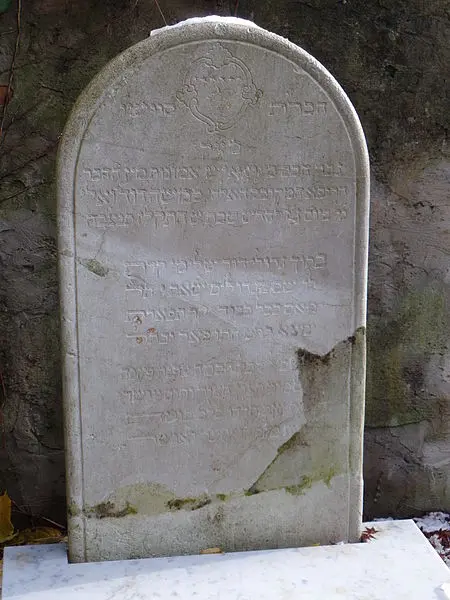
- 7 Tevet — Rabbi Moshe David Valle
Rabbi Moshe David Valle, an Italian kabbalist and physician of the 18th century, was born in Padua, Italy. He was a recognized authority on Kabbalah and lectured before the Padua-based association "Mevakshei Hashem," alongside two well-known rabbis, Yisrael Chizkiyahu Treves and Yaakov Chazak.
These lectures were also attended by the great Ramchal, who became deeply interested in Kabbalah and began studying it under Valle's guidance, his sharp mind surpassing that of his fellow students.
At the age of 25, Rabbi Moshe David Valle wrote a polemical work in Italian against Christianity, divided into 7 parts.
He also wrote 70 Tikkunim in Hebrew on Devarim 34:12. Between 1721 and 1767 he wrote 8 large volumes in Hebrew, most of which consisted of commentary on the entire Torah. These remain unpublished to this day.
Ephraim Luzzatto wrote a sonnet, "Eleh Bnei HaNe'urim," praising the lectures of Rabbi Valle and Treves.
A Person's Appearance
Rav Moshe David Valle taught that after the age of 40, a person cannot complain about his appearance, since by then he himself is responsible for it. One's outward appearance is a reflection of one's inner self. The Hebrew word "panim" means "face," while the word "pnim," sharing the same root, means "inner being," "essence," "inner part." This means that a person's inner world is directly reflected on his face.
On the Philistines
Rabbi Moshe David Valle discusses the meaning behind the Philistines offering a sacrifice to their water-god for the capture of Samson.
"And the lords of the Philistines gathered themselves together to offer a great sacrifice unto Dagon their god, and to rejoice, and they said: Our god has delivered Samson our enemy into our hand." (Shoftim 16:23)
He writes that the Philistines were close to holiness, and therefore the guardian angel appointed over them, which is their god, was rooted in the sefirah of Binah, which is the mystery of the great sea, and therefore their god had the form of a great fish — this is the secret of Dagon, whose gematria equals 63, which is the name of Binah (a reference to the spelling of the Tetragrammaton, which had a numerical value of 63 and represented the sefirah of Binah), from which it draws its power.
Above the waist he had the form of a man, representing the partial good that existed in the angels of the nations in their higher aspect, close to holiness, but below the waist he had the form of a fish, representing his degradation in the lower aspects.
And so the lords of the Philistines gathered to offer a great sacrifice to their god Dagon, for they believed that their salvation had come from him, in that this righteous man had been delivered into their hands.
All the more so, since they had captured him through seduction, and this fish depicted in human form has no power other than seduction, just as sailors speak of the fish called a siren in the local tongue.
It is unknown whether they speak the truth, but in any case the undeniable truth is that the Philistines are a brilliant husk closest to holiness, and all their power lies in seduction and cunning.
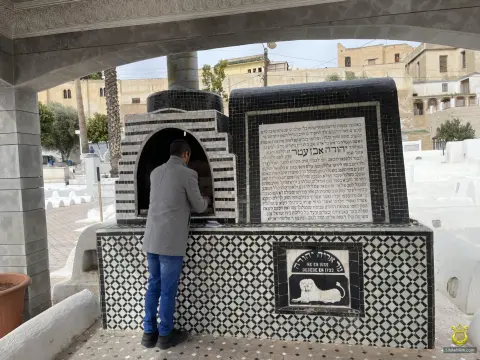
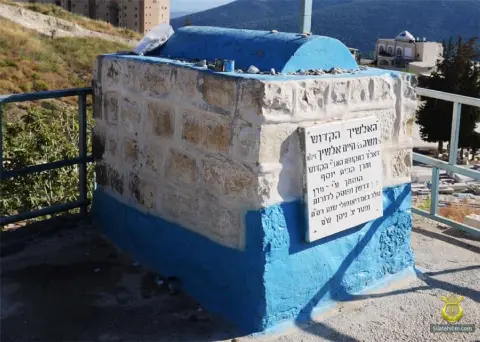
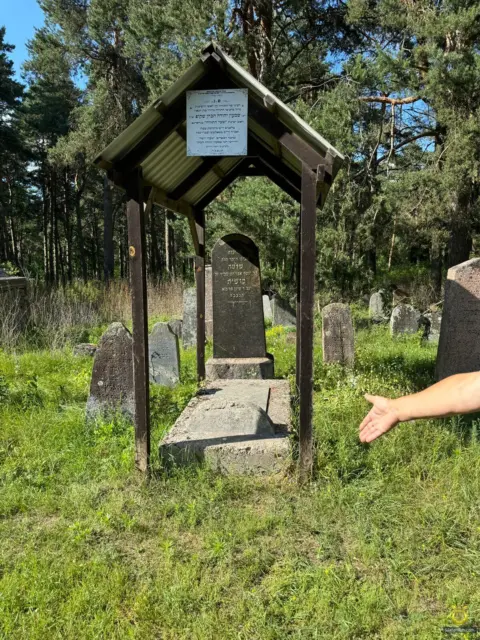
The tzadik's resting place is in Padua, Italy. May the merit of the tzadik protect our people.
(Valle, M.D., "Or Zarua," Kisei Ramad Valle on Shoftim 16:23)