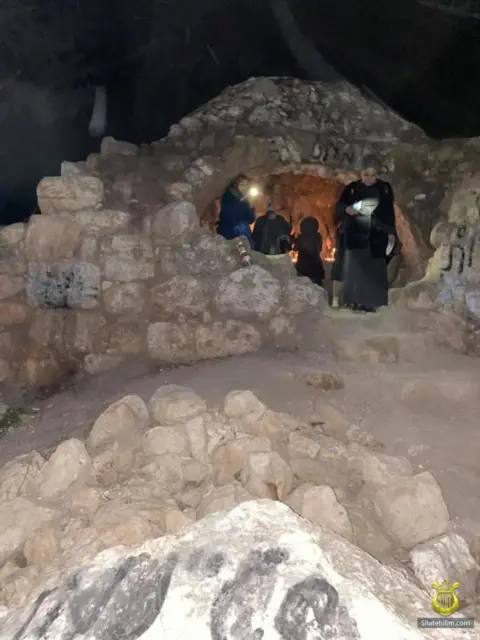
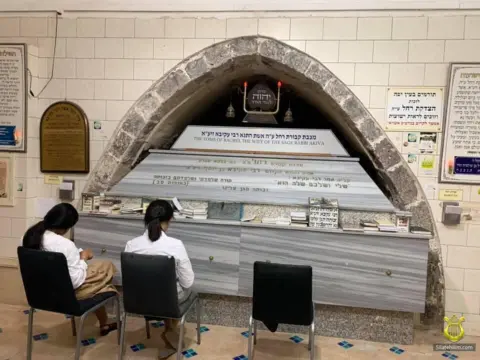
Grave
Israel Dov Ber of Veledniki
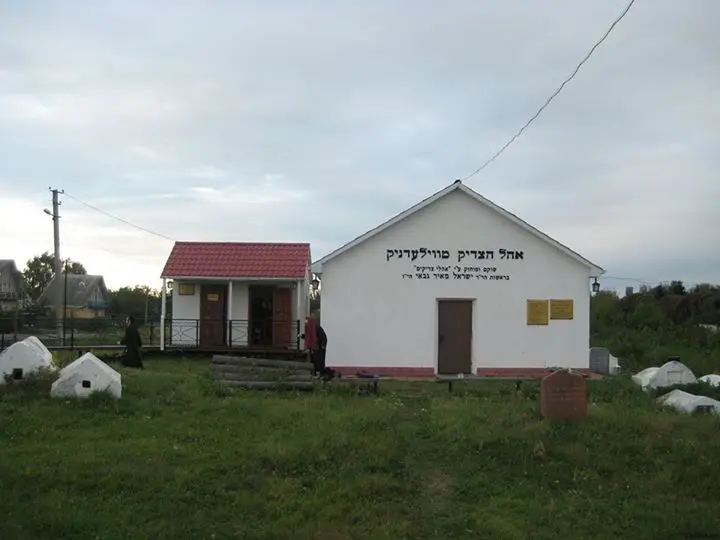
Rabbi Israel Dov Ber ben Yosef of Veledniki - Baal Mofet (miracle worker), author of "Sheerit Israel," which consists of 3 parts, one of them "on repentance during the fast days of Shovavim."
Yahrzeit - 21 Tevet;
Burial place - Old Veledniki.
He was born in the village of Stara Kotelnya, located between Berdichev and Zhitomir on the Guyva River (along road No. 0601 from Zhitomir to Skvira).
So it was that in 1789 in Kotelnya, a son was born to the melamed Rabbi Yosef and Perl Gita, and he was named Israel Dov Ber.
When he was about four years old, his father, Rabbi Yosef, left this world, and when he was about nine, his mother's soul ascended to Gan Eden, leaving little Isroel a complete orphan.
It is told that before her death she called him to her and asked him to bring her some book. This surprised him greatly, since he knew well that his mother could not read Hebrew - and there were no other books in the house. So he asked her which book exactly she wanted. His mother said it made no difference, whichever one came to hand first - and the son handed her a heavy volume of the responsa of the Rif.
Taking the book in her hands, she said: "Holy letters, plead before the Al-mighty for my son Isroel Ber, that he grow up to be a G-d-fearing Jew…" - for she already knew that little time remained for her in this world. Many years later, Rabbi Israel Dov himself told this story to a woman who had asked for his blessing for her son: "that he grow up to be just like you." After telling the story, he said: "If you are a mother like my mother was, then your son will be like me."
Even then he became known as the "illui of Kotelnya."
When he was 12 years old, it happened that the holy Rabbi Menachem Nachum of Chernobyl was detained for 9 days in nearby Zhitomir. In the synagogue he asked the talmidei chachamim studying there: "Which of you can make a siyum tomorrow on any tractate of the Talmud?" No one was prepared to take on such a task. Then he turned to the young Israel Dov: "Can you?" He immediately answered: "If the Rebbe says so, I will make the siyum!" The Chernobyler asked which tractate exactly he wanted to study, and in response heard: "Whichever the Rebbe wishes."
The Chernobyler turned to the shelf, took out tractate Bava Batra, and handed it to Israel Dov.
He sat all night by candlelight over the book - and by noon the next day he came to the Chernobyler to make the siyum. Seeing the astonishment in the Tzadik's eyes, he said: "The Rebbe may test me - I remember even the number of names of all the Tannaim and Amoraim in this tractate, both overall and on any given page."
At the age of 13 (Bar Mitzvah, 5562), he traveled to the town of Pogrebishche, where at that time the holy Rabbi Shalom Shachna lived, son of the holy Rabbi Avraham "the Angel" and grandson of the great Maggid of Mezeritch. He then studied for some time with the tzadik of Lechovitz, whose influence he himself always emphasized, even though his most significant teacher later became Rabbi Mordechai of Chernobyl.
After his marriage, Rabbi Israel Dov became the rabbi of the town of Veledniki (now Old Veledniki, since there is also a New Veledniki nearby) on the Norin River, slightly west of Ovruch.
He became known as the "Baal Shem" of Veledniki starting in 1829, while his teacher was still alive.
His teachings were collected by the son of his student, Rabbi Alexander Sender, and published as the book "Sheerit Israel" (Lviv, 5624 [1864]). Approbations for the book were written by Rabbi Aharon of Chernobyl and Rabbi David of Talne (sons of Rabbi Mordechai of Chernobyl).
"Sheerit Israel" consists of three "gates":
1. Obedience and attachment to the righteous;
2. Teachings for the festival days;
3. On repentance during the fast days of Shovavim.
Everywhere in his book "Sheerit Israel" where he says "I heard from my teacher," he means the holy Rabbi Motele of Chernobyl.
Here is one example of the author mentioning the father of his teacher, the holy Rabbi Menachem Nachum of Chernobyl:
Sheerit Israel (Shaar HaHitkashrut, Drush 6, Maamar 1):
"It is said in tractate Chulin 17b: 'Rav Sheshet would test [the shechita knife] with the tip of his tongue' - one can say that during a meal, when he touched the food (meat) with the tip of his tongue, he immediately sensed the quality of the knife's sharpening beforehand (i.e., before that meat's shechita). As, for example, happened with the holy Rabbi Nachum of Chernobyl. When a chicken was slaughtered for him, during the meal he could sense all the thoughts of the shochet during the shechita, and so on."
Once the Veledniker told his students about himself:
"When a cow passes by the window of my house, just by looking at it I can know all the deeds of its owner from the day of its birth until this very day."
Segulot from the Rebbe of Veledniki
Zera shel chaya ve-kayama (the birth of a healthy child).
The Rebbe told the following story: "Once a Jew came to the holy Rebbe of Veledniki (who was 'a fine Polish Jew') and asked for a blessing for 'zera chaya ve-kayama' (that a healthy child be born). The holy Rabbi of Veledniki told him to hang silk curtains in his bedroom, as a segula for the birth of a boy.
Afterward his students asked him - where is it written that silk curtains are a segula for the birth of boys? The Veledniker Rav answered them that it is written explicitly ("meforash") in "Asader LiSeudata": "Vilein milaiyo - yeon li-rekiayo" - that is, when curtains are hung ("li rekiayo") ("milaiyo" in Aramaic refers to something made of silk fabric) - then "taman man sharyo?" (who will be there?) - "alo hu shimsho!" ("shemesh-zun" in Yiddish means both "sun" and "son") - meaning boys will be born…"
When the Chabad chassidim at 770 heard this "pshetl," they laughed - but immediately fell silent, because the Rebbe said with a very serious expression: "In this case, the 'cleverness of the explanation' of the tzadik was of no significance whatsoever - what mattered was that that chassid listened to his Rebbe - and indeed a son was born to him!!!" ("The trick is not in the explanation - the trick is that afterward he had a son.") Among the chassidim listening to the Rebbe's story at that moment were three young Chabad chassidim who also had trouble having children. One of them took the Rebbe's words very seriously and decided to do the same in his own home. The other two laughed at him. The first had a son born to him, while the other two, unfortunately, remained childless. (This story, with names and details, is recorded in "Eichal Negina.")
In "Siach Zkeinim" it is written that a son was born to Gaon Rabbi David Tzvi Hen, but the next pregnancy ended in miscarriage. At that time it was customary for husbands to travel for a blessing to the Rebbe Tzemach Tzedek, while wives would go to the Tzadik of Veledniki. So his wife, together with her companion, traveled to Veledniki. When they came to the tzadik, she said that her husband had been in Lubavitch and received a blessing from the Rebbe - but the child had not survived. The tzadik promised her that she would have a daughter. When asked "What name should be given to her," the tzadik answered: "Nokh mayn mame" (after my mother). When she asked the name of his mother, he answered "Perle Gute" (and this, incidentally, is the only source from which we know his mother's name). When her companion asked for a blessing for children, the tzadik, showing her his palm, said: "When hair grows here, you will have children! You shouldn't have killed cats as a child."
In the book "Beis Rebbe" it is written that after the Mitteler Rebbe passed from this world, some Lubavitcher chassidim traveled to Veledniki to ask Rabbi Israel Dov to become their mentor. He sent them back to "the holy Rabbi Mendel" (the Tzemach Tzedek), and then lamented:
"What is this?! How can they live by the mind alone, without emotion?! The great 'Baal HaTanya' gave his chassidim the finest rifles, the finest gunpowder and bullets, and taught them to shoot - yet they don't want to; they just fiddle with the rifles like toys."
It is said that before his passing he promised to help anyone who would even hold onto the handle of the door to his "ohel" (tomb).
During World War II, the Nazis wanted to turn the tzadik's tomb into a fuel depot, ignoring the protests of local residents. When they tried to break the gravestone that stood in the way of placing gasoline barrels, one of the men breaking it died on the spot, and another became disabled. But despite the fact that they could not break the gravestone, several barrels were still squeezed in, one on top of another - and on the very first night, one of the barrels crushed a guard to death. The officer in charge of the fuel mocked his subordinates' fear and said he would spend the next night in the tomb himself. What exactly happened there is unknown, but the depot was removed from the tomb.
When the Red Army recaptured Veledniki from the fascists, not a single house remained intact - so heavily had the artillery pounded it from both sides. Except for the tzadik's tomb! It was from there that the Soviet authorities began rebuilding the town. But they, too, decided to play with fire - they decided to demolish the tomb. Workers came and began digging under the tomb's walls - but by morning all the trenches were found filled in with earth again! This happened a couple of times - until the authorities gave up.
Even in Soviet times, Jews traveled from afar to his grave. Before me, even now, lies a two-kopeck coin (from 1988), which about eighteen years ago was given to me as a "segula li-yeshua" by the now-deceased Reb Nisan (Uncle Nyuma) Sherman, who traveled every year from Kishinev to the grave of the Veledniker. Upon arrival, he would place this coin on the gravestone, pray, and upon leaving, take it back with him - as, according to him, was the custom among Jews in those days! "Always carry this coin in your wallet - and the tzadik will always help you." (Eliyahu HaKatan Getz)
Segula at the grave
There is a tradition of placing house keys and a coin at the Tzadik's grave for good luck - then taking them back and carrying them with you always.
(https://silatehilim.com/21-тевета-йорцайт-раби-исраэл-дов-бэр/)
Location
Старые Веледники, Житомирская область, Украина, 11144