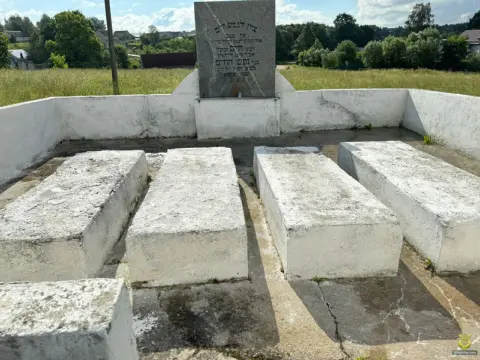
Grave
Imayot

The Resting Place of Imayot — the Matriarchs Bilhah and Zilpah, as well as Yocheved, Tzipporah, Elisheva, and Avigail
Zilpah and Bilhah
"And Lavan gave to his daughter Rachel his maidservant Bilhah to be her handmaid" (29:29).
The Torah speaks sparingly of Yaakov's two "junior" wives. Throughout this portion and those that follow — which recount the lives of Yaakov and his family — they remain largely in the background, functioning essentially as passive figures in the plans and actions of their mistresses and their sons. Nearly everything we know about them comes from the Midrash and the commentaries of the Sages. Let us try to gather at least some of what is known.
The Midrash tells us that Bilhah and Zilpah were daughters of Devorah, the nursemaid of Yaakov's mother Rivkah. Devorah is mentioned in only a single verse in the Torah, in the next portion, Vayishlach, which describes Yaakov's return to Eretz Yisrael after his years with Lavan: "And Devorah, Rivkah's nurse, died, and she was buried below Beit El under an oak; and its name was called Allon-Bachut" (35:8). Since the word for "weeping" appears in a form suggesting an intensive or plural grief — "allon-bachut" — the commentators conclude that Yaakov wept not only for Devorah, but also for Rivkah, who had died at the same time.
Devorah's husband and the father of Bilhah and Zilpah was a man named Achosa. In his youth he was taken captive in war, but Lavan ransomed him and gave him Devorah, his maidservant, as a wife.
While Rachel and Leah were alive, the Shechinah (the Divine Presence) did not depart from their tents. After Rachel's death, the Shechinah moved to the tent of her handmaid Bilhah and remained there, as the Kabbalistic work the Zohar states, throughout all the years of Bilhah's life.
From the Torah we learn that after Rachel's death, Yaakov moved his bed to Bilhah's tent — because the Shechinah dwelt there — rather than to the tent of his senior wife, Leah.
The Zohar notes that Reuven showed extreme disrespect toward his father and toward G-d when he publicly laid down on Bilhah's bed in an attempt to defend his mother Leah's honor. This is how we must understand the verse in Vayishlach: "And Reuven went and lay with Bilhah, his father's concubine..." (35:22) — he lay not with her, but on her bed.
Yet the same Zohar states that the Shechinah moved to Bilhah only after the deaths of both wives — Rachel and Leah — while Leah was still alive at the time of the episode described. It is possible that the Zohar means to suggest that Leah died immediately after Rachel, which would imply that Reuven acted for a different reason.
The Midrash also tells us that Yosef, Rachel's son, was deeply devoted to Bilhah. When he revealed himself to his brothers in Egypt, he sent his father ten donkeys laden with precious gifts (in addition to ten donkeys carrying food). Five of these ten donkeys, laden with gifts, were designated for Bilhah, who had served as a mother to him after Rachel's untimely death.
Bilhah continued to serve Yaakov even in Egypt. When he fell ill, it was Bilhah who brought Yosef the alarming news: "And it came to pass after these things that someone said to Yosef: Behold, your father is ill..." (48:1).
From Targum Yonatan we also learn that after Yaakov's death, Bilhah was sent by the brothers to Yosef on a delicate mission. "And they commanded her to say to Yosef: 'Your father gave orders before his death, saying: So shall you say to Yosef: Please forgive the transgression of your brothers and their sin, for they did evil to you (selling you into slavery)...'" (50:16–17). In truth, Yaakov had left no such instructions. But the brothers and Bilhah resorted to this deception out of fear that Yosef might take revenge for what they had done.
Such, in brief outline, are the known facts about Bilhah. Of Zilpah, Leah's handmaid, we know even less. We know only that Leah gave her to Yaakov as a wife after she herself had ceased bearing children — having given birth to Reuven, Shimon, Levi, and Yehudah — while the previously barren Rachel had sent her own handmaid Bilhah to their shared husband, and Bilhah had given birth to Dan and Naftali.
This was not merely a matter of competition. Leah had learned through prophetic channels that Yaakov would have twelve sons, the founders of the tribes of Israel, and four wives. Zilpah was to be the fourth (Midrash HaGadol).
One further detail is worth noting. In describing the births of Yaakov's sons, the Torah consistently mentions that their mothers conceived: "va-tahar" — and she conceived. Only regarding Gad and Asher, born to Zilpah, is the expression "va-tahar" absent. This is because, as the Midrash collection Bereishit Rabbah explains, Zilpah was at the time a very young girl, and her pregnancy was barely noticeable.
Yocheved
Yocheved was among the seventy souls who descended to Egypt. She was born, in the most literal sense, within the walls of the city. The Torah also mentions her in the portion of Pinchas (Bamidbar 26:59), identifying her as the wife of Amram and daughter of Levi.
Yocheved was the mother of Aharon and Miriam. She gave birth to Moshe Rabbeinu at the age of 130. The Torah refers to Yocheved as a "head of the Hebrew midwives."
Shortly before Moshe's birth, Pharaoh ordered that all newborn Hebrew boys be cast into the Nile. Yocheved managed to hide her son at home for three months. When she could conceal him no longer, she placed the child in a basket among the reeds on the bank of the Nile. There he was found by Pharaoh's daughter, who had come to bathe. At the suggestion of Moshe's sister Miriam, who was watching from a distance, Pharaoh's daughter agreed to summon a Jewish wet nurse. Miriam called Yocheved, and so Moshe was nursed by his own mother. He grew up in his parents' home until he was weaned.
Yocheved gave her son the name Yekutiel, meaning "My hope is in G-d" (Sefer HaYashar, Shemot; Yalkut Shimoni, Shemot 166; Seder HaDorot). The prophetic significance of this name lay in the fact that the child born to her was destined to instill hope in G-d in the hearts of the Jewish people, who were crushed by hardship and suffering (Vayikra Rabbah 1:3).
Elisheva, Daughter of Aminadav
The sister of the prince of the tribe of Yehudah and the wife of the High Priest, she was the most distinguished among the Jewish women of her time. But this was not her greatest virtue…
Her father, Aminadav, was one of the most respected men of the generation of the Exodus. Her brother Nachshon is to this day regarded as the symbol of selfless faith and bold resolve — it was he who first leaped into the not-yet-parted waters of the Red Sea and pressed forward, thereby ending the panic among the Jewish people. Her husband Aharon, who "loved peace and pursued peace," was beloved by the people as no other.
According to the Midrash, Elisheva was, like her mother-in-law Yocheved and her sister-in-law Miriam, a midwife who saved Jewish infants from Pharaoh's decree. She too refused to cast newborns into the Nile, and she risked her own life to help hide them.
Our Sages say that the Holy One, Blessed be He, granted Elisheva her four sons — Nadav, Avihu, Elazar, and Itamar — in reward for her righteousness and noble lineage. All four grew up to be righteous men, and their mother's heart rejoiced when all four were anointed to the priesthood.
But her joy turned to grief in a single day. It was the eighth day of the dedication of the Mishkan, during the ceremony of the sacrificial offerings. Her two eldest sons, Nadav and Avihu, were working alongside their father, assisting him in bringing the offerings. Her two younger sons, Elazar and Itamar, were assigned to perform other tasks.
Elisheva watched the ceremony, her heart overflowing with joy for her family and for all of Israel.
Then, as Aharon was preparing to bring yet another offering, Nadav and Avihu, seized by the solemnity of the moment, grabbed their fire pans and brought a fire offering before the L-rd that He had not commanded.
Elisheva watched as fire descended from heaven in response and consumed her sons.
Our Sages explain that Nadav and Avihu paid so dearly for their act because they were tzadikim of the very highest level — and from such people the standard of judgment is far more exacting…
According to another view, they brought their own fire to the altar out of an overwhelming desire to draw close to the Holy One, Blessed be He. Their longing for Him was so intense that their souls simply burst forth from their bodies…
Neither Elisheva nor Aharon uttered a single word of complaint against the Holy One, Blessed be He. They accepted the decree with strength. Aharon could not even observe mourning rites — he was obligated to complete the ceremony. In place of the elder brothers who had perished, Elazar and Itamar took their positions beside their father. Nadav and Avihu were buried by their more distant relatives, Mishael and Eltzafan, who were not priests.
Elisheva was filled with faith in the Holy One, Blessed be He, and she understood that her sons had died because of their very righteousness.
The Sages see in Elisheva an example of how good and evil, joy and sorrow, are intertwined in this world. The happiest day of her life — and of the entire nation's life — became a day of the deepest grief.
Our Sages cite the marriage of Aharon and Elisheva as an example of a proper match: "Always endeavor to connect yourself with a good family. For Moshe married the daughter of a pagan priest, and his grandson became an idolater. But Aharon married the daughter of Aminadav, and his grandson Pinchas became a zealot for the sake of the Holy One, Blessed be He."
Our Sages point to yet another detail as a lesson in choosing a spouse wisely. The Torah states that Aharon took as his wife "the sister of Nachshon." By this, the Torah hints to us that when choosing a bride, one should pay attention to her brothers, for her sons will resemble them.
Finally, Aharon and Elisheva established the custom of naming children after ancestors: their son Nadav was named in honor of his grandfather Aminadav, and the name Avihu means "he is my father" — that is, the paternal grandfather.
Tzipporah
Tzipporah and Batya were the reincarnations of the twin sisters of Hevel, whom Kayin had killed out of jealousy over them. When the angels appeared before the Holy One, Blessed be He, with an accusation against mankind — "What is man, that You should remember him, and the son of Adam, that You should be mindful of him?" — G-d replied that if they themselves were to live on earth, who could say whether they would be able to overcome the evil inclination. The angels then asked: "Test us, L-rd, and put us to trial."
The angels immediately descended to earth and saw the twin sisters of Hevel ("the sons of the mighty saw the daughters of men, that they were fair"). The evil inclination prevailed over them, and they resolved to take the women for themselves. But the women said to the angels: "What will happen if we conceive from you, and you ascend back to heaven and disappear? Teach us first to pronounce the Name of the Holy One, Blessed be He, so that we too may ascend after you." The angels revealed the Divine Name to the women, whereupon the women immediately ascended to heaven and took refuge by the Throne of Glory.
The sisters remained there until Yitro and Pharaoh came into the world.
When the time came, the Almighty made one of them the daughter of Pharaoh — Batya, who raised Moshe — and the other the daughter of Yitro, Tzipporah, who became the wife of Moshe. Korach and his associates claimed that with Hevel's death, Kayin was obligated to marry his brother's widow or to release her through the rite of chalitzah.
And as long as he had done neither, the widow was forbidden to any other man, just as a married woman is forbidden. To this Moshe replied: "Were the guilt mine, I would not have merited to receive the Torah, and G-d would not have granted me the special radiance. Moreover, Kayin could not have married his brother's widow, because he was the one who had killed him."
The Midrash recounts that already at the well, Moshe saw how beautiful and righteous Tzipporah was, and he asked for her hand in marriage. But she replied that it was not so simple. In her father's garden, embedded in the earth, stood a wondrous staff that had been created at the time of Creation and given to Adam. It had passed from generation to generation — it had been with Avraham, Yitzchak, and Yaakov, and from Yaakov it passed to his son Yosef. After Yosef's death (by which time he had been the second-most powerful man in Egypt), Pharaoh took it, and Yitro, who was then one of Pharaoh's chief advisors, saw the staff and quietly took it for himself. After he thrust it into the ground in his garden, no one could pull it out. When suitors began coming for Tzipporah, Yitro decided he would give her only to the man who could draw out the staff — but until then no one had succeeded. Moshe came to Yitro's garden and drew out the staff with ease. Yitro was astonished and immediately understood: this must be the man destined to lead the Jewish people out of Egypt. But he was also afraid — many Egyptians would perish, the land would be devastated; was this a good thing? According to other accounts, Yitro also feared that since Moshe was a fugitive, Egyptians or Ethiopians might come looking for him, and Yitro himself would be punished for harboring him. He therefore threw Moshe into prison and left him there for many years.
But Tzipporah, who had been moved by Moshe's nobility and had come to love him, thought: How can I save this righteous man? And she found a way. She said to her father: You have no wife, and you have seven daughters. Let six of them tend the flocks, and I will keep the house. And throughout all those years she secretly brought Moshe food from her father's table. Eventually she reminded her father of Moshe, persuaded him that there was no longer anything to fear — no one had come looking for him — and suggested they find out what had become of him. They checked and found that he had survived. This convinced Yitro of Moshe's extraordinary righteousness and that G-d was with him. And so Yitro joyfully gave Tzipporah to Moshe in marriage.
Avigail
At the time when David and his men were in hiding from Shaul and suffering from hunger, David sent messengers to Naval with a proposal — they would guard his fields and flocks in exchange for food.
Naval refused David's request outright, rudely insulting him and his messengers. He did not offer even a piece of bread to the hungry young men who stood before him. "Who is David that he should make demands of me?! And I have no need of his protection!" he declared.
David was so enraged by Naval's conduct that he resolved to kill him and his entire household. He took four hundred men with him and set out for Naval's home.
Naval's servants were the first to learn of the danger. They understood that speaking to their master was useless — his arrogance made him incapable of grasping the peril. They turned instead to his wife, Avigail. They told her how David's messengers had come to her husband, greeted him respectfully, and proposed a mutually beneficial arrangement, and how Naval had responded with coarse insults. They confirmed that even before speaking with Naval, David's men had protected them from the bandits who were so prevalent in those days, and that those men now had the power to do them great harm.
Avigail immediately understood that her household faced real danger. Without losing a moment, she sprang into action. Without saying a word to her husband, Avigail took bread, wine, meat, raisins, and figs, loaded the donkeys with all of this, and sent it ahead to David.
And she herself went to meet him. Avigail fell at David's feet and pleaded for mercy. She addressed David as her lord and swore that she had known nothing of her husband's exchange with his messengers. She called her husband a scoundrel and his words disgraceful. She asked David to prevent bloodshed and foretold his future kingship. She also promised that if he spared her husband and his other enemies, the Holy One, Blessed be He, would deal with them Himself.
Concluding her words, Avigail said: "And the L-rd will deal well with you, and you will remember your handmaid." Our Sages see in these words a veiled request that he take her as his wife.
David allowed himself to be persuaded. He was captivated by Avigail's grace. He abandoned his intention to kill Naval and his household. "Blessed be the L-rd, who has sent you to meet me," he said to Avigail. "And blessed are you!"
When Avigail returned home, she found that her husband — who had begrudged a piece of bread to the hungry — had thrown a lavish feast in honor of the sheep-shearing and had drunk himself into a stupor. When he sobered up, Avigail told him everything that had happened. Naval was so distraught over the food he had given away to David that he suffered a stroke, and within a few days he died.
Upon learning of Naval's death, David sent messengers to Avigail to ask for her hand in marriage. Avigail agreed at once and hurried to David together with his messengers.
David was a distant relative of Naval. Some commentators hold that this marriage was the fulfillment of the mitzvah of yibbum, whereby a man marries the widow of his closest male relative who died without heirs. In support of this view is the fact that the Torah refers to Avigail as "the wife of Naval" even after she had married David.
From that time on, Avigail shared with David both joy and sorrow. After Shaul's death, she came with David to Hebron, which was then the capital, and there she bore him a son.
The commentators say that David had a special feeling for Avigail. Rabbi Shmuel says that he was grateful to her for dissuading him from the bloodshed that would have become an indelible sin upon him. The Midrash teaches that after her death, she was granted a place in Gan Eden alongside the righteous women.
(Based on an article by Rav Nachum Purer, and on the book "Ahavat Chaim," Bamidbar)
Gallery