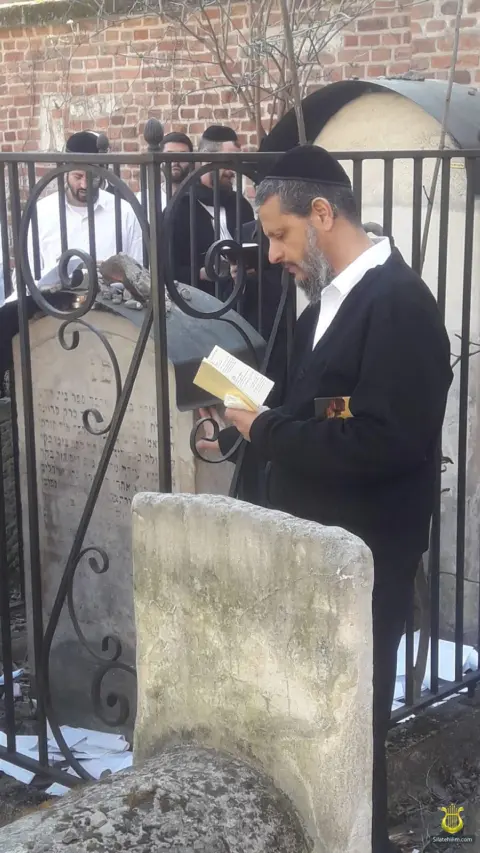
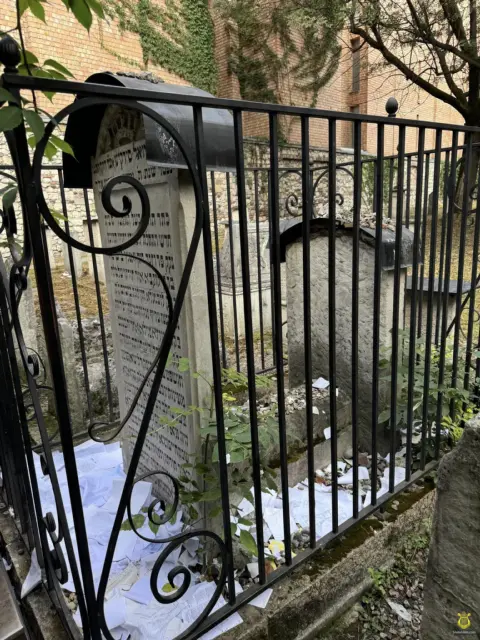
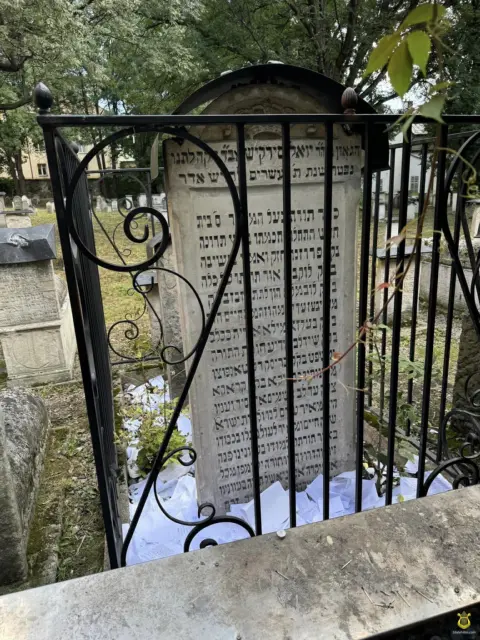
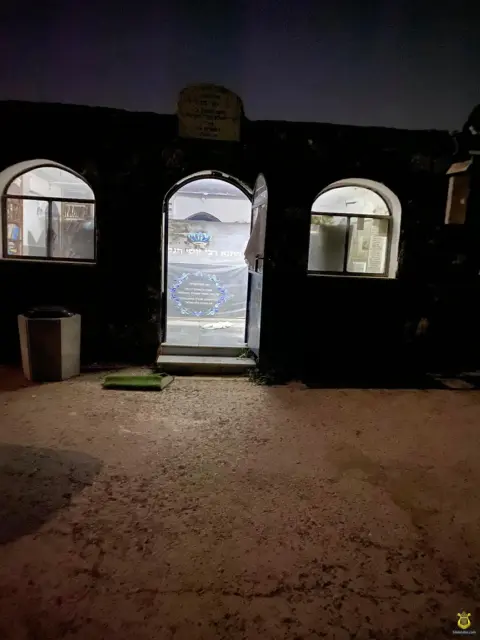
Grave
Bach
Rabbi Yoel Sirkis
Rabbi Yoel bar Shmuel Yaffe Sirkis - the Bach (Bayit Chadash) (1561—1640) — an outstanding halachic authority.
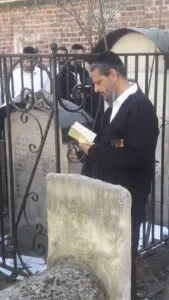
Yahrzeit - 20 Adar Burial place - Remuh Cemetery, Krakow, Poland Rabbi Yoel Sirkis, known as the Bach - בית חדש) ב"ח) - an acronym of his great work, "Bayit Chadash," - was a prominent Jewish posek and halachist. He lived in Central Europe and held rabbinic positions in Belz, Brisk (Brest-Litovsk), and Krakow. Sirkis was born in Lublin in 1561. At the age of fourteen he entered the yeshiva of Rabbi Naftali Tzvi Hirsch Shor, a leading student of Rabbi Moshe Isserles - the Rema. After spending some time there, he went to Brisk, where he attended the yeshiva of Rabbi Feivush. While still a young man he was invited to serve as rabbi of Pruzhany near Slonim. Later he held rabbinical posts in Lukow, Lublin, Medzhibozh, Belz, and Shydlowiec, and finally in Brisk and Krakow, succeeding his teacher Rabbi Feivush in each of these last two positions. The Bach was an adherent of Kabbalah and an opponent of pilpul. He was also critical of those who relied exclusively on the Shulchan Aruch when rendering halachic rulings, rather than on the Talmud and the Geonim. He was the father-in-law of Rabbi David HaLevi Segal - the Taz, who frequently cites him in "Turei Zahav," his commentary on the Shulchan Aruch. Rabbi Sirkis passed away in Krakow in 1640. "Bayit Chadash" (בית חדש - "New House"), abbreviated as the Bach - ב"ח, is Rabbi Sirkis's most famous work, serving as a major commentary on the Arba'ah Turim of Yaakov ben Asher. The work presents and clarifies the fundamental principles of Torah recorded in the Mishnah, the Babylonian and Jerusalem Talmud, and the major codes. "Hagahot HaBach" - suggested textual corrections to the Talmud and Rashi, copied from notes the author added to his own copy of the Talmud. Other notable works: "Meshiv Nefesh," a commentary on the Book of Ruth (Lublin, 1616). "Teshuvot HaBach" ("Responsa of the Bach"). "Beurei HaBach le-Pardes Rimmonim," explanations of passages from the great kabbalistic work of Moshe Cordovero - the Ramak. Stories of the Tzadikim When the time came to marry off his daughter, the Bach, according to custom, undertook to fully support his future son-in-law during his years of study, providing for all his needs, including a daily meat meal (so it was written in their kest agreement). However, over time the Bach's financial situation deteriorated greatly, and his son-in-law began to be served chicken-foot aspic and similar dishes for dinner, which could only barely be called meat. And the Bach's son-in-law was the most talented rabbi of his generation, Rabbi David HaLevi - the Taz. Rabbi David endured this breach of the agreement for a long time — and then he actually took his father-in-law to a rabbinical court. And imagine — the rabbinical court ruled in the Bach's favor. Chicken feet, he declared in his ruling, are also meat! But despite the verdict, the judges were shocked by the young scholar's brazenness and callousness. He may be talented, even brilliant, but how could he squeeze every last drop out of his impoverished father-in-law, who didn't have a penny to his name! The Bach, it should be noted, was also one of the most illustrious scholars of his generation. One of the judges, unable to hold back, told the young man to his face exactly what he thought of him after the trial. Rabbi David had to explain himself: "You think I don't understand," he said, "how terrible this looks from the outside? But what can I do about my own body — without eating meat, I feel weak, and my mind doesn't work properly. I feel nothing but love for my father-in-law. That is why I did not want him to be blamed for my poor learning. I wanted the court to rule that what I am fed in his house counts as meat! Then the Bach will be cleared both before people, having fulfilled his obligation, and before Heaven." At the trial, the dispute was resolved by the great Rabbi Nathan Nata Shapiro in a way that satisfied everyone. Some time later, the Bach managed to arrange a rabbinic position for his son-in-law in a small town, and they went their separate ways. A letter has survived in which the Bach asks his son-in-law to send him four zlotys so that he could finish a new suit; it was no longer possible to wear the old one because of all its patches, but there was no money to finish the new one. Once, the wife of one of the townsmen felt the onset of labor on Friday night, during Shabbat. Light was urgently needed, but all the candles — lit before Shabbat began — had already burned out. "Where can I get a burning candle at night?" the husband thought, and set off for the rabbi's house, reasoning that surely he would be studying at night, and so a lit candle could be borrowed from him! How surprised he was, then, when, approaching the Bach's house, he saw no light in any of the windows. Some rabbi! Instead of studying on Shabbat night, he's sleeping! The unfortunate townsman did not know that on that very Shabbat, the wind had blown out the candle in the rabbi's room, and since it is forbidden to light a fire on Shabbat, the Bach was sitting in the dark, studying from memory — sitting and reviewing pages of Talmud he had learned in his youth… One way or another, the baby was delivered, and the next day, while receiving congratulations on the birth of his son, the happy father recounted his nighttime adventures, making sure to mention that, imagine, the windows of our town rabbi's house had been dark. The townspeople grew alarmed: had they made a mistake in inviting the wrong rabbi? They had taken on a supposedly learned man, and it turns out he sleeps on Shabbat night! The "town elders" conspired, and right then, at the end of Shabbat, without waiting to clarify the circumstances or even speaking with the rabbi, they sent him a letter of dismissal. Upon receiving the letter, the Bach also acted decisively: without any delay, he immediately set off on his way… Some time later, a fire broke out in the town, burning almost everything to the ground. A segula for Refuah Shleimah in the names of Rabbi Yoel Sirkis - the Bach https://silatehilim.com/сгула-гаона-янука-для-рефуа-шлема/ May the merit of the tzadik protect our people! (https://dailyzohar.com/tzadikim/780-Rabbi-Joel-ben-Samuel-Sirkis; Toldot.ru)Gallery