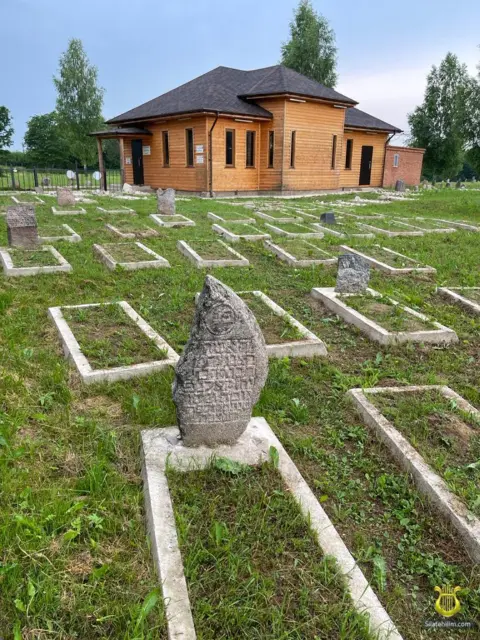
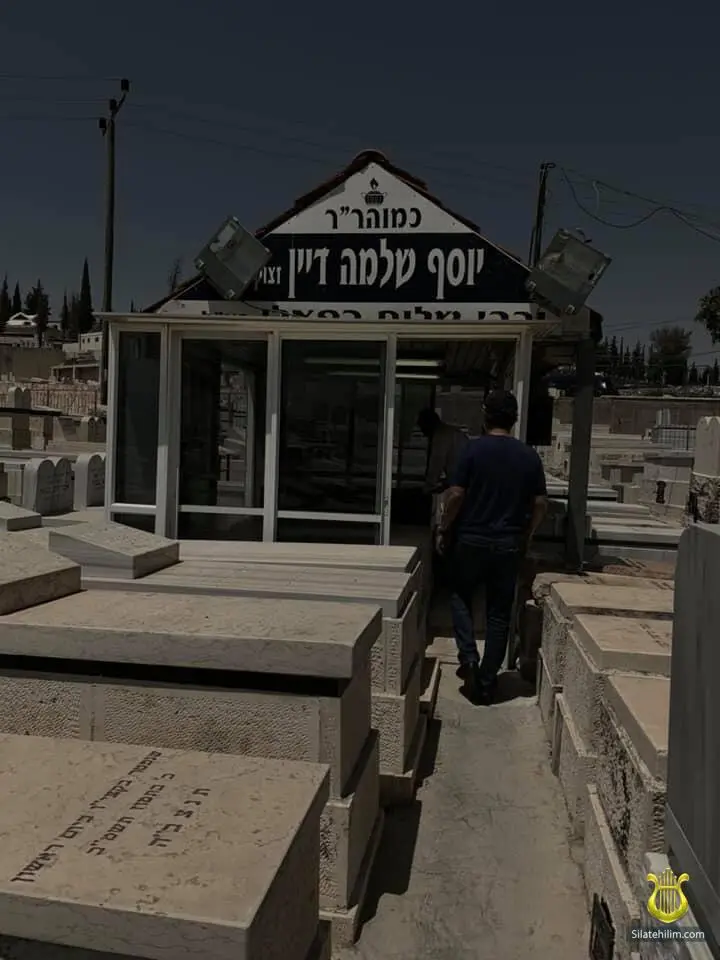
Grave
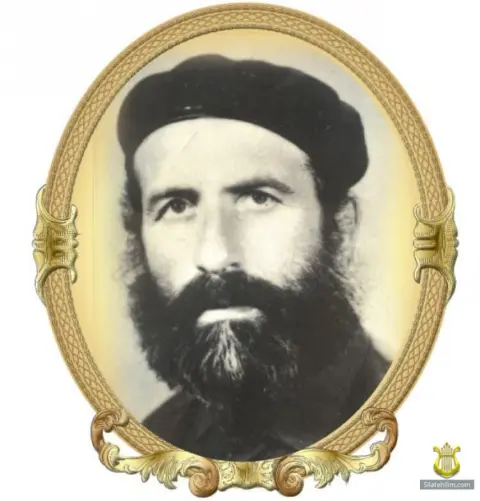
Yosef Shlomo Dayan (Lamed-Vav Tzadik)
Yahrzeit (Hillula)
- 9 Tammuz — Yahrzeit/Hillula of Rabbi Yosef Shlomo Dayan - The Hidden Tzadik
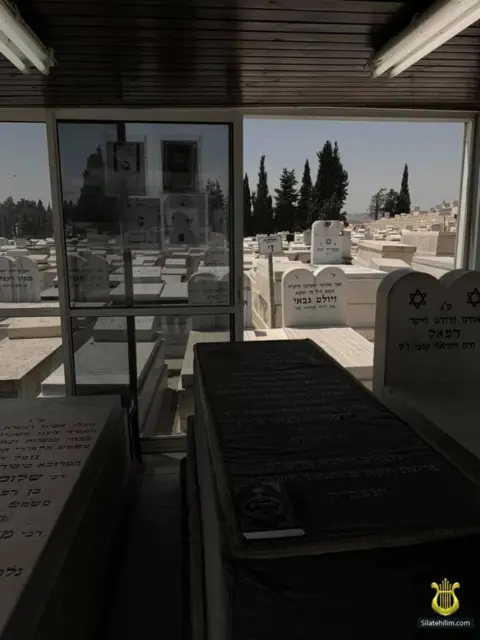
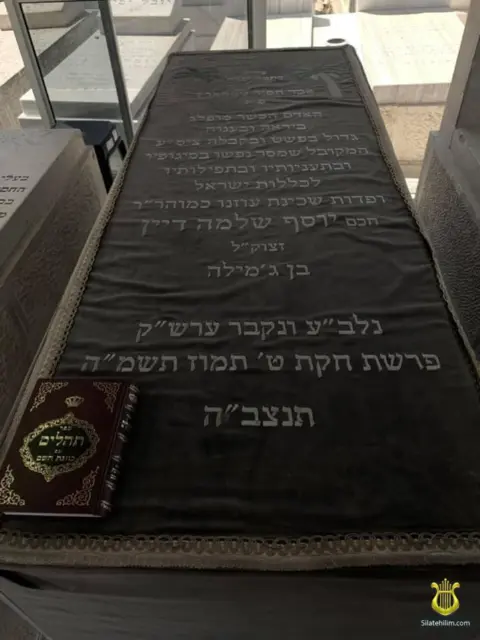
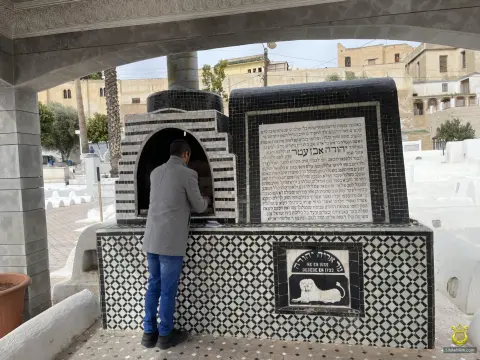
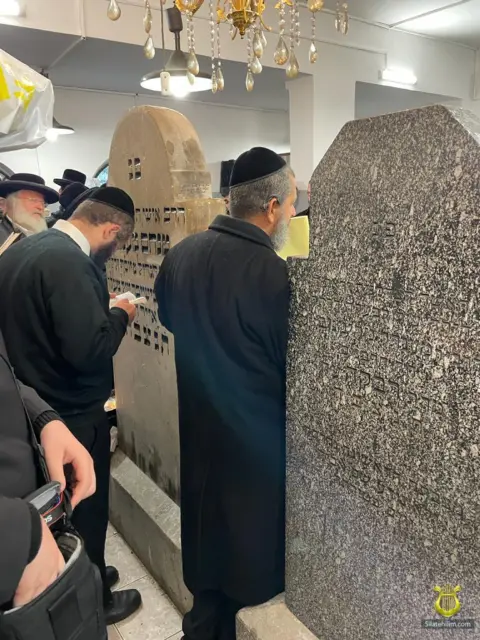
The Resting Place of Rabbi Yosef Shlomo Dayan
Burial place - Jerusalem, Har HaMenuchot;
Yahrzeit - Tamuz 9
The kabbalists Rabbi Mordechai Sharabi and Rabbi Yitzchak Kaduri testified that he was one of the "36 Hidden Tzadikim" of our generation.
He was born in Aleppo, Syria, into a family of dayanim whose lineage traces back to King David.
One day he packed his belongings and moved to Jerusalem. His goal was to hasten the coming of Mashiach and the time of redemption by rectifying the sins of the Jewish people, the mitzvot that had not been observed, and the prohibitions that had been transgressed.
He knew that in order to rectify the sparks caused by each sin, one must perform specific kavanot (rearrangements of the Divine Name that overcome the forces of separation in the Heavens) and yichudim (specific meditations).
From the age of 18 he worked as a courier, but when he was imprisoned on false charges, he decided to withdraw from all worldly affairs and focus on Torah study. He changed his name from Shlomo to "Yosef," and began studying the four paths of the depths of Torah. He knew the entire Tanach by heart, tried to conceal his knowledge, and only a few people knew of his greatness.
He never married, lived modestly, and fiercely guarded the sanctity of the covenant. He kept away from all luxury and would not even allow himself a heater in winter. He wore a thin shirt all year round, sometimes immersing in the mikveh while still dressed so that his clothes would also be purified; he fasted and ate only raw rice soaked in water, or raw potatoes and stale bread, purifying the physicality of his body and always keeping the Names of Ha-Shem before him. Despite his lifestyle, his body did not suffer, and he was accustomed to little sleep and scant food.
After thoroughly studying the book "Etz Chaim" [Tree of Life] and its commentaries, as well as other kabbalistic works, he became an expert in many of the most complex aspects of the Torah,
but he dedicated himself to studying "tikkunim," praying, and doing teshuva; for 15 years in a row he walked alone to the graves of tzadikim in the Galilee, subjecting himself to tremendous hardship, spending his time in fasting and prayer.
The Importance of Visiting the Graves of Tzadikim (Kivrei Tzadikim)
Rabbi Yosef Dayan believed that in order for a person to rectify himself and cleanse his soul of sins, he must draw close to tzadikim and righteous people, cling to them, and thereby elevate himself.
But since in our generation it is impossible to know who is a true tzadik, a person is obligated to go to the graves of renowned tzadikim and pray there, pleading with them to awaken heavenly mercy in order to rectify the mind, spirit, and soul.
He always used to say: "An hour of prayer and study at the graves of tzadikim is worth 100 hours of study," and this is especially valuable when access to the tzadik's grave is difficult and exhausting. Every step taken in such a place softens the harsh judgments in Heaven, because "the reward is according to the exertion."
Rabbi Yosef Dayan believed that even if a person has suffered greatly because of his sins and feels desperate and hopeless, he need only come to the grave of a tzadik, pray, and prostrate himself upon the grave — this will help him cleanse himself of sin and rise up from the lowest depths in which he finds himself.
Rabbi Yosef Dayan himself frequently went to the grave of Shmuel HaNavi and would say that anyone who performs a Tikun at the grave of Shmuel HaNavi can be certain that Heaven will help him.
Even if he is not helped the first time, he will surely receive heavenly assistance after some time.
Since he knew Arabic and other languages, he would disguise himself as an Arab cleaner and, entering schools and convents, would find Jews who had fallen into the hands of missionaries and try to rescue them. Every night he studied until dusk, immersed in the mikveh, prayed at sunrise, and after prayers would quietly recite the Shema once again, enunciating every word.
He preferred to pray by a wall, and began every prayer and mitzvah with the words "Leshem Yichud Kudsha," gave charity even when his financial situation was difficult, and recited the blessing on the moon seven days after the "molad," without waiting for "Motzaei Shabbat."
All year round he lit a candle in a special room in the Nachlaot neighborhood of Jerusalem for the elevation of the soul of the tzadik whose yahrzeit fell on that day, reciting many names and lighting numerous candles on a tray.
He helped and financed, from his own money, the construction of a hall in the "Nezer Aharon" synagogue in Jerusalem.
He prayed, performed tikkunim, and fasted for the success and quality of the construction, and did not want his name as a donor to be memorialized there.
In Adar 5740 he suffered a severe heart attack and was hospitalized for a long time. He sent his students to the graves of tzadikim to pray for his recovery, and when he was discharged from the hospital, he took no medication and ate only honey to strengthen his heart.
In 5743 he told his students that "in two years I will complete my tikkun." Sensing that his passing was near, he revealed to his students the secret of dream interpretation, and instructed them to continue performing Tikkunim at the grave of the prophet Shmuel and to pray at the graves of tzadikim.
On Thursday evening, the 8th of Tamuz, as usual, he studied Torah all night in the cave of Shimon HaTzadik.
On the 9th of Tamuz, at around 3 in the afternoon, he returned his soul to the Creator from a heart attack.
Rabbi Dayan is buried in the Har HaMenuchot cemetery in Jerusalem, not far from the grave of Rabbi Kaduri.
Rabbi Meir Malka, founder of the Fund for Perpetuating the Memory of Rabbi Kaduri and author of the book "Yeshuot Yitzchak," had the great merit of establishing a monument for Rabbi Yosef Shlomo Dayan in 2011, 26 years after his passing.
May the merit of the tzadik protect our people!
(Tzadikim.com)
Gallery