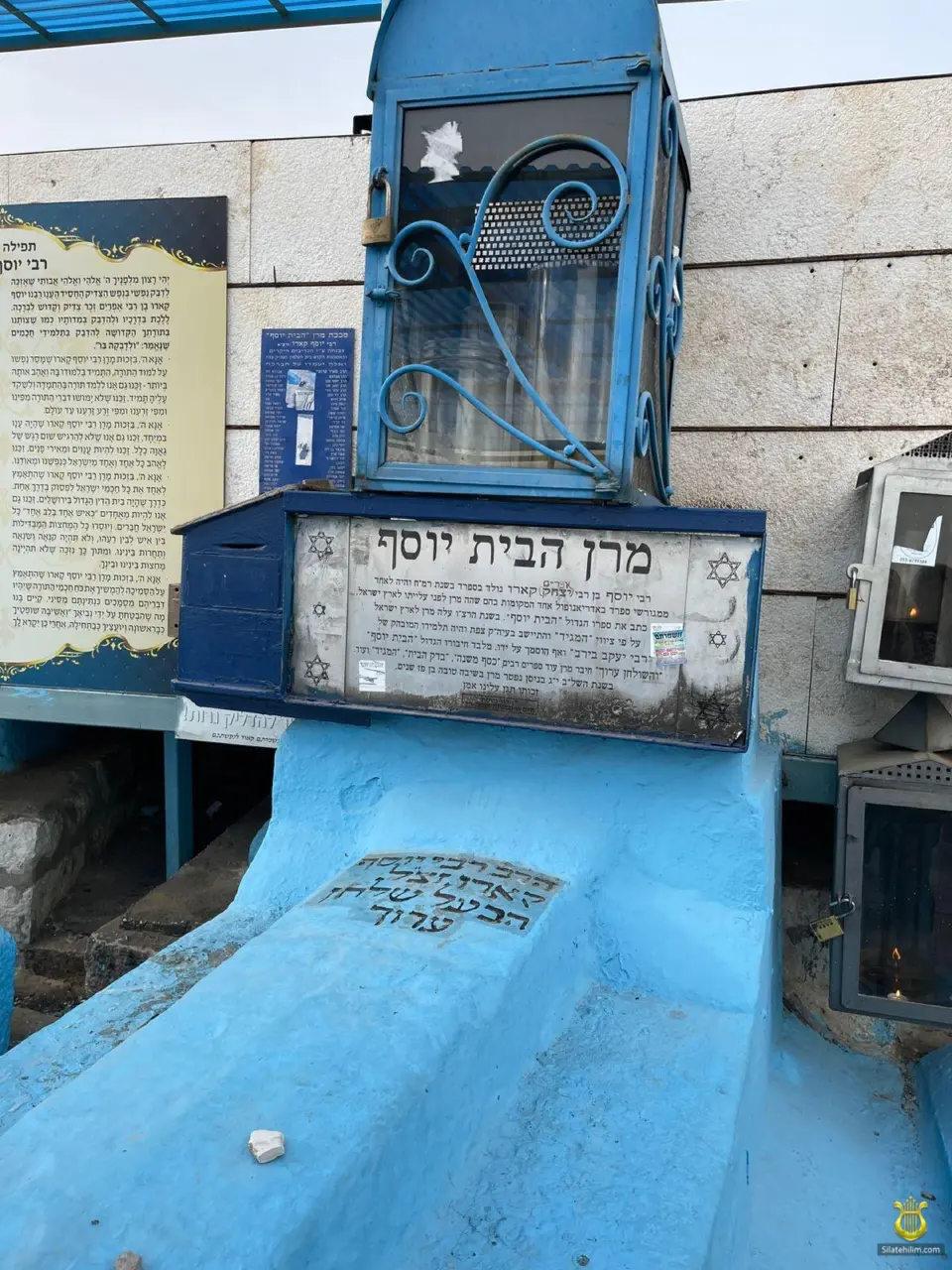
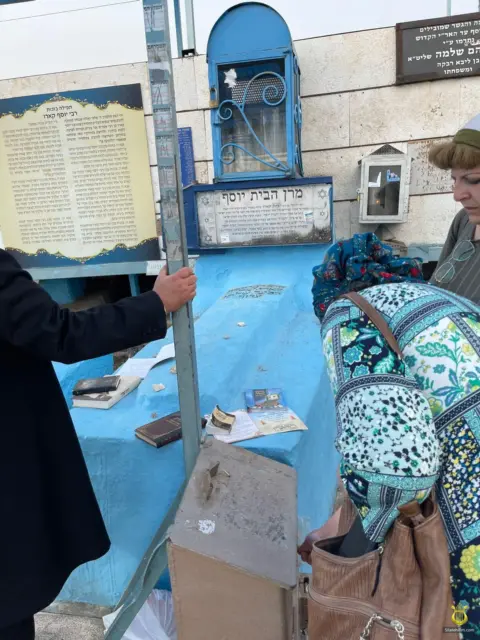
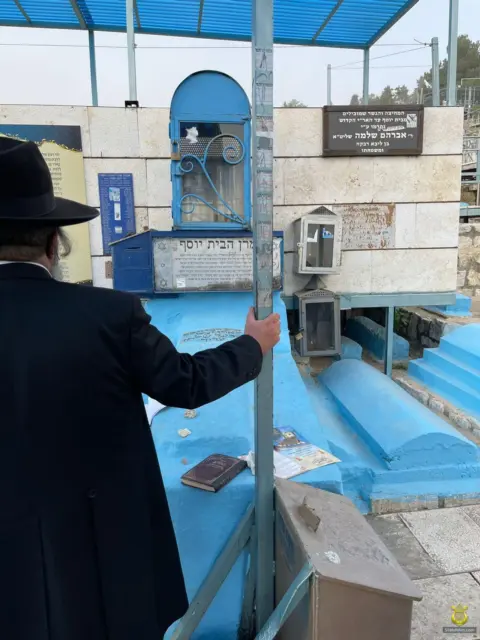
13 Nisan — Rabbi Yosef Karo - Baal HaShulchan Aruch
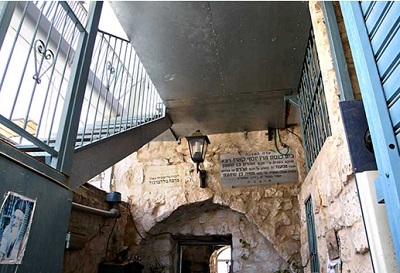
On the first of January 1837, a terrible earthquake struck Galilean Tzfat, and the entire city was reduced to ruins. Yet the residential part of the house where Rabbi Yosef Karo — the "Mechaber" (compiler), the "Maran" (teacher of the nation) — had lived three centuries earlier remained completely undamaged. The residents said that the holiness of Rabbi Yosef protected the house. It seems this protection has lasted to our own day: descendants of the sage still live in the three-story house, his synagogue stands nearby, and the southern parts of the house and synagogue have remained unchanged since the 16th century. The northern parts were rebuilt in 1857, twenty years after the earthquake.In the courtyard of the house there still exists a cave in which Rav Yosef Karo, often together with his friend Rabbi Shlomo Alkabetz, communed with an angelic teacher (a Maggid). The records of their conversations, made by Rabbi Karo, were published more than half a century after his passing under the title "Maggid Meisharim" (Herald of the Righteous). The first part appeared in 1646 in Lublin, the second in 1656 in Venice. The kabbalist and historian Rabbeinu Chida states that only one-fiftieth of Rabbi Karo's manuscript was ever printed. The rules of conduct recommended by the Maggid in the book are not meant to be followed by others — they were addressed only to Rabbi Yosef himself.Rabbi Karo's synagogue todayThe future great codifier was born in Toledo, Spain, in 1488. At the age of four, along with most of Spanish Jewry, he went into exile; first to Portugal, from where they fled further in 1497. Fortunately, the children of Rav Ephraim Karo were not taken from him, unlike many other Portuguese exiles. After long wanderings the family found refuge in Istanbul — Sultan Bayezid II had invited the refugees to settle in his empire, saying: "They tell me Ferdinand of Spain is a wise ruler?! He impoverished his own land to enrich mine!"His father endured the wanderings with great difficulty and died young. But he managed to teach the talented boy a great deal — Rabbi Karo often cites his father's analyses, a great Talmudist in his own right. After his father's death, Yosef's uncle, a renowned commentator on the Torah, became his teacher and guardian. His work "Toldot Yitzchak" (The Life of Yitzchak) was extremely popular — it was reprinted four times in its first fourteen years!Toledo — the city where Rav Yosef Karo was bornRabbi Yitzchak Karo, who had moved to Portugal even before the general expulsion, was also forced to flee to Turkey in 1497; several of his sons perished during the wanderings. He not only taught his nephew but cared for him as a son and may even have formally adopted him. They were extremely close — later on, the Mechaber frequently cited his uncle's rulings and responsa.Rav Yosef quickly became known as an authority in Jewish law — even in his youth he was called upon to answer questions in various areas of halacha. After marrying the daughter of Rabbi Chaim ibn Ashbalag, Rav Yosef moved to Edirne (Bulgarian Adrianople) — a city that had served as the capital of the Ottoman state from 1365 to 1451. Together with his father-in-law he founded a yeshiva, where young men not only studied the Law but also entered into the hidden depths of Torah. Rabbi Shlomo Alkabetz, an outstanding kabbalist and poet (author of "Lecha Dodi"), also lived in Edirne. He became Rabbi Karo's chavruta; according to Rav Shlomo's testimony, the heavenly Maggid appeared to the two friends many times already in Edirne. Alas, a few years later an epidemic broke out in Edirne, claiming the lives of Rav Yosef's young wife and three sons — life was not kind to the sage.After the loss of his loved ones, Rabbi Karo left Edirne — apparently settling for a time in Nikopol, a major military and administrative center of the Ottoman Empire, which the Turks had taken from Bulgaria a century and a half earlier. A few years later he married the daughter of Rav Yitzchak Saba, granddaughter of the outstanding Spanish kabbalist Rav Avraham Saba, who had also found refuge in Edirne. With his new wife, Rabbi Karo moved to Salonika, where he founded a yeshiva.There he grew close to Shlomo Molcho — a visionary who had first been a Marrano and secretary to the Queen of Portugal, and later became a refugee and rabbi. When Molcho, despite the protest of Pope Clement VII, was burned at the stake by the Inquisition in Mantua, Rabbi Karo said with sorrow: "I would wish to die such a death for the sanctification of the Creator's Name!"Rav Karo's fame as a codifier of law was already at its height when, back in 1522, still in Edirne, he began work on his commentary "Beit Yosef" — on the foundational halachic code "Arba Turim" by Rabbi Yaakov ben Asher. The work continued for about two decades — and another ten years were spent on editing and verification! Of course, it is hard to say exactly where the writing ends and the editing begins, but twenty-eight years passed before its first publication.Fame, authority, wealth — none of these had any effect on Rabbi Yosef. This is hardly surprising, given that for more than fifty years a Maggid appeared to him, calling itself "the Mishnah" (the Jewish law): "I am the Mishnah, speaking through your mouth." Maran measured himself not against other people, but against the Almighty's will for mankind — and so envy, flattery, and self-satisfaction were foreign to him.A person should regard himself as "second to the King" — and Rabbi Yosef Karo was the embodiment of such a person. You will not find the slightest trace of self-assurance in the words of the man called "the greatest codifier of all generations." Here is how he describes the origin of the method by which "Beit Yosef" and "Shulchan Aruch" (The Set Table) were created:"I understood that I should not establish laws through reasoning and proofs drawn from the Talmud, for that is how the authors of the Tosafot, the Rambam, the Rashba, and the Ran proceeded, and each of these sages upheld his own position. How could I presume to intervene in the disputes of the great ones, bringing my own arguments?! So I decided to rely on the three pillars of the law upon which the whole House of Israel stands: the Rif, the Rambam, and the Rosh. And I said to myself: wherever two of them agree with each other, the law shall be established according to their view — except in those rare cases where the majority of other sages disagree with these two, and the practice in all communities is otherwise… And this is the best way to establish the law."In 1536 he made aliyah to the Land of Israel; before Rosh Hashanah, in the month of Elul, he reached Tzfat, where Rabbi Shlomo Alkabetz had settled a year earlier.Tzfat, one of the four "holy cities of Israel" (along with Jerusalem, Hebron, and Tiberias), had by this time become the Jewish center of the Holy Land. The position of the Jews there was considerably more secure than in Jerusalem, where they suffered constant extortion and attacks. Jewish agricultural settlements surrounded Tzfat, some of which, apart from brief periods of exile, had existed there since the days of the Kingdom of Judah. According to local tradition, the yeshiva of Noach's son Shem and his great-grandson Ever once stood in Tzfat, and our forefathers Avraham, Yitzchak, and Yaakov studied there.In 1524 a yeshiva opened in Tzfat — Rabbi Karo was destined to make it a center of Jewish scholarship for the entire world, described in glowing terms by many students and visitors. In its best times more than two hundred students studied there, taught by leading sages of the generation.The chief rabbi of Tzfat was Rabbi Yaakov Beirav (1474–1546), who, like Rabbi Karo, was born in Toledo, Spain. Rabbi Karo became his disciple and close associate, and was soon appointed a judge on the city court his teacher headed — probably the most respected court among the people at that time. Relying on the Rambam's formulation that "if the sages of Israel unite and designate several people, granting them semicha, those people may pass semicha on further," Rav Beirav gathered all the rabbis of Tzfat, and they unanimously ordained him. He, in turn, ordained four other outstanding sages: Rabbi Yosef Karo, Rabbi Moshe Trani, Rabbi Moshe Galanti, and Rabbi Moshe Cordovero (the latter two being disciples of Rabbi Karo). Rabbi Karo then passed semicha on to another disciple, Rabbi Moshe Alshech, who in turn passed it to his disciple Rabbi Chaim Vital.In Tzfat, Rabbi Karo completed his work on "Beit Yosef" — a detailed commentary on the "Arba Turim." Whereas the Baal HaTurim himself generally avoided final rulings, Rabbi Karo pursued a different goal — he sought to present the Law in its final, practical form for people to use, and so he composed a concise handbook of Jewish law, the "Shulchan Aruch." With the addition of the Ashkenazic "glosses" of the Rama of Krakow — the Rema — it gradually became the primary legal code of our entire people.Interestingly, in his responsa Rabbi Karo always cites not the "Shulchan Aruch" but the much more detailed and expansive "Beit Yosef." Published in installments between 1550 and 1559, "Beit Yosef" was warmly received — outstanding rabbis immediately began writing commentaries and clarifications on it. And, naturally, objections as well — many "had something to say," whether against the method of analysis itself (by majority vote), against the very idea of a unified code of law ("for the lazy"), or against specific conclusions… All the more so since, of the three "pillars" — the Rambam, the Rif, and the Rosh — the first two were Sephardic, and the Sephardic tradition thus carried more weight. The Rema, too, began with a commentary on the "Arba Turim," arguing with Rabbi Karo, whom he treated with the utmost respect. Only later, on this foundation, did he create his "glosses" that supplemented the "Shulchan Aruch."The objections were sometimes very profound, as with the Rema, and sometimes absurd. It was even claimed that the "Shulchan Aruch," published in 1565, was the product of an old man's declining faculties. Yet the outstanding work "Kesef Mishneh" (Double Silver) — published ten years later (1575), shortly before the author's passing, and which has since become the primary commentary on the Rambam's main work, the "Yad HaChazakah" (Mighty Hand) — was never subjected to such attacks… After the death of his second wife (in 1564), Rabbi Karo married again, to the daughter of a rabbi of Jerusalem — and at the age of eighty, this "feeble" man had a son, Yehuda…Rabbi Karo also created "Bedek HaBayit" (Repair of the House) — a supplement to the "Shulchan Aruch" in which he responds to objections. But he cared so little for his own prestige that this book was only published in Salonika in 1605, thirty years after the author's death. Twenty years after his father's passing, Rabbi Yehuda published his letters and responsa; three years after that (1598) came "Klalei HaTalmud" (Principles of the Talmud) — a study of the methodology of the primary work of the Oral Torah.In 1546, after the death of Rabbi Yaakov Beirav, Rabbi Karo became the rabbi of Tzfat and head of its rabbinical court. And yet, this great mystic and the most authoritative Jewish codifier of his time, in 1570, at the age of eighty-two, asked the thirty-six-year-old Arizal for permission to attend his classes! Though he sometimes fell asleep during them — the Arizal once remarked that Rabbi Karo felt closer to the logical Kabbalah of his own disciple, Rabbi Moshe Cordovero. Maran spoke of the Arizal as "the prophet of the generation, for whom nothing in the world remains hidden." And he arranged for his son to marry the Arizal's daughter.Rabbi Yosef Karo left this world before Pesach, on the 13th of Nisan 1575, at the age of eighty-seven. And to us he left the gift of unity among communities, uniting the people through a single, universally accepted Law. Kabbalah and logical analysis, humility and greatness, connection to the higher worlds and firm footing on the ground, understanding of the needs of those living here — all of these were joined in him harmoniously and inseparably.May the merit of the Tzadik protect Am Yisrael!(Reb Arye Yudasin - https://evreimir.com/166892/sredstvo-ot-zemletryasenij/)