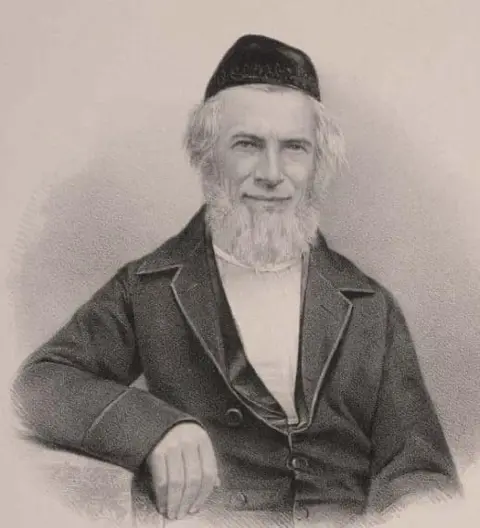
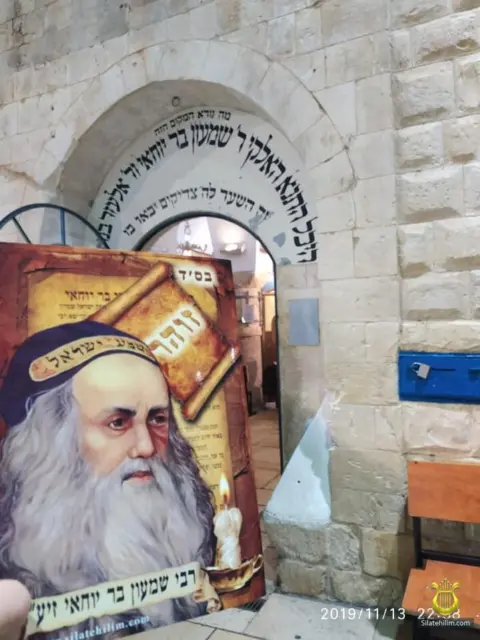
Grave
"Aruch la-Ner"

Yahrzeit (Hillula)
- 25 Kislev — Yaakov Ettlinger - "Aruch La-Ner"
Rabbi Yaakov ben Aharon Ettlinger (1798 – 1871) – "Aruch la-Ner" – was a German rabbi and one of the leaders of Orthodox Judaism.
Yahrzeit – 25 Kislev
Resting place – Altona, Germany
Ettlinger was born in Karlsruhe, Baden, and died in Altona, Prussia. He received his early education from his father Aharon, who served as Klausrabbiner (rabbi of a small synagogue) in Karlsruhe.
Aharon was also a recognized Talmudic scholar who devoted himself to Kabbalah. Ettlinger then went to study under the rabbi of Karlsruhe, Rabbi Asher Wallerstein, son of the famous Sha'agat Aryeh. Wallerstein was also the chief rabbi of the entire duchy of Baden. Ettlinger remained his student until the age of 18. He completed his Talmudic education at the yeshiva of Avraham Bing in Würzburg, one of the most important centers of Torah in Germany. There he also studied at the University of Würzburg, focusing mainly on philosophy. He was thus one of the first German rabbis to receive an academic education, though it should be noted that he never received any formal degree.
In 1826 he was appointed Kreisrabbiner (district rabbi) of Ladenburg, residing in Mannheim. He held this position until he succeeded Akiva Yisrael Wertheimer as chief rabbi of Altona. His yeshiva was attended by a great many students who became leaders of their generation.
Rav Shimshon Raphael Hirsch was his student in Mannheim, and Azriel Hildesheimer was his student in Altona.
Five of his sons-in-law became prominent Orthodox rabbis: Yosef Isaacson of Rotterdam, Salomon Cohn of Schwerin, Yisrael Meir Freimann of Ostrowo, Moshe Leib Bamberger of Kissingen, and Marcus Mordechai Horovitz of Frankfurt.
He was the last German rabbi to serve as a civil judge. Against his wishes, the Danish government, to which Altona then belonged, revoked this right of the Altona rabbi in 1863. Ettlinger was one of the most outspoken opponents of the early Reform Judaism movement and led the protest of 173 rabbis against the 1844 Braunschweig Conference. A telling story is told by Abraham Geiger, who met Ettlinger as a student in 1829. During a school examination, a teacher remarked that Joseph's brothers had not behaved in a brotherly manner, whereupon Ettlinger indignantly rebuked him for speaking ill of the twelve tribes of Israel.
Ettlinger expressed a positive attitude toward Kabbalah, as can be seen from his first work, "Bikkurei Yaakov." In the introduction, Ettlinger explains that he chose this title because its numerical value corresponds to "Yaakov" and "Rachel," who are mystically represented in the laws of the sukkah discussed in the book. A similar belief in the teachings of Kabbalah is expressed in a sermon in which he called for early burial, since as long as the body remains unburied, evil spirits hold power over it. In one responsum, he replied to Rabbi Tzvi Hirsch Kalischer, who was trying to gain support for his movement to build the Third Temple and offer sacrifices there. Ettlinger voiced strong opposition. Among his arguments was that most of the sacrifices would in any case be invalid. Ettlinger maintained that since the Mishnah states that for a sacrifice to be valid it must be offered with the intention of providing a "pleasing aroma," any sacrifice offered during the period of exile would automatically be invalid, since the Torah clearly states that G-d declared He would no longer "savor" the "aroma" of offerings during the era of exile.
In the famous dispute over machine-made matzah, Ettlinger ruled that machine-made matzah may be used on Passover. Nevertheless, he ruled that the edges of the matzah must be trimmed so that it appears round, like traditional matzah.
"Aruch la-Ner"
Ettlinger's book "Aruch la-Ner," consisting of novellae on many Talmudic tractates, is studied in yeshivas around the world. This is most likely due to the "rigorous intellectual discipline and detailed analysis of Talmudic sources" that characterize this work. He is widely cited by such rabbis as Elchonon Wasserman, Baruch Ber Leibowitz, and Reuven Grozovsky. In his will, Ettlinger asked that he not be called a "tzadik" (righteous person) and that the inscription on his tombstone contain only the titles of his works and the number of years he served as rabbi of Altona. He also asked that the four death penalties (stoning, burning, beheading, and strangulation) be symbolically applied to his body.
May the merit of the tzadik protect Am Yisrael!
(https://dailyzohar.com/tzadikim/1242-Rabbi-Jacob-Ettlinger)
Gallery