

9 Tammuz · Yahrzeit
Rabbi Yekutiel Yehuda Halberstam - the Klausenburger Rebbe
Rabbi Yekutiel Yehuda bar Tzvi Hirsch Halberstam - the Klausenburger Rebbe
Yahrzeit - 9 Tammuz
Resting place - Netanya, Israel
Rabbi Yekutiel Yehuda Halberstam was born on the 4th of Shevat, 5665 (1905), in the Polish town of Rudnik. His parents were descendants of great Chassidic dynasties. His father, Rav Tzvi Hirsch, was a grandson of the Admor of Tzanz - Rav Chaim Halberstam, the "Divrei Chaim," and of Rav Yekutiel Yehuda of Sighet, the "Yetev Lev." His mother, Rebbetzin Chaya Mindel, descended from Rav Tzvi Elimelech Shapiro of Dinov (the "Bnei Yissaschar") and Rav Tzvi Hirsch Eichenstein of Zhidachov. When Yekutiel Yehuda turned three, his father wrapped him in a tallit and carried him to cheder for the first time. After the first lesson ended, his father again wrapped him in the tallit and carried him home. For the rest of that day, his father made sure his son did not go outside - even the very first Torah lesson was not to be tainted by outside influence. During the years of World War I, the Halberstam family was forced to leave Rudnik. During this period, the head of the family, Rav Tzvi Yehuda, passed away. Although Yekutiel Yehuda was the youngest son and barely thirteen when his father died, his father's Torah had a decisive influence on his formation.
"My father walked, his whole life, in the paths of holiness laid out by the great Rabbi Chaim of Tzanz. My father told us a great deal about our great-grandfather. But these were not tales of miracles. They were accounts of how the 'Divrei Chaim' served the Creator - how he prayed, how he studied Torah. All of this taught us how we ourselves must serve Ha-Shem." After his father's passing, Rav Yekutiel Yehuda, already known throughout Poland as the Illui of Rudnik, continued to study Torah. His mentors were among the greatest Torah sages of Poland at that time: Rav Avraham Mordechai Alter of Ger (author of "Imrei Emet"), Rav Meir Yechiel of Ostrowiec, and Rav Chaim Elazar Shapiro of Munkacz (author of "Minchat Elazar").
Klausenburg
At the age of 20, Rav Yekutiel Yehuda Halberstam married Peshel Teitelbaum, daughter of Rav Chaim Tzvi of Sighet (Hungary). His future father-in-law gave Rav Halberstam a gold watch as an engagement gift. The young Torah scholar showed his character: he sold the expensive watch and used the proceeds to buy a complete edition of the Babylonian Talmud. The newlyweds spent the first two years after their wedding in Sighet, after which Rav Halberstam was offered the position of rabbi of the community of Klausenburg (in Romania). The Klausenburg community had a centuries-old history, but by the time Rav Halberstam arrived, it was under heavy influence of Reform and socialist movements. He slept only three hours a night, often on a bench in the synagogue, and often ate only once a day. He spent most of his time in prayer and study. Word of him quickly spread throughout Romania and Hungary, and even reached the Land of Israel. In 1937, the Rebbe Yekutiel Yehuda Halberstam was offered a position on the rabbinical court of Jerusalem. He wrote to his mother for advice. She advised him that, given his youth, he should remain where he was. When World War II began, the Jews of Hungary and Romania lived relatively peacefully. Nevertheless, local antisemitism flourished. In 1941, the Rebbe Yekutiel Yehuda, his wife, and their 11 children were arrested and taken to Budapest. The Rebbe was imprisoned together with a group of Jewish activists, who were all eventually sent directly to Auschwitz. Only through the efforts of friends and supporters was the Rebbe released, and the family was able to return to Klausenburg. On March 19, 1944, the Germans invaded Hungary; the Gestapo chief Adolf Eichmann immediately organized roundups of Jews, ghettos began to be established, and the deportation of Hungarian Jews to Auschwitz began. In Klausenburg, the ghetto was established on May 1, 1944. For several weeks the Rebbe hid in an open grave in the cemetery. He then fled to the town of Bánya, where he, together with 5,000 other Hungarian Jews, was placed in a forced-labor camp. The Rebbe was forced to shave off his beard, but he did not lose his composure or his faith in G-d.
In the camp he continued to lead prayers and even held a Tisch on Shabbat. A month after the Rebbe's arrival, the labor camp was liquidated. All the prisoners were sent to the death camp of Auschwitz. Around the same time, the Rebbe's wife and the children who had remained with her were sent from Klausenburg to Auschwitz. They were gassed on June 2, 1944. In Auschwitz, the Rebbe managed to survive and pass through every circle of hell. From the very beginning in Auschwitz he tried to keep every mitzvah he could. He never touched treif food and refused to eat food prepared in non-kosher vessels. He often went hungry. But his faith gave many others spiritual strength. He assured fellow prisoners that G-d was with them even in the valley of death. In 1944, a year after the Warsaw Ghetto Uprising, the Rebbe, together with other prisoners, was sent to clear rubble in the destroyed ghetto. From Warsaw the Rebbe was taken to the Dachau concentration camp. The Rebbe survived only by a miracle. "Great powers are hidden within a person!" the Rebbe would repeat. "Before the war, I would ask my students to bring me heavy volumes of the Talmud, thinking I could not lift them myself. I never imagined that, finding myself in a Nazi camp, I would be able to lift metal rails and carry enormous stones on my back." With these words the Rebbe inspired Holocaust survivors to find hidden strength within themselves and to overcome, with honor, every trial that lay before them.
After liberation, the Rebbe set about rebuilding the spiritual life of the surviving Jews. In the autumn of 1945, Munich became a center of religious Jewish life for all the displaced persons' camps. There the Rebbe founded an organization of survivors, which ran religious schools for boys and girls and yeshivas for young men from 19 other displaced persons' camps. In addition, the Rebbe arranged for kosher slaughter, a mikveh, and helped couples marry. In the spring of 1946, the Rebbe traveled to New York to raise funds on behalf of the organization, managing to raise $100,000 - an enormous sum for that time. That same autumn he went on another fundraising trip and decided to settle in New York, in order to strengthen the American Jewish community and continue working for the benefit of Holocaust survivors on that side of the Atlantic. In 1947 he established his court in the Williamsburg section of Brooklyn, New York. On August 22, 1947, the Rebbe Yekutiel Yehuda married for a second time, to Chaya Nechama Unger, the orphaned daughter of the Rebbe of Nitra, Shmuel Dovid Unger (1885-1945). Five daughters and two sons were born to them. While living in the United States, the Rebbe Yekutiel Yehuda always dreamed of settling in Israel. To this end, in 1958, in Netanya - a coastal resort town - he founded the Chassidic neighborhood of Kiryat Tzanz. Yeshivas, schools for boys and girls, and homes for the elderly soon sprang up there. In 1960, the Rebbe moved permanently to Israel, settling in Netanya, and from Kiryat Tzanz he also continued to oversee the Williamsburg community.
The Rebbe founded batei midrash and schools in other cities of Israel, and established Kiryat Tzanz on the outskirts of Jerusalem. In 1968 he founded another Tzanz settlement in the United States, in Union City, New Jersey.
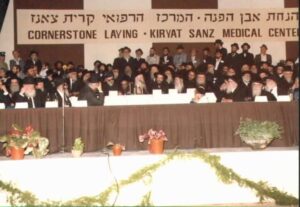
The Rebbe is also known for founding, in Netanya, a 484-bed hospital called "Laniado." The hospital operates entirely in accordance with Jewish law. The idea of founding the hospital took shape during the Holocaust. The Rebbe dreamed of creating a hospital where medicine would be practiced with compassion and mercy toward the patient, in the spirit of Jewish tradition. At the laying of the cornerstone of the building in 1980, the Rebbe said in Yiddish: "I survived Hitler's gas chambers. I spent several years in Nazi death camps. Besides murdering my wife and 11 children, my mother, my sisters, my brother - my entire family, about 150 people - I remained the only survivor, and I witnessed their cruelty. I remember, as if it were today, how they shot me in the arm. I was afraid to go to the Nazi infirmary, even though there were doctors there. I knew that if I went, I would never come out alive... Despite my fear, I tore a leaf from a tree and pressed it to the wound. With G-d's help, the wound healed within three days. Then I promised myself that if, with G-d's help, I ever managed to be rid of these reshaim (evil people), I would build a hospital in Eretz Yisrael where every person would be cared for with dignity..."
Stories of Tzadikim
The Grave of Rabbi Yehuda bar Ilai
Once, the Klausenburger Rebbe went with his Chassidim to the grave of the Tanna Rabbi Yehuda bar Ilai.
They recited Tehillim, and then prayed Mincha, since it was already growing dark. After Mincha, the Rebbe's mood changed; something was troubling him. When his students asked him what had happened, the Rebbe explained: "Rabbi Yehuda bar Ilai states in Masechet Berachot (chapter 4, mishna 1) that one must pray before Plag HaMincha - one hour, or an hour and a quarter, before dark (there is a dispute about this).
Even though we do not follow his opinion, it would be chutzpah (impudence) to pray Mincha at his grave after the time he himself established.
We must come back tomorrow and set things right.
The next day, they returned to the grave of Rabbi Yehuda bar Ilai. This time they came earlier in the day and prayed Mincha before Plag HaMincha, in accordance with Rabbi Yehuda bar Ilai's opinion. After they finished praying Mincha, the Rebbe felt a weight lift from him.
He had corrected what he considered an affront to the great Tanna Rabbi Yehuda bar Ilai.
(From the sefer "Maggid" by Rabbi Paysach Krohn)
The Grave of Rabbi Menachem Mendel of Vitebsk
The Klausenburger Rebbe wept for hours at the grave of Rebbe Menachem Mendel of Vitebsk.
Reb Shmuel Unsdorfer was one of the closest and most devoted followers of the Rebbe of Tzanz. He later became the father-in-law of the Rebbe's son, Rebbe Tzvi Elimelech, who is today the Klausenburger Rebbe of Netanya.
Rebbe Shmuel told the following story.
Once they went on a tour of the graves of tzadikim.
At every grave the Rebbe visited with his Chassidim, they would recite Tehillim, then move on to the next grave and recite Tehillim there as well.
This continued until they reached the grave of the great Rabbi Menachem Mendel of Vitebsk - a disciple of the Maggid of Mezeritch, who moved to Eretz Yisrael in 1777.
When they approached his grave, the Rebbe threw himself down and lay stretched out over it, weeping and weeping - for two hours straight.
Some time later, Rebbe Shmuel Unsdorfer asked the Rebbe why he had only recited Tehillim at all the previous graves, yet at this particular place he had wept like a child.
The Rebbe answered that he was so far removed from Rabbi Akiva and all the sages of the Talmud that he simply recited Tehillim for them.
Reb Shmuel gathered his courage and asked: "With all due respect, what connection does the Rebbe have to the great Vitebsker? He was one of the greatest disciples of the Maggid of Mezeritch."
The Rebbe answered: "Compared to the Vitebsker, I too am nothing, but you must understand - the disciples of the Baal Shem Tov took upon themselves a special mesirut nefesh (self-sacrifice) to help every Jew even after their own passing. So yes, I do have a connection to him, and that is why I lay upon his grave and wept."
The Passover Seder
Once, in a personal conversation, Rebbetzin Chava Kupperman spoke about the Klausenburger Rebbe with great warmth.
When the Rebbe came to Israel after all he had endured in the Holocaust, in which he lost 11 children and his wife, and after his time in America where he had managed to revive the life of the community there, he decided to hold a Passover seder for all the survivors of the Shoah. Having gathered together Jews exhausted from the horrors of the war and the loss of their loved ones, the Rebbe began the seder, but the outraged Jews began to grumble, unwilling to take part in any religious ritual: "If G-d has abandoned us, what is the point of all this?" they said...
And then Rabbi Yekutiel said:
- "Do you remember how many Jews left Egypt - 20%, one-fifth. And how many came out of the Shoah? That's right - also one-fifth of the Jews."
- "Do you remember what the Jews did when they crossed the Yam Suf, when no one knew how it would end? Yes - they sang the Shirat HaYam - they made a Kiddush Hashem for having remained alive. So we too, having come out of the furnace of the Shoah, will now make a Kiddush Hashem. We, the survivors, will do it on behalf of those who could not come out."
And the people began holding out their cups to be filled with wine, and they listened to their first post-war Passover seder.
A Segula from the Klausenburger Rebbe
In the book "The Klausenburger Rebbe - The War Years," on page 36, it is described how, during the Holocaust, the Klausenburger Rebbe taught his assistant to observe the following three practices in order to be saved from any danger:
- to make sure, without fail, that his head was covered at all times;
- to observe the laws of washing the hands;
- when in danger, to recite 3 verses [interestingly, all three of these prayers contain something that counteracts the power of Haman]:
1. The name of Avraham Avinu's mother - "Amatlai bat Karnevo."
"The mother of Avraham was Amatlai bat Karnevo, and the mother of Haman was Amatlai bat Orvetai - and here is a sign for you to distinguish between them: the pure to the pure, and the impure to the impure - the name of Haman's mother, Orvetai, comes from the word "orev" (raven).
2. The verse: יבא המלך והמן היום - "Yavo hamelech ve-Haman hayom" - ("let the king and Haman come today"). (Megillat Esther 5:4)
In Megillat Esther, the Name of Ha-Shem is not written explicitly.
But the Arizal teaches that the Names of Hashem can be found in the first and last letters of the words of the verses of Megillat Esther.
So in the verse: "Yavo hamelech ve-Haman hayom" - (יבא המלך והמן היום) - the first letters spell out the Holy Name, symbolizing Rachamim (mercy).
Haman said before his wife and friends the phrase: "[Vechol] zeh einenu shoveh li" (Megillat Esther 5:13) - (וכל] זה אינינו שוה לי) - "all this means nothing to me" - where the Holy Name appears in reverse order, corresponding to Middat HaDin (judgment).
Esther, however, when inviting the king to the feast, spoke a phrase that rearranges the letters of Hashem's Name, transforming judgment into mercy: "Yavo hamelech ve-Haman hayom."
3. "Elokei d'Rabbi Meir, Aneni."
May the merit of the great tzadik Rabbi Yekutiel Yehuda Halberstam protect Am Yisrael!
(http://zchusavos.blogspot.com/…/klausenberger-rebbes-visits…)
Pilgrimage site:
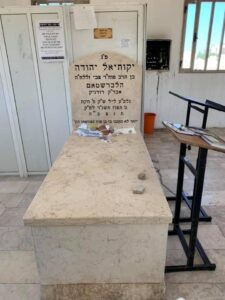
Grave: Yekutiel Yehuda Halberstam