

7 Iyar · Yahrzeit
Rabbi Shlomo Ephraim Luntchitz - the "Kli Yakar"
Rabbi Shlomo Ephraim ben Aharon Luntchitz (1550 - 1619) was a rabbi and Torah commentator - author of the "Kli Yakar".
Yahrzeit - 7 Iyar
Burial place - Jewish cemetery Prague-Josefov
He was born in Lenczyca (also known as Luntchitz) and studied under Solomon Luria in Lublin, later serving as Rosh Yeshiva in Lviv (Lemberg).
In 1604 he was appointed rabbi of Prague and held that position until his death, from 1604 to 1619.
In the introduction to his "Kli Yakar" he relates that the name Shlomo was added to his name during a life-threatening illness, a common practice in Judaism.
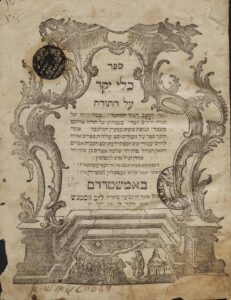
Luntchitz is best remembered for his homiletical work, first and foremost the "Kli Yakar" ("precious vessel," an allusion to Proverbs 20:15) on the Torah, which first appeared in Lublin in 1602, is still printed in many editions of the Chumash, and remains very popular to this day.
He composed two penitential prayers in memory of the pogroms of 1611 that struck Prague on the 2nd of Adar according to the Jewish calendar.
In addition, he wrote:
"Ir Giborim" ("city of mighty men," cf. Proverbs 21:22), consisting of Petichot u-She'arim ("openings and gates") and two works of Torah discourses. It was first published in Basel in 1580.
"Olelot Ephraim" ("Gleanings of Ephraim," a reference to Judges 8:2), four volumes of discourses published in Lublin in 1590.
"Amudei Shesh" ("pillars of marble," Esther 1:6), discourses (Prague, 1617). Known for his criticism of pilpul, although the same work engages in pilpul itself.
"Siftei Da'at" ("words of wisdom," also Proverbs 20:15), a continuation of the Keli Yekar in style and scope, Prague, 1610.
"Orach le-Chayim" ("a path to life," Proverbs 10:17), discourses for Shabbat Shuva and Shabbat HaGadol, Lublin, 1595.
"Rivot Ephraim" ("myriads of Ephraim," Devarim 33:17), not preserved, but mentioned in the introduction to Orach le-Chayim.
The Story of the Birth of Rabbi Shlomo Ephraim Luntchitz
His father, Rav Aharon, worked at a tavern, and for 6 years he did not pay the owner, since there was no income. So the owner decided to throw the entire family into a pit for this, and ordered everyone to throw garbage into this pit, and posted a guard. Rav Aharon, with his pregnant wife and children, in the damp, filthy pit, prayed to Ha-Shem for salvation. And suddenly the guard's attitude toward them changed - he would not let others throw garbage into the pit, and he brought them food. He understood that he would be punished for this by the owner, but he could not help himself.
One day the guard came to the pit, saw a light in the pit, and asked Rav Aharon what this was, what this light was. Rav Aharon answered that this was light from above, that a son had been born to him, and that the light had filled the pit because of him. The guard ran home to bring food and clothing for the wife and child. The owner summoned that guard and asked him about Aharon's family - were they still alive in the filthy pit?
The guard answered that they were alive, and that a beautiful son had been born to them and had filled the pit with light. The owner ran to the pit and saw it with his own eyes, and since he himself had no children, he fell in love with the infant and offered Rav Aharon an exchange - to leave the pit with his family and receive the tavern as a gift in exchange for this child. Rav Aharon agreed; he had no choice.
The owner could not get enough of the child - by the age of 6 he already knew more than his teachers. One of the teachers told the owner that in France there was an instrument ("kli") that no one knew how to play. The owner decided to test little Ephraim - they took him to the city, showed him the instrument, and the boy began to play it, and everyone was amazed, since no one knew how to handle this instrument. And the boy fell in love with the instrument and took it with him.
Years passed, the boy reached the age of bar mitzvah, and then, every night for 21 days, he began to see his father, Rav Aharon, in a dream, who told him: "I am your father. Before, there was no need for mitzvot, and I did not come, but now there is - you are a Jew and must live as a Jew." The boy told the owner, who told him to pay no attention, saying it was just his imagination.
Rav Aharon asked for help from Heaven, stole away his son, and brought him to the yeshiva of the Maharal of Prague, explained everything to him, and disappeared. The Maharal of Prague understood that this boy had a "neshama kedosha" (holy soul) and began to teach him all the mitzvot, Torah, and Gemara. He saw that the child was extraordinary and gifted.
Meanwhile, the owner searched everywhere for the boy, for he loved him very much, had grown attached to him, and felt he would die without him.
Someone told him that there was a sorcerer in the forest who could help find the boy. The sorcerer told the owner that he needed to bring him the object the boy was most attached to - he should bring it to the sorcerer, who would locate the boy by means of it. The owner brought the instrument the boy loved, and the sorcerer immediately saw where he was - in the yeshiva of the Maharal of Prague - and that it was heavily guarded there, but he would help get the boy out.
The Maharal sensed that something unnatural was happening and told 3 students to guard the boy that night and not take their eyes off him.
The sorcerer came to the yeshiva, began to cast his spell, and put the 3 students to sleep, and the boy saw the owner and ran after him.
In the morning the Maharal came and saw that the boy was gone. He summoned 10 sages, and they began to pray, and he went to the local police and said that a Jewish boy had been stolen from his yeshiva. The police took the boy back, and the owner died of grief. The Maharal sent the boy to Pressburg with a letter in which he described what a special boy he was and how he needed to be protected from the sitra achra, for he had a "neshama kedosha."
Some time passed and the boy fell seriously ill. The doctors advised him to walk in the garden among the trees for 40 evenings, so that his health would return to him. And so, on the 40th day of walking in the garden, the boy found himself in a dark forest. He was frightened, wept, and begged G-d to help him, when suddenly he saw an old man who said to him: "Do not be afraid, I am David HaMelech, I have come to help you. Soon the 'merkavot sitra achra' (chariots of the impure forces) will pass by here, but do not be afraid - I will give you kavanot (intentions), and they will not touch you."
After a while the young man saw chariot after chariot, which stopped near him, and he performed the kavanot that David HaMelech had given him. But he missed one kavana, and the "sitra achra" seized him and said: "I will let you go if you swear that you will read one page from this book every day." And the boy agreed, and began to read a page from that book every day, studying Torah less and less.
The rabbi of Pressburg understood that something was wrong with the boy and asked the young man to tell him everything, and he told him about the secret of the "laila nora'ah" (the terrifying night) and about David HaMelech and about the oath to the "sitra achra."
The rabbi then gathered 10 Torah scholars and told them to go with the young man into the mikveh and perform the kavanot, while he himself would stand in the same place from his own corner and also perform kavanot. And so they entered the mikveh and began the kavanot, and suddenly a fire appeared, and it said that the young man belonged to it, since he had sworn an oath. The Rav of Pressburg continued the kavanot until the fire consumed the entire mikveh where they stood, and the fire consumed everything - only the 10 students and the young man remained alive. The Rav of Pressburg told the boy that he was sending him back to the Maharal, since he himself was now old and it was not easy for him to fight the "sitra achra." The Maharal of Prague sent the boy to Lviv, married him to the daughter of a hidden tzadik (tzadik nistar), and asked him not to reveal his abilities to people, but to live an ordinary life. And when someone would come to him with a letter, he should carry out everything written in it.
Time passed, and the rabbi worked as an egg seller and lived in great poverty. He always signed his name "Olelot Ephraim." One day, Torah scholars came to Lviv looking for him, but no one knew anything about him, until someone recalled his signature, "Olelot Ephraim." They came to him and saw how poorly he lived - his children and wife in torn clothing - and thought they had come to the wrong place, but they gave him the letter anyway.
The letter said that he must return to Prague. The Torah scholars gave him money for clothing and travel. Around that time someone had been robbed, and seeing poor Ephraim suddenly buying fine clothing, they accused him of theft. He was caught and put in prison. The rabbi's wife asked the Torah scholars for help, and they paid to have him released from prison.
Through the influence of the Maharal of Prague and the Shelah HaKadosh, Rav Shlomo Ephraim became the Rav of Prague.
When he was about 50 years old, he became gravely, mortally ill, so it was decided to add the name Shlomo to his name, and a revival from the brink of death occurred. Following this, he thanked the Creator of the world for the miracle he had received, and also mentioned it in the introduction to his book "Kli Yakar," where the rabbi describes what happened: "In 1601, before the days of Purim, I took to my bed with a dangerous illness for several weeks, until I was given the name Shlomo. And through G-d's compassion, He brought me out of my illness to be revived. On that day I made a vow to G-d and undertook to write this book in honor of G-d and His Torah and to reveal secrets."
After the Maharal's death, Rav Ephraim Shlomo continued to serve alone as the Rabbi of Prague, and 23 years later, Rav Yeshaya HaLevi Horowitz - the Shelah HaKadosh (deported together with the Jews from Frankfurt) - joined Rav Ephraim Shlomo to serve together with him in the city of Prague.
A Segula from Rav Ephraim Shlomo Luntchitz for the Time of a Brit Milah (Circumcision)
In addition to his famous book "Kli Yakar," Rav Ephraim Shlomo wrote "Olelot Ephraim" - discourses for holidays, circumcisions, the chuppah, and so on.
In this book he writes that every person should, during the crying of a child being circumcised, focus on his own pain and problem, and should join his prayer to the voice of the circumcised child, which rises unhindered to Heaven, undelayed by any klipah (evil shell), as it is said in Tehillim (6:9-10):
ס֣וּרוּ מִ֭מֶּנִּי כָּל־פֹּ֣עֲלֵי אָ֑וֶן כִּֽי־שָׁמַ֥ע יְ֝הוָ֗ה ק֣וֹל בִּכְיִֽי׃ י שָׁמַ֣ע יְ֭הוָה תְּחִנָּתִ֑י יְ֝הוָ֗ה תְּֽפִלָּתִ֥י יִקָּֽח
- "Suru mimeni kol po'alei aven, ki shama Ado-nai kol bichyi. Shama Ado-nai techinati, Ado-nai tefilati yikach" - (Depart from me, all workers of iniquity, for the L-rd has heard the voice of my weeping. The L-rd has heard my supplication; the L-rd will receive my prayer).
"For the L-rd has heard the voice of my weeping" - that is, the L-rd hears the cry of the circumcised child, and at that moment a time of favor, "eit ratzon," arrives. "He has heard my supplication; the L-rd will receive my prayer." And this is a wonderful segula. At the time of the circumcision, when the infant cries out from the pain, that is the moment to ask for something important that is causing suffering. (Rav Eliyahu Guttmacher - Tractate Shabbat (Kel.))
May the merits of the Tzadik Rabbi Shlomo Ephraim ben Aharon Luntchitz protect us all!
 https://dailyzohar.com/tzadikim/209-Rabbi-Shlomoh-Efraim-of-Luntchitz
https://dailyzohar.com/tzadikim/209-Rabbi-Shlomoh-Efraim-of-Luntchitz
Pilgrimage site:
Grave: Shlomo Ephraim Luntschitz