

28 Tevet · Yahrzeit
Rabbi Avraham Antebi - Aleppo
Rabbi Avraham Antebi - Tzadik of Syria, who saved Aleppo from an earthquake (1765-1858)
Yahrzeit - 28 Tevet
Resting place - Aleppo, Syria
He was born in Aleppo (Aram-Tzova), Syria, in 1765, a descendant of Jews expelled from Spain who had settled in the town of Ein-Tab, known today as Antep, located in southern Turkey. His great-great-grandfather, Chacham Rachamim (1554-1627), emigrated from Ein-Tab to Aleppo, which is the origin of his family name, Antebi.
In his youth he studied mainly with his father, Chacham Yitzchak Antebi, and with the great sages of Aleppo. In 1817 he was appointed rabbi and chief judge of all of Aleppo, a position he held for more than 40 years.
Rabbi Antebi was a prolific writer. His works deal mainly with halacha (Jewish law), drashot (sermons and discourses), and mussar (Jewish ethics). He also wrote several poems and songs of a religious nature. But no less than for his writings, he was known for his passionate devotion to the welfare of his community, which in those years found itself in very difficult circumstances.
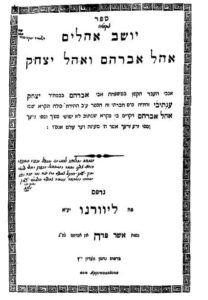
In 1824, an earthquake destroyed the city of Aleppo, killing about a thousand Jews (at the time the community numbered no more than 10,000), and the survivors, including the rabbi, were forced to set up camp and live in tents outside the city for 18 months. It was during this time that Rabbi Antebi wrote his first book, which he called "Yoshev Ohalim" (Dweller in Tents). This book contains sermons on the weekly Torah portions, in which he creatively combines halachic analysis, biblical narratives, and aggadic accounts (stories and parables of the sages). In these makeshift tents, without access to his books, Rabbi Antebi wrote his work, citing all his sources from memory.
The main problem Rabbi Antebi faced as the community's leader was the widespread impoverishment of the community. Incomes fell, prices rose, and the Ottoman Empire demanded higher taxes. There are many stories about how the rabbi devoted all his efforts to supporting those in need. In his mussar works "Ohel Yesharim" and "Chochma u-Mussar," he writes extensively that every Jew is responsible for his fellow Jew and must not ignore him in difficult times. He also wrote that one of the reasons for the poor economic situation of the Jews of Aleppo was that people engaged only in trade and had no other professions. The rabbi urged parents to give their children a profession, rather than being content merely to teach them trade.
One of the rabbi's most important books, "Mor VeHalot," contains questions and answers concerning countless cases that arose in the community and required an authoritative rabbinic ruling.
The custom of the Jewish courts in Aleppo was that the city's chief rabbi - at the time, Rabbi Antebi - would individually adjudicate various monetary disputes, without the accompaniment of two other judges (dayanim), as was the common practice among other rabbis, yet there remained an "ethical" problem.
The famous Rabbi Shabtai HaKohen (the Shach, of Poland), basing himself on the Shulchan Aruch and the Jerusalem Talmud, wrote that although a rabbinic judge may technically judge alone, today no one can be considered a "great expert," as was the case in the time of the Talmud, since knowledge of Torah has diminished over time. Therefore, today no rabbi should judge cases individually. And many prominent rabbis accepted the Shach's opinion.
At this point, Rabbi Avraham enlightens us with his halachic insight. Rabbi Antebi disagreed with the Shach's view. Here are some of his words:
"Contrary to [what the Shach said], one can find a genuine expert more readily in our generations than in the generations of the Talmud, since the entire expertise [of the Talmudic sages] was based on memory and oral transmission. In those times, being an expert was not very common. This is not the case in our generation, because everything [the laws] has already been recorded in books, and [the sages] have left no matter, great or small, unrecorded. Therefore, if a rabbinic judge knows how to legally analyze [the case at hand] and is familiar with the works of the poskim (halachic decisors), there is no doubt that he can be considered a 'great expert' in the law."
Rabbi Avraham Antebi passed away in Aleppo in 1858 at the age of 93, and to this day he is remembered as one of the greatest luminaries of Aleppo.
 (Rabbi Joseph Bitton: https://esefarad.com/rabbi-ishmael-hacohen-1723-1811-2-2-3-2-3-3-2-2-2-2/)
(Rabbi Joseph Bitton: https://esefarad.com/rabbi-ishmael-hacohen-1723-1811-2-2-3-2-3-3-2-2-2-2/)