

27 Kislev · Yahrzeit
Rabbi Chaim of Czernowitz - the "Be'er Mayim Chaim"
Rabbi Chaim ben Shlomo Tirer was born in 1760 in the Galician town of Buchach (about a hundred years later, the Nobel laureate in literature Shmuel Yosef Agnon was born there).
Yahrzeit - 27 Kislev Resting place - Tzfat, Israel His book "Be'er Mayim Chaim", a commentary on the Torah, is considered one of the most important works of Chassidic thought. Much of it is based on the kabbalistic teachings of the Arizal. He also wrote the famous "Siduro Shel Shabbat" and "Sha'ar HaTefillah."His teachers were the renowned Chassidic tzadikim Rabbi Shmelke of Nikolsburg and Rabbi Yechiel Michel of Zlotchov, as well as Rabbi Dov Ber of Mezeritch himself. Rabbi Chaim served as rabbi in Mogilev, Botosani, Kishinev, and Czernowitz.
He led the community in Czernowitz for 18 years and became known as Rabbi Chaim of Czernowitz.
But he is even better known as the "Be'er Mayim Chaim" (after the title of his main work).
The honor in which he was held in Czernowitz was so great that for many years after he left the post of rabbi of Czernowitz, the position remained vacant. In 1807, Rabbi Chaim left his post, and his whereabouts remained unknown until 1813.
In 1813, Rabbi Chaim moved together with his students to Eretz Yisrael, to the city of the kabbalists, Tzfat, where he spent the last years of his life.
Sipurei TzadikimFires and Shabbat
Rabbi Chaim Tirer, the "Be'er Mayim Chaim," one of the best students of Rabbi Michel of Zlotchov, discovered upon arriving in Czernowitz a very serious breach in the boundaries of holiness: every Shabbat, in the main synagogue of Czernowitz, men and women danced together inside the synagogue and called it oneg Shabbat ("the delight of Shabbat").
Already on the first Shabbat, the "Be'er Mayim Chaim" demanded: "You appointed me rabbi of the community, so from now on this improper custom must be abolished."
The heads of the community came and complained: "How can we abolish the delight of Shabbat for the whole community?"
Hearing these words, the tzadik grew alert and promised: if you agree to abolish this custom, there will be no fires in the city.
Fires were the main scourge of that region of Bukovina, which consisted entirely of wooden houses, and entire towns could go up in smoke and flame. Such a promise was a powerful temptation, and the community took upon itself to observe the rabbi's decree.
During Rabbi Chaim Tirer's tenure - about 40-50 years - no fires broke out in Czernowitz.
Even thirty years after his death, as long as the decree was observed, the city remained protected from fire. Seventy years later, a new generation arose "which knew not Yosef," and resumed the dancing. The very next day a great fire broke out in the city, and all the houses were reduced to ashes.
"Siduro Shel Shabbat" "Shabbat is so important for a Jew that the sages say that if all Jews were to observe just two Shabbatot in a row, the Redemption would come" - the "Be'er Mayim Chaim" loved to repeat. Rabbi Chaim's love for the Shabbat was so extraordinary that the sign with a red arrow pointing to his grave at the famous ancient cemetery of Tzfat mentions not only his most famous work - "Be'er Mayim Chaim," a profound commentary on the Chumash, but also another outstanding work - "Siduro Shel Shabbat," which reveals the essence of the holy Seventh Day. Once, in a heart-to-heart conversation with a simple peasant, Rabbi Chaim made every effort... "All week you work with your animals, sowing, plowing, doing exhausting labor. But on the holy Shabbat you receive a second soul, a pure soul, that allows you to experience complete rest from the mundane... On the holy Shabbat every Jew becomes a king, a son of the King of kings." Hearing Rabbi Chaim's simple yet jewel-like words, the peasant wept and promised to begin observing the Shabbat, but begged to be exempted from the prohibition during plowing and harvest time, since times were very hard. "No," Rabbi Chaim told him firmly but with concern, and explained - "The laws of Shabbat were given at Marah (the place with the bitter waters) to teach that even when everything seems so difficult and observing Shabbat seems impossible, a Jew must overcome the obstacles and observe it anyway. And when he does," Rabbi Chaim assured, "the Master of the Universe will see to it that the bitter waters become sweet for him." Grave of the Tzadik To reach the burial cave of the "Be'er Mayim Chaim," the quickest route may be to start at the foot of the "new" cemetery and climb up the hill to the ancient cemetery. Alternatively, if starting from the top of the hill, the path to Rabbi Chaim passes right by the plot of the holy Arizal.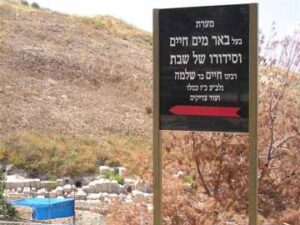 A sign in Hebrew points to "Be'er Mayim Chaim and Siduro Shel Shabbat - Rabbi Chaim bar Shlomo." (Just a few steps down is the burial cave of the outstanding Torah commentator Rabbi Moshe Alshich.)
He passed away in 1817, on the third day of Hanukkah.
A sign in Hebrew points to "Be'er Mayim Chaim and Siduro Shel Shabbat - Rabbi Chaim bar Shlomo." (Just a few steps down is the burial cave of the outstanding Torah commentator Rabbi Moshe Alshich.)
He passed away in 1817, on the third day of Hanukkah.
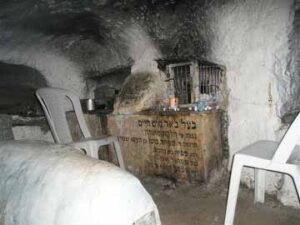 May the merit of the tzadik "Be'er Mayim Chaim" protect Am Yisrael!
(http://ascentofsafed.com/cgi-bin/ascent.cgi?Name=chernovitz; based on an article by Rabbi Yitzchak Ginsburgh)