

26 Iyar · Yahrzeit
Rabbi Shlomke of Zvhil - Baal HaMofet
Fame and Publicity
Once Rebbe Shlomke met a man who was excessively chasing after honor.
Rebbe Shlomke said to him:
"When a soul descends into this world, it is allotted a certain amount of joy. This joy is distributed among all its needs. It will receive a certain amount of nachas from children, from good livelihood, from health, from honor, and so on. If you derive so much pleasure from being shown so much honor, you deprive yourself of the opportunity to find joy in other areas."
Rebbe Shlomke of Zvhil used to say in the name of the Maggid of Mezeritch, of blessed memory:
The word "pirsum" (fame, publicity) is made up of two words: "pri" (fruit) - "samech-mem" (Satan).
In other words, fame is Satan's portion.
I know that fame harms me, but I accept it in order to inspire other Jews and strengthen their faith.
A certain prince took great pleasure in horseback riding. The Baal Shem Tov, of blessed memory, said: "He is destined to become ruler over a great country, yet he trades that destiny for the pleasure of riding a horse."
The Mikveh
Since people constantly came to Rebbe Shlomke and shared their problems and worries, he went to the mikveh often. If a sick person came to him, it would become clear to him in the mikveh whether that person would survive or not. Every time, Rebbe Shlomke predicted correctly. Reb Elya Ros, of blessed memory, the Rebbe's gabbai, once asked:
"How can the Rebbe predict the future, who will recover and who won't? Does the Rebbe have the Urim veTumim (the High Priest's breastplate, on which letters would light up so the people would know what the Almighty was saying)?"
Rebbe Shlomke answered:
"We live in a generation of 'hester panim,' when Divine providence, 'hashgacha pratit,' is hidden. This causes people to begin doubting and to weaken in their faith. Therefore, in every generation the Almighty appoints a tzadik to whom 'hester panim' does not apply. Through this tzadik, knowledge of the Almighty is revealed in this world."
The Benefit of Suffering
Rebbe Shlomke of Zvhil's granddaughter (the wife of Rebbe Mordechai of Zvhil) wore torn shoes. Rebbe Shlomke's wife hinted about this to Rebbe Shlomke, hoping he would give money for the granddaughter to buy new shoes. But Rebbe Shlomke said to his granddaughter:
"This suffering will save you from the pains of childbirth."
At that time she was pregnant. She later admitted that she had never had such an easy childbirth. Someone once told Rebbe Shlomke that he had just lost a great deal of money. The Rebbe replied:
"Instead of giving you a blessing to find the lost money, I give you a blessing that a child be born to you." This man had had no children for many years. In the merit of this blessing and thanks to the suffering, a child was born to him.
Averting Severe Suffering
Rebbe Shlomke's granddaughter (the wife of Reb Elazar Adler, of blessed memory), soon after her wedding, fell ill with a terrible disease. The doctors said there was nothing they could do, and that she had only a few weeks left to live.
Rebbe Shlomke told her to take upon herself three things, and then she would merit a refuah shlema, a complete recovery.
- For two years she may not wear jewelry.
- She may not kiss her children.
- She may not attend her children's weddings.
She accepted these restrictions upon herself and recovered immediately. As we have explained, when a person limits their pleasures in this world, they can avert severe suffering from themselves.
Bizyonot (Humiliation)
Rebbe Shlomke of Zvhil, of blessed memory, often spoke of how much a person can achieve by staying silent when another shames him.
He said that shame can save a person from much suffering and punishment, and sometimes even from death itself. Once Rebbe Shlomke of Zvhil, of blessed memory, was sitting among the poor at the Kotel.
Someone came and gave each person a single coin.
This man did not know that Rebbe Shlomke was sitting among the poor, so he gave him a coin as well. When the man left, Rebbe Shlomke gave his coin to the person sitting next to him.
That person asked: "Why didn't the Rebbe tell that man that he doesn't need charity?"
The Rebbe answered: "I didn't want to miss the opportunity to feel a bit of shame."
Once Rebbe Shlomke's granddaughter told him that her family was in great poverty and had no money to buy bread. Rebbe Shlomke advised her to go to the Kotel and pray there. At that time the plaza at the Kotel was quite small, and her loud prayers disturbed a woman sitting nearby.
The woman shouted: "Quiet! Quiet!"
But Rebbe Shlomke's granddaughter paid her no attention and continued to weep and pray loudly. When she finished and turned to go home, the woman said:
"Do you think this whole place belongs only to you? Couldn't you pray quietly?"
She said several more humiliating words. Rebbe Shlomke's granddaughter accepted the shame in silence.
On her way home she found a gold Napoleon coin.
With this money the family could live for half a year.
She told Rebbe Shlomke what had happened: "Praise to the Almighty, He heard my prayers and gave me money. But why did I need to endure so much shame?" Rebbe Shlomke answered:
"The shame was only the beginning of the salvation, because it pushes away all troubles and difficulties.
After you were humiliated, you merited to find that coin."
The Segula of Rabbi Shlomke of Zvhil Rebbe Shlomke of Zvhil gave a special segula for when a person has already tried every remedy and has not achieved the desired result: if there is no help from Above, then the best time for a person to make the Almighty his "shutaf" - partner - is on Erev Shabbat - at the time of Kiddush. The Gemara teaches: Do not read "Vayechulu HaShamayim veHa'aretz" - (and the Heavens and the Earth were completed), but read: "Vayachlu" - (and they completed) - already speaking of partnership. It is precisely at this moment that the person himself and the Almighty appear together, as partners; at this moment they become co-creators and complete the building of the world, making it perfect. The segula is this: after "Shalom Aleichem" and "Eshet Chayil", during Kiddush, at the moment the words "Vayechulu…" (completion) are said - mentally say "Vayachlu" with the kavana that we are partners of the Almighty and together create worlds from the beginning - Bereishit - and ask the Almighty to help solve one's problems and deliver one from troubles. Although there is a rule that on Shabbat one does not make requests (Shabbat is 1/60th of Olam Haba - the World to Come, which we strive for, and in which there are no troubles or problems at all), halacha says that if a person is in great distress, tormented and troubled, with sorrow in his heart and in need of help from Heaven, then this is the most fitting time to turn to the Almighty with his request. And this itself is the Oneg (delight) of Shabbat - that after praying, relief comes upon his soul. Sippurei Tzadikim - The Shabbat Cholent While the Rebbe of Zvhil lived in Zvhil, he managed to conceal his greatness. Although everyone knew he was a scholar, they did not realize how elevated a level Reb Shlomke was on, until the following story took place. One of the town drunks of Zvhil was a man we will call Andrei. He was mostly harmless, content with a bottle or two of vodka. Although Andrei was not Jewish, he liked to spend time in the Jewish part of town, because there he wouldn't be beaten, as he might be in other parts of town, and he knew the Jews were compassionate people who would give him food when he asked. One Shabbat morning, after a heavy drinking bout the night before, Andrei felt especially hungry. He knocked on several doors but got no answer, since it was Shabbat and the residents were in the synagogue. At the next house he tried, there was also no answer, but he noticed the door had not been properly locked. The homeowners, rushing to get to the synagogue, had left the door unlocked. Andrei opened the door and was greeted by a set table with beautiful golden challahs, a decanter of red wine, and other delicacies. A heavenly aroma rose from the stove; the smell of cholent and kugel was mouth-watering. Andrei didn't know where to start. The wine attracted him most, but he thought it better to eat first on an empty stomach. He opened the pot of cholent and scooped himself a large portion, which he shoved down his throat like a man who had never seen food before. The cholent was followed by a huge piece of kugel. At that moment he heard people outside returning home from the synagogue, and thought it best to leave the house at once before he was caught red-handed. He was still chewing his food as he headed for the door, but was stopped by the golden challah on the table; it looked so beautiful, and he was still so hungry. He tore off a huge piece of challah, took a big bite of it, and reached for the door handle. He had so much food in his mouth that he could not chew properly. A piece of challah went down the wrong way, and he could not breathe. Andrei began to choke, his face turned red, and within moments he collapsed dead in front of the door. A few minutes later the couple who lived in that house returned home. They tried to open the door, but something was blocking it. The husband pushed with all his strength and got the door open. They went inside and looked to see what was blocking the door. They were shocked to see Andrei, the town drunk, lying on the floor of their house. The husband began to shake him and demand that he leave, but soon realized that Andrei was completely lifeless. He saw a large piece of challah next to Andrei and guessed what had happened. The husband and wife began to panic. There had recently been pogroms in the area. If people learned that Andrei had been found dead in a Jewish home, they would accuse the Jews of murdering him. Although they didn't care at all about Andrei, they used any opportunity to attack Jews. The wife told her husband to run to Rebbe Shlomke and ask for his advice. The homeowner rushed to the Rebbe's house and told him what had happened. The Rebbe agreed with him that the townspeople might use this as a pretext for a new pogrom. Reb Shlomke took a spoonful of his cholent and told the man to put it in the mouth of the dead drunk. Thoughts raced through the man's mind - how could he feed a dead man - but he asked no questions, since he was a simple Jew who had complete emunah in everything the Rebbe told him. He quickly went home, trying not to spill the cholent. He tried to push the cholent into Andrei's mouth, but his lips would not part. Then the man said in panic: "Reb Shlomke said I must feed you cholent." At the mention of the Rebbe's name, the lifeless drunk opened his mouth, and the man quickly put in as much of the Rebbe's cholent as he could. He nearly fainted at what happened next. Andrei got up off the floor and, staring straight ahead, walked out the door. The man followed Andrei, curious as to what would happen. Andrei walked through the town like a zombie, staring straight ahead. A few minutes later Andrei reached his own house. As soon as he entered his home, he collapsed on the floor, lifeless as before. The man ran home to tell his wife what had happened. They had just witnessed an open miracle. They had seen a dead man rise and walk through the town to his own house. Now they understood that Reb Shlomke was far greater than he appeared to be. The story spread quickly, and now everyone knew that their Rebbe was a very holy man who had been trying to hide his greatness. It is said that this very story is what prompted Reb Shlomke to consider moving somewhere where people would not know him. He eventually moved to Jerusalem, where he managed to keep his identity hidden, until one day someone from Zvhil encountered him in a synagogue and revealed who he was. After that, crowds of people flocked to him for advice and help, until he passed away on the 26th of Iyar, 1945, the 41st day of the Omer, Yesod she-b'Yesod. One of the tzadikim at the funeral noticed the scent of all sorts of fragrant spices coming from Reb Shlomke's body. He later asked Reb Shlomke's son, Reb Gedalia, what the source of this custom was. Reb Gedalia answered that they had no such custom. They then understood that this wonderful fragrance had actually come from the great tzadik himself. Bizyonot - Salvation from Death Rabbi Yehuda Leib Slonim told an interesting story that he himself witnessed. During the war in 1948, when Jerusalem was under bombardment and shelling, the city's residents hid in shelters. One of these was located in the Beit Yisrael neighborhood, on a street today called "Rabbi of Zvhil," not far from the Mir Yeshiva. The residents of the neighborhood hid in the shelter, among them Rabbi Gedalia Moshe of Zvhil. Despite the explosions outside, the darkness, and the cramped conditions, he studied without lifting his head. In the same shelter there was a mentally ill woman. She constantly caused scenes, cursed, shouted, and picked on one person after another. The atmosphere became simply unbearable. Several people took the initiative and decided to put her out the door. The next day, when the woman came again, they were preparing to carry out their plan, but, remembering that the Rebbe was among them, they went to ask his opinion. "Who am I to tell you what to do?" was the Rebbe's answer. "But, if you are asking what I think, listen to a story. In the town of Zvhil I had a sister. Once she became seriously ill, and was at death's door. Then my father, Rabbi Shlomke of Zvhil, made an unusual decision. He went looking for 'bizyonot' - humiliation and disgrace. 'This will save her,' he said. Among my father's various communal responsibilities was overseeing the rental of premises belonging to the local cheder. Rabbi Shlomke went to a certain woman who owed several months' rent for a shop. Until then he had never reminded her of the debt, but now he decided to remind her. The woman began shouting and cursing loudly. "'Some Rebbe he is, he should be ashamed to ask me for money,' she shouted. A crowd gathered, and quite a scene ensued. My father stood and listened in silence. He came home very pleased. And indeed, my sister recovered. Years passed. My sister again became seriously ill and was in critical condition. And my father again went out to seek 'bizyonot' for himself. But this time he did not succeed. However hard he tried, nothing worked. Some time later my sister passed away. My father used to say: 'Mit bizyonot ken men opkimen dem toit' - 'With the help of disgrace, one can drive away death.'" The Rebbe looked around at the now-silent people and concluded his story: "There is a war going on now, death is in the streets, it's impossible to go out and seek 'bizyonot' for oneself. So Heaven has taken pity on us and sent it right here, into our shelter. And you want to drive it away." P.S. The Rebbe of Zvhil, may his merit shield us, taught that when a person takes bizyonot upon himself (voluntarily accepts humiliation, and does not answer back to those who offend him) - this is for him an Et Ratzon, a time of Heavenly favor, and at that moment this person can ask Hashem for something deeply personal - one may ask for a bracha for oneself, and it will be fulfilled right away. Bizyonot (Humiliation) Is Stronger Than the Mikveh Rebbe Shlomke of Zvhil, of blessed memory, brought salvation to people when he immersed in the mikveh. Once a wealthy man entered the mikveh while Rebbe Shlomke was in the water. The wealthy man did not know Rebbe Shlomke, but when he saw Rebbe Shlomke's clothing next to his own, he became angry (Rebbe Shlomke's clothing was old and far from presentable). The rich man threw his clothes aside and spoke unpleasant words. Rebbe Shlomke had to pick his clothes up off the floor. Afterward Rebbe Shlomke told his gabbai: "Today I merited more yeshuot through the humiliation I endured than through immersing in the mikveh." Even a small dose of shame atones for many sins and pushes away many troubles from a person. (The Power of Tehillim after visiting the resting place of Rabbi of Zvhil; based on a lesson by Rav Yaakov Doctor)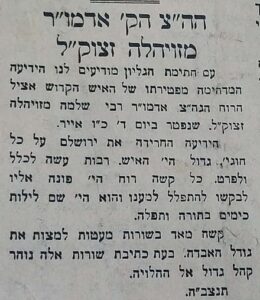 May the merit of the tzadik protect Am Yisrael!
(Rav Refael Avitan, translated by Lena Solomonova; "Well of Torah" by Rabbi Elimelech Biderman)
May the merit of the tzadik protect Am Yisrael!
(Rav Refael Avitan, translated by Lena Solomonova; "Well of Torah" by Rabbi Elimelech Biderman)