2 Shevat · Yahrzeit
Rabbi Zusha of Anipoli
Rabbi Zusha Meshulam ben Elazar Lipman of Anipoli - one of the most beloved tzadikim of the Chassidic movement among the people.
Yahrzeit - 2 Shevat
Resting place - Anipoli, Ukraine
He was the older brother (by 17 years) of the famous Rabbi Elimelech of Lizhensk, the "Noam Elimelech."
The two brothers joined the circle of students of the Maggid of Mezritch.
Rabbi Zusha soon excelled in his studies and earned recognition and esteem among his fellow students for his profound piety.
Rabbi Schneur Zalman of Liadi said of him:
"His prayers were uttered with an intensity and reverence beyond all comparison."
He combined selfless devotion and attachment to G-d with a fervent love for the Jewish people, sharing in their joys and carrying their burdens.
People responded to him in kind, flocking to him in great crowds. They saw in him a tzadik and a guide, but above all, a supporter and defender.
He was a rabbi who recognized only kindness.
In his final years he suffered from a prolonged illness, but he never complained.
"Whatever comes from G-d is good," he would say. His final resting place is next to the grave of his mentor, the Maggid of Mezritch.
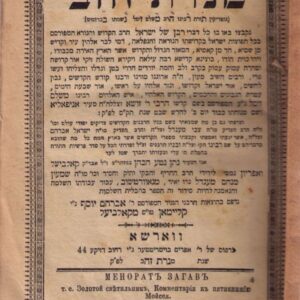
Rabbi Zusha did not write any books. His thoughts and comments are scattered throughout the works of his students. Later, they were collected into a book called "Menorat Zahav."
He was succeeded by his son, Rabbi Tzvi Menachem Mendel.
Repentance
The Chozeh of Lublin studied under Rabbi Elimelech, who sent him to Reb Zusha.
Reb Zusha asked him: "How would you make a person repent?"
The Lubliner answered: "I would show him in the Shulchan Aruch where he was wrong."
Reb Zusha replied: "I don't think that would work. Do you think that would make the person feel good? On the contrary, it would only make his condition worse. And if a person feels bad, he will run away from you. People do wrong because they lack the strength to do right."
The Lubliner asked Rabbi Zusha: "How would you do it?"
To which Reb Zusha said: "I would shine a light into them, into their hearts, the great light of G-d's love."
Giving thanks for the bad just as for the good
The Maggid of Mezritch's students once asked him a question:
"How can a person reach the level spoken of in the Talmud, in Brachot: A person must bless [G-d] for the bad [occurrences] just as he blesses [G-d] for the good."
The Maggid answered them that they could find the answer if they went to meet his student, Rabbi Zusha of Anipoli. They went to the Beit Midrash and found Reb Zusha there. His clothes were torn and faded, but his face glowed. They asked him their question. Rabbi Zusha was astonished that the Maggid had sent them to him for an answer. He told the two brothers that they should find a person who had truly suffered in order to get the answer to their question. Rabbi Zusha said that in his entire life he had never experienced any suffering of the flesh, and therefore he did not know how to answer them.
Then the brothers understood that their question had already been answered. For they saw a man who could see good and be happy even in bad circumstances. Rabbi Zusha lived his whole life in poverty, but his strong attachment to G-d was a source of joy, and he felt no sorrow from his poverty, only joy.
Hachnasat Kallah
Once Reb Zusha went to visit his teacher, Reb Dov Ber, the Maggid of Mezritch. After resting and drinking in his teacher's wisdom, Rabbi Zusha prepared to leave. When he entered the Rebbe's study to say goodbye, he told Reb Dov Ber that he needed to marry off his daughter. At that time Rabbi Zusha was very poor, and a child's wedding required great expense. Rabbi Dov Ber took 300 rubles and placed them in his student's hand, wishing him mazel tov, and sent him on his way. Reb Zusha was overjoyed. Now his wife and daughter would not have to worry.
The way home passed through many towns and villages, and as he was passing through one tiny village, he was struck by the sound of bitter weeping coming from a small hut. The villagers were going about their business, but he alone stopped and asked, "Who is crying?"
"It's a poor widow - she was about to marry off her daughter, but on the way to the chuppah she lost the entire dowry. Now the wedding won't happen, because the groom and his family refuse to go through with it without the dowry. And how will she gather 300 rubles again?"
Reb Zusha's tender soul ached for the poor woman. He suddenly realized he had 300 rubles. He went up to the hut and knocked on the door.
"Good woman, I think I've found your money!"
Her eyes widened in astonishment and disbelief.
"Can you tell me if this money has any distinguishing marks?" Rabbi Zusha asked.
"There must be - the bundle had two fifty-ruble notes, ten twenty-ruble notes, and it was tied with red thread," said the widow.
"Yes! That is exactly what I found. I'll go to the inn, get the money, and bring it to you," said Rabbi Zusha.
He ran to the inn, exchanged the bills as the widow had described. He tied them together with red thread and ran back. By the time he returned, the small village was already abuzz with the latest news. The girl had changed into her wedding dress, and neighbors were bustling about preparing the wedding feast. When Reb Zusha gave the widow the money, he said: "I'll keep one twenty-ruble note for my trouble."
She looked at him as if he were speaking a foreign language. The others who heard this stood with their mouths open.
"What?" the widow cried out. "How can you rob a poor widow of twenty rubles! And after having performed the most beautiful and holy mitzvah!"
Others gathered around Rabbi Zusha, shouting: "Thief! Stealing a widow's money! Shame on you!"
Rabbi Zusha, however, refused to budge. He clung to the twenty rubles as if his life depended on it.
"This money is mine, as a reward, for my trouble!"
Relatives, friends, and other townspeople scolded Rabbi Zusha, and it soon seemed as if they would tear him apart to get the money.
Finally someone suggested: "Let's go to the rabbi, he can settle this once and for all!"
Everyone agreed to abide by the rabbi's ruling and ran to his house.
The rabbi heard both sides, and then ruled: "Reb Zusha must give the widow the twenty rubles."
Nevertheless, Reb Zusha refused to part with the money. A young man reached into Zusha's pocket and pulled out the bill. Zusha was then led to the edge of the village and unceremoniously thrown out.
Many months later, that village rabbi encountered Rabbi Dov Ber and told him about the incident with his student. The Maggid replied to the rabbi: "You must go to Rabbi Zusha and ask for forgiveness. That money did not belong to the widow. I myself gave it to him so he could marry off his child! He demanded the twenty rubles because he wanted to avoid pride at all costs. He wanted this great mitzvah to be completely pure."
The rabbi was stunned and ashamed when he heard this. He traveled to Anipoli to ask Rabbi Zusha's forgiveness. But Rabbi Zusha answered him: "You don't need my forgiveness, for I was never angry. I place little value on my honor, and I will forget about this story if you tell the widow the truth. I don't want her to think that this money isn't rightfully hers."
The rabbi, of course, agreed, and this story was never mentioned again.
The Gaon Yanuka related that our teacher Rabbi Zusha always said that he asked forgiveness from the ground upon which he walked. However, he also comforted himself, saying to the ground: "But I know that one day you will walk upon me." Constant reflection on his ultimate purpose is the core of the teaching and way of life of our teacher Rabbi Zusha.
Our teacher also recalled a story told by the Chozeh of Lublin about Rabbi Zusha. Sometimes he would withdraw into the forest for several days in solitude. Once he went four days without food, but refused to ask others for help. In his distress he raised his eyes to Heaven and beseeched the Almighty to sustain him. The Almighty miraculously created two springs in his mouth - one of milk and one of honey. He lived off these for seven months, until one day people noticed him reciting a blessing without appearing to eat anything. Seeing this, they realized something unusual was happening. As soon as the miracle became known, it ceased. The holy Chozeh of Lublin confirmed that this story was absolutely true.
May the merit of this tzadik protect Am Yisrael!
A Great Segula for Complete Healing from Rabbi Zusha of Anipoli
Chassidut on Tehillim - Rabbi Zusha of Anipoli