
Skip to content
This English version of the site was translated with AI assistance. We apologise for any errors and are working to improve it.

17 Iyar · Yahrzeit

Rabbi Yechezkel Landau - the "Noda BiYehuda"

Rabbi Yechezkel HaLevi ben Yehuda Landau (1713—1793) - the "Noda BiYehuda" - Rav of Prague. Yahrzeit - 17 Iyar Resting place - Prague, Fibichova Street (Old Jewish Cemetery) Rav Yechezkel Landau, known by the name of his main work, the "Noda BiYehuda" (Known in Judah), was invited to take the "rabbinic throne" in Prague, the capital of Bohemia. In anticipation of the sage's arrival, the community built a raised throne so that "his majesty" could proclaim the words of Torah from it. Alas — the rabbi was of gigantic stature, few people even reached his shoulders — and he bumped his shoulders against the ceiling. He delivered his first lecture in one of the most prestigious communities in Europe hunched over the table. One might say that he continued to "stoop down" to the rabbinic throne from the great height of his stature in the wisdom of Torah. Rav Landau was born on October 8 (18 Tishrei), 1713, in the Polish town of Apta (Opatów), to Rav Yehuda Landau, a "parnas" (community benefactor) and one of the leaders of the "Council of Four Lands" — the central body of Jewish self-government in the Polish-Lithuanian Commonwealth. The family traced its lineage to great Torah sages: to Rashi, to Rav Yehoshua Eshel of Krakow, to the 15th-century Talmudist Yehuda Lev of Landau in Germany, and to his son, author of the compilation "Agur" (Stored Away), which records his father's rulings and customs. The name of the city became the family surname. From the second half of the 16th century, Rav Yechezkel's ancestors lived in Opatów, many of them serving as rabbis and dayanim of the town and outstanding Torah scholars. Opatów was captured several times by the Swedes; it is possible that as a result, "Landau" became "Landau" and "Landa." His father was the boy's first teacher. Yechezkel became famous very early on — he was called the "illui (prodigy) of Apta," and already in his youth, communities across Eastern Europe turned to him with complex halachic questions. He showed special reverence for his parents through his writings: his book "Noda BiYehuda" was named in honor of his father, and his second book, "Tziyun LeNefesh Chaya" (Memorial for a Living Soul), was named in honor of his mother, Chaya. At the age of 18, he married the daughter of Rav Yaakov of Dubno — they had 8 children, one of whom, Rav Shmuel (1752-1834), a dayan of Prague, compiled the collection of responsa "Shivat Tzion" (Return to Zion) and a commentary on his father's works. At age 21, Rav Yechezkel was invited to serve as dayan (judge) in the city of Brody, one of the most learned Jewish communities in the world, and remained there until 1746. His next position was as rabbi of Yampol, a trading town on the banks of the Dniester (now in Ukraine), from where he was called to Prague in 1755. He served as rabbi of Prague (and all of Bohemia), as well as dayan and head of the famous yeshiva he founded, "Noda BiYehuda," until his passing on April 29 (17 Iyar), 1793. Fortunately, there were not so many "dramatic" events in his life. One reason: tall, powerfully built, with a beautiful, strong voice and gentle manners, the rabbi commanded general respect by his very appearance alone, even before people became acquainted with his boundless knowledge and remarkable understanding of people. It seemed he had a "telescope into the depths of a person's soul" — he could see straight through many people at first glance. Few had the courage to enter into conflict with such a giant in spirit and body.   Sipurei Tzadikim The Impostor A wealthy man came to the rabbi. He had married his daughter to a thirteen-year-old boy from a good family. A conflict arose between the young couple, and the offended husband left town and disappeared. Five years later, a young man appeared with a story of travels overseas, bearing a striking resemblance to the missing husband and knowing many intimate details of their life together. The daughter accepted him as her husband, but soon she and her father began to notice differences in character from the missing young man. The wealthy man went to the rav with his doubts and brought the "husband" along. Rav Yechezkel asked the father to have his daughter avoid marital relations until the end of the week, and on Shabbat, the father should bring the young husband to the synagogue and let him walk ahead through the doorway, to find their usual seats. The young man became confused... Caught, he confessed his imposture in the rav's study. It seems he had become friends with the real husband on a ship, and the real husband, distressed over his own flight, had told his new friend much about his brief married life. When Rav Landau was asked how he solved the problem so quickly, he replied: I immediately saw that I was dealing with a clever impostor. What would a fraud never think to ask about? — The place of holiness, the house of prayer — it simply would never occur to him!   The Exposure A traveling merchant left 10,000 dinars with his longtime business partner for safekeeping before Shabbat, but the next day the local merchant claimed he had never received anything. Rav Landau summoned the merchant and told the visitor to wait nearby and, at a certain moment, to "accidentally" walk in and demand repayment of the debt. The rav urged the merchant to give charity for the poor — 1,000, or even 500, or 300... "Business is bad, I can't." Then the guest walks in, and bargaining begins — the merchant declares he owes nothing, but, in order to clear himself of all suspicion (the rav hints that otherwise "this troublemaker will spread gossip all over town, and you'll never wash it off"), he is willing to pay... it reaches 500 dinars. At that point, Rav Landau stood up and demanded in a thunderous voice the return of the entire sum: "I was urging you to give even 300 to charity — you had no money — yet here you are ready to give 500, even though you claim you owe nothing at all?!" The merchant burst into tears and returned everything. This was with ordinary people, but in a conflict between sages, Rav Landau found it far harder to make progress. In 1749, a dispute broke out that shook Jewish communities across Europe (and beyond) for a long time. The great halachist and kabbalist Rav Yaakov Emden (1698-1776) suspected another outstanding sage, the kabbalist of Altona, Rav Yonatan Eybeschutz (1690-1764), of secret apostasy — Sabbateanism. The leaders of the generation had to intervene in the matter: the Vilna Gaon, Rav Landau, Rav Falk (the "Pnei Yehoshua"), and the Chatam Sofer. The Noda BiYehuda issued a proclamation, "Igeret Shalom" (Letter of Peace), declared the amulets attributed to Rav Eybeschutz, which contained hints of Sabbatean "kabbalah," to be forgeries, and cleared him of all accusations. However, he opposed Rav Eybeschutz's move to Prague and knew that one of his sons had in fact become a Sabbatean; apparently some doubts remained. The mission of reconciliation succeeded only partially, and the quarrel dealt a heavy blow to the authority of the rabbis and the stability of Jewish life, even though the dispute was "for the sake of Heaven." Rav Landau's activity as head of the community was varied and successful. He was held in great esteem at the Austro-Hungarian court and sought to establish peaceful relations with the non-Jewish population. At the same time, he did not deviate a hairsbreadth from the Law.   By the Law of Maria Theresa A wealthy Kohen from Prague wanted to marry a divorced woman (forbidden to a Kohen), and the Rav categorically refused to give his blessing. Undeterred, the man appealed all the way to the Empress, who ordered the wedding ceremony to proceed. Rav Landau immediately agreed, and under the chuppah he instructed the groom to repeat: "By this ring you are consecrated to me according to the law of Empress Maria Theresa" (instead of the customary "according to the law of Moshe and Israel"). The crowd that had come to the wedding to watch Rav Landau violate the Torah quickly dispersed, and the Rav explained: "By the law of Moshe it is forbidden — marry by the law of the Empress instead." The matter fell apart, and soon the troublemaker himself changed his mind. Rav Landau's authority in the eyes of both the people and the authorities only grew as a result. Rav Yechezkel actively fought against sectarians, placing a cherem (ban) on Sabbateans and Frankists, and he opposed the emerging Chassidic movement, in which he feared encountering yet another pseudo-kabbalistic sect. Some Chassidic leaders, in particular the Kotzker Rebbe, thanked the Vilna Gaon and the Noda BiYehuda for this, saying, "otherwise we might really have become sectarians." The "Haskalah" movement, "Jewish Enlightenment," was at first received favorably by the rabbi — he encouraged breadth of education; but soon, when it became clear that most of its leaders were trying to "dilute the Torah" and adapt Jewish life to that of the surrounding nations at the cost of altering or even abolishing some commandments, he became its firm opponent.   Rav Landau and the Baal Shem Tov As we shall soon see, without him we might not have the Torah of the Baal Shem Tov, the Kedushat Levi, the Noam Elimelech, the Likutei Moharan, the Bnei Yissaschar, the Tanya, the Sefat Emet, and other works. Rav Landau was a great Gaon in Torah and a great tzadik, and was also well versed in the hidden Torah. He was a fierce opponent of the Chassidic movement recently founded by the Baal Shem Tov. He was on friendly terms with the Baal Shem Tov, but did not believe him to be a great tzadik. When the Baal Shem Tov was in his town, he would stop to visit Rabbi Yechezkel, who personally attended to him in order to fulfill the mitzvah of "hachnasat orchim" (hospitality). When the Baal Shem Tov realized that he was causing the Noda BiYehuda to interrupt his Torah study, he stopped coming. Rabbi Yechezkel's wife, however, truly believed the Baal Shem Tov to be a great tzadik, and she and her sons would visit him. The "Divrei Chaim" of Sanz said that if the Noda BiYehuda were alive, he would sit beneath his table just to learn from him. Rabbi Yisrael of Ruzhin told one of his students, who was a grandson of Rabbi Yechezkel, that he had heard from the Ohev Yisrael, who had heard it from the Maggid of Zlotchov, that when the time came for the Baal Shem Tov's soul to descend into this world, all manner of accusing angels spoke up, arguing that Mashiach would come before his appointed time if the Baal Shem Tov were to descend into the world. Defending angels spoke in favor of the Baal Shem Tov's arrival in the world. In the end, it was decided that another lofty soul would also be sent down, one who would likewise be a great tzadik, but an opponent of the Baal Shem Tov and his teachings. This division would prevent Mashiach from coming before his time. This other great tzadik was Rabbi Landau, the Noda BiYehuda. Thus, we can truly say that the Noda BiYehuda was the most important figure in the history of Chassidism, because without him, the Baal Shem Tov could not have come into this world.  

Why the Vilna Gaon Did Not Bless the Noda BiYehuda with Two Hands

In the book "Maaseh Alpas" by Rav Ben Zion Alpas, one of the geniuses of previous generations, a man of great devotion to Torah and prayer, who wrote it at the age of 90, the following is recorded.

He testifies that he himself heard the following story from the mouth of Rav Yechezkel Landau:

"When the Gaon Rav Yechezkel Landau became a groom, his father-in-law brought him to the Gra on Shabbat to be blessed. The Gra was sitting at the second Shabbat meal, eating kugel, and the groom was wearing a shtreimel. The Gaon wanted to place his hands on the groom's head to bless him, and the groom stepped back so that the Gaon would not smear his shtreimel with his greasy hands from the pashtida. So the Gra placed just one hand on the shtreimel and blessed him — and he lived a long life and studied without glasses until his final day.

For the rest of his days, Rav Yechezkel Landau regretted what he had done — that he had valued his shtreimel more than the Gra's hands.

The blessing of the Vilna Gaon took effect, and Rav Yechezkel Landau lived to the age of 91.

Later, it was heard as an explanation from the Vilna Gaon that only Kohanim may bless with two hands.

  May the merit of the tzadik protect Am Yisrael! (http://zchusavos.blogspot.com/2007/05/noda-beyehudah-most-important-tzadik-in.html, via evrey.com)
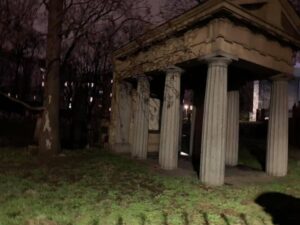
Pilgrimage site: Grave: Noda BiYehuda