
13 Elul · Yahrzeit
Rabbi Yechiel Avraham Fish - "The Tiler" - Tzadik Nistar
Rabbi Yechiel Avraham ben Yosef Chaim Fish - "The Tiler" from the circle of Kabbalist tradesmen
Yahrzeit - 13 Elul
Resting place - Tzfat
He was born in the city of Tarnów (Poland).
Little is known about Rav Fish's life in Poland before World War II, except that his father was a Stutchiner chosid and head of the town's Chevra Kadisha.
During the Holocaust he was the only one of his family to survive — the Nazis burst into his home and opened fire continuously, but when they turned to face him, the house suddenly went dark, and at that moment he managed to jump out the window.
He explained his survival by a blessing he received as a child from a righteous woman whose blessings always came true.
While in the concentration camp, he shared his coat with a Jewish boy who was nearly freezing to death, and afterward cared for that boy, who was also the sole survivor of his family.
He immigrated to Israel and lived at 32 Kalisher Street in Tel Aviv.
He worked as a builder-tiler, and was part of a group of hidden tzadikim who gathered in the shadow of the "holy shoemaker" - the Mekubal Rabbi Moshe Yaakov Rabikov, and every night he studied Kabbalah together with the "shoemaker."
In the 1960s, a circle of Kabbalist tradesmen was formed in Israel, who studied the hidden Torah together. They were known by names taken from their trades:
1. "The Shoemaker" – Rabbi Moshe Yaakov Rabikov;
https://silatehilim.com/events/22-тишрея-йорцайт-илула-рабби-моше-яаков/
2. "The Artist" – Rabbi Yehuda Leon Patilon;
https://silatehilim.com/events/рабби-йеуда-леон-патилон-святой-худо/
3. "The Janitor" – Rabbi Yosef Voltuch;
https://silatehilim.com/events/20-ияра-йорцайт-рабби-йосеф-волтух-дво/
4. "The Milkman" – Halban – Rabbi Chaim Avishalom Cohen Perachya;
https://silatehilim.com/events/12-ава-йорцайт-илула-хальбан/
5. "The Tiler" - Rabbi Avraham Yechiel Fish.
Since he was not blessed with children, he provided financial help for building homes for hundreds of couples, and would buy them a large refrigerator. When asked why specifically a refrigerator, he would answer that when he would be placed in Gehinnom, where it is very hot, he would ask to be cooled off in the refrigerators he had bought for these couples.
For many years, every evening he would go out to the gardens and city boulevards, gather the poor, and bring them to his home, giving them food, clean clothing, and a place to sleep.
Once he told them: "If you behave as I do, you too will reach the level that I have reached."
Another time he said: "The gematria of 'chesed' is 72, which is the greatest of the Names of the Most High," hinting that his acts of chesed were what allowed him to enter the club of hidden tzadikim of Tel Aviv of the previous generation.
Many times, before the person standing before him had even spoken a word, he would answer his question, and sometimes he flatly refused to accept a donation from someone on the grounds that the money in his hand was the result of desecrating the Shabbat.
He founded, at his own expense, two special homes in Bat Yam and Tzfat, and for about a year and a half worked as a builder on a building constructed for Belz institutions in Tel Aviv without asking for a salary, because he wanted to be a partner in building Torah.
He wore the clothing of deceased people so that, in the physical world, they could fulfill mitzvot through their money and the like.
He worked on the rectification of the souls of the deceased.
Rav Avraham Fish wrote 2 Torah scrolls for the souls of the departed among Klal Yisrael: a Sefer Torah for the rectification of wandering souls, and a Sefer Torah for the rectification of returning souls.
He never took a vacation - he explained that when it comes to helping the people of Israel, one cannot take a vacation.
Before Sunset
One day, at the entrance to a run-down building on Rechov Kalisher in Tel Aviv, stood Avraham of Bnei Brak, who had gone through hard times and lost his apartment. He thought he was finished — where would his large family live, even temporarily? He came to Rav Fish on the advice of a good friend. Heaven forbid, he wasn't asking for a handout; that would have been too shameful. All he wanted was a bracha and some advice.
"Yungerman," Reb Avraham thundered at him, "I'll give you a decent loan, enough to put toward buying an apartment. You must repay it within a year; every three months you'll pay me a quarter of the sum. Payments will be made on Rosh Chodesh. Woe to you if you come after sunset on Rosh Chodesh."
The avreich was not used to hearing such harsh words, and Rav Fish could speak even more sharply. But Avraham took the stack of bills and left, feeling relieved.
He managed to make the first payment on time, but was late with the second; he arrived after dark, and Rav Fish became furious: "I told you not to come after sunset!" The young man was bewildered; he had barely managed to gather the sum he owed, and what difference did it make to this temperamental man whether he arrived before or after sunset? Was there some mitzvah here bound to a specific time?
"Get out of here!" Reb Avraham shouted. "Don't come back, and don't bring me any more money. You don't know how to come on time!"
The avreich left, stunned by the large sum of money he had been given, and at the same time puzzled by the anger of this strange rabbi, to whom such a huge number of people came.
"That's how he worked," his students explained. "The avreich got his apartment, and Rav Fish brought mockery upon himself. The avreich now saw him as a deranged eccentric, instead of a generous benefactor."
How to Rise to the Level of a Tzadik
Some time after the war, Rav Fish was walking on a winter night through the streets of Tel Aviv and found a Jew, nearly frozen from the cold, sleeping on a bench. Rav Fish woke the stranger and invited him to spend the night at his home - except that he himself was still homeless. He lived in a small nook under a staircase in an old building, and this tiny space could barely fit one more bed.
Several months passed with the two of them sharing this tiny space, and then Rav Avraham was called up for IDF reserve duty. When he returned a few days later, his "guest" informed him that he was now the owner of this tiny nook. He took over Rav Avraham's bed and agreed to let Rav Avraham sleep in the corner, if he could fit. Rav Avraham held himself back from responding to the man's insolence. Years later, he remarked to someone, hinting that the self-restraint of that time had raised his neshama to an incredible height.
Reb Avraham was also closely connected to Rav Aharon of Belz and served as shamash in the "Belz Beit Midrash." One Erev Shabbat, a young avreich entered the Beit Midrash and heard someone reciting "shnayim mikra ve-echad targum" in a tone that seemed to shake the Heavens. But as soon as Reb Avraham heard someone come in, he stood up and began pacing the room, mumbling to himself like a madman.
The avreich, however, was not fooled: "You can't fool me! Just a few minutes ago you were reading the chapter with deep fervor, and now you're trying to trick me into thinking you're crazy!"
Any publicity caused Rav Fish great distress, but it was only a matter of time before people would hear about his special powers.
A Miraculous Rescue(told by the son of the man who was saved)
"This happened about 2 years after the war ended. My father was arrested by the British police on suspicion of collaborating with the underground, and although he was temporarily released on bail, the outlook looked grim. In despair, he traveled to Tel Aviv to the Mekubal 'The Shoemaker' - Rav Moshe Yaakov Rabikov, who listened to his sorrowful story and told him: 'I cannot help you. I will send you to a man who will be shocked at the very thought that you came to him for help. He will begin to act as if he's insane and say strange things, but you must not leave him until, in the midst of his ramblings, he gives you a bracha and promises that you will be saved. Then you will know that you are saved.'"
Rav Yaakov Moshe sent him to the home of Rav Avraham Fish in Tel Aviv.
Rav Avraham's first reaction was shock. Who knew of his involvement in spiritual matters? But he quickly recovered and indeed began gesturing wildly and babbling. My father listened carefully to everything he said, and then suddenly, in the midst of the rambling, he heard the strange man say the words: "An angel will come and turn the verdict in your favor."
"Upon hearing these words, my father turned to leave; but then Reb Avraham, realizing that his visitor had heard the promise of salvation, came closer to him and warned him: 'Yungerman! Woe to you if you publicize my name or send other people here. You have been warned!'"
Revelation
Those who were close to Rav Fish knew that he was not merely a mystic, but a Talmid Chacham who had developed methods to ensure that others would never learn the true extent of his Torah knowledge. He always insisted that he was a simple laborer, a man without any special knowledge or wisdom of his own.
Rav Yehuda Zev Leibowitz, a Mekubal who passed away about two years ago and who, like Reb Avraham, was childless, testified that Reb Avraham knew the entire Masechet Eruvin by heart, with all its intricacies and commentaries — one of the most difficult Masechtot in Shas. Of course, those who knew Reb Avraham personally would find this hard to believe; he had successfully created the image of a man who lacked even a drop of Torah knowledge.
In fact, no one could ever find a single book in his house besides a siddur and, occasionally, a volume of Mishnayot from Seder Zeraim. Rav Yehuda Segal of Tel Aviv once related that, according to Kabbalah, childless people are advised to study Seder Zeraim, since they have no zera (offspring) of their own. Once someone asked Reb Avraham whether that was the reason he had that particular sefer, and after that the sefer disappeared from his table.
Who discovered this hidden tzadik? Who was the man who caused so many Jews to visit his home? Some say that Rav Yisrael Abuchatzeira, the Baba Sali, sent his gabbai, Rav Eliyahu Alfasi, to Reb Avraham to bring salvation to certain people. Before his death, the Baba Sali revealed to his followers a Heavenly decree that Rav Fish would take his place, with the power to bless and bring salvation to the Jewish people.
And indeed, after the passing of the Baba Sali, people began flocking to Rav Fish; he no longer hid himself, opening his doors wide to all Jews.
A Simple Truth
Rav Fish always favored simple people with pure faith. He said that it would be easier for these people to be saved from their troubles, since they would not try to understand his actions or examine his ways; they simply had faith, and it was easy for them to bring about salvation from Heaven. Sometimes he would even point to a person entering his home and remark to the person sitting next to him that the newcomer would certainly receive the yeshua he needed, since he was filled with pure faith.
Rav Fish's followers say that it was during the Seudat Melaveh Malkah that the greatest mystical feats took place. Many people would join him for this meal, some bringing their own special dishes. Often the meal would resume several times, as groups of people came and went until morning. Through it all, Reb Avraham would stand there, handing out blessings and good wishes, and even cursing the enemies of the Jewish people, all while still trying to use the language of a simpleton in his constant attempts to conceal himself.
During these sessions he would light many candles in honor of David HaMelech and would become furious if anyone touched the candles. He would gaze for long periods at the flickering flame and mutter incomprehensible words. On these Motzei Shabbat nights, many people received blessings, and promises were fulfilled.
Reb Avraham had three golden goblets, and his regulars knew that they held certain mystical secrets. "When I ordered a goblet from a Jewish jeweler, I asked that the cup and its base together weigh exactly 600 grams, not a drop more or less," Rav Fish once related. But the jeweler could not make it that precise, and Reb Avraham became very upset; it interfered with his mystical, kabbalistic intentions. "Then I understood that this was a hint from Heaven that until the Final Redemption comes, nothing in the world will be perfect; there will always be some flaw, as a sign of the exile we are still living through."
During the Melaveh Malkah meal, every week he would tell the same story about the Baal Shem Tov. Through this story he sought to bring about yeshuot for everyone present and for the people who visited his home throughout the week. There are several well-known versions of this story, but this is the version that Reb Avraham Fish would tell:
In his youth, the Baal Shem Tov would seclude himself in the Carpathian Mountains during the week and would come home only for Shabbat and Yom Tov. Every day he immersed himself in a river that flowed through the mountains, and even when the river froze, the Baal Shem Tov would break the ice to enter the water, emerging with shards of ice clinging to his beard and peyot.
In that area lived a young gentile who fished in the river, and every morning he noticed drops of blood on the ice at the riverbank. The young fisherman kept watch over the area and noticed the Baal Shem Tov coming out of the river and standing on its icy surface. He saw the Baal Shem Tov try to pull his feet off the ice, only to find them frozen to the surface. The Baal Shem Tov would then forcefully tear his feet from the ice, tearing his skin and shedding drops of blood, which the fisherman would find frozen on the surface of the river every morning.
The fisherman took pity on the Baal Shem Tov and from then on laid down hay on the surface of the river, at the spot where the Baal Shem Tov would come out of the water. The Baal Shem Tov was pleased by his actions, called the fisherman over, and asked him what blessing he wished for: abundant livelihood, health and physical strength, or long life. The gentile, of course, asked for all three, and the Baal Shem Tov promised him what he had asked for.
Years later, after the passing of the Baal Shem Tov, the fisherman himself would tell this story. By that time he had lived to a ripe old age, was still strong and healthy, and had never lacked for anything in his life.
Whenever Reb Avraham told this story, he would always conclude it with an evident love for his fellow Jews that constantly burned in his heart: "And so, there is a kal va'chomer here. If this gentile merited health, livelihood, and long life, how much more so do Jews deserve it."
The Cold of Gehinnom
Besides a small monthly sum that Rav Fish and his wife Freidel kept for themselves for sustenance, everything else they gave away to the poor and needy. Since Rav Fish never had children of his own, he made sure to provide financial assistance to hundreds of newlyweds, in particular buying them refrigerators. He explained that after his death he would certainly be sent to Gehinnom, and he hoped that the many refrigerators he had given away would cool the fire of Gehinnom, at least a little. He also donated ovens to impoverished newlyweds, claiming that there is also a Gehinnom of ice, and that the ovens might help bring a bit of warmth there for him.
He donated a large number of Sifrei Torah to many synagogues, calling them "Sefarim of Shalom Bayit," since he regularly hired sofrim who were struggling with shalom bayit due to a lack of parnassah. Reb Avraham did not require them to finish their work by a deadline; he wanted to be able to pay them a fixed monthly salary, regardless of how much progress they had made.
In addition, he had two more Sifrei Torah written for the Jewish people: one for the rectification of lost souls, and another for souls that know no peace in this world. Exactly how Rav Fish carried out these rectifications of Jewish souls will forever remain a mystery, but we know that in addition to the Torah scrolls, he wore the clothing of deceased people so that they might merit a share in the World of Truth.
The Final Wish
Rav Fish had a connection with the Premishlaner Rebbe of Bnei Brak, and eyewitnesses recall their many mysterious conversations on deep mystical subjects during the Rebbe's visits to Reb Avraham's home in southern Tel Aviv.
Rav Fish, thinking about his passing, begged his followers to bury him in Tzfat, on a plot he had purchased many years earlier. Since he had no children of his own to carry out this task, he wanted his students to know of this wish.
"If I die on a Friday," he emphasized, "and it's already nearly Shabbat, just bury me quickly. Be sure to get to Tzfat, even if you have to bring me there in a garbage truck. And if it's already nearly Shabbat, just lower me into the grave, without even covering it."
Incredibly, that is exactly what happened. Rav Fish passed away in Jerusalem, where he had spent his last few weeks, on Friday, the 13th of Elul, 1998.
According to his instructions, the funeral was to take place in Tzfat, but since Reb Avraham had no established chassidic court, no one knew exactly who would accompany him on his final journey or what vehicle would be used to transport the niftar.
Meanwhile, six of his students set out by car from Bnei Brak with the Premishlaner Rebbe, hoping they might somehow manage to locate the vehicle carrying Reb Avraham to Tzfat. They drove for about an hour, but the Rebbe told them to keep going, even though Shabbat was approaching and Rav Fish's vehicle was already far to the north of them.
Suddenly they were stopped by a van parked on the shoulder of the highway, which had a flat tire. They stopped and discovered that this was the very vehicle carrying Rav Fish! The Rebbe got out, and after making sure there was a minyan — the Rebbe, his six companions, and three passengers in the vehicle carrying the body — the door was opened, and the Rebbe recited Kaddish for a man whose entire life had been shrouded in mystery. The tire was then repaired, and the van rushed on to the Friday burial in Tzfat.
"Tzfat has good air," Rav Fish once said with a mysterious smile, "when I want to relax, I'll go out and stroll in the pleasant breeze."
Many years earlier, Reb Avraham had bought himself burial shrouds and would show them to the many visitors to his home. He explained that Mashiach would begin his entry into Eretz Yisrael from the Galilee, and so it would be good to begin techiyat hameitim in Tzfat.
He was buried in the last few minutes before Shabbat, and those attending the funeral hurried to leave the cemetery before Shabbat, just as he had predicted.
Rabbi Avraham Fish's Segula for Yeshuot
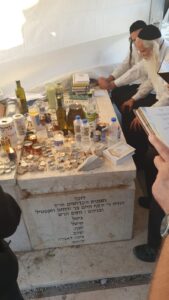
The inscription on his tombstone states that anyone in need of yeshuot should recite three times the verse from the Shabbat song-zemer "Tzur Mishelo Achalnu". This, he said, would help restore the glory of the Shechinah.
רחם בחסדך על עמך צורנו
- "Rachem be-Chasdecha al amecha tzurenu" -
(Have mercy, in Your kindness, upon Your people, our Rock).
 Rav Avraham Fish left no children, but before his death he left his followers one more legacy, perhaps his greatest secret: to reach far beyond one's imagined abilities, to grant others good even beyond one's own capacities, and thereby purify one's own abilities. Master your neshama, and bring the world to greater holiness.
(Translation of an article in "Mishpacha," issue 488)
Rav Avraham Fish left no children, but before his death he left his followers one more legacy, perhaps his greatest secret: to reach far beyond one's imagined abilities, to grant others good even beyond one's own capacities, and thereby purify one's own abilities. Master your neshama, and bring the world to greater holiness.
(Translation of an article in "Mishpacha," issue 488)
Rav Avraham Fish left no children, but before his death he left his followers one more legacy, perhaps his greatest secret: to reach far beyond one's imagined abilities, to grant others good even beyond one's own capacities, and thereby purify one's own abilities. Master your neshama, and bring the world to greater holiness.
(Translation of an article in "Mishpacha," issue 488)