1 Kislev · Yahrzeit
Yahrzeit/Hillula of Rabbi Sholom Shachna of Lublin
Rabbi Sholom ben Yoske Shachna - teacher of the Rema (Rabbi Moshe Isserles) - was born in 1495 in Lublin, into the wealthy family of Yoske Shachna, who served as the personal banker to King Sigismund I of Poland. He received his education in Prague, after which he returned to Lublin, where he served as rabbi until his death.
Rabbi Sholom Shachna was a student of Yaakov Pollak, the founder of the method of Talmud study known as Pilpul. In 1515, Shachna founded a yeshiva in Lublin, which at that time was the third-largest Jewish community in Poland.
Shachna became renowned as a teacher, and students from all over Europe came to Lublin to study. The yeshiva became a center for the study of Talmud and Kabbalah; in 1567, with the king's permission, the yeshiva was granted the rank of rectorate and equal rights with Polish universities - this led some to call Lublin the "Jewish Oxford." Shachna was succeeded as head of the Lublin Yeshiva by Solomon Luria (the Maharshal).
His most famous student was Rabbi Moshe Isserles - the Rema, who would go on to become a rabbi and Talmudist in Krakow's Kazimierz district.
The Lublin Beit Din, headed by Sholom Shachna, also enjoyed significant authority; under his leadership, sessions of the Council of Four Lands were held in the city on several occasions.
In 1541, King Sigismund I appointed Sholom Shachna and M. Fishel as "chief seniors" of the Jews of Lesser Poland, effectively making them heads of Jewish autonomy; they were exempted from taxes and received nearly unlimited administrative and judicial power, including the right to pass death sentences.
This provoked widespread discontent among the Jewish community and led to conflict between Sholom Shachna and a number of communities: in particular, local Jews prevented his attempt to settle in Kazimierz.
Sholom Shachna forbade the publication of his works, explaining that a halachic authority must take into account the particularities and needs of his own time, and therefore no ruling can be considered final. The nature of Sholom Shachna's halachic work can only be judged from the recollections of his son Yisrael and his most well-known students - Moshe ben Yisrael Isserles, Chaim ben Betzalel, and Binyamin Aharon Solnik. Some of Sholom Shachna's responsa have survived.
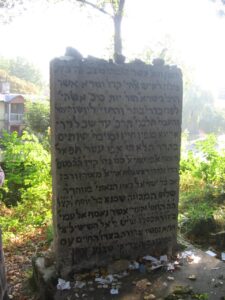
Sholom Shachna passed away in 1558 and was buried in the old cemetery in Lublin.
The tombstone at Sholom Shachna's grave has survived to this day.
After Sholom Shachna's passing, Solomon Luria became the head of the Lublin Yeshiva.
May the merit of the tzadik protect our people!