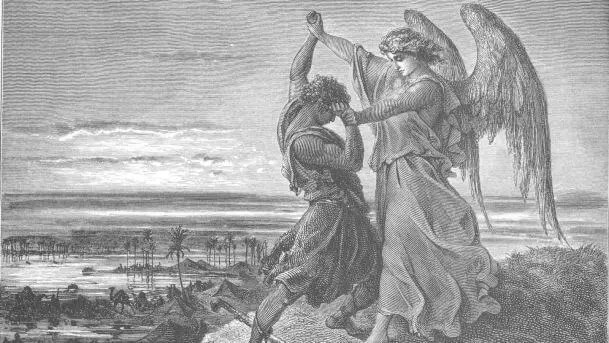
The Torah tells us:
“And Jacob was left alone. And a man wrestled with him until the break of dawn. When he saw that he could not overcome him, he touched the socket of his thigh, and Jacob’s thigh socket was dislocated as he wrestled with him.”(Bereishit 32:25–26)
As a result, Jacob “limps on his thigh. Therefore, to this day the children of Israel do not eat the sciatic nerve that is in the thigh socket, because he struck Jacob’s sciatic nerve.”(Bereishit 32:32–33)
It is well known that the angel of Esau, Jacob’s brother, wrestled with Jacob.
According to the Zohar ha-Kadosh, the angel saw how strong Jacob was—his fathers, Abraham and Isaac, protected him from both sides—and was unable to defeat him. He then injured his thigh, the outer, protruding part of the body. (Zohar I, 146a, 171a)
The thigh socket symbolizes the connection between the intellect and heart granted to a person from Above, and our deeds.
The legs, which enable us to stand on the earth, represent our involvement in the material world and our struggle for survival.
The head, torso, and legs represent the intellect, emotions, and their implementation in life.
In Hebrew, Gid ha-Nasheh - גִּיד הַנָּשֶׁה—the tendon (gid)—is the “sciatic nerve.”
Jacob was indeed firmly protected, but “when he saw that he could not overcome him, he touched the socket of his thigh.”
This socket serves as the connecting link to the legs and symbolizes the mechanical nature of our actions and calling. If a person acts mechanically, his conduct is superficial and devoid of depth, leaving him especially vulnerable. In such a case, the material world presses down on him most heavily and can wound him.
In the Zohar, one passage says that Jacob was wounded in Netzach (the right thigh), while another says it was in Hod (the left thigh). (Pardes, Gate 17, “Jacob’s Thigh”)
But the sun rose and began to heal Jacob, until he became completely well. (Rashi, 33:18) We, too, will be healed when the Redemption comes.
The Zohar reveals another meaning. The Torah says—“et gid ha-Nasheh”, and “et” (“aleph,” “tav”) is an acronym for “Tisha b’Av”(9 Av), the saddest day of the calendar, when we mourn the destruction of the Temple by the Romans, the descendants of Esau.
This verse contains a profound foreshadowing: the “unknown one” (the angel of Esau, the ancestor of the Romans) “touched Jacob’s thigh socket,” ultimately causing the destruction of the Holy Temple and sending the Jewish people into exile. Because of the injury he sustained, “the children of Israel do not eat [it] (correspondingly, on Tisha b’Av).”Akedat Yitzchak goes even further: the entire expression—“et gid ha-Nasheh”—points to the four fasts of the year on which we mourn the destruction of the Temple by the descendants of Esau:
“et”—“Tisha b’Av”;
“gid” begins with the letter “gimel” (3 Tishrei, the Fast of Gedaliah),
“yud”—(10 Tevet),
“dalet”—(the fourth month, Tammuz), referring to the 17th of Tammuz;
“ha-Nasheh” consists of the same letters as “ha-shanah” (the year).
Thus, the verse teaches that the injury inflicted by Esau, which resulted in damage to Jacob’s sciatic nerve, was embodied in historical time; therefore, we fast on four days of the year.
(Rabbi Simon Jacobson, Lechaim magazine)
Moreover, the Sages teach that each of the 365 negative commandments corresponds to one day, and the prohibition against eating the “gid ha-Nasheh” corresponds to 9 Av. Each day of the year has an angel responsible for that day, and the angel corresponding to 9 Av is the angel of Esau—the one who wrestled with Jacob Avinu.
Was this helpful?
96% of readers found this article helpful (25 votes).
Please note: some articles on our site contain the holy Names of the Almighty. If you print these articles, they may not be thrown away or destroyed. Please handle printed copies with care and respect.
Material from our site may be copied for the purpose of spreading Torah, provided a link to Silatehilim.com is included. Any use of the site's material in print publications or for commercial purposes is prohibited without the rights holder's consent.