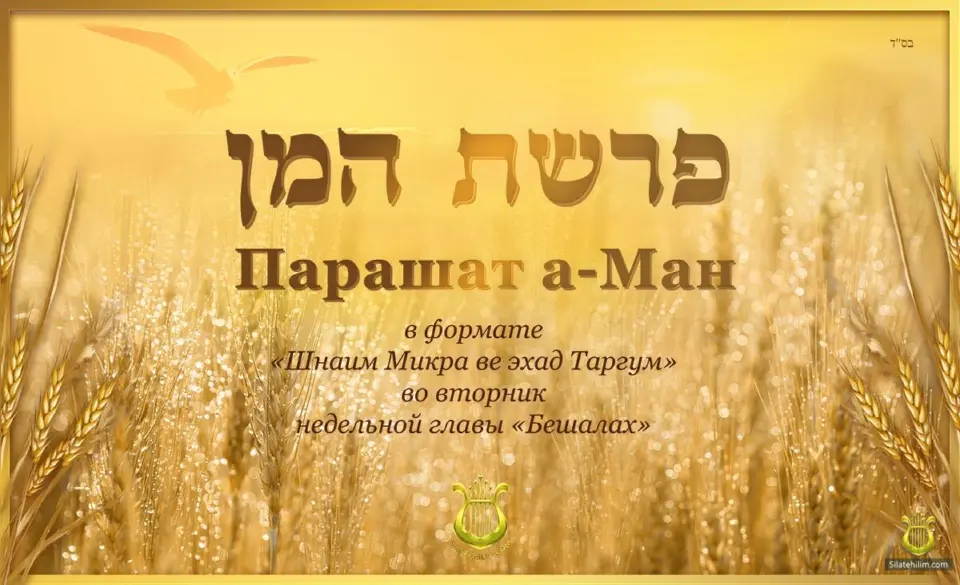
Parashat HaMan in the format of "Shnayim Mikra ve-Echad Targum" - Aramaic
Parashat HaMan is the most powerful segula for Parnasa.
Although our Sages advise us to read the chapter about the Man daily, in particular Rabbi Yosef Karo in the "Shulchan Aruch" (Orach Chaim 1:5), Chazal indicate that the most auspicious time for this segula is Yom Shlishi (Tuesday) of the weekly Torah portion "Beshalach", where the miracle of the giving of the Man is described.
The transliteration in the format of "Shnayim Mikra ve-Echad Targum" — that is, reading the "chapter of the Man" three times: twice in Hebrew and once in Aramaic — the translation known as Targum Onkelos — is a segula given to us by our Sages.
In this reading, each verse is repeated three times: twice as "mikra" (in Hebrew) and once as "targum" (in Aramaic) — everything is already accounted for in the text.
This concept of reading the Torah text twice along with one reading of the Aramaic translation is not coincidental. The Gemara (Berachos 8a) teaches: "One should always complete the weekly Torah portions together with the congregation [by studying] 'Shnayim Mikra ve-Echad Targum' (the portion twice and Targum Onkelos once)."
The Gemara says that for one who makes an effort to do this every week, "his days and years are lengthened."
The week of parashat Beshalach is a good time to try this — you will gain an additional benefit from the segula.
"Shevet Mussar" — Rabbi Eliyahu HaCohen Itamari of Izmir teaches that the segula of Parashat HaMan is stronger when it is read specifically as "Shnayim Mikra ve-Echad Targum."
The Secret of the Man from the Torah
"Vayikre'u beit Yisrael et shemo man vehu kezera gad lavan veta'amo ketzapichit bidvash" — the phrase "zera gad" — גד "gad" is an acronym of ג "gimel" and ד "dalet" — "gomel dalim" (one who gives to the poor). A person who gives to the poor and needy is, as it were, sowing a seed for a future blessing of Parnasa.
It is good to light a candle before the prayer Le-Chvod Rabbi Menachem Mendel of Rimanov (may his merit shield us). This tzadik devoted 22 years of his life to studying the subject of the Man, thanks to which abundance was poured out upon the entire world throughout those years.
It is also good to give tzedakah in the amount equivalent to 57 "zan" (sustenance) before the reading.
Introduction
"Yehi ratzon milefanecha Ado-nai Elo-heinu ve-Elo-hei avoteinu shetazmin parnasa lechol amecha beit Yisrael. Ufarnasati ufarnasat anshei beiti bichlalam. Benachat velo betzaar, bechavod velo bevizuy, be'heter velo be'isur. Kedei shenuchal la'avod avodatecha velilmod Toratecha, kemo shezanta la'avoteinu man bamidbar be'eretz tziya va'arava."
(May it be Your will, L-rd our G-d and G-d of our fathers, to provide sustenance for Your entire people, the House of Israel, and for me, and for my household among them. With ease, and not with suffering. With honor, and not with disgrace. In a permitted way, and not in a forbidden way. So that we may serve You and study Your Torah. Just as You fed our forefathers manna in the wilderness, in a land of drought and desolation.)
Parashat HaMan
1. Vayomer Ado-nai el Moshe ineni mamtir lachem lechem min hashamayim, veyatza ha'am velaketu devar yom beyomo, lema'an anasenu hayelech beTorati im lo.
Vayomer Ado-nai el Moshe ineni mamtir lachem lechem min hashamayim, veyatza ha'am velaketu devar yom beyomo, lema'an anasenu hayelech beTorati im lo.
Va'amar Ado-nai le-Moshe ha ana machet lechon lachma min shmaya veyipkun ama veyilketun pitgam yom beyome bedil de'anasinun hayehachun be'Orayti im la.
2. Vehaya beyom hashishi vehechinu et asher yavi'u vehaya mishne al asher yilketu yom yom.
Vehaya beyom hashishi vehechinu et asher yavi'u vehaya mishne al asher yilketu yom yom.
Vihe beyoma shtitaa vitaknun yat deyatun vihe al chad tren al dilketun yom yom.
3. Vayomer Moshe ve-Aharon el kol benei Yisrael, erev vidatem ki Ado-nai hotzi etchem me'eretz Mitzrayim.
Vayomer Moshe ve-Aharon el kol benei Yisrael, erev vidatem ki Ado-nai hotzi etchem me'eretz Mitzrayim.
Ve'amar Moshe ve-Aharon lechol benei Yisrael beramsha vetid'un arei Ado-nai afek yatchon me'ara'a deMitzrayim.
4. Uvoker ur'item et kevod Ado-nai beshom'o et telunotechem al Ado-nai, venachnu ma ki talinu aleinu.
Uvoker ur'item et kevod Ado-nai beshom'o et telunotechem al Ado-nai, venachnu ma ki talinu aleinu.
Uvetzafra vetechezun yat yekara de-Ado-nai kad shmia (kadamoi) yat tur'amutchon al meymera de-Ado-nai venachna ma arei atra'amtun alana.
5. Vayomer Moshe betet Ado-nai lachem ba'erev basar le'echol velechem baboker lisboa bishmoa Ado-nai et telunotechem asher atem malinim alav, venachnu ma lo aleinu telunotechem ki al Ado-nai.
Vayomer Moshe betet Ado-nai lachem ba'erev basar le'echol velechem baboker lisboa bishmoa Ado-nai et telunotechem asher atem malinim alav, venachnu ma lo aleinu telunotechem ki al Ado-nai.
Va'amar Moshe bid'itan Ado-nai lechon beramsha bisra lemeichal velachma betzafra lemisba bedishmian kadam Ado-nai kadam yat tur'amutchon di atun mitra'amin aloi venachna ma la alana tur'amutchon ela'en al meymera de-Ado-nai.
6. Vayomer Moshe el Aharon emor el kol adat benei Yisrael, kirvu lifnei Ado-nai ki shama et telunotechem.
Vayomer Moshe el Aharon emor el kol adat benei Yisrael, kirvu lifnei Ado-nai ki shama et telunotechem.
Va'amar Moshe le-Aharon emar lechol knishta divnei Yisrael krivu kadam Ado-nai arei shmian kadamoi yat turhamutchon.
7. Vayhi kedaber Aharon el kol adat benei Yisrael vayifnu el hamidbar, vehine kevod Ado-nai nir'a be'anan.
Vayhi kedaber Aharon el kol adat benei Yisrael vayifnu el hamidbar, vehine kevod Ado-nai nir'a be'anan.
Va'ava kad malil Aharon im kol knishta divnei Yisrael veyitpenyu lemadbera ve'ayekara de-Ado-nai itgeli ba'anana.
8. Vayedaber Ado-nai el Moshe lemor.
Vayedaber Ado-nai el Moshe lemor.
Umalil Ado-nai im Moshe lemeymar.
9. Shamati et telunot benei Yisrael daber aleihem lemor, bein arbayim tochlu vasar uvaboker tisbe'u lachem vidatem ki ani Ado-nai Eloheichem.
Shamati et telunot benei Yisrael daber aleihem lemor, bein arbayim tochlu vasar uvaboker tisbe'u lachem vidatem ki ani Ado-nai Eloheichem.
Shmia kadamai yat tur'amat benei Yisrael malel imon lemeymar bein shimshaya techlun bisra uvetzafra tisbe'un lachma vetid'un arei ana Ado-nai Elahachon.
10. Vayhi va'erev vata'al haselav vatechas et hamachane, uvaboker hayeta shichvat hatal saviv lamachane.
Vayhi va'erev vata'al haselav vatechas et hamachane, uvaboker hayeta shichvat hatal saviv lamachane.
Va'ava veramsha uslekat selav vachfat yat mashrita uvetzafra avat nechatat tala sechor sechor lemashrita.
11. Vata'al shichvat hatal vehine al penei hamidbar dak mechuspas dak kakefor al ha'aretz.
Vata'al shichvat hatal vehine al penei hamidbar dak mechuspas dak kakefor al ha'aretz.
Uslekat nechatat tala vha al apei madbera da'adak mekalaf da'adak kegir keglida al ara'a.
12. Vayir'u venei Yisrael vayomru ish el achiv man hu ki lo yad'u ma hu, vayomer Moshe aleihem hu halechem asher natan Ado-nai lachem le'ochla.
Vayir'u venei Yisrael vayomru ish el achiv man hu ki lo yad'u ma hu, vayomer Moshe aleihem hu halechem asher natan Ado-nai lachem le'ochla.
Vachazo venei Yisrael va'amaru gevar la'achui mana hu arei la yed'au ma hu va'amar Moshe leon hu lachma di'yav Ado-nai lechon lmeichal.
13. Ze hadavar asher tziva Ado-nai liktu mimenu ish lefi ochlo omer lagulgolet mispar nafshoteichem ish la'asher be'aholo tikachu.
Ze hadavar asher tziva Ado-nai liktu mimenu ish lefi ochlo omer lagulgolet mispar nafshoteichem ish la'asher be'aholo tikachu.
Den pitgama di fakid Ado-nai lekutu mine gevar lefum mechle umra legulgalta minyan nafshatechon gevar ledi vemashkene tisbun.
14. Vaya'asu chen benei Yisrael veyilketu hamarbe vehamam'it.
Vaya'asu chen benei Yisrael veyilketu hamarbe vehamameit.
Va'avadu chen benei Yisrael ulekatu de'asge ude'azer.
15. Vayamodu va'omer velo edif hamarbe vehamam'it lo echesir ish lefi ochlo lakatu.
Vayamodu va'omer velo edif hamarbe vehamam'it lo echesir ish lefi ochlo lakatu.
Uchlo veumra vela otar de'asge ude'azer la chasir gevar lefum mechle lekatu.
16. Vayomer Moshe aleihem ish al yoter mimenu ad boker.
Vayomer Moshe aleihem ish al yoter mimenu ad boker.
Va'amar Moshe leon enash la yash'ar mine ad tzafra.
17. Velo shame'u el Moshe vayotiru anashim mimenu ad boker, vayarum tola'im vayivash vayiktzof aleihem Moshe.
Velo shame'u el Moshe vayotiru anashim mimenu ad boker, vayarum tola'im vayivash vayiktzof aleihem Moshe.
Vela kabilu min Moshe vesh'aru guvraya mine ad tzafra urchesh richasha usri urgaz aleon Moshe.
18. Vayilketu oto baboker baboker ish kefi ochlo, vecham hashemesh venamas.
Vayilketu oto baboker baboker ish kefi ochlo, vecham hashemesh venamas.
Ulekatu yate bitzfar bitzfar gvar lefum mechle uma demishta'er mine al apei hakla kad hama aloi shimsha pashar.
19. Vayhi beyom hashishi laketu lechem mishne shenei ha'omer le'echad, vayavo'u kol nesi'ei ha'eda vayagidu le-Moshe.
Vayhi beyom hashishi laketu lechem mishne shenei ha'omer le'echad, vayavo'u kol nesi'ei ha'eda vayagidu le-Moshe.
Va'ava beyoma shtitaa lekatu lachma al chad tren tren umrin lechad ve'atu kol ravrevei knishta vechviu le-Moshe.
20. Vayomer aleihem hu asher diber Ado-nai shabaton shabat kodesh le-Ado-nai machar, et asher tofu efu, ve'et asher tevashelu bashelu, ve'et kol ha'odef hanichu lachem lemishmeret ad haboker.
Vayomer aleihem hu asher diber Ado-nai shabaton shabat kodesh le-Ado-nai machar, et asher tofu efu, ve'et asher tevashelu bashelu, ve'et kol ha'odef hanichu lachem lemishmeret ad haboker.
Va'amar leon hu di malil Ado-nai shevata shevat kudsha kadam Ado-nai machar yat di atun atidin lemefa efu ve'yat di atun atidin levashala bashilu ve'yat kol mutara atznau lechon lematrat ad tzafra.
21. Vayanichu oto ad haboker ka'asher tziva Moshe velo hiv'ish verima lo hayeta bo.
Vayanichu oto ad haboker ka'asher tziva Moshe velo hiv'ish verima lo hayeta bo.
Ve'atznau yate ad tzafra kema depakid Moshe vela sri verichasha la ava be.
22. Vayomer Moshe ichlu'u hayom ki shabat hayom le-Ado-nai, hayom lo timtza'u basade.
Vayomer Moshe ichlu'u hayom ki shabat hayom le-Ado-nai, hayom lo timtza'u basade.
Va'amar Moshe ichlui yoma den arei shabta yoma den kadam Ado-nai yoma den la tashkechune bechakla.
23. Sheshet yamim tilketu'u uvayom hashvi'i shabat, lo yihye bo.
Sheshet yamim tilketu'u uvayom hashvi'i shabat, lo yihye bo.
Shita yomin tilketune, uveyoma shvia shabta la yei be.
24. Vayhi bayom hashvi'i yatze'u min ha'am lilkot velo matza'u.
Vayhi bayom hashvi'i yatze'u min ha'am lilkot velo matza'u.
Va'ava beyoma shvia nefku min ama lemilkat vela ashkachu.
25. Vayomer Ado-nai el Moshe, ad ana me'antem lishmor mitzvotai vetorotai.
Vayomer Ado-nai el Moshe, ad ana me'antem lishmor mitzvotai vetorotai.
Va'amar Ado-nai leMoshe ad eimatai atun mesarvin lemitar pikudai ve'orayatai.
26. Re'u ki Ado-nai natan lachem hashabat, al ken hu noten lachem bayom hashishi lechem yomayim, shevu ish tachtav al yetze ish mimekomo bayom hashvi'i.
Re'u ki Ado-nai natan lachem hashabat, al ken hu noten lachem bayom hashishi lechem yomayim, shevu ish tachtav al yetze ish mimekomo bayom hashvi'i.
Chazu arei Ado-nai yehav lechon shabta al ken hu yehav lechon beyoma shtitaa lechem tren yomin tivu enash techotoi la ipok enash me'atre beyoma shvia.
27. Vayishbetu ha'am bayom hashvi'i.
Vayishbetu ha'am bayom hashvi'i.
Venachu ama beyoma shvia.
28. Vayikre'u beit Yisrael et shemo man, vehu kezera gad lavan veta'amo ketzapichit bidvash.
Vayikre'u beit Yisrael et shemo man, vehu kezera gad lavan veta'amo ketzapichit bidvash.
Ukro beit Yisrael yat shme man vehu kevar zra gada chivar uta'ame keiskretavan bidvash.
29. Vayomer Moshe ze hadavar asher tziva Ado-nai, melo ha'omer mimenu lemishmeret ledoroteichem lema'an yir'u et halechem asher he'echalti etchem bamidbar behotzi'i etchem me'eretz Mitzrayim.
Vayomer Moshe ze hadavar asher tziva Ado-nai, melo ha'omer mimenu lemishmeret ledoroteichem lema'an yir'u et halechem asher he'echalti etchem bamidbar behotzi'i etchem me'eretz Mitzrayim.
Va'amar Moshe den pitgama di fakid Ado-nai mle umra mine lematra ledarechon bedil deyechezun yat lachma di ochalit yathon demadbera be'afakuti yathon me'ar'a de-Mitzrayim.
30. Vayomer Moshe le-Aharon, kach tzintzenet achat veten shama melo ha'omer man vehanach oto lifnei Ado-nai lemishmeret ledoroteichem.
Vayomer Moshe le-Aharon, kach tzintzenet achat veten shama melo ha'omer man vehanach oto lifnei Ado-nai lemishmeret ledoroteichem.
Va'amar Moshe le-Aharon sav tzlochit chada ve'av taman mle umra man ve'atzna yate kadam Ado-nai lematra ledarechon.
31. Ka'asher tziva Ado-nai el Moshe, vayanichehu Aharon lifnei ha'edut lemishmeret.
Ka'asher tziva Ado-nai el Moshe, vayanichehu Aharon lifnei ha'edut lemishmeret.
Kema di fakid Ado-nai leMoshe ve'atznehe Aharon kadam sa'aduta lematra.
32. Uvnei Yisrael achelu et haman arba'im shana ad bo'am el eretz noshevet, et haman achelu ad bo'am el ketze eretz Kena'an.
Uvnei Yisrael achelu et haman arba'im shana ad bo'am el eretz noshevet, et haman achelu ad bo'am el ketze eretz Kena'an.
Uvnei Yisrael achalu yat mana arba'in shnin ad dematon le'ar'a yatvata, yat mana achalu ad de'atu lis'yafei ar'a diChna'an.
33. Veha'omer asirit ha'eifa hu.
Veha'omer asirit ha'eifa hu.
Veumra chad asra bitlat se'in hu.
Translation
1. And the L-rd said to Moshe: "Behold, I will rain down bread for you from the heavens; and the people shall go out and gather each day's portion, so that I may test them, whether they will walk in My teaching or not.
2. And it shall be on the sixth day, that they shall prepare what they bring, and it shall be twice as much as they gather every day."
3. And Moshe and Aharon said to all the children of Israel: "In the evening you shall know that the L-rd took you out of the land of Egypt.
4. And in the morning you shall see the glory of the L-rd, for He has heard your complaints against the L-rd. And who are we, that you complain against us?"
5. And Moshe said: "When the L-rd gives you meat to eat in the evening, and bread to be satisfied with in the morning, for the L-rd has heard your complaints which you complain against Him — and who are we? Your complaints are not against us, but against the L-rd."
6. And Moshe said to Aharon: "Say to the whole congregation of the children of Israel: 'Come near before the L-rd, for He has heard your complaints.'"
7. And it came to pass, as Aharon spoke to the whole congregation of the children of Israel, that they turned toward the wilderness, and behold, the glory of the L-rd appeared in the cloud.
8. And the L-rd spoke to Moshe, saying:
9. "I have heard the complaints of the children of Israel; speak to them, saying: 'At twilight you shall eat meat, and in the morning you shall be satisfied with bread; and you shall know that I am the L-rd, your G-d.'"
10. And it came to pass in the evening, that quail came up and covered the camp; and in the morning there was a layer of dew around the camp.
11. And the layer of dew went up, and behold, on the surface of the wilderness there was a fine, flaky substance, as fine as frost, on the ground.
12. And the children of Israel saw it, and said to one another, "What is it (man hu)?" for they did not know what it was. And Moshe said to them: "It is the bread which the L-rd has given you to eat.
13. This is the thing which the L-rd has commanded: 'Gather from it, each man according to what he eats, an omer per head, according to the number of your persons; each man shall take for those in his tent.'"
14. And the children of Israel did so; and they gathered, some more, some less.
15. And they measured it with an omer, and he who gathered much had nothing over, and he who gathered little had no lack; each man gathered according to what he would eat.
16. And Moshe said to them: "Let no one leave any of it until morning."
17. But they did not listen to Moshe, and some men left part of it until morning; and it bred worms and became foul; and Moshe was angry with them.
18. And they gathered it every morning, each according to what he would eat; and when the sun grew hot, it melted.
19. And it came to pass on the sixth day, that they gathered twice as much bread, two omers for each one; and all the leaders of the congregation came and told Moshe.
20. And he said to them: "This is what the L-rd has said: 'Tomorrow is a complete rest, a holy Sabbath to the L-rd. Bake what you will bake, and cook what you will cook, and set aside all that is left over to be kept until morning.'"
21. And they set it aside until morning, as Moshe commanded, and it did not become foul, nor was there any worm in it.
22. And Moshe said: "Eat it today, for today is a Sabbath to the L-rd; today you will not find it in the field.
23. Six days you shall gather it, but on the seventh day, the Sabbath, there will be none."
24. And it came to pass on the seventh day, that some of the people went out to gather, and they found none.
25. And the L-rd said to Moshe: "How long will you refuse to keep My commandments and My teachings?
26. See, for the L-rd has given you the Sabbath; therefore He gives you on the sixth day bread for two days.
27. Let every man remain in his place; let no man go out of his place on the seventh day."
28. And the people rested on the seventh day. And the House of Israel called its name "man"; and it was like coriander seed, white, and its taste was like a wafer made with honey.
29. And Moshe said: "This is what the L-rd has commanded: 'A full omer of it shall be kept for your generations, so that they may see the bread with which I fed you in the wilderness, when I brought you out of the land of Egypt.'"
30. And Moshe said to Aharon: "Take a jar and put in it a full omer of man, and place it before the L-rd, to be kept for your generations."
31. As the L-rd commanded Moshe, so Aharon placed it before the Ark of Testimony, to be kept.
32. And the children of Israel ate the man forty years, until they came to an inhabited land; they ate the man until they came to the border of the land of Canaan.
33. And an omer is the tenth part of an eifah.
Prayer after reading Parashat HaMan
Ata hu Ado-nai levadecha, ata asita et hashamayim ushmei hashamayim, ha'aretz vechol asher aleha, hayamim vechol asher bahem ve'ata mechaye et kulam ve'ata hu she'asita nisim venifla'ot gedolot tamid im avoteinu bamidbar himtarta lahem lechem min hashamayim umitzur hachalamish hotzeta lahem mayim vegam natata lahem kol tzorcheihem, simlotam lo bal'ta me'aleihem, ken berachamecha harabim uvechasadecha ha'atzumim tezunenu utefarnesenu utechalkelenu vetaspik lanu kol tzorkenu vetzorchei amecha beit Yisrael hamerubim bemilui uverevach beli torach ve'amal gadol mitachat yadecha hanekiya velo mitachat yadei basar vadam.
Next, one should say the following prayer with intent:
Yehi ratzon milefanecha Ado-nai Elohai ve-Elo-hei avotai, shetachin li ule'anshei beiti kol machsorenu vetazmin lanu kol tzorkenu lechol yom vayom mechayenu dei machsorenu ulechol sha'a vesha'a mishaoteinu dei sipukenu ulechol etzem me'atzamenu dei michyateinu miyadecha hatova veharechava velo kemi'ut mif'alenu vekotzer chasadenu umiz'ar gemuloteinu vyihyu mezonotai umezonot anshei beiti mesurim beyadecha velo beyad basar vadam.
Translation
"You are the L-rd, You alone. You are the One who made the heavens and the heaven of heavens, the earth and all that is on it, the seas and all that is in them, and You give life to them all. You are the One who has always performed great wonders and miracles with our forefathers. Also in the wilderness You rained down for them bread from the heavens, and from the flinty rock brought forth water for them, and also provided them with all their needs; their clothes did not wear out on them. Likewise, by Your great mercy and Your abundant kindness, provide us and supply us with all we need, and also satisfy the many needs of Your people, the House of Israel. With generosity and abundance, without great toil and effort — from Your own pure hand, and not from the hands of people."
[Next, one should say the following prayer with intent]
"May it be Your will, L-rd my G-d and G-d of my fathers, to prepare for me and all my household everything we lack, and to provide us all our needs every day of our lives, and every hour according to our need, and every bone of our bones according to its need for life, as befits Your good and generous hand, and not according to our lowly deeds, limited kindness, and meager mercy. May my sustenance and the sustenance of my household, my descendants and the descendants of my descendants, be placed in Your hands, and not in the hands of people."
The Hebrew and Aramaic text can be found here:
https://www.tefillos.com/parshas_hamon.asp
Segula of Rabbi Menachem Mendel of Rimanov for Parashat HaMan
https://silatehilim.com/сгула-от-рава-менахем-менделя-из-риман/
The Connection Between the Man and Fish
https://silatehilim.com/связь-мана-и-рыбы/
The Connection Between the Man and the Verse "Mah Asher Shemena Lachmi"
https://silatehilim.com/связь-мана-со-сгулой-мэ-ашэр-шмэйна-ла/
(With gratitude to Zoya and Elisha Tigay for the Aramaic transliteration for Silatehilim)
Source: (Материал сайта "Сила Теилим" - с благодарностью Йешиве "Кисе Рахамим", Вике Шехурдин, Зое Хае Тигай и Элише Тигай - за транслит и перевод)
Was this helpful?
100% of readers found this article helpful (419 votes).
Please note: some articles on our site contain the holy Names of the Almighty. If you print these articles, they may not be thrown away or destroyed. Please handle printed copies with care and respect.
Tags: Сгулот, Парнаса, Парашат Бешалах, "Шнаим Микра ве эхад Таргум", Бешалах, арамит, Парашат а-Ман, Парашат а-Ман на арамите, Сгулот для Парнасы, Паршат а-Ман