The carob tree is called “haruv” in Hebrew and “bokser” (bokser) in Yiddish.
This tree is not mentioned even once in the Tanakh. Nevertheless, there is a commentary explaining the verse “...and He fed him honey from the rock” (Deuteronomy 32:13) as referring to the carob tree, which grows among rocks and whose ripe fruit tastes like honey. (Jerusalem Talmud, Peah 7:4)
Rashbi and Tu BiShvat
Some people once came to Yosef Abu Musa in the village of Peki’in, where he lived, and asked him:
“Do you know, or have you heard, why the people of Israel have the custom of eating carob fruit on Tu BiShvat?”
He replied: “I heard a tradition from my father, handed down from our ancestors. For 12 years, Rabbi Shimon bar Yochai and his son Rabbi Elazar hid from persecution. They hid in a cave nearby. Especially for them, the Holy One, blessed be He, created a spring and a carob tree, so that they could live on its fruit. Thus they sat and studied Torah day and night until they heard a Heavenly Voice proclaiming:
- My beloved children, leave the cave and go teach Torah to the people of Israel, because they are scattered among the nations and are forgetting their Torah.
Rabbi Shimon rose and said:
- Master of the Universe, You know that I did not rise up against the wicked imperial government for my own sake or for my father's sake, but for Yours. I swear that Your teaching will not be forgotten by Your people, for You Yourself promised that we and our descendants would remember the Torah forever. But I fear something else: I fear that the Jews will forget the Land of Israel, for they eat foreign food and breathe foreign air.
At once, the Heavenly Voice was heard again:
- And you, my son, establish a custom: year after year, on Tu BiShvat, let the Jews eat carob fruit.
(In Hebrew, the words “cheruvin” (carob pods), “cherev” (sword), and “churban” (destruction) share the same root.)
And when they eat them, they will ask:
“These carob pods that we are eating today—what do they signify?”
And they will remind them, and they will remember that our Temple has been destroyed and the Land of Israel lies desolate.”
They wrote everything they had heard to Rabbi Hanina, and he established the corresponding custom.
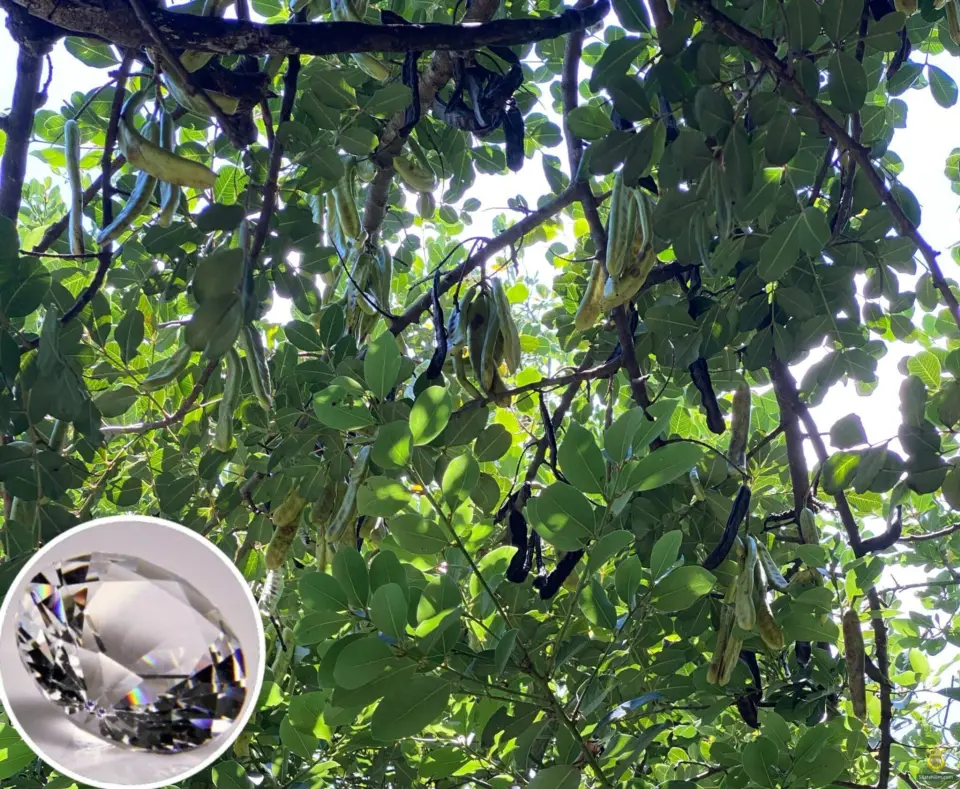
In Peki’in, deep within a grove, there is a cave where Rabbi Shimon bar Yochai and his son hid from the Romans for 13 years, sustaining themselves on carob fruit and water from the spring and attaining all 125 levels of spiritual elevation. A carob tree grows there, right at the entrance to the cave.
Rabbi Shimon emerged from the cave with the book of the Zohar.
In front of the “Idra Rabba” (the Great Assembly), where Rabbi Shimon taught his disciples, two carob trees—“haruv”—still grow; once every 300 years, they change sex.
Because Rabbi Shimon bar Yochai is associated with the festival of Lag BaOmer, carob is part of the festive meal on Lag BaOmer.
Among the fruits eaten on Tu BiShvat, carob holds a special place, although the Torah does not count it among the important fruits (it is not one of the seven species for which Israel is famed). Tradition relates that the Queen of Sheba, when she set out to meet King Solomon, took carob seeds with her, and from that time onward this tree took root in the Land of Israel.
The Torah does not specify the fruit of which tree Adam and Eve ate.
The Sages suggested that it was a fig (since its leaf is mentioned (Genesis 3:7)); or grapes (since abusing them leads to a loss of reason (Genesis 9:20)); or an etrog (since the word apparently derives from “ragag”—“to passionately desire”); or wheat (since the word “chita,” meaning wheat, was associated with the word “chet” (sin)); or the carob tree (called “haruv” in Hebrew, resembling a word meaning destruction).
Rabbi Honi HaMe'agel
The Aggadah states that a carob tree requires 70 years to reach fruit-bearing age—the span of a human lifetime.
Once, Rabbi Honi HaMe'agel was walking along the road and saw a man planting a carob tree—“haruv”.
“How many years will it take this tree to bear fruit?” Honi asked him. The man replied: “Seventy years.”
Honi asked him: “And are you certain that you will live for seventy years?!”
The man said to him: “When I came into this world, I found a carob tree in it. Just as my fathers planted one for me, so I am planting one for my son.”
Honi HaMe'agel then sat down to eat some bread. Drowsiness overcame him, and he fell asleep. Rocky outcroppings rose up around him and concealed him from view. He slept for 70 years. When he awoke, he saw a man gathering fruit from that very carob tree.
He asked him: “Were you the one who planted this tree?”
The man replied: “I am his grandson.”
Honi said: “It seems that I slept for 70 years...”
He went home and asked: “Is the son of Honi HaMe'agel alive?” They told him: “His son is no longer alive, but his son's son is alive and well.” He said: “I am Honi HaMe'agel!”—but they did not believe him. He went to the study hall and heard the Sages saying: “This mishnah is clear and understandable to us, just as in the days when Honi HaMe'agel was alive...” (Babylonian Talmud, Ta'anit 23a)
In the Talmud, the haruv is called the tree of the poor.
Rabbi Hanina ben Dosa
“Rav Yehudah said in the name of Rav: Every day a Bat Kol is heard proclaiming: The entire world is sustained in the merit of Hanina, My son, while Hanina, My son, is content with only a kav of carobs from one Shabbat to the next.” (Ta'anit 24b)
Carat
Interestingly, the word “carat”, the unit of weight used to measure precious stones and precious metals, actually derives from the word carob—“haruv”. Carob seeds have an interesting characteristic: they always weigh the same.
There was also a system of weights used by jewelers in ancient Europe. The ancient Romans, for example, had 22 units of weight. The largest, the talent, was equal to 26.2 kilograms. The smallest, the siliqua and the gran (or granule), were 0.189 and 0.057 grams, respectively.
What did people measure with these units, and where did they obtain such tiny weights?
In ancient times and later, right up to the present day, apothecaries measured potent substances, such as poisons, in grains, while jewelers used siliquae to weigh precious stones and gold.
The seeds of the carob tree, known in Latin as Ceratonia siliqua (from the Greek keratos, “horn”), were used as weights on scales. The plant received its name from the shape of its curved fruit. Since carob seeds hardly differ from one another in weight, they seemed like ready-made natural weights. Later, the siliqua came to be called a “carat” (it is not difficult to see that the word is ultimately based on the same “keratos”).
Carat—from the Italian “carato,” through the Arabic “qirat,” from the Greek “kerátion”—the pod of the carob tree, whose seeds served as a measure of mass—later came to be used in jewelry to determine the weight of precious stones and pearls.
Segula
At the grave of Habakkuk the Prophet, a magnificent carob tree grows. The segula, after praying at the grave, is to break off branches from this tree and perform certain actions with them; it has led to the birth of a great many boys.
Photo: the carob tree in Peki’in, directly in front of Rashbi’s cave
(according to holy Jewish sources; based on the website https://dona-anna.livejournal.com)
Was this helpful?
100% of readers found this article helpful (26 votes).
Please note: some articles on our site contain the holy Names of the Almighty. If you print these articles, they may not be thrown away or destroyed. Please handle printed copies with care and respect.
Material from our site may be copied for the purpose of spreading Torah, provided a link to Silatehilim.com is included. Any use of the site's material in print publications or for commercial purposes is prohibited without the rights holder's consent.