The Secret of the Prayer "El Na Refa Na La" - The 11-Letter Healing Name
The Secret of the Prayer "El Na Refa Na La" or the 11-Letter Healing Name
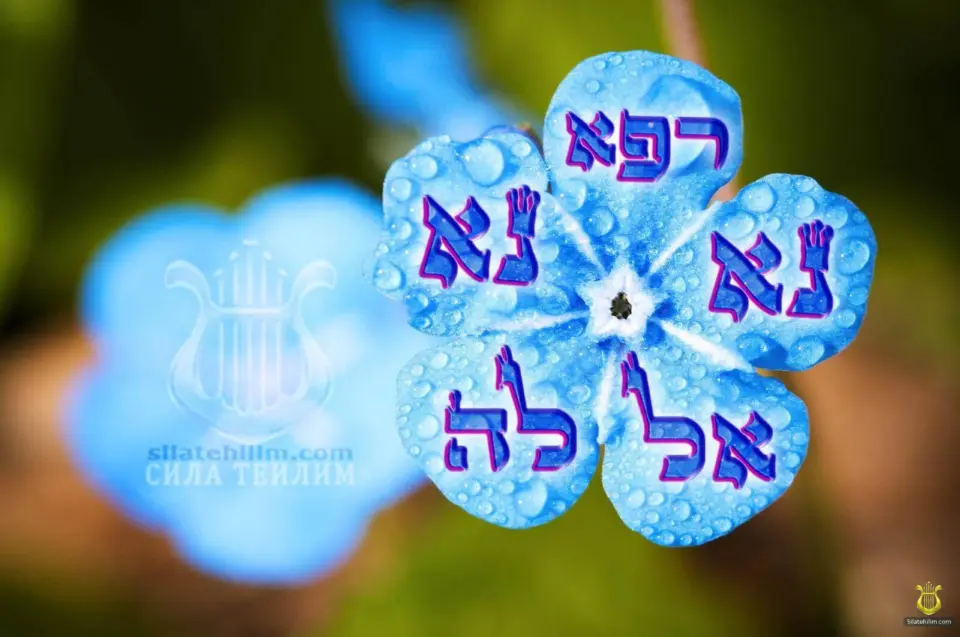
"El Na Refa Na La" - Moshe Rabbeinu's Prayer for Miriam - is the shortest prayer - an 11-letter Healing Name.
Chazal call this prayer the Prayer of Moshe for the Shechinah.
When Miriam fell ill, Aharon turned to Moshe with a request to help their sister, and Moshe immediately said the following prayer:
וַיִּצְעַ֣ק משֶׁ֔ה אֶל-יְהָוֹ֖ה לֵאמֹ֑ר אֵ֕ל נָ֛א רְפָ֥א נָ֖א לָֽהּ -
- "Vayitz'ak Moshe el Ado-nai leimor: El na Refa na la" - (and Moshe cried out to G-d, saying: Please, G-d, please heal her).
The 11 letters of the words: אֵ֕ל נָ֛א רְפָ֥א נָ֖א לָֽהּ - "El na Refa na la" - the holy Zohar calls this the 11-letter Name of Healing. This verse of the Torah is a Holy Name.
Moshe did not want to pray at length, since Miriam was his sister, and he did not want to trouble the King of Kings over a personal matter. Therefore the Holy One, Blessed be He, honored Moshe. And the Holy One, Blessed be He, always cherishes the honor of tzadikim more than His own. (Zohar on Beha'alotcha 12:13)
This is the shortest prayer in the Torah. Later, these remarkable words - Moshe's prayer "El na Refa na la" - were incorporated by Rabbi Elazar Azkari (a kabbalist of Tzfat) into his Shabbat hymn "Yedid Nefesh" - the words of Moshe's prayer for Miriam became an expression of our neshama's (soul's) yearning for Ha-Shem.
Yedid Nefesh
"Yedid nefesh, Av ha-rachaman, mshoch avdecha el retzonecha.
Yarutz avdecha kmo ayal, yishtachaveh mul hadarecha.
Ki ye'erav lo yedidutecha, mino'fet tzuf ve-chol ta'am.
Hadur na'eh ziv ha-olam, nafshi cholat ahavatecha.
Ana, El na, refa na la, beharot la no'am zivecha,
az titchazek ve-titrapeh, ve-hayta lach shifchat olam.
Vatik yehemu rachamecha, ve-chus na al ben ohavecha,
ki zeh kamah nichsof nichsaf, lirot be-tiferet uzecha,
ana, Eli, machmad libi, chusha na ve-al tit'alam.
Higaleh na u-fros, chaviv, alai et sukat shelomecha.
Ta'ir eretz mi-kvodecha, nagila ve-nismecha bach.
Maher, ahuv, ki va mo'ed, ve-choneni ki-mei olam".
(Beloved of my soul, Beloved of my soul, Merciful Father! Draw Your servant to Your will, and he will run like a gazelle to bow before Your splendor; Your love will be sweeter to him than honey and every delicacy. O magnificent and beautiful one, Radiance of the world, my soul is lovesick for You. I beg You, G-d: heal it by showing it Your gracious light! Then my soul will be healed and strengthened, and it will have eternal joy. Eternal One, be filled with compassion and have mercy on Israel, Your beloved son. For I passionately long to see the splendor of Your might; I beg You, my G-d, delight of my heart, have mercy and do not hide Your face from me! Reveal Yourself, beloved, and spread over me Your shelter of peace; illuminate the earth with Your glory, and we will exult and rejoice in You! Hurry, beloved, for the time has come; and be gracious to us as in days of old).
This is a good segula for healing, and depending on who is being prayed for, the last letter of the last word "El na, refa na la" is changed (in Hebrew "la" - her, "lo" - him). This is how we pray only in the segula for Healing. But Moshe Rabbeinu used the pronoun "la" also because he had in mind the Shechinah, which is feminine.
The grandson of the Baal Shem Tov, Rabbi Moshe Chaim Ephraim of Sudilkov, explains that Moshe's prayer, with which he prayed for his sister Miriam, hints at the custom of praying for a sick person by mentioning the patient's name together with their mother's name.
The phrase רְפָא נָא - "Refa na" - (heal her, please) has a gematria of 332:
"Refa" - 281, "na" - 51.
The exact same gematria is found in the names Miriam מרים - 290 and Yocheved יוכבד - 42 - together - 332.
And the gematria of the phrase - אל נא רפא נא לה - equal to 449, is the same as the phrases אהבת אם - "a mother's love", and אם ובת - "mother and daughter."
Prayer for the Shechinah
When Moshe Rabbeinu prayed for his sister's recovery: "G-d, please, heal her, please" (Bamidbar 12:13), he was praying for the healing of the Shechinah, not directly for the healing of his sister herself. Moshe understood that if the Shechinah were not "ill" and were not, in some sense, in exile, the very possibility of suffering would not exist. Rectifying the Shechinah automatically rectifies all other problems. (Tikkunei Zohar, Tikkun 6)
The Prayer of Moshe and Korach
"And Moshe heard it and fell on his face" (Bamidbar, Korach) - the sages ask: why did he fall on his face and not answer the accusations? After all, silence is a sign of agreement.
Korach and his companions accused Moshe of taking another man's wife for himself.
Moshe answered them: "You know that G-d Himself pointed out the sin of everyone who sinned with the Moabite women: the Cloud of Glory withdrew, and the sun's rays pointed at those people. If you are right, why did the sun not point at me?"
"Even if the sun points at you," they answered, "we would not notice it, since your face shines like the sun!"
And then Moshe fell on his face, hiding it, so that they could see whether the sun pointed at him. It is known that at that moment Moshe was praying, for there is no better prayer than one said with the face lowered. A hint of this is contained in the words that Moshe uttered when praying for Miriam's healing:
"G-d, please, heal, please, her." The word "please" in Hebrew - na (נא) - is an acronym for the phrase "nefilat apayim", meaning "falling on one's face."
("Ahavat Chaim" by Rabbi Menachem Menashe - Bamidbar, Korach; Degel Machaneh Ephraim, Parashat B'Ha'alotcha, based on a lesson by Rebbetzin Chana Bracha Siegelbaum)
Was this helpful?
99% of readers found this article helpful (216 votes).
Please note: some articles on our site contain the holy Names of the Almighty. If you print these articles, they may not be thrown away or destroyed. Please handle printed copies with care and respect.
Tags: Молитва, Излечение, Моше Рабейну, Молитва Моше, 11-буквенное лечащее имя, Молитва Моше Рабейну за Шхину, Самая короткая Молитва Моше или 11-ти буквенное Лечащее Имя.