Bread and Salt—Our Grandmothers’ Jewish Prohibitions
The universal custom of welcoming guests with bread and salt, like many other customs, has Jewish roots.
I remember from childhood how our grandmothers and mothers would scold us if we forgot to put a salt shaker on the table, quoting the saying that one must not eat bread without salt.
In the Talmud, we also find repeated recommendations to eat bread with salt:
“When a poor person comes to you to taste bread with salt…” (Berachot 2b);
“This is the way of Torah: eat bread with salt…” (Pirkei Avot 6:4);
“Bread with salt and a pitcher of water...” (Bava Kamma 92b).
In all of these passages, the word used for “
bread” is
פת (
pat), rather than
לחם (
lechem). This is because the gematria of the word
פת (
pat) is 481 (with the kolel). The sum of the gematriot of the words
ימין “right” (110) and
שמאל “left” (371) is also 481.
These concepts are also identified with Chesed and Gevurah.
Chesed is the right branch of the Tree of Life, while Gevurah is the left.
Bread is the physical embodiment of these spiritual concepts: it is made from flour and water (elements associated with Chesed) and baked by fire (an element associated with Gevurah).
Salt—the primary seasoning—is associated with the sefirah of Yesod, through which the energy of all the other sefirot enters Malchut.
The flame (fire) of Gevurah on which
bread is baked must be seasoned with Chesed. Yet the true blending and interpenetration of the light of both sefirot (Chesed and Gevurah) is possible only in the sefirah of Yesod.
This is why our sages advise dipping a piece of
bread in
salt—so that the Gevurah present in the
bread can enter the Chesed that is also present in the
bread, with the help of Yesod, embodied by the
salt.
Jewish tradition teaches us to dip
bread in
salt not only on Shabbat, but on the other days of the week as well.
This custom is also explained by the fact that our table is compared to the altar in the Temple. (Pirkei Avot 3:3)
In the Temple, all sacrifices were offered with
salt, and therefore
salt also occupies a place of honor on our table.
Salt never spoils; it has no expiration date, and thus became a symbol of the eternal covenant between G-d and the Jewish people.
As it is written:
“You shall not omit salt from the meal offering of the covenant with your G-d.” (Leviticus 2:13)
Salt gives everything flavor. So too with our connection to the Almighty: it should be felt in all our deeds, lending flavor to our lives even when a person is occupied with mundane matters.
We dip
bread in
salt (rather than sprinkling salt on the bread), because
salt can represent Gevurah—the strictness of the Almighty—while
bread symbolizes Chesed—the goodness of the Almighty.
By dipping bread in salt, we help goodness overcome strictness. Interestingly, the gematria of the word
“lechem” (bread) is 78.
By dipping
bread in
salt three times, we symbolically divide 78 by three and obtain 26—and the number 26 is the gematria of one of the Names of the Almighty.
This act reminds a person that:
“...man does not live by bread alone. Man lives by everything that proceeds from the mouth of the L-rd.” (Deuteronomy 8:3)
Segulot involving bread and salt:
1. Ben Ish Chai teaches that the salt should remain on the table until the conclusion of Birkat HaMazon, since the table is compared to the altar, about which it is said:
“With every offering you shall offer salt,” and it also has the power to protect against misfortune.
2. One must remember not to throw bread to someone sitting at the table; rather, it should be placed within that person’s reach so that they can take it themselves.
3. Bread should never be passed from hand to hand—except to mourners (chas v’shalom); instead, it should be placed on the table so that people can take it themselves.
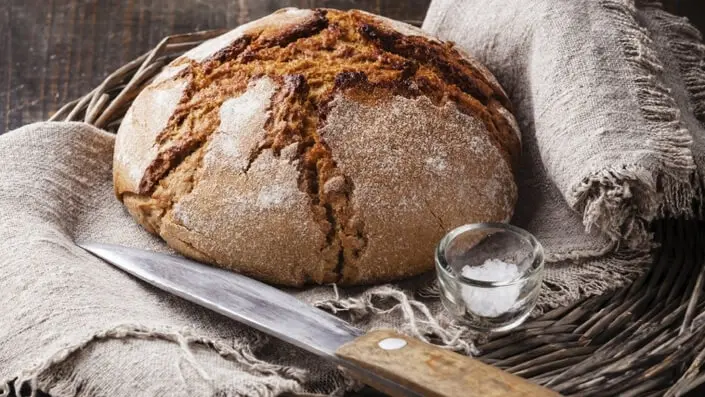
4. Throughout Shabbat, bread, salt, wine, and a knife should be present on the table.
(Rabbanit Leah Ben Abu—granddaughter of Baba Sali)
5. Throughout the week, bread (
lechem), salt (
melach), and za’atar (
za’atar) should be present on the table—the first letters of these words form the word MaZaL.
(Yodei Binah Yeshiva)
6. The Gemara teaches:
“Pat Shacharit be-melach ve-kiton shel mayim mevatlim”—(bread after the morning prayer with salt and a little water protects against 83 diseases).
Baal HaTurim reveals that the word for
illness—
“machalah”—מחלה—contains the same letters as the words:
bread, “lechem”, and
salt, “melach”.
The gematria of the word for illness—
“machalah”—is 83. The word
“machalah” is associated with
Mara (the root of the 83 illnesses).
"Pat Shacharit" – 83 Diseases and the 83 Halachot of the Rambam
(Compiled by the editorial staff based on lessons on Hafrashat Challah with Baba Sali’s granddaughter, Leah Ben Abu, and on the books by Rabbanit H. B. Siegelbaum, “The Seven Species of the Land of Israel” and “Ahavat Chaim” on Exodus)
Please note: some articles on our site contain the holy Names of the Almighty. If you print these articles, they may not be thrown away or destroyed. Please handle printed copies with care and respect.